Any construction project undertaken in Great Britain must comply with the Construction (Design and Management) Regulations 2015 (CDM 2015). Under these regulations, there are specific documentation requirements. A failure to notify the relevant authorities when required can result in significant fines.
The purpose of these documentation requirements is to ensure that health and safety is considered from the very start of a project, rather than only once construction work begins.
Pre-construction information, notification records, the construction phase plan and the health and safety file all help duty holders understand the risks involved, coordinate their work and pass on the information needed to manage those risks.
In this blog, we look at when a construction project must be notified to the HSE, who is responsible for notification and what should be included in the pre-construction information.
The current CDM Regulations in Great Britain are the Construction (Design and Management) Regulations 2015. There is no separate 2020 version of the CDM Regulations.
However, the regulations were subject to a post-implementation review, which was published in 2020. This review considered whether CDM 2015 was meeting its intended aims and recommended that the regulations should remain in place.
This means that, for construction projects today, duty holders should continue to follow CDM 2015. The requirements around pre-construction information, project notification, the construction phase plan and the health and safety file all sit under CDM 2015.
All projects, whether domestic or commercial, must be notified to the Health and Safety Executive (HSE) when they meet the CDM 2015 notification threshold.
This is because the HSE keep a closer eye on larger projects during both the Pre-Construction and Construction Phases. They are likely to conduct site visits and check for CDM requirements on larger sites.
However, it is important to note that CDM 2015 applies even when a project is not notifiable to HSE. A small project may not need F10 notification, but duty holders must still comply with their relevant CDM duties.
Under the CDM Regulations, the HSE must be notified if:
- Work is scheduled to last longer than 30 working days and has more than 20 workers working simultaneously at any point in the project, or
- The project exceeds 500 person days
A project may be notifiable irrespective of the number of contractors involved.
The Client is responsible for notifying the HSE on commercial or non-domestic projects.
For domestic projects, notification must be carried out by the contractor, or by the principal contractor where there is more than one contractor. A principal designer may also carry out the notification where there is a written agreement that they will take on the client’s duties.
The HSE must be notified at the earliest point once it becomes clear that the notification criteria are likely to be triggered. Normally, this will be in the Pre-Construction Phase before construction work begins.
However, it is possible that during the early planning stages, the project may appear to be too small to trigger the notification process, but, as it progresses, it exceeds the limits.
In this scenario, if a construction project does not appear to be notifiable, but subsequent changes to its scope mean that it then fits the criteria, then the client must notify the work to the relevant enforcing authority. This should be done as soon as possible, even if the construction work has begun.
CDM project notification must be completed online using HSE’s F10 notification form.
HSE no longer processes paper forms or accepts notifications by email or post.
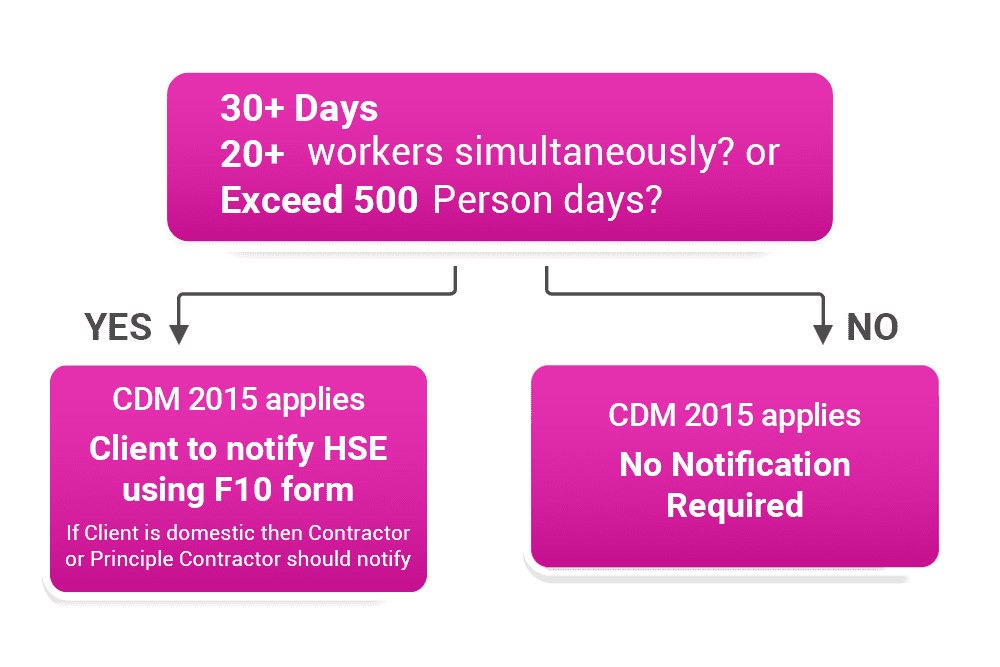
The above diagram illustrates the key decisions when establishing if a project is notifiable.
As mentioned, first assess whether the construction work is scheduled to last longer than 30 working days and have more than 20 workers working simultaneously at any point, or whether the project will exceed 500 person days.
If the answer is yes, then:
- CDM 2015 applies
- The project must be notified to HSE using the online F10 form
For commercial projects, the client must notify HSE. For domestic projects, notification must be carried out by the contractor, principal contractor or principal designer, depending on the arrangements in place.
If the answer is no, then:
- CDM 2015 still applies
- No F10 notification is required
- Duty holders must still comply with their relevant CDM duties
Schedule 1 of the CDM Regulations provides full details of the information that has to be submitted to the enforcing authorities. This includes:
- Information about where and when the construction project will be carried out
- A description of the project, and
- The construction work it entails
The fourth element is the project documentation requirements. The CDM regulations require that three main documents are assembled and used to control construction projects:
- Pre-construction information – This includes all the information developed during the design stage of a project
- A construction phase plan – Which details and controls how the project will be carried out
- A health and safety file – Which acts like an operations manual after the construction work has finished
We will cover the construction phase plan and the health and safety file in later blogs, but let’s now consider the pre-construction information.
During the pre-construction phase, the design team must start to pull together the necessary information to support the safe completion of the project. The pre-construction information supports the preparation of the construction phase plan.
In particular, the pre-construction information helps Designers and Contractors, whether they are bidding on the project or already appointed, to carry out their duties. It also assists Principal Designers and Principal Contractors with planning, managing, monitoring, and coordinating the work of the project.
Pre-construction information may include documents such as:
- Site surveys
- Architectural drawings and specifications
- Planning applications
- Existing health and safety files, surveys or reports, where relevant
It should include relevant information needed to plan, manage and carry out the construction work safely.
Under CDM regulations 2015, the pre-construction information must include information about the project details, such as the client brief, key dates of the construction phase, and the planning and management of the project, such as the resources and time being allocated to each stage of the project.
It must include arrangements to ensure cooperation between duty holders, and that the work is coordinated. There should be details regarding health and safety hazards on site, including information on any design and construction hazards and how they will be addressed.
The information must be relevant to the particular project. Generic details are not acceptable. The documentation must have an appropriate level of detail. A large project will require far more information than a short job. The documentation and information supplied must be proportionate to the risks involved. Where there are significant risks, there must be suitable detail to address how they will be managed.