In short: A scaffolding inspection checklist is the structured set of checks a competent person works through to confirm a scaffold is safe to use — and to record that decision to the legal standard. Under the Work at Height Regulations 2005, a scaffold must be inspected by a competent person before use, at suitable intervals, and after any exceptional event that could jeopardise its safety — with a maximum interval of 7 days for a construction scaffold from which a person could fall two metres or more. This article outlines the main areas to check, explains why each one matters, identifies who is competent to carry out and sign off the inspection, and describes what to do when something fails.
Scaffolding Inspection Checklist: What Inspectors Must Check
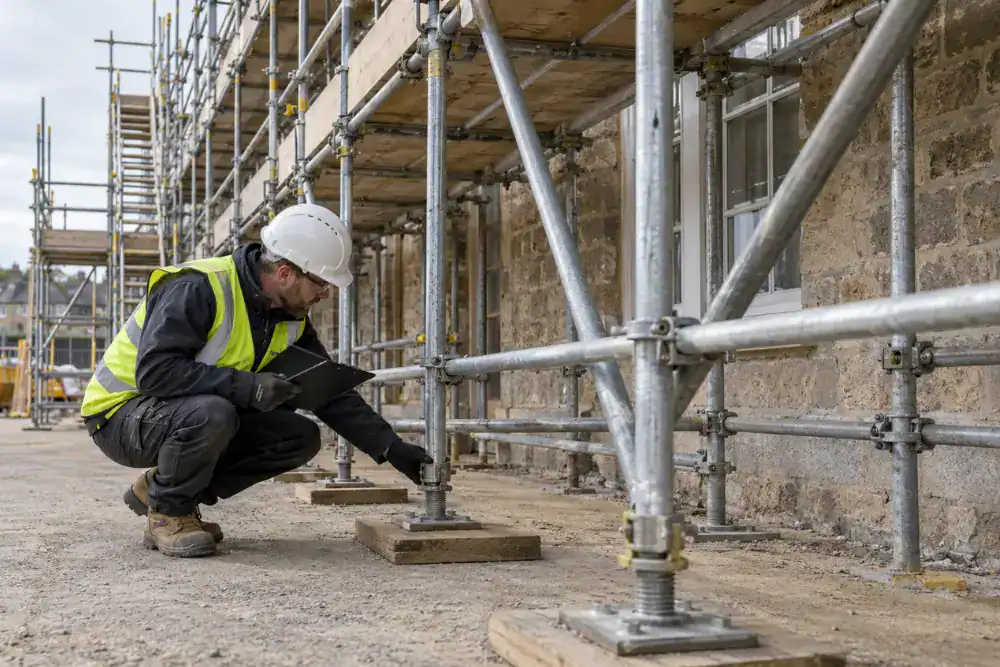
A scaffolding inspection checklist is only as good as the person using it — which is why this article pairs every item on it with what to check, why the item matters, who is allowed to sign it off, and what to do when something fails. Treat the checklist as the framework, and the reasoning behind each item as the part that lets you inspect with judgement rather than simply checking items off a list.
Falls from height remain a major cause of fatal injury in construction in Great Britain. Proper scaffold design, erection, use and inspection are essential to preventing them. (HSE, 2026)
Competent inspectors, employers and others who control the work, including principal contractors where applicable, need to know what must be checked, by whom, how often, and what the record must contain. This article covers all four.
What Are the Key Rules for Scaffolding Inspection in the UK?
- A scaffold inspection is a legal statement, not a brief visual walkover: under the Work at Height Regulations 2005 it must be carried out by a competent person before use, at suitable intervals, and after any exceptional event that could jeopardise its safety — and at least every 7 days where the scaffold is a construction working platform with a fall risk of two metres or more. (Work at Height Regulations, 2005)
- Defects involving ties, foundations and bracing can seriously compromise scaffold stability and are the most difficult to confirm without close examination, which is exactly why a hurried inspection is likely to miss them.
- A green scaffold tag records what the last inspector says they found; it is not proof the scaffold is safe, and it is only as reliable as the honesty of the inspection behind it.
What Are the Scaffolding Inspection Requirements Under the Work at Height Regulations?
Under the Work at Height Regulations 2005, which applies in Great Britain, a scaffold must be inspected by a competent person before use following installation or assembly, at suitable intervals and after any exceptional event that could jeopardise its safety. For scaffolds used in construction where a person could fall two metres or more, the maximum interval between inspections is 7 days. (Work at Height Regulations, 2005)
Competence has to match the scaffold. A basic scaffold may be inspected by someone with suitable inspection training and the necessary background experience, while complex or bespoke scaffolds require competence appropriate to their design and complexity. Industry bodies such as the Construction Industry Scaffolding Record Scheme (CISRS) provide recognised scaffold inspection qualifications for those seeking to formalise or demonstrate their competence.
For a construction working platform from which a person could fall two metres or more, the inspection report must contain the particulars set out in Schedule 7 of the Work at Height Regulations 2005. That means recording the name and address of the person for whom the inspection was carried out, the scaffold’s location and description, the date and time, any matter that could give rise to a risk, action already taken, any further action required and the name and position of the person making the report. (Work at Height Regulations, 2005)
The inspector must prepare the report before the end of the working period and provide it within 24 hours to the person on whose behalf the inspection was carried out. The person on whose behalf the inspection was carried out must keep a copy on site until the construction work is completed, and at their office for three months after that. (Work at Height Regulations, 2005)
Key insight: If more than seven days have passed since the last inspection, a qualifying construction scaffold must not be used until it has been inspected again.
When Must a Scaffold Be Re-Inspected?
A further inspection is required after any exceptional circumstance liable to jeopardise the scaffold’s safety, regardless of when the previous inspection took place.
Examples of such events include:
- High winds and storms, which can loosen ties, shift boards and rack the structure out of square.
- Snow, ice, heavy rain or standing water where the conditions could increase loading, create slip hazards or affect the scaffold’s foundations.
- Any impact that could have affected the scaffold’s strength, stability or alignment, even where no damage is immediately visible.
- Significant alteration, partial dismantling or any event during relocation that could have affected the scaffold’s safety.
- A prolonged period out of use where conditions may have caused deterioration, or work by other trades who may have removed a tie, board or brace to get access.
The classic failure is the inspector who checks the inspection tag first and misses that the tower was relocated overnight. After moving a tower, check that it remains correctly configured and safely positioned before anyone uses it.
What Should Be in Place Before a Scaffold Inspection Begins?
Before use, confirm that the scaffold has been inspected after erection and still corresponds with its design, compliance sheet or manufacturer’s instructions.
A handover certificate records that the completed scaffold has been inspected and handed over against its applicable design, compliance sheet or manufacturer’s instructions. A handover certificate is recognised industry practice, but it does not replace the required inspection before use.
The scaffold tag shows the current inspection status, but it deserves a plain warning: a green tag is a claim, not a guarantee. It does not replace the statutory inspection report or an inspector’s independent examination. Any apparently incorrect or outdated tag should be reported and updated or removed by an authorised person in accordance with the site procedure.
Finally, confirm that the scaffold still matches its applicable design, compliance sheet or manufacturer’s instructions. Any modification must be made by an authorised, competent person and followed by an inspection before further use, with the design or handover documentation updated where necessary.
The tag tells you what the last inspector says they found; it does not tell you whether they actually checked the ties. Treat the tag as a status indicator only and complete the inspection independently.
What Does a Scaffolding Inspection Checklist Cover?
A scaffold inspection should cover, from the ground up: the foundations and base, standards and ledgers, ties, bracing, boards and platforms, guardrails and toe boards, access, couplers and fittings, loading, proximity to power lines, and the general condition of the structure. These checks provide a general starting point and must be considered alongside the applicable design, the relevant compliance sheet — TG20 (Technical Guidance for tube-and-fitting scaffold compliance) for tube-and-fitting scaffolding, or TG30 (Technical Guidance for system scaffolding) for system scaffold — manufacturer’s instructions and site-specific requirements. (NASC TG20, 2021); (NASC TG30, 2024)
Work from the ground up, because the failures that bring scaffolds down usually start at the parts that cannot be seen without looking closely. Every item below carries the reason it matters — because a check you do not fully understand is one you are more likely to skim.
| # | Checklist item | What to check | Why it matters |
|---|---|---|---|
| 1 | Foundations & base | Firm, level ground; base plates and sole boards (timber pads that spread the load of base plates onto soft or uneven ground) present and bearing correctly; no scour (erosion of ground beneath or around the scaffold base) or settlement | Inadequate support or settlement at the base can destabilise the entire scaffold |
| 2 | Standards & ledgers | Standards plumb; ledgers level; spacing correct for the design or TG20; no bowing | Out-of-plumb standards and incorrect spacing can overload members and reduce the scaffold's capacity |
| 3 | Ties | Present, correct type and spacing, secured to a sound structure; none removed | Missing, damaged or incorrectly positioned ties can significantly reduce the scaffold's stability |
| 4 | Bracing | Ledger, façade (vertical diagonal bracing along the scaffold face) and plan bracing (horizontal diagonal bracing across the scaffold frame) present and fixed in the locations required by the design or manufacturer's instructions | Bracing keeps the frame rigid; gaps allow it to rack (distort out of square) and fail under load |
| 5 | Boards & platforms | Platforms correctly boarded, with boards sound, properly supported and free from displacement, excessive overhangs or gaps through which a person or material could fall | Trap boards and gaps can cause falls and dropped-object incidents |
| 6 | Guardrails & toe boards | Guardrails at the correct height, intermediate rails and toe boards to every open edge | Edge protection is the primary fall-prevention control on the platform |
| 7 | Access | Safe ladder or stair access installed and secured in accordance with the scaffold design or manufacturer's instructions | Unsafe access is a common source of injury, especially where it is used repeatedly through the day |
| 8 | Couplers & fittings | Correct type, tight, no damage or corrosion, no broken pins | Loose or incorrect couplers reduce joint strength and the integrity of the whole structure |
| 9 | Loading | Scaffold used within its rated duty class (load capacity category); no overloading with stored materials | Loading beyond the design capacity significantly increases the risk of structural failure |
| 10 | Proximity to power lines | Required separation and control measures maintained around overhead lines, accounting for direct contact and electrical flashover | A metal scaffold near live overhead lines is a serious electrocution and arcing hazard |
| 11 | General condition | No impact damage, no unauthorised alterations, no missing components | Unauthorised changes invalidate the design and the last handover |
Notice how many of the highest-consequence items — foundations, ties, bracing — are the ones that cannot be assessed quickly from ground level. These areas can be difficult to confirm during a brief inspection, despite their importance to the scaffold’s stability.
How Does a Mobile Tower Inspection Differ?
A mobile tower inspection includes all the standard checks for a fixed scaffold, plus specific checks focused on what happens each time the tower is moved. Alongside the relevant checks above, confirm that:
- The wheels and castors are undamaged and locked, and the tower is only moved when it is clear of people and materials.
- Stabilisers, outriggers and any required ballast are fitted correctly, and the tower’s height and configuration comply with the manufacturer’s instructions.
- The tower was assembled and inspected by someone with suitable training and competence.
- It is never moved with a person or materials on the platform, and it is checked after repositioning and formally re-inspected if it was significantly altered or something occurred that could have affected its safety.
Key insight: Moving a tower can introduce new hazards. After repositioning it, check the ground conditions, castor brakes, stabilisers and configuration before use. A new formal inspection is required if the tower was significantly altered or something occurred that could have affected its safety.
What Should You Do If a Scaffold Fails an Inspection?
When an inspection identifies a defect, the competent person assesses the risk, takes appropriate action and records the finding and any remedial measures. If a defect could make the scaffold or part of it unsafe, prevent access to the affected area until the risk has been controlled.
- Classify the defect. Decide whether use must stop completely or whether the affected area can be safely isolated under clearly documented controls.
- Act on it. Report the defect to the scaffolding contractor for rectification. For a critical defect, physically prevent access and make the exclusion unmistakable — do not rely on word of mouth or a verbal warning to the next shift.
- Update the tag. If a tag system is used, it must be updated by an authorised person to reflect the scaffold’s current status.
- Record everything. The Schedule 7 report must record any matter that could give rise to a risk, action already taken and any further action considered necessary. Records become evidence: if an incident follows, the report is what an accident investigation uses to establish whether the inspection regime was sound.
Finding a defect is not a failure of the inspection — it is the inspection working. The failure is finding a defect, saying nothing, and letting the scaffold stay in use.
Does a Checklist Confirm That a Scaffold Is Safe?
No. A checklist does not make a scaffold safe. A competent person’s inspection helps establish whether the scaffold remains safe to use and identifies any defects that need attention. The inspection report is only where that judgement gets written down.
Four things are worth holding onto. The legal frame is not negotiable: a competent person, inspection at suitable intervals (with a 7-day maximum for construction scaffolds where a fall of two metres or more is possible), and a record kept to the Schedule 7 standard. The hidden items — ties, foundations and bracing — carry the highest consequences, so they deserve the most attention, not the least. A defect found and acted on is the system doing its job; a defect ignored is how people fall. And competence must match the scaffold: the level of training and experience required of the inspector rises with the complexity of the structure. (Work at Height Regulations, 2005)
Inspectors looking to develop or demonstrate the knowledge behind each of these checks can find structured support in Human Focus’s Scaffolding Inspection course, which walks learners through inspection principles and how to complete inspection records to the required standard. Human Focus also provides broader construction safety and health and safety training for those who need a wider grounding in site safety requirements. Completing a course alone does not establish competence, which also depends on suitable knowledge and experience.