The strongest safety training programmes combine: approved training for mandatory requirements, and effective internal training for the specific tasks, equipment and processes of the organisation.
What Types of Internal Bespoke Safety Training Does Your Organisation Need to Provide?
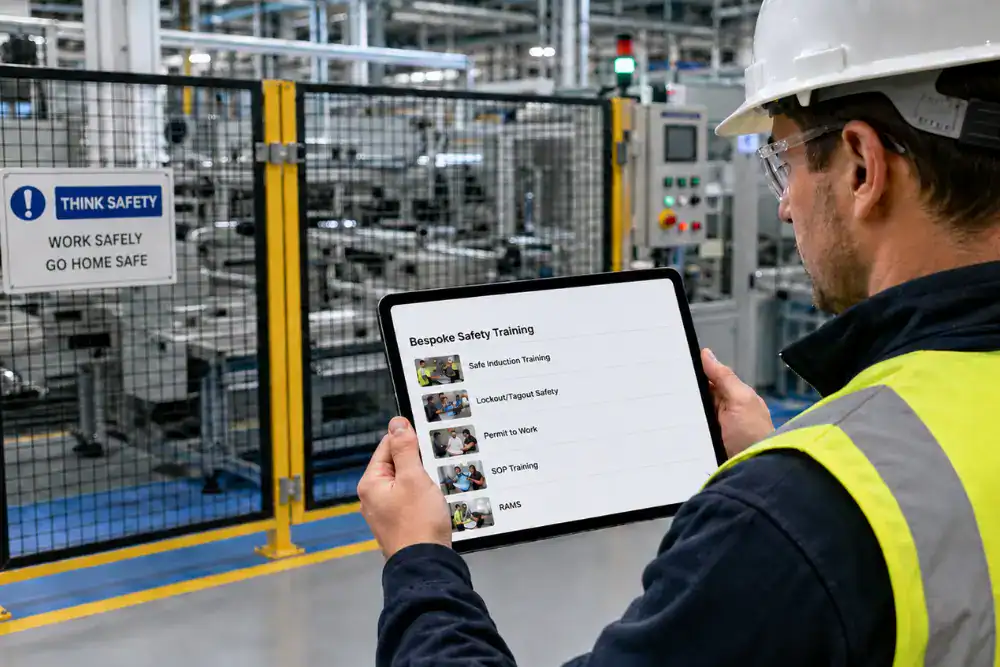
Every organisation that carries out physical work has a body of internal knowledge that determines how that work gets done safely. It lives in standard operating procedures, risk assessments, method statements, permit systems, induction programmes and, most critically, in the experience of the people doing the work.
Approved online safety training — covered in the first two guides in this series — addresses the mandatory training requirements set by legislation and regulation. It provides a credible, auditable foundation. But it cannot tell your maintenance technician exactly how to isolate your specific conveyor system. It cannot walk your new starter through your site-specific induction. It cannot capture the critical knowledge your most experienced operator carries in their head.
That is the job of internal, task-specific safety training. And for most organisations, getting it right is harder than it looks.
The Core Problem
The issue is not usually a lack of documents. Most organisations have too many documents. The problem is that those documents are not usable as training, not accessible at the point of work, and not connected to any evidence of competence. The result is an organisation that is technically documented but practically undertrained.
A Practical Example: Isolating a Conveyor
Consider a maintenance task involving the isolation of a conveyor system before maintenance work begins. An approved online course on lockout/tagout/tryout (LOTOTO) will cover the general principles: why isolation matters, the steps involved in a safe isolation, and what can go wrong when isolation is not carried out correctly. That approved training is valuable and necessary.
But it cannot cover the specific details that determine whether the task is actually performed safely on your site: the exact location of isolation points on your conveyor, the specific permit to work process your organisation uses, the verification steps required by your local procedure, the names and responsibilities of the authorised persons involved, and the particular hazards created by your equipment configuration.
That knowledge has to come from internal training. And if it exists only in a poorly formatted SOP that maintenance staff have quietly adapted over time to reflect how the task is actually done — rather than how the document says it should be done — the organisation does not have a training programme. It has a compliance artefact and a gap.
Imagined Work Versus Actual Work
Most experienced frontline workers can easily demonstrate what they do and what they know. Ask them to walk and talk you through a task and they will do it in minutes. Ask them to write it down in a form that meets documentation requirements and it will either never happen or will produce something that bears little relationship to how the work is actually done.
Closing the gap between imagined work and actual work requires tools that make it easy for frontline workers to capture and share their operational knowledge — without requiring them to be writers. If you can capture that knowledge in the right way, the benefit compounds: a single lesson learnt in one location by one team can be shared across shifts and sites, multiplying its value many times.
1. The Types of Internal Safety Documentation
The foundation of any internal safety training programme
Internal safety training starts with documentation. Before any training can be delivered, the information on which it is based needs to exist in a usable form. Most organisations have accumulated a substantial body of this documentation — though the quality, accessibility and usability of that documentation varies enormously.
| Document type | What it covers |
|---|---|
| Inductions | Covers new starters joining the organisation and contractors arriving on site. Employee inductions typically address internal processes, safety systems, site rules and the organisation's safety culture. Contractor inductions may be project-specific or site-specific and often focus on higher-risk activities and site controls. |
| Standard Operating Procedures (SOPs) | Detailed guidance for specific machines, equipment or production processes — covering exactly how to perform the task and what the associated hazards are. SOPs form the backbone of initial induction training for task-specific safety. They are the organisation's primary reference for how work should be done. |
| Process Guidance | Higher-level guidance that helps workers understand how their task fits into the wider production or operational process. Whilst SOPs are specific to a particular machine or process, process guidance provides the bigger picture. This matters because decisions taken locally have to take into account wider implications — many accidents have occurred because local decisions, made in good faith, had consequences for the wider system that the workers involved did not understand. |
| Risk Assessments & Method Statements (RAMS) | Developed for specific tasks, typically time-limited and often used with contracted work. Method statements overlap with SOPs in some respects, but RAMS are typically task and time-specific rather than permanent operating documents. They are the recognised vehicle for assessing risks and providing task guidance for non-routine or higher-risk work. |
| Policies & Safety Rules | The organisation's documented approach to the hazards and risks it faces — covering policy commitments, responsibilities and the practical rules that implement those policies. Many organisations also develop practical guidance through initiatives such as 'lifesaving rules': a small number of non-negotiable safety rules for the highest-consequence risks. These policy documents are another foundational element for internal safety training. |
| Control of Work Guidance | Organisation-specific procedures for managing high-risk work: permit to work systems, energy isolation procedures (LOTOTO — lockout, tagout, tryout), pre-task risk assessment requirements and similar control systems. While approved online training covers the general principles of control of work, every organisation's system has specific details that must be trained out internally. |
2. Stage 1: Making Internal Documentation Usable
The challenge most organisations underestimate
Internal safety training can be considered in two main stages. The first — and often the most neglected — is the quality of the documentation itself. Before any of this material can be used effectively as training, it needs to be formatted and written in a way that allows for easy comprehension by the people who will use it.
This is not a minor editorial concern. Internal documentation is used as part of daily operating processes. It is the reference material people turn to at the moment they need to do a task safely — learning at the point of work. If the documentation is poorly designed, it fails at the most critical moment.
The Human Factors Problem with Most Internal Documentation
Internally produced documentation is often poor in terms of its design for usability by frontline employees. There is a well-established body of human factors research covering what makes procedural documentation effective, and most internally produced documentation fails to meet even the basic requirements.
The issues fall into three main areas:
- Written content and structure — procedure step sequencing, vocabulary, numbering and indentation, referencing, and the use of technical jargon. Most procedural documentation relies too heavily on words and too little on structure. Even where the person writing the document is a competent writer, long written descriptions of work tasks and associated risks are difficult for most people to make sense of quickly. Documentation needs to be readable by people with lower reading ages, easy to scan, and free from jargon that only specialists understand.
- Visual layout — text layout, font choice and the use of colour. Poor visual layout makes even well-written content harder to absorb. Good layout makes the critical information immediately visible.
- Graphics — signs, tables and images. Graphics are used extensively in safety documentation — but often without regard to basic human factors principles, making them confusing or even counter-productive. This is a significant missed opportunity. Pictures genuinely do speak a thousand words. They are immediately accessible to everyone, regardless of literacy level or first language. A well-designed graphic communicates instantly what a paragraph of text communicates slowly and imperfectly.
The Accessibility Challenge
Health and safety information is often not delivered in ways that allow it to be rapidly absorbed and implemented on a daily basis. The goal should be to remove the chore of processing large amounts of information and replace it with documentation that is immediately useful at the point of work. If a document cannot be used as a practical job aid by a frontline worker under real working conditions, it is not doing its job.
The Task Specificity Problem
Beyond formatting, there is a deeper problem with most internal safety documentation: it is too generic.
Big, generic RAMS that cover every eventuality without being specific to the job in hand do not tell workers what they actually need to do to work safely on this task, with this equipment, in these conditions. Workers are routinely faced with mountains of paperwork that is technically compliant but practically useless.
But perhaps the most significant issue is this: much of the most useful safety knowledge about how to work safely is not in any document at all. It is inside the heads of experienced frontline operatives.
This happens when there is an artificial division between workers and the documentation they are supposed to use. Health and safety is ‘done to’ them rather than developed with them. The RAMS they see either do not capture the genuinely useful knowledge — the things that actually make the difference between a safe and an unsafe outcome — or they describe a version of the work that does not match the realities people face on the ground.
The result is what is widely described as the gap between imagined work and actual work. Standard operating procedures are routinely and unofficially adapted by frontline teams without their managers’ knowledge. Procedures are not updated. RAMS are not reviewed. The gap between what the documentation says and what people actually do widens over time — and it is in that gap that accidents happen.
Imagined Work Versus Actual Work
Most experienced frontline workers can easily demonstrate what they do and what they know. Ask them to walk and talk you through a task and they will do it in minutes. Ask them to write it down in a form that meets documentation requirements and it will either never happen or will produce something that bears little relationship to how the work is actually done.
Closing the gap between imagined work and actual work requires tools that make it easy for frontline workers to capture and share their operational knowledge — without requiring them to be writers. If you can capture that knowledge in the right way, the benefit compounds: a single lesson learnt in one location by one team can be shared across shifts and sites, multiplying its value many times.
The Accessibility at the Point of Work Problem
Even well-designed, task-specific documentation fails if it is not accessible where and when it is needed. If a worker needs to refer to a procedure during a task, the procedure needs to be at the point of work — not in a filing cabinet, on a shared drive only accessible from a desktop computer, or in a laminated folder in the supervisor’s office.
Documentation needs to become a practical job aid that people actually use rather than a compliance artefact that people sign and forget. And it needs to be easy to update when things change — because in any operational environment, things change constantly.
Getting the design of internal documentation to a standard that genuinely supports learning at the point of work is not a small task. But it is the essential first step before any of this material can function effectively as safety training.
3. Stage 2: Converting Documentation Into Training
From operational reference to formal learning
Once critical documents have been updated and are being used effectively as part of daily operations, there is a second stage: converting that documentation into formal training content that can be managed, tracked and evidenced as part of an ongoing safety competency system.
Employers are legally required to give employees the information they need to work safely. Internal documentation is a key part of that information. That legal duty extends to having evidence that the information has been provided and that employees have understood it. Stage 2 is where that evidence is created.
Converting Static Documents into Interactive Training Content
What works as a process document — an SOP or a RAM — does not automatically work as a training course. The format, structure and presentation that makes a document effective as an operational reference is not the same as what makes it effective as a learning experience.
Converting internal documentation into effective training content requires a deliberate re-engineering process: reformatting text and graphics, breaking content into bite-sized learning chunks, identifying the critical safety information that must be understood and retained, and structuring the content so that it builds knowledge systematically rather than simply presenting information in sequence.
This is a learning design process. It requires specific expertise to do well and it is not straightforward. The temptation is to simply upload a PDF and call it a course. The result is invariably poor engagement, poor retention and poor evidence of genuine understanding.
Developing Assessment Questions
Once internal content has been reformatted as training, it is necessary to develop assessment questions that test whether the worker has understood the critical information. This is more difficult than it sounds.
The challenge is identifying what constitutes the genuinely critical information within a document — the things a worker must understand to perform the task safely — and developing questions that test understanding rather than memory of wording. A question that can be answered correctly by someone who has simply read the slide without understanding it is not an effective assessment. The goal is questions that distinguish between a worker who understands the safety requirements and one who does not.
Developing good assessment questions from internal content is a skilled task. Done well, it is the mechanism by which an organisation can demonstrate that its internal safety training has been not just delivered but understood.
Tracking, Monitoring and Audit Evidence
Once internal content has been converted into training with effective assessment, it needs to be deployed in a way that can be tracked and monitored, with evidence retained for audit and compliance purposes: who completed the training, when, what score they achieved and when a refresher is due.
This can be done offline through classroom delivery and paper records. But offline delivery is full of friction and potential error. Records get lost. Completions are missed. Refresher dates are not tracked. Evidence is not available when clients, auditors or regulators ask for it.
Online delivery of internal training content removes that friction — providing the same tracking, monitoring and evidence management for internal bespoke training as for approved online courses. The most effective internal safety training systems bring both together: approved training for mandatory requirements and custom safety training programmes for organisation-specific content, all managed through a single platform.
4. How AI and Modern Tools Are Changing What Is Possible
From a daunting task to a manageable process
The challenges described above — reformatting poorly designed documentation, converting static documents into interactive training, developing assessment questions, making content accessible at the point of work — are real and significant. For many organisations, the sheer volume of internal documentation makes the prospect of addressing all of it feel overwhelming.
AI tools are changing this picture in three important ways.
AI-Assisted Document Reformatting
AI tools are increasingly able to read existing documentation — SOPs, RAMS, policy documents, process guides — and automatically reformat them into more usable, human factors-compliant documents. This does not replace the need for human judgement in assessing whether the content is accurate and appropriate. But it significantly reduces the time and effort required to take a poorly formatted document and produce a version that is readable, well-structured and suitable for use at the point of work.
AI-Assisted Course Authoring
AI course authoring tools can take existing documentation and convert it into structured online training courses — breaking content into modules, reformatting text and graphics, and presenting the material in a format suitable for interactive online delivery. This reduces what was previously a significant manual effort — rebuilding a document as a course in an authoring tool — to a much faster and more accessible process.
AI-Generated Assessment Questions
AI tools can also scan documents for critical information and generate assessment questions from the content. This does not eliminate the need for review and refinement — the quality of AI-generated questions still needs to be checked by someone who understands the subject matter. But it provides a starting point that significantly accelerates the process of developing assessments for internal training content.
Capturing Offline Learning
The most effective safety training systems can also capture offline briefing and training sessions — toolbox talks, classroom sessions, site induction training, on-the-job inductions — and integrate them into the overall competency record. This creates a complete ecosystem of learning and development, rather than a platform that only tracks online completions.
Used together, these tools do not eliminate the expertise and judgement required to build an effective internal safety training programme. But they make the process significantly faster and more accessible — bringing the goal of a fully integrated safety competency system within reach for organisations that would previously have found it prohibitive.
5. The Onboarding Challenge
Getting started is often the hardest part
Even with the right tools and the right approach, the initial challenge of moving from a largely offline environment — with documentation spread across SharePoint sites, shared drives, filing cabinets and individual computers — to an integrated online safety training ecosystem is substantial.
Most organisations are sitting on thousands of documents in various states of quality and accessibility. The prospect of converting all of this into effective, tracked online training is daunting — even with AI tools to accelerate the process. The questions are familiar: Where do we start? How do we prioritise? How do we handle documents that are out of date? Who is going to do this?
Where to Start
Prioritise by risk, not by volume. Start with the internal safety documentation that relates to your highest-consequence hazards and highest-risk tasks. A well-designed, accessible SOP for a high-risk task is worth more than a complete library of poorly formatted documents for lower-risk activities.
Focus first on getting the documentation right — usable, accurate and accessible at the point of work. Deployment as formal training follows naturally once the documentation is fit for purpose.
An important consideration when choosing an online safety training provider is whether they can support this onboarding process — not just provide a platform and leave you to populate it. The gap between having the right system and having a functioning internal safety training programme is the onboarding process, and for many organisations it is the difference between a project that succeeds and one that stalls indefinitely.
The goal is a system that, once set up and running, is intuitive and easy for internal teams to maintain and update. Courses can be created and updated without specialist technical knowledge. New documentation can be converted quickly. Content can be curated and refreshed by the people who know it best — the internal duty-holders and subject matter experts who understand what has changed and what needs to be updated.
How to Know If Your Internal Safety Training Needs Attention
The following questions are designed to help you assess the current state of your internal safety training provision. They are useful to work through before speaking to a safety training provider — because the more specifically you can describe your situation, the more focused and productive that conversation will be.
- Are SOPs, RAMS and inductions stored across multiple systems, folders or sites? If nobody can easily find the current version of a critical procedure, it is not functioning as training.
- Are workers signing documents without any evidence they have understood them? A signature is not evidence of understanding. If completion is the only record, the training record is weaker than it looks.
- Are PDFs being uploaded and treated as training courses? Uploading a document to a platform does not make it a training course. Without reformatting, assessment and tracking, it is still just a document.
- Are frontline workers informally adapting procedures because the written version does not match the real task? If the document does not reflect how the work is actually done, it is not controlling the risk — it is recording an imagined version of it.
- Is it difficult to prove who has received which site-specific, task-specific or equipment-specific training? If the answer to this question requires someone to search through spreadsheets, email threads or filing cabinets, the evidence system is not adequate.
- Are refresher dates for internal training difficult to manage? If renewal tracking for internal training relies on someone remembering, the programme has a gap.
- Are experienced workers carrying critical safety knowledge that is not captured anywhere? If the departure of one or two key people would take irreplaceable safety knowledge with them, the organisation has an unmanaged risk.
What to Do with Your Answers
Before your next conversation with a safety training provider, review your highest-risk SOPs, RAMS and inductions. Identify which documents are currently used as practical job aids, which are only compliance records, and which need to be converted into trackable training. That analysis will give you a clear starting point for prioritising your internal training programme — and will make any subsequent conversation with a provider significantly more productive.
Putting It Together: The Types of Bespoke Safety Training That Work
Internal safety training is not a replacement for approved online training. It is a complement to it. The strongest safety training programmes combine:
- Approved online safety training for mandatory requirements — credible, accredited, current and evidenced
- Role-based training at the right level — matching depth of knowledge to the responsibilities each role carries
- Internal bespoke training for the organisation-specific knowledge that approved courses cannot provide — the types of bespoke safety training covering specific equipment, site rules, processes, permit systems and the operational knowledge that experienced workers carry
Getting all three right requires good documentation, effective conversion of that documentation into training content, robust tracking and evidence management, and the capability to keep the whole system current as the organisation changes.
None of this is straightforward. But the tools now exist to make it significantly more manageable than it has ever been — and the cost of not getting it right, both in terms of safety outcomes and compliance exposure, is high.
Human Focus Bespoke Training Capability
Human Focus has developed a world-class bespoke safety training system with intuitive course authoring tools — including AI-assisted document reformatting and conversion of internal documentation into online training courses. The platform supports the full lifecycle: from raw internal documents through to formatted, trackable, assessed online training content.
Human Focus also provides a done-for-you onboarding service — helping organisations take their existing internal documentation and get it set up as effective online training quickly, so that the full benefit of the system is realised from the outset rather than deferred while internal teams work through the conversion process.
If you have worked through the diagnostic questions above and identified gaps in your internal safety training provision, the next step is a conversation about where to start. Book a free demo to discuss your specific situation — bring your answers to the diagnostic questions and we will focus the conversation on your highest-priority gaps rather than a generic platform overview.