Emotional intelligence is the ability to recognise, understand and manage your own emotions and respond appropriately to the emotions of other people.
Often shortened to EI, and sometimes referred to as EQ, emotional intelligence influences how people communicate, handle pressure, respond to feedback and manage relationships.
At work, these abilities become particularly noticeable when conversations are difficult, or emotions are running high. Someone who recognises that frustration is affecting their tone, for example, has an opportunity to adjust how they respond before a disagreement develops.
Emotional intelligence is therefore less about appearing calm or agreeable all the time and more about noticing emotional information and responding to it thoughtfully.
Think about the last difficult conversation you had at work. Did you notice how you were feeling while it was happening, or only afterwards?
That distinction gets to the heart of emotional intelligence.
Psychologists have developed several models of emotional intelligence, so there is no single definition accepted across every area of research.
One influential academic approach, associated with psychologists Peter Salovey and John Mayer, treats emotional intelligence as a set of abilities related to perceiving, understanding and managing emotion. Daniel Goleman’s work later brought the concept to a much wider audience and applied it extensively to workplace behaviour and leadership.
The idea was not immediately welcomed by the business world. In a Harvard Business Review discussion about the history of emotional intelligence, Goleman recalled that publishers in the early 1990s warned him against putting the word ’emotion’ in the title of a business book. At the time, emotions were widely treated as something separate from serious management and professional performance. His 1995 book Emotional Intelligence helped bring the subject into mainstream workplace discussion.
Attitudes have shifted considerably since then. Conversations about feedback, psychological safety, difficult relationships, conflict and workplace pressure now routinely involve emotional and interpersonal skills.
In practical terms, emotional intelligence means recognising what you are feeling, understanding how those feelings may affect your behaviour and paying attention to emotional information from the people around you.
That does not mean suppressing emotion. Anger, anxiety, disappointment and excitement can all provide useful information. The skill lies partly in recognising what you are experiencing before it begins to control how you communicate or make decisions.
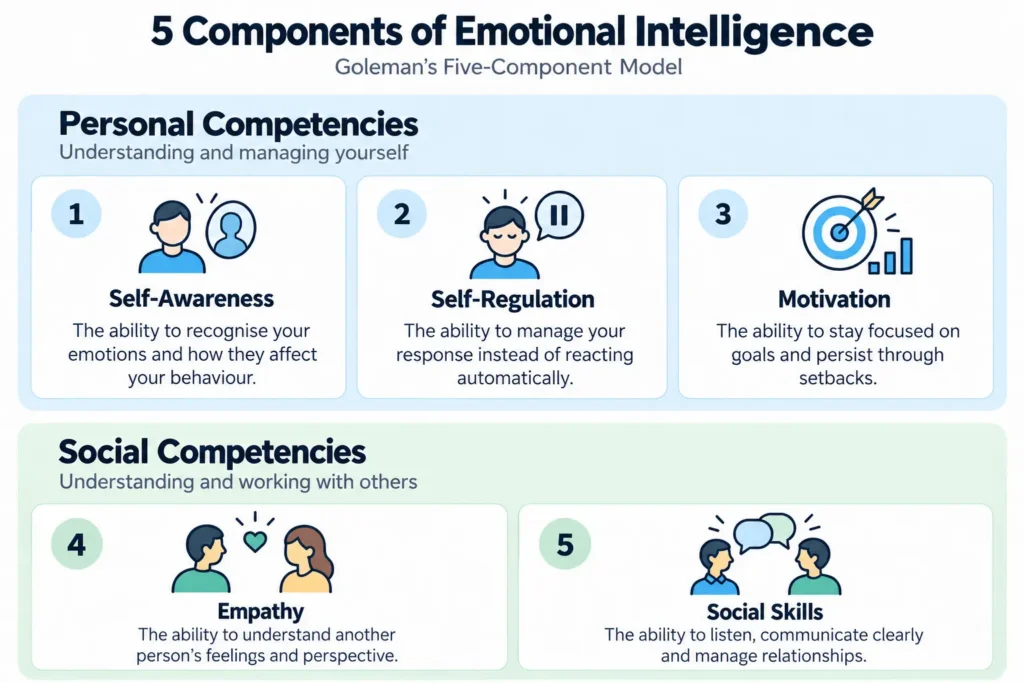
Although it’s not the only model, Goleman’s model of emotional intelligence remains highly influential and is widely used in workplaces. It groups five components into two categories: personal competencies and social competencies:
Personal Competencies:
- Self-awareness
- Self-regulation
- Motivation
Social Competencies:
- Empathy
- Social skills
Self-awareness means recognising your own emotions and understanding how they may influence your thoughts and behaviour.
Suppose a manager receives an email questioning a decision they made. Their immediate reaction might be irritation. Self-awareness allows them to notice that reaction before replying.
It also involves recognising patterns. You might know, for instance, that you become impatient when deadlines are tight or that you tend to become defensive when a particular part of your work is criticised.
Identifying these patterns gives you more control over what happens next.
Self-regulation is the ability to manage your response to an emotion rather than reacting automatically.
This does not require hiding how you feel. Someone can disagree strongly with a colleague while still choosing appropriate language and keeping the discussion focused on the issue.
At work, self-regulation can be particularly useful during conflict, periods of pressure or conversations that have taken an unexpected turn. Even a short pause before responding can create enough distance to reconsider what you were about to say.
Within Goleman’s model, motivation concerns the internal drive to work towards goals and persist when progress becomes difficult.
Work rarely goes exactly as planned. Projects are delayed, proposals are rejected and mistakes have to be corrected. Motivation can affect how someone responds to those setbacks.
Motivation is the emotional competency involved in returning to a difficult task after receiving criticism, adjusting an approach that did not work or continuing to develop a skill that takes time to learn.
Empathy involves recognising and trying to understand another person’s feelings or perspective.
It does not require agreeing with them.
An employee may disagree with a colleague’s concerns about a proposed change while still recognising why the change is causing uncertainty. Understanding that perspective can make the resulting conversation more constructive.
One of the best-known business anecdotes about empathy comes from Microsoft CEO Satya Nadella. He has described an early Microsoft interview in which he was asked what he would do if he saw a baby that had fallen in the street. Nadella approached the question analytically and answered that he would call emergency services. The interviewer replied that the first response should be to pick up and comfort the crying child. Nadella later used the story to explain how his understanding of empathy developed over time.
The story is memorable because intelligence and empathy are doing different jobs. Technical reasoning might identify the practical action required. Emotional awareness also recognises the immediate human need.
Empathy relies heavily on listening. Paying attention to what someone actually says, asking appropriate questions and checking your understanding can reduce the risk of assuming you know what they think. Developing these habits is also an important part of improving communication skills.
Social skills concern how people manage interactions and relationships with others.
They include listening, communicating clearly, handling disagreement, adjusting your approach to different audiences and recognising how your behaviour affects a conversation.
These skills are not restricted to managers. Employees at every level rely on them when working with colleagues, customers, contractors and other stakeholders.
Definitions become more useful when they can be connected to recognisable behaviour. Emotional intelligence in the workplace often appears during ordinary conversations rather than major events.
You receive feedback on a piece of work and immediately feel defensive.
An emotionally intelligent response begins with recognising that reaction. Instead of interrupting or explaining every decision straight away, you might ask for an example or clarify what needs to change.
You can still disagree with the feedback. The difference is that your initial emotional response does not determine the entire conversation.
Afterwards, you can consider whether the criticism contains information that will help you improve.
Two colleagues disagree over who was responsible for a missed deadline. Voices become sharper, and both begin focusing on each other’s behaviour rather than the original problem.
Emotional intelligence may involve recognising that the conversation is becoming personal and changing the approach. Someone might adopt a calmer tone, ask what happened at each stage of the task and bring attention back to what needs to be resolved.
Listening also matters. People are less likely to resolve a disagreement if they are preparing their next argument while the other person is speaking.
Where disagreements are becoming more serious, understanding how to address the underlying issue early can help prevent workplace conflicts from escalating.
Emotional intelligence also matters when you are the person delivering criticism.
A manager who needs to discuss repeated errors could choose a suitable time, explain the specific behaviour that needs attention and describe its impact. They can then allow the employee to explain their perspective.
This approach does not require avoiding difficult subjects. Clear feedback is still necessary. Emotional awareness can help the manager deliver it without unnecessary hostility or ambiguity.
Pressure can change the way people communicate.
A normally patient employee may become abrupt when several deadlines collide. Another person may rush a decision because they want to remove the immediate source of stress.
Recognising these changes is part of self-awareness. Someone who notices that stress is affecting their judgement might take a few minutes to review an important email before sending it or ask a colleague to check a decision.
Managing the emotional response does not remove the workload, but it may reduce avoidable problems caused by acting impulsively.
During a meeting, a manager explains a new process and asks whether everyone understands. Nobody objects, but one colleague looks confused and has stopped contributing.
An emotionally aware manager does not have to guess what that person is feeling. They can simply check.
A question such as ‘Is there anything in that process you would like me to go over again?’ creates an opportunity for clarification without assuming the reason for the person’s behaviour.
This illustrates an important point about empathy: noticing emotional cues can prompt a conversation, but it does not give you access to another person’s thoughts.
Popular culture often makes this kind of behaviour easy to recognise. Ted Lasso, for example, frequently shows characters trying to understand what sits behind another person’s behaviour before reacting to it. That does not mean excusing poor conduct. In a workplace setting, the same principle can mean noticing that a colleague has become withdrawn or unusually defensive and asking what is going on rather than assuming you already know the reason.
Work involves relationships, even in highly technical roles.
People have to ask questions, receive instructions, explain decisions, solve disagreements, respond to mistakes and deal with competing priorities. Emotional intelligence skills can support these interactions because they help people recognise how emotions may be affecting communication.
Self-awareness can make feedback easier to process. Self-regulation may help prevent frustration from turning into an unnecessary argument. Empathy can improve understanding when colleagues approach the same problem differently.
These abilities are also relevant to leadership. Managers regularly have to communicate decisions that people may dislike, address performance concerns and respond to employees experiencing uncertainty or frustration.
However, emotional intelligence should not be treated as a guarantee of good leadership or business performance. Technical knowledge, judgement, experience, organisational systems and many other factors also matter.
Which do you find harder at work: recognising your own emotional reaction or understanding why somebody else is reacting the way they are?
The answer can point towards the emotional intelligence skill that deserves more of your attention.
Emotional intelligence and IQ describe different areas of ability, and neither should be treated as a replacement for the other.
Someone can have strong analytical abilities and still find difficult conversations challenging. Equally, strong interpersonal skills do not replace the technical knowledge required to carry out specialist work.
Most jobs involve a combination of these abilities.
Emotional intelligence skills can be developed through deliberate reflection, feedback and practice.
Start by identifying situations that regularly trigger a strong emotional response. Perhaps you become defensive when someone questions your work or impatient when meetings run over time. Recognising the pattern makes it easier to notice when it happens again.
When an emotional response starts building, pause before acting on it. Even a brief delay can provide time to consider whether your first response will help the situation.
Try to describe emotions accurately as well. ‘I’m annoyed’ may actually mean you are embarrassed about a mistake, concerned about a deadline or frustrated because expectations were unclear. Understanding the source of the feeling can make the next step easier to judge.
Other people can also provide useful information. Ask trusted colleagues or managers how you come across during meetings, disagreements or periods of pressure. Feedback may reveal habits that are difficult to notice yourself.
Active listening is another useful area to practise. Concentrate on understanding the speaker before deciding what you want to say next. Ask questions when something is unclear and check that you have understood their point correctly.
Finally, review difficult interactions after they happen. Consider what triggered your response, what went well and what you would handle differently next time.
Improving emotional intelligence can also be one of your personal development goals, particularly if you identify a specific behaviour you want to work on.
These questions are intended for reflection rather than diagnosis or scoring.
- Can I recognise when stress is changing my tone or behaviour?
- Do I usually pause before responding when I feel angry or defensive?
- Can I receive constructive feedback without immediately trying to justify myself?
- Do I ask questions before assuming why someone behaved in a particular way?
- Can I disagree with someone while keeping the conversation focused on the issue?
- Do I listen to understand another person’s position before forming my response?
- Can I identify situations that regularly trigger a strong emotional reaction?
- After a difficult interaction, do I consider what I could handle differently next time?
You are unlikely to answer ‘yes’ in every situation. The purpose is to identify specific behaviours that may be worth practising.
Employers can create opportunities for people to develop the communication and interpersonal skills associated with emotional intelligence.
Manager development can include practice in delivering feedback, listening to employee concerns and handling difficult conversations. Conflict-resolution training can give employees practical techniques for dealing with disagreements before they intensify.
Organisations can also encourage managers to ask for feedback about their own communication. Senior employees who acknowledge mistakes, listen before responding and remain professional during disagreement provide useful examples for others.
Training can support this development where employees need more structured guidance. Human Focus Communication Skills Training covers listening, empathy, tone, body language and adapting communication to different situations, all of which are relevant to applying emotional intelligence at work.
Employers should avoid using isolated behaviours or informal assessments to label people as having ‘high’ or ‘low’ emotional intelligence. A person’s response in one meeting does not provide enough information to make that judgement.
Emotional intelligence is the ability to recognise and understand emotions in yourself and other people and to manage your own responses appropriately. At work, this can include recognising when frustration is affecting your behaviour, listening carefully during disagreements and adapting how you communicate according to the situation.
The five components commonly associated with Daniel Goleman’s model are self-awareness, self-regulation, motivation, empathy and social skills. Other models of emotional intelligence also exist, so these five components should be understood as one influential way of explaining the concept rather than a universal scientific definition.
Suppose a colleague criticises your work during a meeting. You notice that you feel defensive but avoid responding immediately. Instead, you ask what specifically needs improvement, listen to the answer and decide whether the feedback is useful. Recognising the emotion without allowing it to control your response is an example of emotional intelligence at work.
Emotional intelligence includes several related abilities and skills, such as recognising emotions, regulating responses, listening, showing empathy and handling social interactions. Different academic models define and measure emotional intelligence differently, so it is more accurate to describe it as a collection of emotional abilities or competencies than as one isolated skill.
Many of the behaviours associated with emotional intelligence can be practised and developed. Someone can work on recognising emotional triggers, listening more carefully, responding less impulsively and considering other people’s perspectives. Development usually requires ongoing reflection and practice rather than simply learning a set of definitions.
Emotional intelligence can help people manage common workplace situations involving feedback, disagreement, pressure and communication. Recognising your own reactions may help you respond more thoughtfully, while empathy and listening can improve understanding between colleagues. These abilities complement rather than replace technical knowledge, professional competence and good organisational systems.