The Management of Health and Safety at Work Regulations 1999 require employers in Great Britain to assess workplace risks and organise effective measures to protect people. Employers must arrange competent assistance, give relevant information and training and monitor and review their controls. Assessments must lead to action, with suitable emergency procedures and health surveillance where required.
Employers can record risk assessments and install safety measures while people remain exposed to harm during routine work. Checking whether those measures are being used and remain effective is a management responsibility.
The difficult decisions often come after an action has been marked complete. A manager must judge whether a changed layout needs reassessment, whether training matches the work now assigned and whether repeated concerns require a different control.
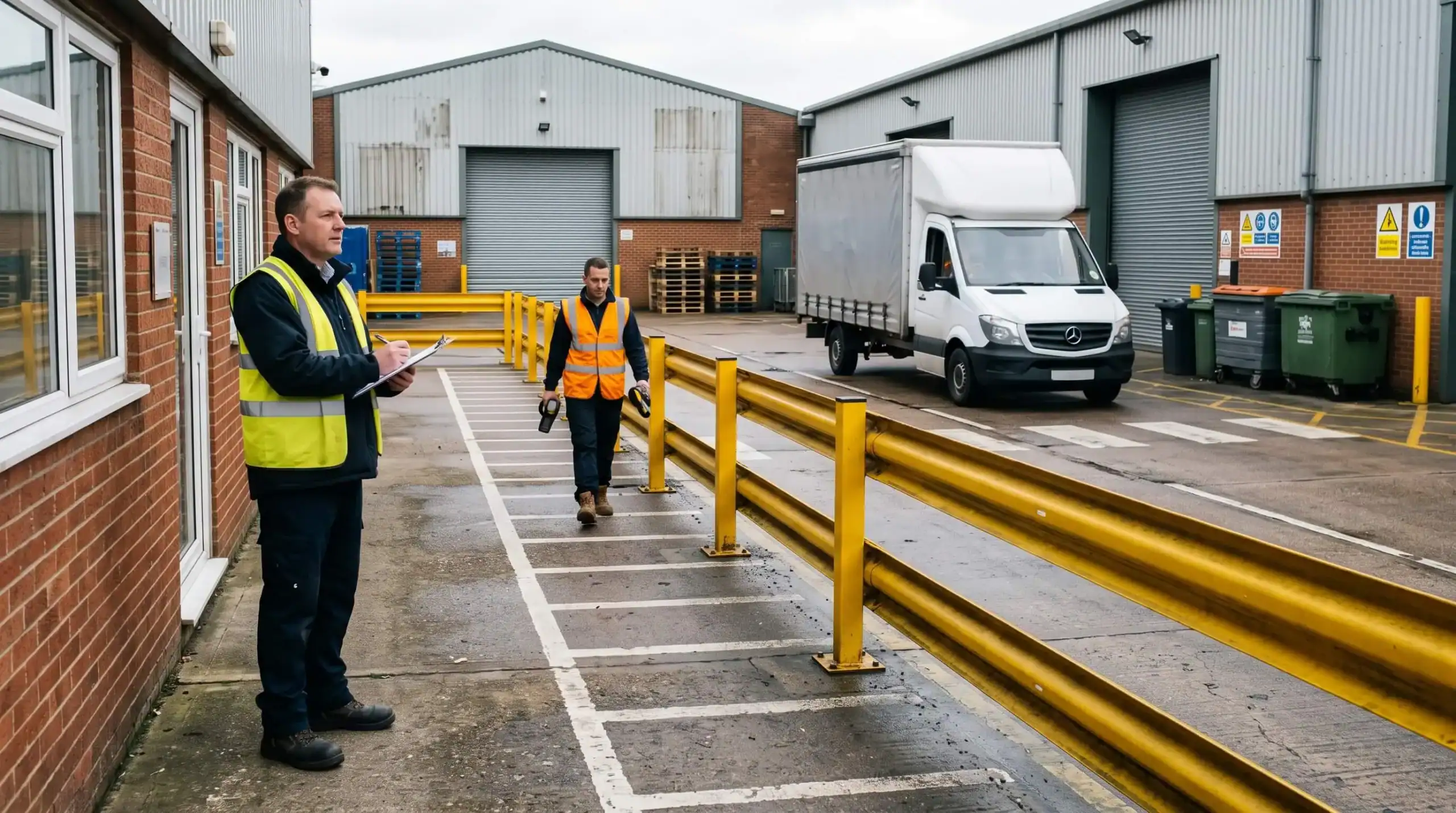
On 10 August 2023, James Tabiri was walking towards the site office across the weighbridge at Biffa Waste Services Ltd’s waste transfer station in Bradford. A reversing skip wagon struck him from behind. He died from his injuries.
Segregated pedestrian routes and barriers were already in place. CCTV from the previous week showed that bypassing those routes was common practice, with some people climbing over the barriers.
HSE found that the company had failed to effectively monitor and review the controls intended to separate pedestrians from vehicles. Biffa pleaded guilty to breaching regulation 5(1) of the Management Regulations and was fined £2.48 million on 15 October 2025 (HSE, 2025a).
The case puts a practical question to any employer relying on a safety control. Who checks whether it protects people during normal work, and what happens when it does not?
The Management Regulations turn the general duties in the Health and Safety at Work etc. Act 1974 into specific requirements for managing risk. They remain in force, as amended (UK Government, 1999).
The 1999 Regulations apply across most workplaces in England, Scotland and Wales, subject to limited exceptions. Northern Ireland has separate Management of Health and Safety at Work Regulations (Northern Ireland) 2000 (HSENI, n.d.).
Employer health and safety duties apply to small organisations too. Having fewer than five employees does not remove the duty to assess and control risks. The five-employee thresholds concern particular recording requirements.
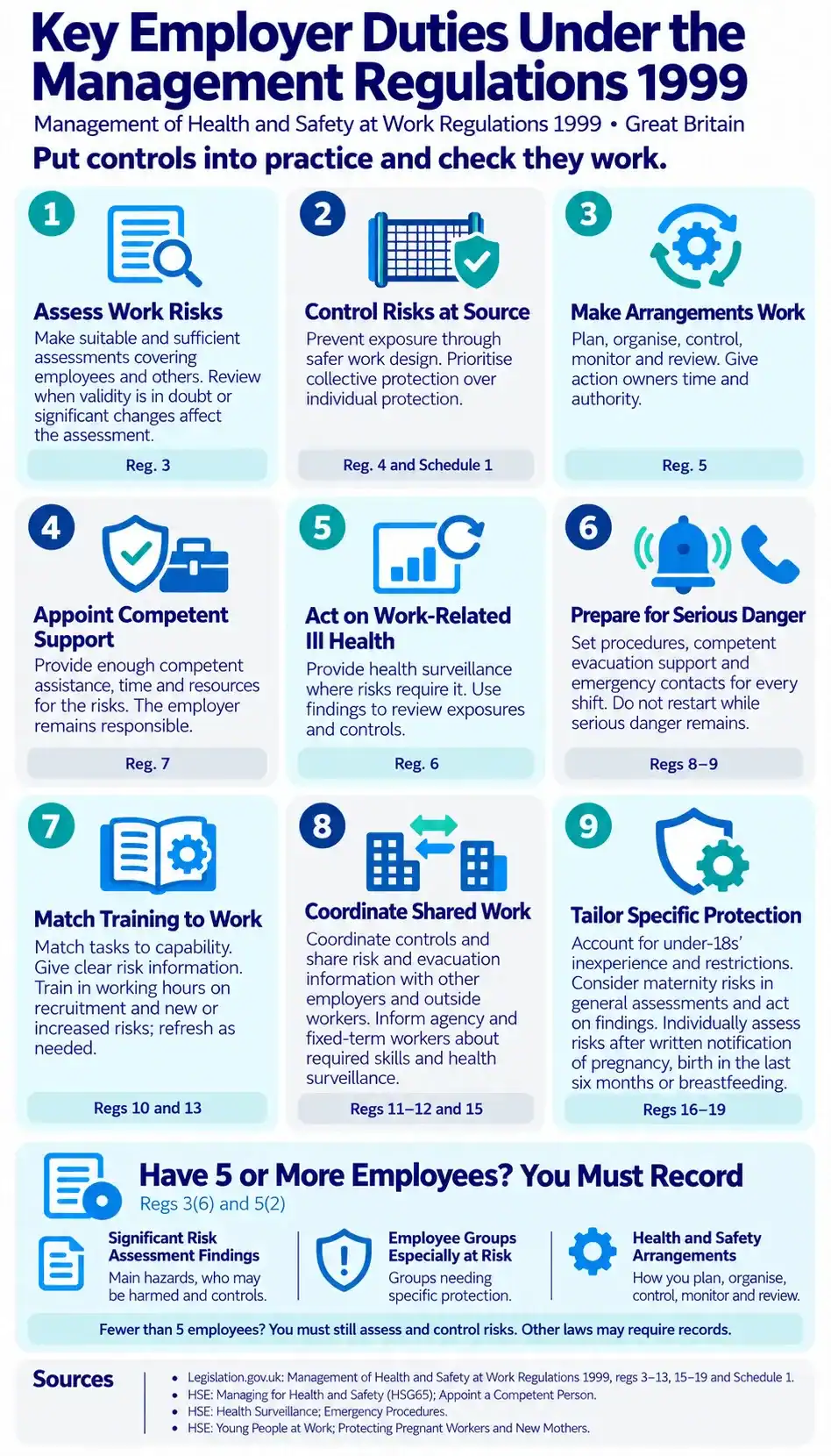
Management of Health and Safety at Work Regulations 1999 duties work together as an ongoing management system, rather than a series of one-off compliance tasks. What matters is whether the arrangements continue to reflect the work, the risks and what happens in practice.
Regulation 3 requires a suitable and sufficient assessment of risks to employees and others affected by the undertaking. In practical terms, the assessment must examine the work closely enough to identify the protective measures needed.
An assessment must be reviewed if there is reason to suspect it is no longer valid or a significant change affects what it covers. There is no universal requirement to review every assessment annually.
Employers with five or more employees must record significant findings and groups of employees identified as especially at risk. Other legislation may require additional records.
or example, suppose a depot moves its unloading area to create storage space. Vehicles approach from a different direction and pedestrians cross at a new point. An assessment based on the old layout no longer describes the work.
A workplace risk assessment should describe current work and lead to action. HSE advises employers to examine non-routine tasks, involve workers and review whether controls are working (HSE, 2024a).
At that depot, telling people to watch for reversing vehicles leaves them exposed to moving traffic. Reducing the need to reverse or separating pedestrians from vehicle movements addresses the risk through the way work is organised.
Regulation 4 and Schedule 1 set out the principles of prevention. These include avoiding risks, tackling them at source, adapting work to the individual and giving collective protection priority over individual protection.
Instructions and personal protective equipment may still be needed. They should form part of a considered choice of controls, rather than compensate for a work layout that could be made safer.
Regulation 5 requires arrangements for planning, organisation, control, monitoring and review. Employers with five or more employees must record them.
For the depot manager, this means deciding who checks the pedestrian route during deliveries, who deals with obstructions and who investigates repeated bypassing. Talking to workers and observing journeys through the yard can reveal why the intended route is not being used.
HSE’s Managing for Health and Safety guidance (HSG65) uses Plan, Do, Check, Act to connect these activities (HSE, 2013).
Assigning the checks is only useful if the person responsible has time to make them and authority to act on what they find.
If the depot manager cannot judge whether a revised layout will separate people and vehicles safely, they need advice from someone with the relevant competence.
Regulation 7 requires one or more competent people to assist the employer. Their number, available time and resources must be adequate for the work and its risks.
HSE describes competence in terms of relevant skills, knowledge and experience. Formal qualifications are not usually essential. Regulation 7 gives preference to a competent employee over someone from outside the workforce (HSE, 2024b).
Specialist advice may still be necessary. Employing a consultant does not transfer the employer’s responsibility for managing health and safety.
The need to check controls also applies to harm that develops over time. At Nottingham City Homes, bricklayers, joiners, electricians and other workers used power tools extensively. HSE began investigating after receiving more than ten reports of vibration-related ill health in a short period.
The investigation found inadequate risk assessment, exposure controls, tool maintenance, health surveillance and training. Measures such as using lower-vibration tools and limiting exposure time had not been properly implemented. The company pleaded guilty to breaching section 2(1) of the Health and Safety at Work etc. Act 1974 on 3 November 2025 (HSE, 2025c).
For managers overseeing this work, detecting ill health needs to trigger a review of the tasks and exposures that could be causing it.
Regulation 6 requires health surveillance appropriate to the risks identified. Health surveillance involves repeated checks for work-related ill health. It differs from general health screening or wellbeing checks (HSE, 2026a).
The results must lead back to workplace decisions. HSE states that findings must contribute to the risk assessment and effective controls (HSE, 2025b). Managers need arrangements for acting on occupational health advice and reviewing the relevant exposures.
An emergency procedure may look workable until someone asks who takes charge on the night shift. The named supervisor works days. The usual contact is unavailable.
Regulation 8 requires procedures for serious and imminent danger and sufficient competent people to implement evacuation procedures. Regulation 9 requires necessary contacts with external services, particularly for first aid, emergency medical care and rescue.
HSE advises employers to consider alarms, reaching safety, contacting emergency services and making plant safe where needed. Workers need training in the procedures, taking account of disabled people and others who may need additional assistance. Work should not resume while serious danger remains (HSE, 2023).
Asking the people on each shift how they would respond can expose assumptions that the written procedure has missed.
At the depot, a worker’s induction may have explained the original traffic routes. Moving the unloading area changes what that worker needs to know before entering the yard.
Regulation 10 requires understandable, relevant information about risks and protective measures. Regulation 13 requires employers to consider workers’ health and safety capabilities when assigning tasks and provide adequate training on recruitment or exposure to new or increased risks.
Training must adapt to changed risks, be repeated periodically where appropriate and take place during working hours. The Regulations do not prescribe one refresher interval for all training.
A 2012 systematic review examined whether health and safety training changed workers’ practices and health outcomes. Across 22 studies, researchers found strong evidence of improved safety practices, but insufficient evidence of effects on injuries, illnesses and symptoms. The authors recommended continuing workplace training (Robson et al., 2012).
For the depot manager, a training completion record needs to be considered alongside how the worker uses the revised routes. Match training needs to the role and risks, provide appropriate instruction and supervision and check that workers can carry out the assigned work safely.
Suppose a contractor at the depot closes a pedestrian crossing while repairing the surface. Visiting drivers continue using the usual route because nobody has told them about the change.
Regulation 11 requires employers sharing a workplace to cooperate, coordinate protective measures and exchange information about risks arising from their activities. Regulation 12 requires host employers to provide relevant risk and safety information to outside employers and workers, including information about evacuation arrangements.
The depot and contractor need to agree who controls access while the crossing is closed, establish a safe alternative and tell everyone affected. Separate assessments cannot resolve those decisions without coordination.
Regulation 15 covers information about any special qualifications or skills and required health surveillance for fixed-term and agency workers. Fixed-term employees must receive this information before starting their duties. Employers using agency workers must give the supplying employment business the relevant information so it can be passed to those workers.
An experienced worker’s ability to carry out a task does not establish that a young worker can do it safely. For workers under 18, the assessment must consider inexperience, awareness of risk and maturity. Additional instruction or supervision may be needed (HSE, 2026b).
Regulation 19 also restricts work that exceeds a young person’s capacity or exposes them to specified hazards. Its training exception applies only to young people above compulsory school age, where the work is necessary for training, competent supervision is provided and risk is reduced to the lowest reasonably practicable level.
Regulation 16 requires employers to consider relevant risks to new or expectant mothers as part of their risk assessment arrangements. Employers should consider risks to women of childbearing age in the general assessment and carry out an individual risk assessment when a worker notifies them that they are pregnant, have given birth within the previous six months or are breastfeeding (HSE, n.d.).
Discuss the actual work, take account of medical recommendations and review the individual assessment as circumstances change. Record the findings and share them with the worker.
If the risk cannot be controlled, follow HSE’s sequence of adjusting conditions or hours, offering suitable alternative work and, if necessary, suspension on full pay.
Regulation 14 requires employees to use equipment, substances and safety devices according to their training and instructions. Employees must also report relevant situations they reasonably consider to present serious and immediate danger and shortcomings in protective arrangements.
If a worker reports that a pedestrian route is blocked, someone must be able to arrange safe access and address the cause. Repeated reports deserve investigation.
Employees’ reporting duties sit alongside the employer’s responsibilities. Reporting an obstruction should lead to a management response, with the worker told how safe access will be restored.
A completed assessment, a training record and a closed action log each tell a director something. None, by itself, shows what happens during a busy delivery or a maintenance task.
A useful health and safety audit brings records together with observations and workers’ accounts. Directors can then ask more specific questions.
- Do assessments reflect current work and significant changes?
- Do people responsible for controls have the authority, time and resources to act?
- Do observations and worker feedback show that controls are usable and effective?
- Are concerns investigated, actions completed and the results checked?
At Biffa, confirmation that pedestrian routes existed would have missed the routine bypassing visible on CCTV. Directors need information about how controls are used during normal work.
When a manager reports that an obstruction has been resolved, check what happens during the next delivery. If the route becomes blocked again, investigate the storage or delivery arrangements that allow it to recur.
Directors need enough understanding to question the information they receive, set priorities and provide resources for action. That includes knowing when a completed action needs further checks.
Human Focus’s IOSH Safety for Executives and Directors covers responsibilities, risk priorities, resources, communication and performance monitoring. Its Plan, Do, Check, Act structure and Action Plan assessment connect those subjects with management decisions.
The course can strengthen directors’ understanding of what to ask and how to oversee health and safety arrangements. Workplace decisions still need competent advice, effective controls and follow-up.
For each significant risk, a director should be able to establish what protects people, whether it works during normal operations and who acts when it does not.