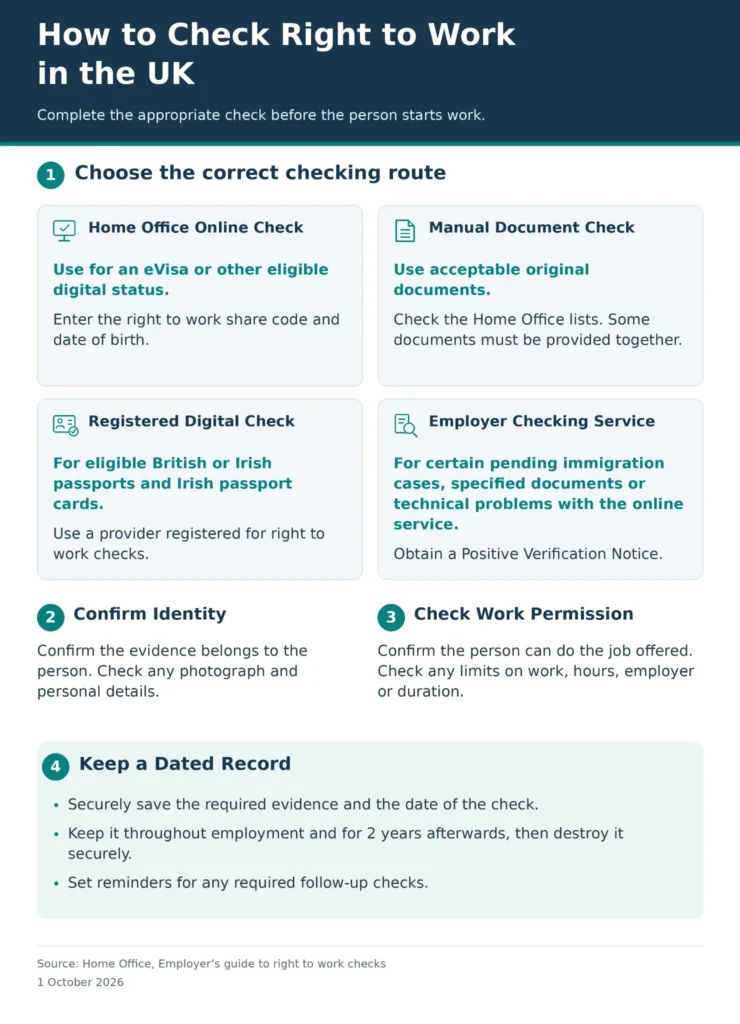
Employers must check that a person is legally allowed to do the job in the UK before they start work. How you carry out the check depends on the evidence they can provide. You may need to use the Home Office’s online service, examine original documents or use a registered digital verification service.
Whichever method you use, you must confirm that the evidence belongs to the person, check any restrictions on their work and keep a record.
This guide explains how to check right to work in the UK, choose the correct method and know when a follow-up check is needed.
A right to work check confirms that a person is legally allowed to do the job offered in the UK. It also identifies any restrictions, such as limits on their working hours or permission to work only for a particular employer.
Completing the check correctly can give the employer a statutory excuse. This is legal protection against a civil penalty if the person is later found to have been working illegally. Employers must follow the checking requirements in the Home Office’s Employer’s Guide to Right to Work Checks and complete any required follow-up checks to maintain this protection.
Employers must complete the check before the person starts work. If the check takes place on their first day, it must be completed before they begin any duties. A late check does not protect the employer against a civil penalty for an earlier period of illegal working.
From 1 October 2026, right to work checking requirements extend beyond employees to certain workers engaged to provide services personally, individual subcontractors and certain online matching services. The Home Office’s employer’s guide explains which working arrangements are covered.
Responsibility can also extend to a business that uses another supplier to fulfil a contract for a client or permits a worker to send a substitute. This is known as extended liability. Buying a service for the business’s own use does not automatically make it responsible for checking the supplier’s staff.
Whether the rules apply depends on the contract and how the work is arranged. Calling someone “self-employed” does not decide the issue. For extended liability, a contract entered into before 1 October 2026 is not brought within the new rules simply because work continues afterwards.
The right method depends on the person’s immigration status and the evidence they can provide.
Use the Home Office online right to work service for someone with an eVisa. Their share code and date of birth allow the employer to view their right to work record, including any restrictions on the work they can do.
Use this route when the person provides original documents accepted by the Home Office. The Employers’ Right to Work Checklist lists the documents and combinations allowed. For example, a UK birth certificate must be accompanied by an official document showing the person’s name and National Insurance number.
This optional route allows eligible British or Irish passports and Irish passport cards to be checked digitally. The employer must use a Right to Work digital verification service provider (RtW DVSP) registered specifically for right to work checks. This process is separate from the Home Office’s online service and does not require an immigration share code.
Use the Employer Checking Service (ECS) where Home Office verification is needed and the usual routes cannot establish the person’s right to work. Examples include certain pending immigration applications or appeals, a non-digital EU Settlement Scheme Certificate of Application or a technical problem with the online service.
The employer must obtain a Positive Verification Notice (PVN) confirming that the person is allowed to do the job. Simply requesting a check does not establish their right to work.
Use the official Home Office right to work service:
- Obtain the person’s date of birth and right to work share code.
- Enter them in the employer-side service and record the correct employer name.
- Check that the photograph matches the person, in person or by video call. Any digital facial recognition used must follow the registered-provider requirements.
- Confirm that the result permits the job offered, including any hours or role restrictions.
- Save the profile page showing the photograph, permission and check date. Record any required follow-up date.
Right to work share codes begin with W and last 90 calendar days. A code’s expiry is different from the worker’s permission expiry. Checking a screenshot supplied by the person does not complete the employer’s online right to work check.
NHS advice is to stay off work until at least 48 hours have passed since the last episode of vomiting or diarrhoea. This applies even if only one of those symptoms occurred. A high temperature or feeling too unwell for normal activities is also a reason to remain at home. (NHS, Diarrhoea and Vomiting)
For example, if the last episode occurs at 10 am on Monday, the 48-hour period ends at 10 am on Wednesday, provided there are no further episodes. If symptoms recur, count again from the latest episode.
Employees should inform their employer and follow any relevant sickness, infection-control or public-health instructions.
Obtain the original acceptable document or required combination. Some routes require two documents; a birth certificate or National Insurance number alone is insufficient for those combinations.
Check that documents are genuine, unaltered and belong to the holder. Compare photographs, dates of birth and names. Obtain supporting evidence for name differences. Check permission dates and work restrictions.
The holder can be present in person or by live video, but the employer must physically hold the original documents. An emailed passport scan or a passport held up to a camera is insufficient. Eligible government-issued digital National Insurance evidence has a specific exception.
Copy the relevant passport identity, expiry and permission pages. Copy other accepted documents in full. Keep clear copies in a format that cannot be manually altered and record the actual check date.
British and Irish citizens normally use acceptable original documents or registered digital verification. Do not require every applicant to provide a share code.
For manual checks, British or Irish passports and Irish passport cards can be current or expired, provided they are otherwise acceptable. Alternatives include the relevant birth, adoption or British naturalisation certificate with the required official National Insurance evidence.
For digital verification, choose a provider on the Office for Digital Identities and Attributes (OfDIA) register whose registration covers right to work checks. Under the digital verification rules, eligible passports or Irish passport cards can be expired by up to six months, with prescribed chip validation. Obtain the required output and identity confirmation.
A narrow exception to the usual share-code position applies to British citizens with a digital certificate of entitlement, who can use it to obtain a code.
Use the Employer Checking Service where current guidance allows, including:
- Certain outstanding applications, appeals or administrative reviews where normal evidence is unavailable.
- A non-digital Certificate of Application requiring Home Office verification.
- An Application Registration Card showing permission for the work concerned.
- Technical problems preventing access to the online service.
A Positive Verification Notice confirms permission for the specified work and normally establishes a six-month statutory excuse from its stated date. Retain it and record the follow-up deadline.
Requesting verification is not the same as receiving a positive result. There is no general grace period allowing new starters to begin while the employer waits for ECS.
Keep the manual document copies, employer-side online profile or prescribed digital provider output, as appropriate. Include the actual check date and any required facial comparison evidence. Retain students’ term and vacation dates where their hours are restricted during term time.
Keep the evidence securely throughout employment and for two years afterwards, then securely destroy it in accordance with Home Office guidance. Follow ICO employment records guidance on access, storage and retention.
A follow-up right to work check is needed where the employer’s statutory excuse is time-limited. This generally means checking on or before the worker’s permission expires, or repeating verification before a six-month PVN-based excuse expires.
No routine follow-up is required after a correct List A check. Continuing employment of workers with EU Settlement Scheme (EUSS) settled or pre-settled status also does not require routine repeat checks.
For example, HR can record the relevant deadline when completing the initial check and set reminders early enough to resolve problems before it expires.
An in-time application may preserve existing work permission under section 3C leave. Existing restrictions normally continue. Give the employee a reasonable opportunity to provide evidence and use ECS where appropriate.
The Home Office discrimination code recommends consistent checks on all relevant recruits, including British citizens. Check applicants at the same recruitment stage and give them a reasonable opportunity to provide acceptable evidence.
Do not make assumptions based on race, nationality, accent, name or appearance. In Great Britain, the Equality Act 2010 prohibits unlawful discrimination; Northern Ireland has separate legislation.
Understanding equality and diversity and recognising implicit bias at work can help managers review how they make recruitment decisions.
Human Focus EDI Training supports awareness of discrimination and appropriate workplace behaviour. Apply that knowledge alongside clear checking procedures and role-specific instruction.
Choose the prescribed route appropriate to their evidence, confirm identity and permission for the work, retain the required record and arrange any necessary follow-up.
Yes, where an eligible manual or registered digital verification route is available. ECS can verify certain cases where normal evidence cannot be provided.
British citizens with a digital certificate of entitlement can obtain a share code. Most use acceptable original documents or registered digital verification.
Use the current Home Office List A or List B, including required document combinations. Do not assume that any identity document proves permission to work.
A List A check establishes a continuing excuse. Time-limited evidence may require follow-up at permission expiry or after six months for a PVN-based excuse.
When the original evidence establishes a time-limited statutory excuse. There is no universal annual recheck requirement. Routine follow-up is not required for continuing employment of EUSS settled or pre-settled status holders.
It is Home Office ECS confirmation that the named person may undertake the specified work. Its stated date normally starts a six-month statutory excuse.
Complete the initial prescribed check before work starts. Waiting for documents or ECS verification does not provide a general exemption from this requirement.
If illegal working is identified without a statutory excuse, civil penalties can reach £60,000 per illegal worker. Knowingly employing a disqualified worker, or having reasonable cause to believe they are disqualified, can lead to criminal prosecution, with up to five years’ imprisonment and an unlimited fine.
Check an employee’s right to work again where the original evidence requires a follow-up. Correct earlier checks may provide an ongoing excuse, so a blanket recheck is unnecessary. Transfers covered by the Transfer of Undertakings (Protection of Employment) Regulations, commonly known as TUPE, have specific checking rules.
Human Focus HR Compliance Training Courses cover topics including equality and diversity, sexual harassment prevention and data privacy. They support awareness of workplace responsibilities among HR teams and managers.
Combine appropriate awareness training with written recruitment procedures and role-specific instruction. Employers remain responsible for completing and retaining the prescribed right to work checks.