Fire Door Checks for Building Managers: What to Check, How Often and What to Record

Fire door checks identify visible damage, faulty self-closing devices, damaged seals and changes that could weaken protection against fire and smoke.

In England, buildings with at least two domestic premises, common parts used for evacuation and a top storey more than 11 metres above ground require communal fire door checks at least every three months. The Responsible Person must also use best endeavours to check flat entrance fire doors at least every 12 months (HM Government, 2022). Other buildings need checking arrangements suited to their risks and applicable duties.

Record findings, arrange necessary repairs and verify the outcome.

For building managers, completing an inspection does not necessarily mean every door has passed. The challenge is keeping missed checks, access problems and outstanding defects visible until the appropriate action has been taken and verified.

Why Identifying a Fire Door Defect Is Not Enough

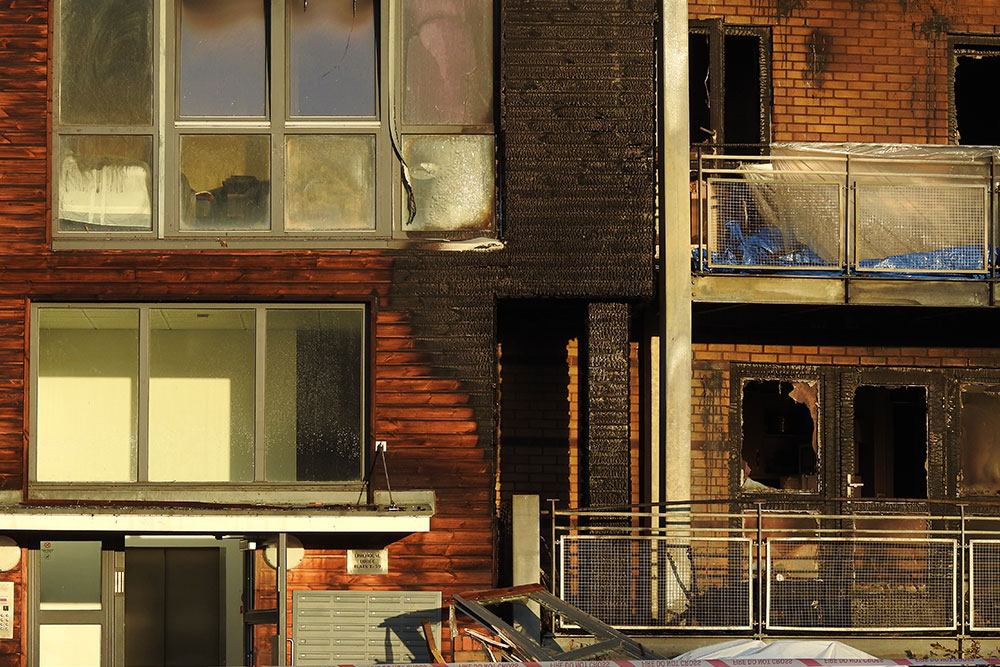
In July 2015, Grenfell Tower’s fire risk assessor identified a missing self-closing device at Flat 45. When he prepared the April 2016 assessment, that defect was not mentioned.

The Inquiry later found nothing to suggest that he had been told the problem was satisfactorily resolved. He should have followed it up during his next assessment and accounted for any unresolved problem when assessing the risk (Grenfell Tower Inquiry, 2024).

The Inquiry also found that the tenant management organisation (TMO) lacked a system for regular inspection and maintenance of flat entrance doors that might have identified missing or defective closers (Grenfell Tower Inquiry, 2024).

These findings predate England’s 2022 checking regulations. For managers today, outstanding defects need to remain visible across inspections, maintenance work and later fire risk assessments, including handovers, until the outcome has been verified.

What Fire Door Regulations Apply to Building Managers?

In England and Wales, the Regulatory Reform (Fire Safety) Order 2005 sets the maintenance duty. Where necessary to safeguard people, Article 17 requires a suitable maintenance system, with fire safety measures kept in an efficient state, efficient working order and good repair (HM Government, 2005).

The Responsible Person is normally the employer in a workplace under its control. Elsewhere, responsibility follows from ownership and control. A building manager’s title alone does not confer that role (Home Office, 2023a).

Under Article 5, managing agents and contractors can also have duties to the extent of their control, including contractual maintenance obligations (HM Government, 2005). Agree who arranges checks, authorises repairs and keeps records before a defect is reported.

For blocks of flats, the Fire Safety Act 2021 clarified that flat entrance doors between homes and common parts fall within the Order’s scope. Common parts include shared corridors, landings and stairways (Welsh Government, 2022).

England’s Fire Safety (England) Regulations 2022 add checking and resident-information requirements. The checking intervals below apply to qualifying buildings above 11 metres, while resident information is required regardless of height (Home Office, 2023b).

Scotland and Northern Ireland have separate fire safety regimes, so England’s checking intervals should not be treated as UK-wide requirements.

The building’s fire risk assessment should identify fire doors, their function and maintenance arrangements. Statutory checking intervals still apply. A shared-corridor door and one serving a locked service cupboard may require different functional checks, but both need to resist fire as intended.

How Often Should Fire Doors Be Checked?

In England, buildings with at least two domestic premises, common parts used for evacuation and a top storey more than 11 metres above ground require communal fire door checks at least every three months and best endeavours to check flat entrance fire doors at least every 12 months (HM Government, 2022).

The first two rows below apply to those buildings.

Building and Doors Checking Frequency
Communal fire doors in the England buildings described above At least every three months.
Flat entrance fire doors in the England buildings described above Best endeavours to check at least every 12 months.
Fire doors in other buildings, including lower residential blocks and workplaces A suitable regime informed by the fire risk assessment, door use and applicable guidance.

The six-month period is not a general rule of law. Buildings outside the prescribed checking requirements still require appropriate maintenance arrangements (Home Office, 2023b).

These are minimum checking intervals, not deadlines for rectification of defects. Needs attention then A disconnected closer reported between visits . Where access prevents an annual flat entrance door check, record attempts, leave the door marked as not checked and arrange follow-up (HM Government, 2022).

What Should Routine Fire Door Checks Include?

In a full-scale fire experiment in an existing residential building, researchers burned a two-seater sofa inside an apartment. They examined how smoke moved into the shared corridor under different door and ventilation conditions.

When the apartment door opened, smoke entered the corridor. Closing it substantially reduced further smoke spread and corridor carbon monoxide concentrations under the conditions tested (de Witte et al., 2025).

For building managers, the finding highlights why a fitted door closer is not enough. The door must actually close fully to provide the protection expected of it. A door that stops short may compromise its ability to restrict smoke spread.

During routine checks, release a self-closing door from fully open, then from around 15 degrees. In both cases, it should close fully into the frame without assistance, overcoming any latch resistance or floor friction (MHCLG and Home Office, 2025b). If it sticks, stops short or needs pushing, record and report the fault.

Routine checks identify visible damage and functional faults. They do not establish whether a doorset provides the required fire resistance. Direct concerns about changes, replacements or suitability to a competent assessor (MHCLG and Home Office, 2025b)

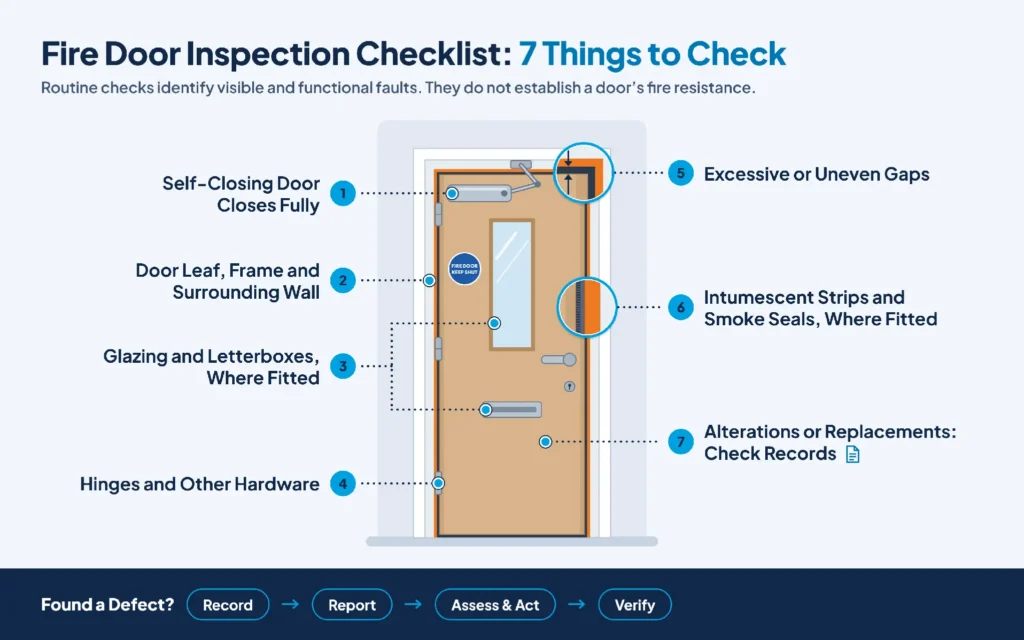
Use the fire door inspection checklist below to identify and record any observed defects within the agreed remit of the checker (MHCLG and Home Office, 2025a).

Item What to Check When to Report or Escalate
Closing and obstructions Self-closing doors close fully without assistance. Wedging, obstructions, sticking, stopping short or a disconnected closer.
Door leaf, frame and securing wall Look for damage to the moving door panel, frame and surrounding wall. Splits, holes, warping or other obvious damage.
Glazing and letterboxes, where fitted Glass and fittings are intact; letterboxes close firmly. Damage, a jammed-open letterbox or an altered opening.
Hinges and other hardware Look for loose or missing fixings and damaged fittings. Defects in hinges, screws, locks or other hardware.
Gaps Look for unusually large or uneven gaps and floor rubbing. Changed fit or clearance that needs assessment.
Strips and seals, where present Check their condition and attachment. Damage, detachment or paint covering them.
Alterations or replacement doors Compare with available door records. Changes that could affect performance or uncertain suitability.

For magnetic hold-open devices, use the test button where provided; avoid pulling the door away from the magnet. Some plant-room, cupboard and riser doors are intended to remain locked shut. Check them against that arrangement, with access limited to what is safe and authorised (MHCLG and Home Office, 2025b).

For clearances, follow the door assembly’s supporting evidence and relevant guidance. Fire door gap tolerances vary by assembly, so refer to unusually large or uneven gaps for competent assessment rather than applying one universal bottom-gap limit.

fire door inspection checklist

Who Can Carry Out Fire Door Checks and When Is a Specialist Needed?

Properly instructed caretakers, housing officers and maintenance staff can carry out the simple routine checks described in government guidance. A specialist is not normally needed solely for those checks (Home Office, 2023b).

Routine checks assume that door suitability has been considered through the fire risk assessment. Repeated closing failures or significant damage may also require specialist advice (MHCLG and Home Office, 2025b).

An older flat entrance door also needs careful judgement. The government’s August 2025 clarification explains that missing modern certification or seals does not automatically make it unsuitable. Its adequacy depends on the building’s fire-risk context; routine checks do not automatically require replacement to current new-build standards (MHCLG and Home Office, 2025b).

Staff need to know where their checking remit ends. Someone who notices a door catching on the floor can record and report it. They should not be expected to alter the door or adjust its fittings without the competence and authority to do that work.

What Fire Door Check Records Should Building Managers Keep?

Arrange access in advance so both sides of a flat entrance door can be examined. Offer workable appointment times and follow up unsuccessful attempts (Home Office, 2023b).

In England’s buildings covered by the prescribed checking intervals, Regulation 10 requires records of steps taken to check flat entrance doors and, where access was not granted, attempts to obtain it (HM Government, 2022).

Wider check and action records help managers organise follow-up. The official checklist includes an action plan, but there is no single statutory form for every fire door record (MHCLG and Home Office, 2025a). A useful working record includes:

  • Door identifier and location.
  • Check date, checker and checks completed.
  • Findings, useful photographs and any access limitations.
  • Required action, named action owner and agreed timescale.
  • Repair details, completion date and verification evidence.

Record the fault precisely enough for the next person to act. “Closer faulty” gives less useful information than identifying the door and recording that it stops short of the latch when released. Keep the observation separate from a diagnosis that needs technical judgement.

Records should show unchecked doors, overdue checks, defects awaiting assessment and repairs awaiting verification, with an owner and follow-up date. A completed inspection does not mean every door passed, and a closed maintenance job does not confirm that the fault was resolved.

How Should Building Managers Act on Fire Door Defects?

Where a fault could weaken containment of fire or smoke, the person coordinating repairs should obtain competent advice on urgency and precautions needed before repair. The Responsible Person must ensure arrangements address identified issues. Necessary repairs or replacement should be undertaken by a competent contractor as soon as reasonably practicable (MHCLG and Home Office, 2025b).

For a door that stopped short of its latch, check its closing operation after repair and record the result. For work affecting fire resistance, obtain the relevant technical evidence and competent confirmation. Close the action only when the reported defect has been addressed and verification recorded.

Repeated failures deserve a closer look. Check whether an obstruction keeps returning, whether access is delaying repairs or whether previous work has left the original fault unresolved. Use what you find to improve the checking and repair arrangements.

Residents also need to know how to report problems. In England, buildings with at least two domestic premises and common parts used for evacuation have a resident-information duty regardless of height. The Responsible Person must explain keeping fire doors shut when not in use, avoiding tampering with closers and reporting faults immediately (HM Government, 2022).

Give that information to new residents as soon as reasonably practicable and repeat it at intervals not exceeding 12 months (HM Government, 2022). A clear contact route helps residents get a fault to the person arranging repairs.

How Can Building Managers Improve Fire Door Checks and Follow-Up?

For building managers, the challenge is ensuring that fire door checks produce consistent, actionable findings, particularly when different staff or contractors carry out inspections. Defects need to be recognised, recorded accurately and passed to the right people for assessment and repair.

Human Focus’s RoSPA-assured, NAFDI-approved Fire Door Inspection Course develops the knowledge needed to identify visible defects, understand door construction and recognise when further assessment is required. Its supporting digital e-Checklist helps standardise how inspection steps and findings are recorded, giving managers clearer information to act on.

Training must be supported by defined responsibilities for reporting defects, arranging repairs and verifying outcomes. Course completion alone does not establish competence or authorisation. Employers must determine who is competent for assigned tasks and provide appropriate procedures and supervision.

The operational goal is to ensure that identified defects lead to appropriate action, rather than remaining unresolved in completed inspection records.

About the author(s)

Human Focus Editorial Staff comprises a dedicated collective of workplace safety specialists and content contributors. The team shares practical guidance on human factors, risk, and compliance to support safer, more effective workplaces.

Share with others
You might also like

Popular Courses

Legionella Risk Assessment Training
Legionella Risk Management Principles for Responsible Persons
View Course Details
IOSH Managing Safely
View Course Details
GDPR Awareness Training Course
GDPR Training
View Course Details
LOTOTO online training course
Safe Isolation – Lock Out, Tag Out, Try Out (LOTOTO) Training
View Course Details
spill kit training
Spill Kit Hazardous Substances Training
View Course Details

Recent Articles

Right to Work Checks
How to Check Right to Work in the UK
what is an abrasive wheel
What Is an Abrasive Wheel? Types, Hazards and Safe Use
AI phishing
AI Phishing: How Artificial Intelligence Is Changing Cyber Fraud
Inclusivity at Work: 8 Signs Your Workplace Goes Beyond Good Intentions
Health and Safety Policy Inspection
Health and Safety Policy: What Directors Must Put Into Practice, Not Just Put on Paper

Current Offers

Level 1 Food Hygiene Awareness – General
Level 1 Food Hygiene Awareness for All Workplaces

Original price was: £25.00.Current price is: £22.00. +VAT

L1 Food Hygiene Awareness Catering
Level 1 Food Hygiene Awareness for Catering

Original price was: £25.00.Current price is: £20.00. +VAT

Level 1 Food Hygiene Awareness for Manufacturing

Original price was: £25.00.Current price is: £22.00. +VAT

PUWER
PUWER Leadership Skills for Supervisors

Original price was: £125.00.Current price is: £100.00. +VAT

PUWER
PUWER Inspector Training

Original price was: £495.00.Current price is: £396.00. +VAT