Inclusivity at work means making sure people can take part in working life. Employees judge inclusivity through their everyday experiences at work, such as how a manager responds to their concerns and whether a development opportunity is accessible to them.
A written inclusivity policy can be useful, but whether it works depends on how it is communicated and how people apply it in ordinary working situations.
This article explains what inclusivity means, including eight observable signs of an inclusive workplace, and how employers can identify avoidable barriers to a more inclusive workplace.
Inclusivity means making workplace activities and opportunities fairly accessible to employees so that they feel valued.
Creating a more inclusive workplace can involve removing avoidable barriers in both systems of work and behaviours of people. An inclusive workplace allows all employees to feel safe to share their ideas and raise concerns (Acas).
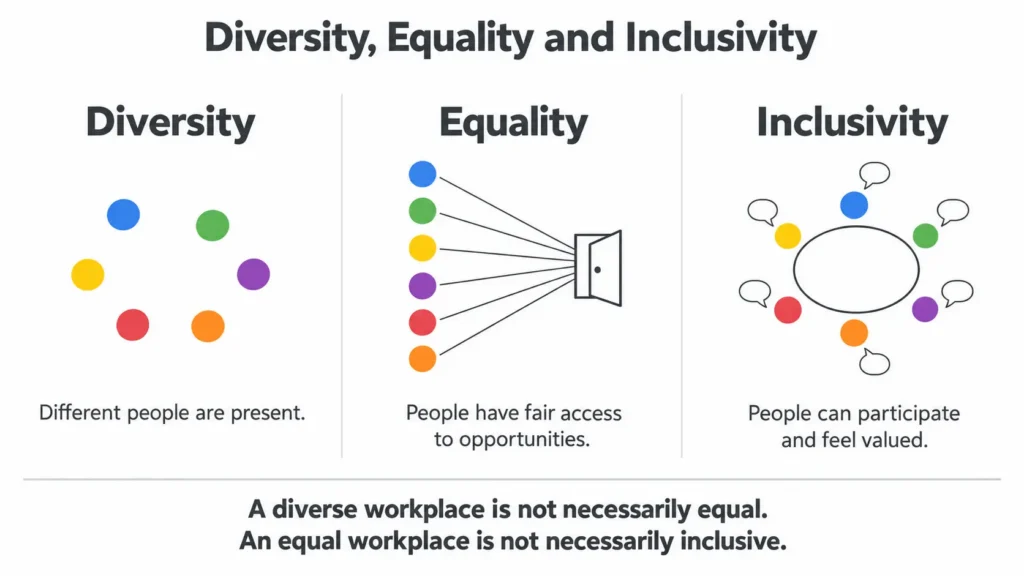
Diversity means having people with different backgrounds, characteristics and experiences. A diverse workplace includes employees with differences such as age, ethnicity, disability, beliefs and ways of thinking.
Equality means fair treatment and equal access to opportunities. An equal workplace applies relevant criteria consistently in recruitment, pay and progression, while addressing discriminatory barriers. Fairness may require different support for different people.
Inclusivity means creating conditions in which a diverse group of people can participate, contribute and feel equally valued. An inclusive workplace makes information and activities accessible, takes different perspectives seriously and gives employees meaningful opportunities to contribute to discussions and decisions.
A diverse workplace is not necessarily equal, and an equal workplace is not necessarily inclusive. An organisation may employ people from varied backgrounds yet distribute opportunities unfairly. It may also apply fair formal processes while leaving some employees unheard or disconnected from everyday team life.
Human Focus’s guide to equality and diversity explains the wider concepts.
Inclusivity does not mean treating all employees the same regardless of their role and needs. Giving everyone the same arrangements can leave some people at a disadvantage.
For example, two employees are asked to complete a task using the organisation’s internal system. One has used it for years; the other is using it for the first time. Giving both the same brief instructions may leave the second employee at a disadvantage.
Providing that employee with a guided demonstration and time to practise gives them a fairer opportunity to meet the required standard. The employer treats them fairly by recognising their different support needs, even though the task is the same.
In Great Britain, the Equality Act 2010 requires employers to make reasonable adjustments for disabled workers and applicants where the legal duty applies. What is reasonable depends on the individual circumstances and whether the adjustment removes or reduces the disability-related disadvantage (Acas). The Act also prohibits unlawful discrimination at work related to protected characteristics.
Meeting these duties is fundamental to an inclusive workplace, but inclusivity at work is broader than legal compliance.
These signs can help you review workplace inclusion. See if these hold true for your workplace, and ask others whether their experiences match your assessment.
Employees can ask questions, disagree respectfully or explain a problem without being mocked or routinely dismissed. Managers listen, consider the issue and explain what will happen next.
A useful check is whether concerns from junior or temporary staff receive the same consideration as those from senior colleagues. Silence alone does not show that everyone feels included.
Information about meetings is shared in advance where possible. People have ways to contribute beyond responding immediately in a busy discussion, such as sending written comments before a decision.
The chair handles interruptions and includes remote participants. Managers can explain how different employees’ views were considered before a decision was made.
Applicants and employees can understand which skills, experience and results matter. Essential job requirements are distinguished from desirable ones, and selection decisions use relevant evidence (Acas).
For progression, look for advertised opportunities and relevant criteria applied consistently. Vague judgements like whether someone fits in should not replace assessment of their ability to do the role.
Managers discuss access needs privately, arrange agreed adjustments and check whether they work. Accessibility reviews cover digital tools, information and working methods as well as buildings (Acas).
Support should reflect individual needs. For some neurodivergent employees, clearer written instructions or a quieter workspace may help (Acas). Human Focus’s article on neurodiversity for employers explores this workplace context.
Employees know how to request changes to working arrangements and how leave applications are assessed. Managers follow clear processes and explain the reasons for their decisions.
Flexible working requests can have different outcomes where circumstances differ. The legal duty to make reasonable adjustments for disabled workers is separate from the procedure for considering flexible working requests (Acas).
Our guide to work-life balance at work explains how employers can tailor flexibility to individual needs while assessing requests against consistent criteria and the requirements of each role.
Development opportunities reach employees across different shifts, working patterns and locations. Managers check whether timing, formats or access requirements prevent anyone from participating.
For example, offering every development session during the day may exclude night-shift staff. A useful review considers who actually takes part, alongside the number of courses made available.
Reports of bullying, harassment or discrimination are taken seriously and addressed promptly through fair procedures, regardless of the seniority of the person involved. Staff know where to report concerns, including an alternative contact if their manager is involved (Acas).
Each complaint is assessed fairly on the evidence, with the response reflecting the circumstances of the case.
Leaders ask employees about their experiences and report back on the issues raised, actions agreed and reasons why some suggestions cannot be adopted.
Surveys should lead to investigation where results suggest a problem. Acas recommends checking whether recruitment, promotion and leadership behaviour match the organisation’s commitments (Acas). Employees should be able to identify changes made after feedback.
Exclusion can arise from familiar routines, even where an organisation has a well-written policy. For example:
- A new starter receives a lengthy handbook, but nobody explains team jargon or how to raise a concern.
- A part-time employee meets agreed targets, but their performance review criticises their “visibility” without linking this to job requirements.
- An employee working remotely misses information because important updates are shared only through office conversations.
- Development opportunities are discussed during after-work drinks, so colleagues who do not attend never hear about them.
These situations do not mean deliberate hostility.
Reviewing who can access information, influence decisions and build useful working relationships can reveal barriers that managers have overlooked.
An EDI policy needs an action plan with clear responsibilities and ways to check progress. Acas recommends involving employees and their representatives when developing the policy and planning how it will work in practice (Acas).
Employers can start with six practical actions:
- Explain the EDI policy, expected behaviour and reporting procedures through induction and everyday communication.
- Train managers and employees on discrimination, relevant legal duties and respectful behaviour. Managers also need support to apply the policy.
- Review recruitment, performance and progression processes for unnecessary requirements or decisions that cannot be explained against relevant criteria.
- Plan for accessible tools, information and venues. Discuss individual adjustment needs and review whether the support provided works.
- Provide clear routes for feedback and complaints, including alternatives where a concern involves the usual contact. Handle information confidentially and fairly.
- Review employee feedback and access to opportunities. Investigate concerns, assign responsibility for changes and tell staff what happens next.
Inclusive leadership requires managers to demonstrate the principles of equality and diversity in their own decisions.
For further practical steps, see Human Focus’s 5 ways to promote equality and diversity in the workplace.
Inclusivity means making it possible for people to participate and feel respected, even when their needs or circumstances differ. At work, it involves looking at how decisions, communication and opportunities affect employees, then removing avoidable barriers. Employees should experience this in ordinary working life.
Inclusivity helps employers identify barriers that prevent people from contributing or progressing. It supports a workplace where differences are respected, and concerns can be raised. It may also support staff motivation and retention, although these outcomes depend on how policies and management practices work in reality (Acas; CIPD).
Diversity describes the range of people, backgrounds and experiences within a workforce. Inclusivity concerns whether those people can participate and have fair access to opportunities. For example, a team may recruit people from different backgrounds but still exclude some members from decisions or development through its everyday working practices.
Managers can review whose views are heard, how work and opportunities are allocated and whether their communication is accessible. They should ask about barriers, consider individual support needs and explain decisions against clear criteria. Regular conversations are useful when managers also follow through on agreed actions and address unacceptable behaviour.
The Equality Act 2010 does not create a general duty to make every workplace “inclusive”. In Great Britain, employers must not unlawfully discriminate and must make reasonable adjustments for disabled workers and applicants where the duty applies. Certain public bodies also have a Public Sector Equality Duty. Northern Ireland has separate equality legislation (GOV.UK; Acas).
Awareness supports a shared understanding of expected behaviour. Human Focus’s online Equality, Diversity and Inclusion (EDI) Training covers EDI concepts, relevant legislation, bullying, harassment, discrimination and unconscious bias. It can help employees understand how to support an inclusive culture at work.
Online awareness training cannot remove structural barriers or replace fair processes, workplace adjustments and effective management.