In short: Office buildings are officially classed as a low-risk environment, but ordinary electrical equipment – extension leads, personal chargers, e-bike batteries and ageing fixed wiring – is a measurable source of UK workplace fires every year. This article sets out five specific, evidence-based risk areas that facilities managers and health and safety leads can check against their own building.
Electrical Safety in Office Environments: Hidden Risks to Address
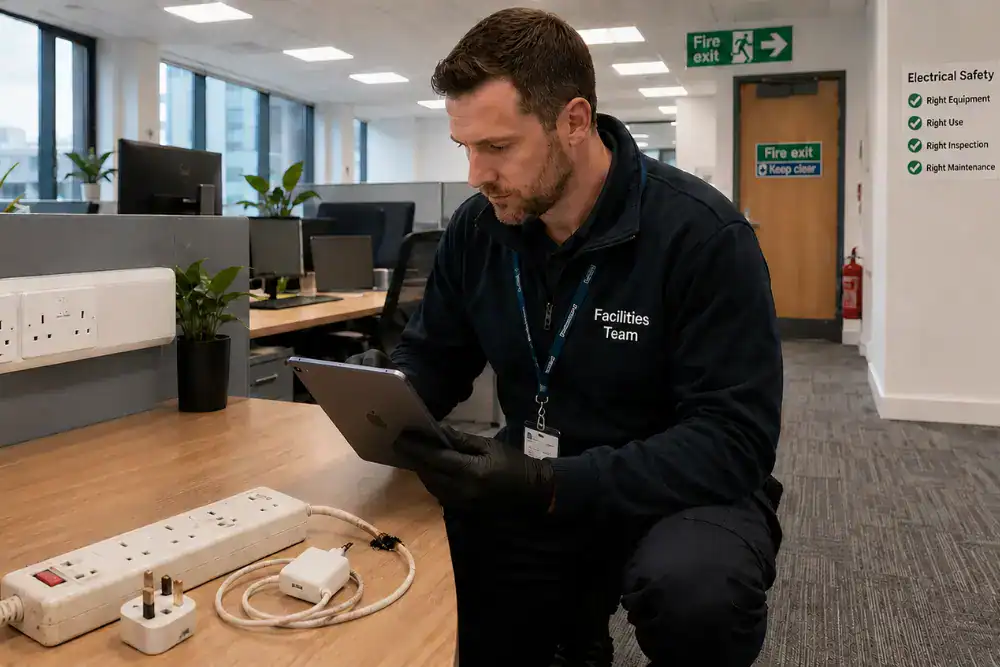
Offices as treated as relatively low-risk environment, and on most measures that is accurate. In many organisations, however, that low-risk reputation can mean some of the more ordinary electrical hazards – equipment that has quietly become a permanent fixture rather than a temporary measure – go unchecked.
This article covers electrical safety in office environments, highlighting five often-overlooked risks, from PAT testing myths to fixed wiring, so that facilities managers and health and safety leads can identify gaps in their own building.
Key Takeaways
- PAT testing should follow actual risk and usage, not a blanket annual rule – extension leads, kettles and chargers usually need more frequent checks than static equipment.
- Hot-desking can overload sockets built for one fixed user, especially when several people share a desk and each bring their own charger or screen.
- E-bike and e-scooter batteries create a fire risk most fire risk assessments don’t cover yet – restricting on-site charging is usually more workable than restricting the vehicles.
- Counterfeit chargers are a hidden risk because personal chargers aren’t owned or maintained by the employer – adding them to the inspection list closes this gap.
- Fixed wiring and smoke alarms need the same attention as appliances – keep the EICR (Electrical Installation Condition Report) current and check detection in plant rooms and comms cupboards.
Hidden Electrical Safety in Office Environments Risks
Electrical Safety Training
Our Electrical Safety Training course helps employers and their staff explore the hazards of electricity and examines precautionary measures that must be taken to manage the risk of electrical injuries and accidents.
1. PAT Testing Myths
No, UK law does not require every electrical appliance in an office to be PAT tested (Portable Appliance Tested) every year, despite this being a genuinely common misunderstanding among UK employers. HSE’s own guidance leaflet says so explicitly, under a heading that states: “Not every electrical item needs a PAT and those that do may not need to be tested every year” (HSE, 2013a).
The underlying law, the Electricity at Work Regulations 1989, requires that equipment is maintained so far as is reasonably practicable to prevent danger – but it does not specify what needs to be done, by whom, or how often (UK Government, 1989).
HSE goes further in its dedicated guidance for offices and similar settings, calling it a myth that all portable appliances in a low-risk environment such as an office need a test every year, and stating that frequency should reflect how equipment is actually used (HSE, 2013b; HSE, 2024).
This common misunderstanding creates risk in two directions. Some offices test low-risk, rarely-moved desktop equipment on a rigid annual cycle while extension leads, kettles and chargers get the same blanket treatment, rather than more frequent attention. HSE’s guidance specifically flags flexible and extension leads as more liable to damage to their plugs, sockets, connections and cable than most other equipment, precisely because they are handled, moved and flexed far more often (HSE, 2013a).
2. Hot-Desking
Hot-desking, hybrid working and the growth in personal devices increase the risk of overloaded sockets because more equipment is now plugged into desks that were originally wired for a single, fixed user. Most UK office buildings were wired around an assumption about socket use that no longer holds: one set of equipment per desk, plugged in once and left alone.
HSE’s basic guidance for employers is blunt: providing enough socket outlets matters, because overloading socket outlets by using adaptors can cause fire (HSE, 2013a). When a desk is shared by several people across a week, each bringing a laptop charger, phone charger, secondary screen or personal fan, the natural response – another adaptor, another extension lead – is exactly the practice HSE warns against.
The Health and Safety (Display Screen Equipment) Regulations 1992 already require employers to assess workstations used by hot-deskers on the same basis as any fixed desk (UK Government, 1992). Folding a basic socket-load check into that same review, rather than treating it as a separate IT or facilities issue, is a straightforward way to catch the problem before it becomes routine.
3. E-Bike and E-Scooter Batteries
Lithium-ion batteries in e-bikes and e-scooters create a fire risk that did not exist in most offices a few years ago, and that most fire risk assessments were never written to cover.
The government’s own data on this is specific and recent. The Office for Product Safety and Standards (OPSS) collects notifications from fire and rescue services across the UK where a consumer product was the probable cause of a fire; in 2024, 93% of fires involving e-bikes or e-scooters notified to OPSS had the battery or generator recorded as the source of ignition, and 39% were confirmed to have occurred while the device was on charge (OPSS, 2025).
The Department for Transport has published specific guidance for premises managers – including offices – on managing this risk. It makes a counterintuitive point: for non-residential premises, restricting battery charging on site (rather than restricting access or storage of the vehicles) is described as the more appropriate approach, since most e-cycles have more than adequate range for a commute without needing to charge at work (UK Government 2024).
That guidance also flags a workplace-specific finding: London Fire Brigade has identified gig-economy delivery riders as a particularly high-risk user group, largely because of the widespread use of owner-modified e-cycles rather than complete systems from reputable retailers.
The legal hook is the same fire risk assessment duty that applies to everything else: under the Regulatory Reform (Fire Safety) Order 2005, the introduction of a new fire hazard requires the risk assessment to be reviewed (UK Government, 2005). London Fire Brigade’s own workplace guidance note covers practical detail on where charging facilities should sit relative to escape routes and how to isolate power to a charging area in an emergency (GN103, 2023).
4. Counterfeit Phone Chargers
Counterfeit phone chargers are a fire risk because most lack the internal isolation and components needed to prevent a lethal shock or fire, and almost everyone in an office carries one without knowing it.
Electrical Safety First, the UK charity dedicated to reducing electrical deaths and injuries, tested a batch of counterfeit phone chargers and found that 98% had the potential to cause a lethal electric shock or start a fire – and that a genuine charger typically contains more than 60 individual components, compared with around 25 in the average counterfeit (Electrical Safety First, 2023).
The defects involved – inadequate isolation between the mains side and the low-voltage output, undersized components – are frequently not visible from the outside, which means a routine visual check is unlikely to catch them.
Personal chargers like these are not owned by the employer, registered as an asset, or covered by any formal maintenance schedule; they simply arrive in pockets every morning. The same is true of kettles, microwaves and personal fan heaters that accumulate in office kitchens.
Faulty appliances of exactly this kind are a measurable contributor to fire risk nationally: analysis of the official Ministry of Housing, Communities and Local Government (MHCLG) fire dataset by Electrical Safety First found that white goods alone were linked to 1,140 accidental electrical fires across England in a single year – roughly three a day (Electrical Safety First, 2025).
Under the Electricity at Work Regulations 1989, the duty to maintain electrical equipment safely applies regardless of who originally bought it – if it is plugged in and used at work, it is the employer’s responsibility (UK Government, 1989; HSE, 2024). A simple “bring it, register it” approach – personal appliances are welcome, but go on the same inspection list as everything else – closes most of this gap without banning anything.
5. Fixed Wiring
Office fixed wiring should be inspected periodically by a competent person using an Electrical Installation Condition Report (EICR), because electrical distribution is the single largest specifically identified cause of fire in “other building” premises – the official category that includes offices – accounting for 16% of fires where a source of ignition was identified (MHCLG, 2025).
That means fuse boards, wiring and fixed distribution equipment behind the walls – the part of the system nobody interacts with day to day.
MHCLG data also shows that smoke alarm presence and operation remains an important factor in fire outcomes, so offices should not assume detection coverage is comprehensive without checking plant rooms, comms cupboards and other low-traffic areas (MHCLG, 2025).
Many office occupiers assume their building’s detection coverage is comprehensive because the premises are commercial. A fire originating in fixed wiring, in a plant room or comms cupboard nobody normally enters, is exactly the scenario in which the absence of detection matters most.
What Should Be on an Office Electrical Safety Checklist?
- Base inspection and testing intervals on actual risk and usage, not a blanket annual rule. Pay particular attention to extension leads, chargers and kettles, which HSE identifies as more failure-prone than static desktop equipment.
- Treat socket loading as part of any hot-desking or hybrid working review, rather than leaving it as an unowned gap between IT, facilities and HR.
- If staff commute by e-bike or e-scooter, or the building receives delivery riders, update the fire risk assessment specifically to cover battery charging, and consider restricting on-site charging rather than the vehicles themselves.
- Encourage manufacturer-supplied chargers and bring personal appliances onto the inspection list – kettles, heaters, personal fridges – rather than leaving them invisible to any maintenance programme.
- Keep the building’s Electrical Installation Condition Report (EICR) current, and confirm smoke alarm coverage actually extends to plant rooms, comms cupboards and other areas nobody visits day to day.