In short: Working near a fragile roof means treating every roof surface as unable to safely support a person’s weight until a competent person proves otherwise. Falls through fragile materials, such as rooflights and ageing asbestos-cement sheeting, cause more UK roofing deaths than any other hazard, and short, informal jobs carry the highest risk of all. The controls that work combine equipment such as load-spreading boards and edge protection with re-verified surveys, weather checks, near-miss reporting, and training that helps people recognise a fragile roof in the first place.
Working Near Fragile Roofs: Risks and Controls Explained
Falls through fragile materials, such as rooflights and ageing asbestos-cement sheeting, cause more roofing deaths in the UK than any other single hazard, and roof work accounts for a quarter of all deaths in the construction industry (HSE, n.d.-a). Falls from height overall remain the leading cause of work-related fatal injury in Great Britain, responsible for 35 of the 124 worker deaths recorded in 2024/25, around 28% of all workplace fatalities (HSE, 2025).
The Health and Safety Executive (HSE) has published detailed guidance on roof work for decades, yet fragile roof incidents keep happening, in many cases not because someone ignored a known risk, but because no one recognised the risk was there in the first place.
This article explains the risks of working near fragile roofs, including the ones that standard guidance and training often miss, and the controls that address them.
Key Takeaways
- Every roof should be treated as fragile until a competent person proves otherwise.
- Falls through fragile surfaces kill more people than any other roofing hazard, more than falls from edges, and roof work alone accounts for a quarter of all UK construction deaths.
- Fragile roof injuries are rarely just a roofer’s problem. Maintenance workers, surveyors, and tradespeople doing “quick” jobs are disproportionately represented in these injuries, often because no one told them the roof was hazardous.
- Short jobs carry the highest risk, not the lowest. Site teams skip controls precisely when a task feels too brief to justify them; this is where fatalities cluster.
- The “walk the bolt line” belief is false and dangerous. No informal technique, including walking purlins (the horizontal beams that support a roof’s covering), bolts, or so-called “safe lines”, offers real fall protection on a fragile surface.
- Weather can turn a “safe” roof unsafe mid-task. Rain, wind, and frost aren’t just discomforts; they actively change roof risk in real time, not just at the planning stage.
- Information gaps can be as dangerous as physical hazards. Undocumented near-misses, unclear client duties, and poor handover between contractors mean the next person on the roof often doesn’t know what the last person learned.
What Does "Fragile" Mean for a Roof?
The HSE’s working definition is deliberately blunt: a fragile surface is one that “will not safely support the weight of a person and any materials they may be carrying,” and the guidance is explicit that all roofs, once fixed, should be treated as fragile until a competent person has confirmed otherwise (HSE, n.d.-b).
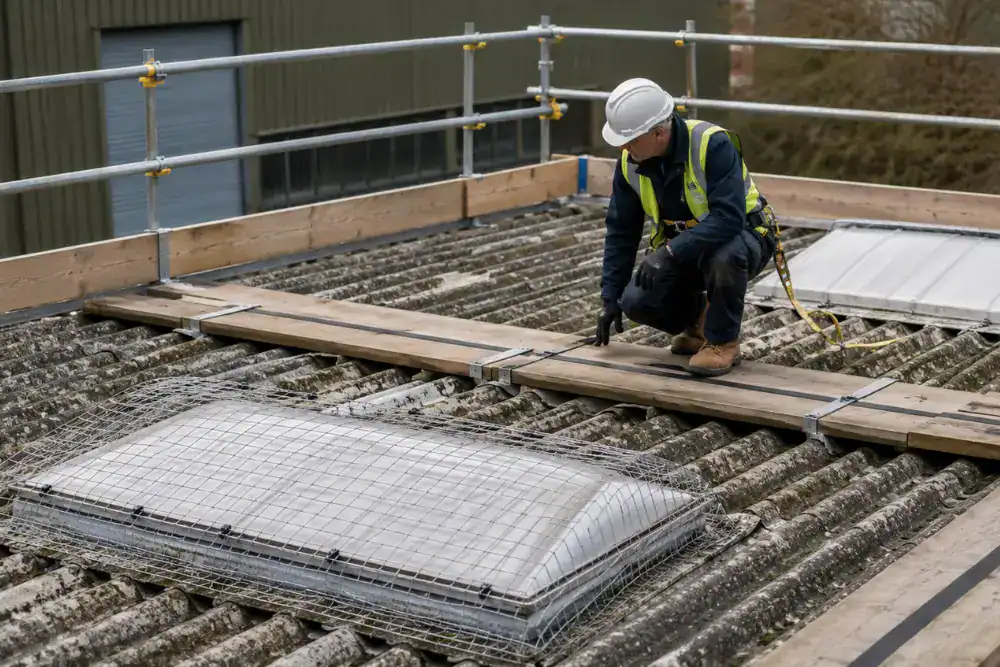
Treating every roof as fragile by default is a more radical requirement than it first appears. Fragility is not a fixed label attached to certain materials; it is a default assumption that has to be actively disproved every time, by someone qualified to do so. In practice, the materials most often responsible are non-reinforced fibre-cement sheets and rooflights, which are “particularly hazardous because they can be difficult to identify in certain light conditions or may be obscured by paint or weathering” (HSE, n.d.-b). Older asbestos-cement sheeting, common on agricultural and industrial buildings built before the 1980s, poses a similar problem: it deteriorates with age while looking structurally sound from above.
Who Gets Hurt Working on Fragile Roofs?
Maintenance workers, surveyors, and other tradespeople who are not trained roofers make up a large share of the people hurt on fragile roofs, not roofers themselves. The HSE’s own guidance notes that “not all the people killed while working on roofs are trained roofers: many people accessing roofs are maintenance workers” (HSE, n.d.-a), and separately warns that those “carrying out small, short-term maintenance and cleaning jobs are over-represented in the injury statistics” (HSE, n.d.-b).
What Are the Well-Known Risks of Fragile Roof Work?
The well-known risks of fragile roof work are worth stating plainly, if briefly, because they set the baseline for everything else in this article:
- Falls through fragile surfaces: the single largest cause of roofing deaths in the UK (HSE, n.d.-a).
- Falls from roof edges or openings: a persistent cause on both domestic and commercial jobs, particularly where site teams skip edge protection on smaller jobs (HSE, n.d.-c).
- Falling materials and tools: these can strike people below, especially where the contractor hasn’t planned access and material handling properly.
Each of these well-known risks is already covered in standard guidance and training. The less obvious risks below are where most of the real value in prevention lies.
What Fragile Roof Risks Get Left Out of Standard Training?
Working at Height Training
Our Working at Height Training course explains the regulations, risks and safety measures of working above ground level. It provides employees and employers with awareness of their legal responsibilities and the necessary precautions to ensure work at height is safe.
1. Degradation Between Inspections
A roof survey is a snapshot, not a guarantee. Frost, UV exposure, and moisture ingress continue to act on a roof after the assessment is signed off, meaning a surface confirmed safe some months ago may not be safe today. HSE’s precautionary principle, treating every roof as fragile until proven otherwise, exists precisely because fragility is a condition that changes, not a fixed classification (HSE, n.d.-b).
2. The Camouflage Effect
Rooflights that are “difficult to identify in certain light conditions or… hidden by paint” (HSE, n.d.-b) aren’t a rare edge case; on an older roof, this is close to the default condition. Visual inspection alone, without testing or documented surveys, routinely fails to catch this.
3. The "It's Only a Two-Minute Job" Mindset
The tasks most associated with fatalities are short, informal ones, such as clearing gutters, inspecting a vent, or retrieving a tool, precisely because the perceived brevity of the task leads people to skip the controls they would use for a longer job. HSE’s own injury statistics confirm that short-term maintenance and cleaning work is over-represented in fragile roof incidents (HSE, n.d.-b).
4. The Purlin Myth
One of the most dangerous pieces of received wisdom in roof work is the belief that walking along the line of roof bolts or purlins is safe. HSE’s own case records include a worker told to “just walk on the bolts and you won’t go through,” shortly before he fell through the roof he was told was safe (HSE, n.d.-d). The guidance is unambiguous: walking the bolt line “is like walking a tightrope and gives no protection at all” (HSE, n.d.-d).
5. Weather as an Active Risk Multiplier, Not a Static Factor
Rain reduces grip, wind can turn loose roofing sheets into projectiles and destabilise workers, and frost embrittles plastics and fixings. A fragility assessment carried out in dry, calm conditions doesn’t automatically hold once conditions change mid-task, yet site teams rarely rebuild weather checks into daily routines.
6. Near-Miss Silence
Research into construction safety consistently finds that near-misses, the close calls that precede accidents, are “frequently left unreported and unrecorded” despite being one of the strongest early-warning indicators available (Hashmi et al., 2024). On fragile roofs, this matters more than most hazards: a worker who steps near a weak rooflight and doesn’t fall through it rarely reports the moment, so the next person who accesses that roof never learns where the specific hazard is.
What Controls Actually Reduce Fragile Roof Risk?
The Work at Height Regulations 2005 set the legal baseline for fragile roof work: work at height must be properly planned, supervised, and carried out safely, and the person planning the work must specifically assess risks from fragile surfaces (Work at Height Regulations, 2005). HSE’s HSG33 guidance translates that requirement into a practical hierarchy:
- Avoid the roof entirely where possible: remote inspection using cameras or drones removes the exposure altogether.
- Use load-spreading equipment: crawling boards and staging boards distribute weight so no single point takes the full load.
- Install barriers, covers, or nets, placed over any surface confirmed or suspected fragile and clearly labelled as a warning (HSE, n.d.-c).
- Provide edge protection: guardrails and toe boards at all roof edges, including rear elevations on terraced properties (HSE, n.d.-c).
But the controls that address the hidden risks above sit outside this equipment-focused hierarchy:
- Re-verify, don’t just record. Treat a roof survey as time-limited, not permanent, particularly after severe weather.
- Apply full controls regardless of task length. The data shows short jobs are the highest-risk category, not the lowest.
- Make near-miss reporting genuinely easy and blame-free. A near-miss on a fragile roof is site-specific information that protects the next person to access it.
- Close the information gap with clients and subcontractors. Many domestic clients don’t know they hold duties under the Work at Height Regulations, and third parties accessing a roof, such as surveyors, HVAC engineers, and pest control technicians, often never receive the site-specific fragility information the original contractor holds.
How Does Training Reduce Fragile Roof Risk?
Recognising a fragile roof, and knowing why even a “quick job” still needs the full process, depends on the people doing the work having the right training, not just the right equipment. That is the gap training closes: it is not a substitute for a competent-person survey, but the layer that determines whether site teams apply controls consistently in the first place. Training is also a legal requirement: the Work at Height Regulations 2005 require that people working at height are given “adequate information, instruction and training” and are assessed as competent for the task (Work at Height Regulations, 2005).
For teams wanting a structured way to build that baseline, Human Focus’s Working at Height Training is an online course approved by the International Institute of Risk and Safety Management (IIRSM), covering hazard recognition, the hierarchy of risk controls, planning and equipment selection, health factors affecting fitness to work at height, and safe systems of work. It is aimed at construction workers, maintenance staff, and the site managers and safety officers who supervise this work, with a certificate valid for three years.
Enrol your team in Working at Height Training today, so they can spot the risks and apply the right controls every time.