To stay within the legal parameters of the Construction (Design and Management) Regulations (CDM 2015), all construction projects must have a written Construction Phase Plan. This applies whether the project is domestic or commercial. It also applies whether the project is notifiable to the Health and Safety Executive (HSE) or not notifiable.
The Construction Phase Plan must be drawn up before the work starts, according to the CDM Regulations. The purpose of the Construction Phase Plan is to control how health and safety will be managed during the construction phase.
In our previous blog post, we provided you with details on what is required in the pre-construction CDM documentation.
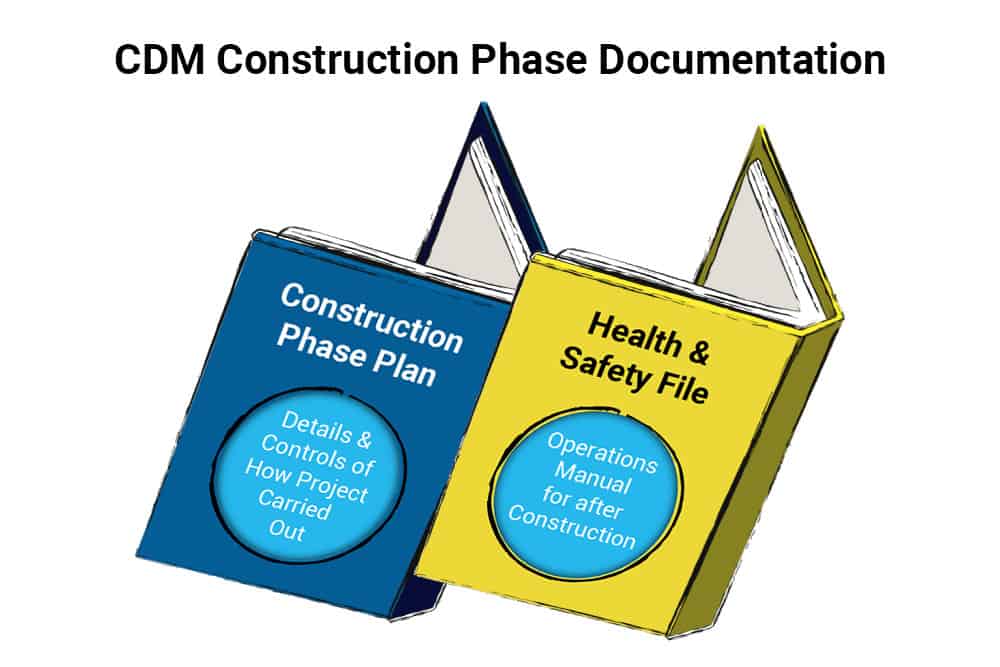
In the construction phase, the key CDM documents are the Construction Phase Plan, which is required for every construction project, and the Health and Safety File, which is required where a project involves more than one contractor.
In this blog post, we will outline the CDM documentation requirements during the construction phase of a construction project. This includes both the Construction Phase Plan and the Health and Safety File.
A written Construction Phase Plan is required for every construction project before work starts. On projects involving more than one contractor, the principal contractor must prepare it. On single-contractor projects, the contractor must prepare it.
The Construction Phase Plan must include details such as the planning arrangements, including the site location and any key dates. Health and safety management systems for the construction phase must also be included. For example, how accidents will be reported and risks assessed.
The health and safety site arrangements should also include site rules, site induction training, and arrangements for specific on-site risks. The Construction Phase Plan does not replace risk assessments and method statements. It is a plan to show how the work will be managed and identifies the significant hazards associated with the work.
The depth of the Construction Phase Plan should reflect the complexity of the work to be completed. A simple plan is required for a simple job, while a more complex project will require a more detailed plan.
The Health and Safety File is a document that is designed to support the future use of the building or structure. It can be thought of as the operator’s manual.
The Health and Safety File supports tasks such as:
- Maintenance
- Cleaning
- Refurbishment
- Demolition work
The Health and Safety File provides relevant information needed to help plan and carry out future work safely, including maintenance, cleaning, refurbishment or demolition. It should include information such as the location of services, for example, electrical and gas supplies.
Depending on the project, this may include information such as residual hazards, structural principles, hazardous materials, key services, access arrangements, as-built drawings, operation and maintenance information for fixed plant and other information needed for future work.
A Health and Safety File is only required on projects in which more than one contractor is involved. This applies to commercial projects and to domestic projects where construction work is carried out by someone else on the domestic client’s behalf. The Principal Designer must prepare, review, update, and revise the file as the project progresses.
For domestic projects, the duties that would otherwise fall on the client normally pass to the contractor or principal contractor, unless a written agreement transfers them to the principal designer.
If the Principal Designer finishes before the end of the project, the file must be passed to the Principal Contractor for the remainder of the project. The Principal Contractor must then take responsibility for reviewing, updating, and revising the file. They must also pass it to the client when the project finishes.
We can now refer back to our previous blog on pre-construction documentation and consider how the three main CDM documents fit together.
The pre-construction information comes first and facilitates the production of the Construction Phase Plan. The next document to be referred to is the CDM Construction Phase Plan. As its name suggests, the Construction Phase Plan applies only to the actual building work that is being done.
The Health and Safety File is relevant throughout every stage of the project. This document draws relevant information from both the pre-construction information and the Construction Phase Plan. It gradually becomes more complete as the project progresses.
For more detailed guidance, refer to HSE’s CDM 2015 pages and HSE guidance L153, Managing health and safety in construction.
If you have any further questions or issues regarding how the CDM Regulations may apply to your site, please review the information in our other blogs in this series. It may also be helpful to directly contact the HSE themselves for assistance. You can contact the HSE directly via their website or telephone them for assistance.
Note: CDM Principal Designer and Principal Contractor roles are separate from the Principal Designer and Principal Contractor roles introduced under the Building Regulations dutyholder regime in England. CDM focuses on construction health and safety, while the Building Regulations roles focus on compliance with building regulations.
A written Construction Phase Plan is required before construction work begins on every construction project. However, not every project has to be notified to HSE. Notification is only required where the project meets the CDM notifiability thresholds.
To ensure that you and your employees have a good understanding of the CDM Regulations, you can find further training on the Human Focus website. The Human Focus Construction Design Management (CDM) Awareness course is an ideal way to improve your knowledge of how the CDM health and safety regulations are applied.
If you would like to find out exactly how the roles of stakeholders work under CDM Regulations, CDM Duty Holder Training will provide you with the information needed to understand the main dutyholder roles.
Both of these Human Focus courses are assured by the Royal Society for the Prevention of Accidents (RoSPA) and can be completed entirely online at your convenience.