In short: Most construction workers recognise a near miss when it happens, but many choose not to report it because they do not trust what is likely to happen next. This article explains the real reasons near miss reporting fails on construction sites, what supervisors and principal contractors can do to rebuild that trust, and why a high number of near miss reports is usually a sign of a healthier site, not a more dangerous one.
Why Don’t Construction Workers Report Near Misses & What Changes That
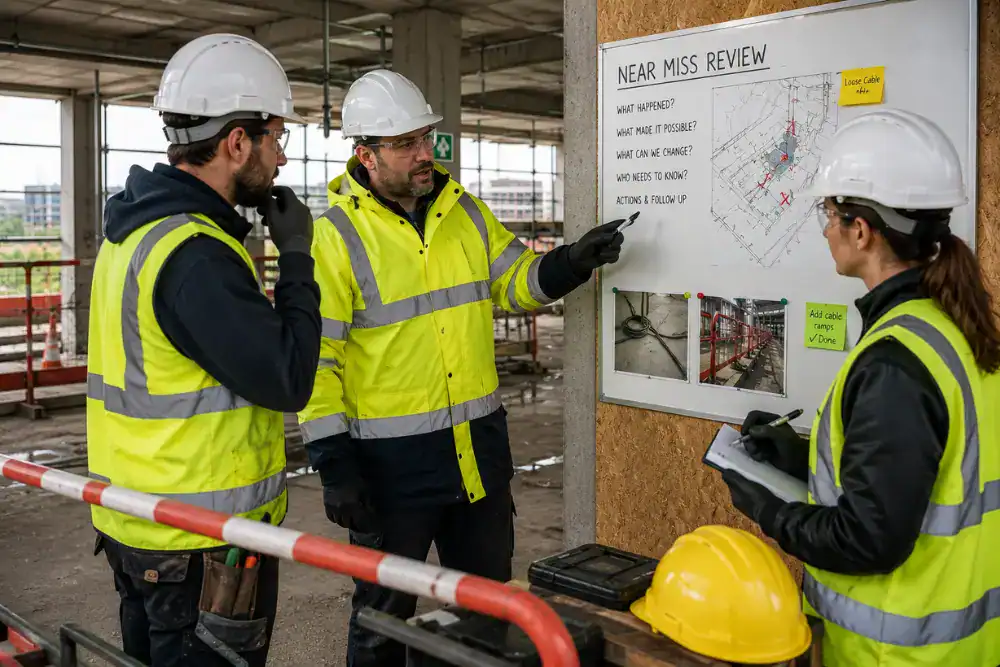
In many organisations, under-reporting is treated as a behavioural or training issue, when the underlying cause is usually cultural: how previous reports were handled shapes whether the next one ever gets made.
This article sets out the cultural barriers that lead construction workers and subcontractors to choose silence over near miss reporting, and what supervisors and principal contractors can do to change that and turn near miss reporting into a genuine source of site intelligence.
Key Takeaways
- Near miss reporting is governed by trust rather than awareness, since workers usually know exactly what nearly went wrong but only report it when they believe doing so will help rather than harm them.
- Supervisor response is the single biggest lever for changing that picture, because a curiosity-first reaction to a near miss builds the trust that produces the next report, while a blame-first reaction shuts it down.
- A falling near miss count is rarely good news, since it usually signals that workers have stopped speaking up rather than that the site has become safer.
Why Don’t Construction Workers Report Near Misses to Site Management?
Many workers do not report near misses because, in many cases, experience has taught them that nothing useful happens when they do. The decision not to report is not carelessness; it is a rational calculation based on what they have seen happen before.
They have watched someone report something and get pulled into a long conversation about what they did wrong. They have seen a report go nowhere — same hazard, same location, three months later. They have heard a supervisor respond to “that was close” with “well, you’re alright aren’t you, get on with it.” They have watched a subcontractor raise a concern and quietly lose work because of it.
So they say nothing. They absorb the near miss as part of the job. They move on.
This pattern of silence is not a training failure. It is a trust problem.
Near Miss Training
Our Near Miss Training course helps line managers extract valuable lessons from near misses to drive safety improvements. Users learn to work effectively with front-line staff to reveal problems and analyse the underlying contexts that cause human errors.
How Should a Supervisor Respond to a Near Miss Report?
A supervisor should respond to a near miss report with curiosity about the conditions that caused it, not scrutiny of the worker who reported it. The moment that determines whether a site gets useful near miss reports is not the one where someone fills in a near miss form — it is the moment immediately after someone says, “that was nearly a bad one.”
If the supervisor’s first question is some version of “who caused that?” or “why weren’t you paying attention?”, the conversation is, in most cases, effectively over. The worker has learned something, and so, often, has everyone watching. The lesson is: speaking up leads to scrutiny, not solutions.
The alternative is for the supervisor to ask, “what made this possible?” rather than “who did this?” Those two questions point in completely different directions. One looks for someone to hold responsible. The other looks for a condition to fix.
When workers see that a near miss report leads to a genuine question about the site rather than a question about their behaviour, they are far more likely to report the next one.
Why Don’t Subcontractors Report Near Misses on Site?
Many subcontractors under-report near misses, often because raising a concern can put their next contract at risk. A subcontractor reporting a near miss faces a calculation that a direct employee does not — they are reporting about a site they did not design, against a programme they did not write, to a principal contractor who decides whether they get called back.
Subcontractors often have the clearest view of where a site’s sequencing is creating risk — where trades are being pushed into close proximity too quickly, where access is not right, where pressure to hit a programme date is making people cut corners they should not. That intelligence is exactly what a site needs to prevent serious incidents. But it only surfaces if those workers believe they can speak without it counting against them.
If a site is not getting near miss reports from subcontractors, that is not a sign everything is fine. It is a sign those workers do not feel safe enough to report.
How Does Programme Pressure Stop Workers Reporting Near Misses?
Programme pressure often stops near miss reporting by making it feel like reporting could slow the job down, even when no one has said so directly. That pressure lives in the way supervisors talk about delays, in comments made during morning briefings, in the unspoken understanding that flagging a problem slows the programme.
“We’re already two weeks behind.” “Let’s just get this done today and we’ll sort it properly next week.” “If we stop now we’ll never get back on track.”
None of that is a direct instruction not to report. But it creates an environment where reporting feels like the wrong move — like creating a problem rather than solving one. Many workers who care about the job, who want to deliver, who understand programme pressure, internalise that message. They push on.
Removing that pressure does not mean ignoring programmes. It means making clear — through actions, not posters — that reporting a near miss is part of doing the job properly, not an obstacle to it. That distinction has to come from leadership, and it has to be visible.
What Happens When a Near Miss Report Leads to No Action?
When a near miss report leads to no visible action, the worker who filed it often stops reporting, and so, in many cases, do the people they talk to on site. A worker takes the time to fill in a report. They describe what happened, where it happened, what came close to going badly wrong. The report goes into a system. Nothing happens. Two weeks later, the same issue is still there. Three months later, it is still there.
Closing the loop is one of the most underused tools available to site management. It does not have to be elaborate. A brief update at the next toolbox talk — “Last week someone flagged the uneven surface near the welfare block. We’ve had it checked and it’s been repaired” — is enough. What it communicates is significant: someone reported something, someone listened, something changed. That makes the next person more likely to say something.
The feedback loop has to be visible and it has to be quick. A fix that appears six weeks after a report, with no explanation, does less work than a fix that happens in two days and gets mentioned at the briefing.
Does a Low Near Miss Count Mean a Site Is Safe?
No. A low near miss count usually means workers have stopped reporting, not that the site has fewer hazards. A site with a strong reporting culture typically has more near misses recorded, not fewer.
More reports mean more visibility into what is actually happening — where the pressure points are, where conditions are drifting, where the next serious incident is being set up. Fewer reports mean that information stays invisible, right up until it becomes an accident investigation.
Near miss reporting numbers are not a safety KPI (key performance indicator) in the way many sites treat them. They are a signal of how much workers trust the reporting process. High numbers, where acted on, mean the culture is working. Low numbers mean something else is happening, and it is worth understanding what.
How Can Workers Report a Near Miss Without Delay?
Workers can report a near miss without delay when the reporting method is as close as possible to the moment it happens, rather than requiring a trip back to a system in the site office. The incident happens at 9 in the morning. The reporting form is on a system in the site office. The worker is on the third floor. By 9.30, they have moved on to the next task. By lunchtime, the details have softened. By the time they might sit down and fill something in, it feels small, distant, not worth the effort.
Mobile reporting tools, brief verbal capture by supervisors, a quick conversation during a break — the closer the reporting mechanism is to the moment, the more useful it is. Supervisors who hear “that was close” and take thirty seconds to ask what happened and write it down are capturing something that a form submitted three hours later often does not.
The informal comment is a near miss report. It just needs someone to treat it like one.
Should a Near Miss Investigation Focus on Blame or Conditions?
A near miss investigation should focus on conditions, not blame, because conditions are what actually caused the incident and what can be changed to prevent the next one. On most sites, the focus lands on individual behaviour: who did this, why did they do it that way, what should they have done differently.
The more useful investigation asks different questions. Was the access right for the task? Was there enough time in the programme for the work to be done safely? Was supervision adequate? Were two trades working in the same space in a way that created conflict? Was the worker aware of the risk, or had the briefing not covered it?
These questions — about conditions, sequencing, supervision and controls — are where the real learning usually sits. Individual error happens, but it rarely happens in isolation; it happens in conditions that made it more likely. Changing those conditions is what actually reduces the risk of the next incident.
An investigation culture that focuses on conditions rather than blame also tends to produce more reports. Workers are significantly more likely to report when they believe the response is likely to be “let’s look at the site” rather than “let’s look at you.”
What Actually Changes Near Miss Reporting Behaviour on Site?
Near miss reporting behaviour is likely to shift when workers see, consistently, that reporting does not lead to grief, that the hazard they flagged gets fixed, that their near miss gets mentioned in a briefing as something the site learned from, that their supervisor’s first response is curiosity rather than blame, and that raising a concern is unlikely to count against them or their employer when the next package of work is being allocated. None of this is complicated in principle, but in practice it requires consistent pressure in the opposite direction to many of the incentives that already exist on construction sites.
None of that is delivered by a form, a reminder, or a poster about near miss reporting. It is delivered by the decisions site management makes, every day, in response to the information workers bring them.
If near miss reporting is low, the question worth asking is not “how do we get workers to report more?” It is “what happens when someone does report, and why would anyone bother?” The answer to that question is where the real problem usually lives.
What Does Near Miss Training Teach Construction Workers?
Near miss training gives workers the language to describe what they saw, the confidence to know that human error is normal rather than something to hide, and a clear understanding of why their report matters beyond satisfying a form. For supervisors, it does something different: it builds the curiosity-first habit of asking what made an incident possible rather than who caused it, which is the response that determines whether the next near miss gets reported at all.
If a site’s near miss reporting depends on workers trusting what happens when they speak up, Human Focus offers two courses built to close that gap from both sides. Near Miss Training in Industry helps workers recognise the everyday traps — fatigue, tunnel vision, time pressure — that quietly set people up for mistakes, while Near Miss Training for Managers in Industry trains supervisors specifically in the curiosity-first response covered in this article.
Find out more and bring your supervisors and workforce onto the matching course.