Many organisations choose an online safety training provider because it solves an immediate problem, getting people through mandatory courses on time. Over time, the same online safety training platform can become a constraint.
The course library may no longer reflect your safety training requirements, competency evidence may be managed separately from online completions and the provider may not offer the delivery, integration and support your organisation now needs.
The signs below are grouped into the three areas that matter most to safety training compliance. If several feel familiar, you may have outgrown your current provider.
Core idea
The question is whether your current online safety training provider can still meet your safety training requirements across roles, risks and responsibility levels. The right provider should also give you the evidence, delivery options, integrations and support needed to build a safety competency framework that can be evidenced during audits, inspections and client reviews.
Signs this may be a problem:
- Your provider cannot clearly show which safety training courses are approved or accredited
- Approval appears to apply to the provider generally rather than to specific courses
- Safety training content is not clearly maintained or updated when legislation changes
- You are unsure whether the safety training would stand up during an audit, inspection or client review
- The approved safety training available does not cover the mandatory safety training topics you need
What To Look For Instead
Look for a provider with approved health and safety training content, backed by recognised bodies on a course-by-course basis.
- Confirm which courses carry independent approval and from which recognised body
- Check that content is maintained to reflect current legislation and guidance
- Verify that the approved library covers the mandatory safety training topics your organisation needs
The important question: Can this provider help us meet a wider range of mandatory safety training requirements with content we can defend?
Signs this may be a problem:
- You source safety training courses from several different providers to fill gaps
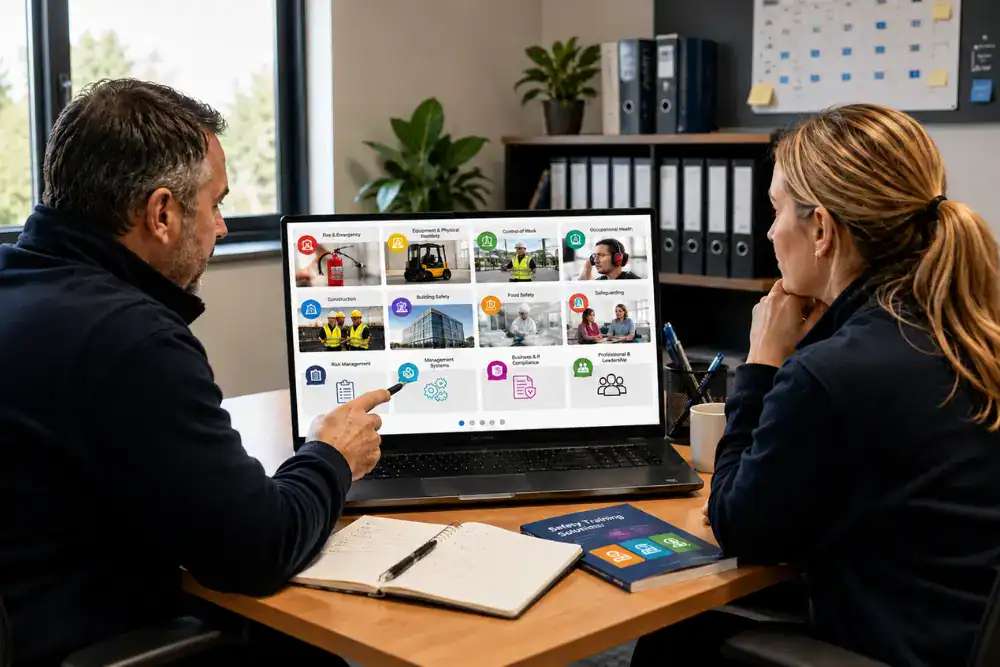
- Key operational risk areas are not covered — fire, equipment, control of work, occupational health, construction, building safety, food safety, safeguarding
- The library is not organised in a way that helps you assess coverage across roles and risks
- The provider offers isolated courses rather than a structured safety training framework
What To Look For Instead
Look for a provider that organises its safety training library around defined safety and compliance domains, so you can systematically review coverage against your operational risks.
- Check whether the library covers your main equipment, environments and risk areas
- Ask whether the catalogue is structured around safety domains rather than a flat course list
- Look for coverage across: Fire & Emergency, Equipment & Physical Safety, Control of Work, Occupational Health, Construction, Building Safety, Food Safety, Safeguarding, Risk Management, Management Systems, Business & HR Compliance
The important question: Can this provider cover the mandatory safety training needs that apply across the complete range of safety training compliance topics?
Signs this may be a problem:
- Supervisors receive the same basic safety training as general workers
- Managers and duty-holders do not have access to higher-level safety training
- There is no clear safety training pathway from awareness to more advanced training
- The catalogue does not indicate which courses suit which level of responsibility
What To Look For Instead
Look for a provider that supports different safety training levels matched to role and responsibility.
- Check that the library includes Intermediate and Advanced safety training, not just awareness-level courses
- Look for clear learning pathways supporting progression from awareness through to duty-holder level
- Ask how the provider helps match training depth to the responsibilities different roles carry
The important question: Can this provider support wider safety training compliance across workers, supervisors, managers and duty-holders?
Signs this may be a problem:
- Safety training content is mostly text-heavy slides rather than video-based and interactive
- Workers report that annual refresher safety training is repetitive and becoming boring
- Engagement with safety training is low and completions feel like a formality
- There is no evidence that the safety training content has been updated recently
What To Look For Instead
Look for a provider that uses video-based, interactive safety training content that is regularly refreshed.
- Ask whether courses are video-based and participative rather than text-heavy click-through
- Check whether annual core refresher safety training content is updated to maintain engagement
- Look for evidence that workers engage with and retain the safety training content
The important question: Will workers actually learn from the safety training, or just click through it to get a completion record?
Signs this may be a problem:
- External certificates and offline safety training records are important part of the safety competency picture but are managed separately from online training, i.e. you do not have a single dashboard for all safety training
- Renewal dates for external safety training are tracked manually
- You cannot easily see who is trained, current and evidenced across all roles and training needs
- Someone has to search multiple places when a client, auditor or contractor asks for evidence
What To Look For Instead
Look for a system that brings all safety training evidence into one competency record.
- Check whether the system can store external certificates, offline records and specialist qualifications alongside online completions
- Ask whether AI-assisted certificate loading can read and extract details from paper, PDF or scanned records — reducing manual data entry
- Confirm that renewal and expiry dates can be tracked across all evidence types
The important question: Does the system manage all our safety training evidence, or only online completions inside that provider’s platform?
Signs this may be a problem:
- Workers rely on paper certificates or plastic cards that get forgotten or lost
- Clients request safety training evidence before work starts and the process is slow
- Site managers cannot verify safety training quickly when workers arrive
- Evidence shared on site is not connected to the central safety training record
What To Look For Instead
Look for an integrated digital training card, mobile safety training passport or QR-code sharing system.
- Check that workers can access and share safety training records from a mobile device or printed QR code on employee badges
- Confirm that shared records include both online course completions and external certificates
- Ask whether records stay connected to the central system so they are always current
The important question: Can our people share their safety training records instantly at the point of work and with clients?
Signs this may be a problem:
- Duty-holders, appointed persons or contractors complete higher level safety training but do not have verification of the trainee identify, i.e. who actually took the training
- If a training record were challenged in an audit, inspection or legal review, you will be relying on self verification of identity – this may well be acceptable for many forms of safety training, but perhaps not for higher risk, critical tasks
What To Look For Instead
Look for a provider that offers proctoring and identity verification for selected higher-responsibility safety training courses.
- Check whether trainee identity verification is available
- Ask what evidence is produced and whether it would withstand audit or legal scrutiny
The important question: For higher-responsibility roles, can we demonstrate not just that safety training was completed, but that the named person completed and passed it themselves?
Signs this may be a problem:
- The online system cannot provide flexible training menus for each individual
- It is hard to create training menus for workers who hold multiple roles and require safety training that reflects all of their responsibilities
What To Look For Instead
Look for a system that flexibly organises safety training around roles, responsibilities and renewal dates automatically.
- Check whether safety training can be allocated by role group so the right courses reach the right people
- Ask whether the system supports workers holding multiple roles, each with their own safety training requirements
- Confirm that automated alerts fire when safety training is overdue or renewal dates are approaching
- Look for dashboards that give managers a live view of safety training status across their teams
The important question: Can the system automatically organise and track safety training across multiple roles, responsibilities and renewal dates?
Signs this may be a problem:
- Your workforce includes people whose first language is not English
- Safety training is only available in English, regardless of worker needs
- You are not confident that workers have genuinely understood the safety training they have completed
What To Look For Instead
Look for a provider that supports multilingual safety training delivery.
- Check how many languages are supported and whether audio, subtitles or both are available
- Ask whether language support applies across the full library or only selected courses
- Confirm whether additional languages can be added on request
The important question: Can every worker complete safety training in a language they can properly understand?
Signs this may be a problem:
- Safety training completion data sits in the provider’s system and cannot easily feed into your HR or safety management system
- You cannot export data in standard formats
- Reporting requires manual extraction and rekeying of data into other systems
What To Look For Instead
Look for a provider that supports standard integration formats.
- Check for SCORM, AICC and xAPI compatibility for course content and training data
- Ask whether integration applies to content delivery, completion data or both
- Confirm whether the provider can support your existing system architecture
The important question: Can safety training content and data integrate with our wider learning, HR or safety systems?
Signs this may be a problem:
- Your online safety provider is slow to respond
- The person you speak to seems to change regularly and they don’t seem to understand your organisation
- The support team gives generic software answers with little understanding of health and safety training requirements
- You get little help with course selection, role-based safety training setup or external evidence management
- They seem to charge for many changes or updates – every conversation becomes an upsell rather than genuine help
What To Look For Instead
Support quality is hard to assess before you buy. Before renewing or switching, ask the right questions.
- Ask who will support you after purchase and whether they understand safety training requirements
- Check whether support includes help choosing suitable courses and setting up role-based safety training
- Ask for named contacts rather than a generic support queue
- Request references from organisations in a similar sector
- Ask whether the provider will help identify safety training gaps or simply renew the licence
- Ask what support comes free, as part of the annual service, and what will be charged for
The important question: Will this provider help us build a better safety training system, or just keep the platform running?
If you answer yes to several of these questions, you may have outgrown your existing provider:
Interpretation
If several of these feel familiar, your organisation may now need a more specialist safety training system — one built around safety competency, not just course completion.
Book a free demo to see how Human Focus can connect your training content, competency records and specialist support into one safety competency system, with evidence that is easier to present during audits, tenders and investigations.