In short: Deciding whether to encapsulate or remove asbestos-containing material (ACM) depends on its condition and how likely it is to be disturbed, not on which option sounds the most decisive. Encapsulation seals stable material safely in place under ongoing inspection, while removal takes the material out of the building through a controlled, often licensed, process. The right choice should follow a competent asbestos assessment, recorded in the asbestos register, in line with the Control of Asbestos at Work Regulations 2012.
Asbestos Encapsulation vs Removal: Making the Right Decision
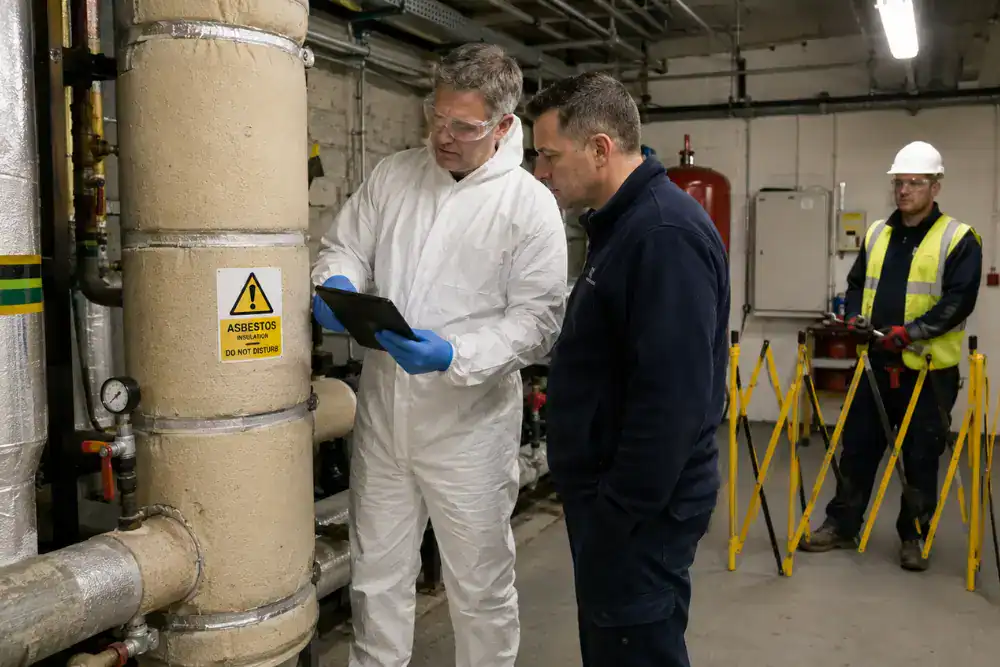
In many organisations, the instinct when finding an ACM is to assume it must be removed immediately, because removal feels like the more cautious choice. That instinct can be misleading, since unnecessary removal can disturb otherwise stable material.
Getting this right is what keeps asbestos a managed risk rather than an emotional decision, and that starts with looking at the material’s actual condition and how likely it is to be disturbed, not at how decisive an option sounds.
This article explains how to make the right asbestos encapsulation vs removal decision when asbestos-containing material (ACM) is found in a building, so the decision is based on risk rather than instinct alone.
Encapsulation means sealing stable material safely in place; removal means taking it out of the building entirely. Which approach is appropriate depends on the material’s condition and how likely it is to be disturbed.
Key Takeaways on Asbestos Encapsulation vs Removal
- Asbestos left in place still has to be managed properly. Encapsulation isn’t a way of avoiding the issue – it’s an active control measure with its own ongoing responsibilities.
- Removal is not automatically safer. Carried out unnecessarily, or without proper planning, it can increase exposure risk rather than eliminate it.
- Encapsulation is not automatically weaker. Done correctly on stable material, with monitoring and clear records, it’s a recognised and valid way of controlling risk.
- The real goal of any asbestos decision is to prevent exposure, not to choose whichever option looks the most decisive.
Why Is Removing Asbestos Not Always the Safer Option?
Removing asbestos isn’t always the safer option, because removal work that isn’t necessary or isn’t properly controlled can disturb material that was otherwise stable – releasing fibres into the air that wouldn’t have been released if the material had simply been left in place and managed.
HSE’s guidance on the duty to manage asbestos is built around this principle: if an ACM is in good condition and unlikely to be worked on or disturbed, it’s usually safer to leave it in place and manage it. Materials that are damaged or likely to be disturbed are a different matter – those should be repaired, protected, sealed or removed, depending on the extent of the damage (HSE, 2024).
In other words, the safest decision is not always to remove asbestos. The safest decision is the one that controls exposure risk over the life of the building.
Asbestos Awareness Course
Our Asbestos Awareness course provides a thorough understanding of asbestos, its likely locations and associated dangers. It supports compliance with asbestos legislation and teaches participants how to stay safe around asbestos and what to do if they’re accidentally exposed.
What Does Asbestos Encapsulation Actually Mean?
Encapsulation means sealing, coating or otherwise protecting an asbestos-containing material so that fibres cannot be released, without taking the material out of the building. It’s a control measure, not a way of ignoring the problem.
Encapsulation can be the right decision when the material is stable, protected and monitored. It’s typically suitable when:
- the ACM is in good condition
- it’s unlikely to be disturbed by normal use of the building
- it can be effectively sealed, enclosed or protected
- the area can be inspected and monitored over time
- anyone who might carry out future maintenance work nearby can be clearly told it’s there
- removing it would create disruption or disturbance that isn’t otherwise necessary
Crucially, encapsulating asbestos doesn’t end the dutyholder’s responsibilities – the dutyholder being the person or organisation legally responsible for managing asbestos risk in the building. It still needs to be entered on the asbestos register, labelled where appropriate, inspected regularly, and included in the asbestos management plan (HSE, 2024). Leaving asbestos in place only works if it is actively managed, recorded and inspected.
What Does Asbestos Removal Actually Mean?
Removal means taking the asbestos-containing material out of the building entirely and disposing of it through a controlled, regulated process. Depending on the type of material and the work involved, this may need to be carried out by a licensed contractor – most repair or removal work on materials like asbestos insulation, lagging (the insulation wrapping found around old pipes and boilers) and asbestos insulating boards falls into this category. Other lower-risk work can be carried out by a competent contractor without a licence, though controls still apply (HSE, 2024).
Removal may be necessary when:
- the material is damaged or deteriorating
- fibres could be released if it’s left in place
- it’s likely to be disturbed by routine activity, maintenance or building use
- refurbishment, demolition or other intrusive works are planned
- the material can’t realistically be protected or monitored going forward
- its location makes ongoing management impractical
Removal can be the right call. It can also be the wrong one, if it’s carried out on stable material that didn’t need disturbing, or if it’s poorly planned and creates exposure risk during the work itself.
What Should Drive the Decision Between Asbestos Encapsulation and Removal?
What should drive the decision between encapsulation and removal isn’t how alarming the material looks, or how it makes people feel knowing it’s there – it’s two practical questions: what condition is the material in, and how likely is it to be disturbed? HSE’s own survey methodology scores both the material’s potential to release fibres and how likely it is to be disturbed during normal use, then combines them into a single risk priority (HSE, 2012a).
A piece of asbestos insulating board hidden behind a fixed panel in a rarely-used plant room, in good condition, is a very different risk to the same material in a corridor ceiling that maintenance teams regularly access to reach cabling. The first might be well managed through encapsulation and monitoring. The second may need removal, simply because ongoing disturbance is far more likely.
Planned building works also change the calculation. An ACM that’s been safely managed in place for years might still need to come out if refurbishment, demolition or intrusive maintenance is on the horizon – not because it deteriorated, but because the planned work would disturb it anyway (HSE, 2024).
Does Cost Matter When Choosing Between Asbestos Encapsulation and Removal?
Cost matters when choosing between encapsulation and removal, but it should never be the deciding factor on its own. Removal is often more disruptive and more expensive than encapsulation, and budget pressure can influence a decision in either direction without anyone making an explicit, risk-based judgement. A decision driven mainly by price, convenience, or how a building “looks” to occupants, rather than by the actual condition and disturbance risk of the material, isn’t a sound risk-management decision – whichever direction it points in.
That need for a sound, risk-based decision is precisely why the duty to manage asbestos exists in law. Regulation 4 of the Control of Asbestos Regulations 2012 (UK Government, 2012), supported by the L143 Approved Code of Practice (HSE, 2013) and HSE’s HSG264 survey guidance (HSE, 2012a), sets out the framework dutyholders are expected to follow:
- Find out what asbestos-containing material is present.
- Assess its condition and how likely it is to be disturbed.
- Decide what action is appropriate based on that assessment.
Why Does an Asbestos Assessment Need to Come First?
An asbestos assessment needs to come first because none of these decisions – encapsulation, removal, or managing material in place – should be made by eye. Before choosing between encapsulation and removal, a competent asbestos assessment, typically an asbestos management survey, or a refurbishment/demolition survey where intrusive works are planned, needs to establish what the material is, where it is, what condition it’s in, and how likely it is to be disturbed (HSE, 2012a).
That assessment, recorded in the asbestos register, is what should drive the decision, not instinct, appearance, or pressure to “deal with it” quickly. The register and management plan also need regular review, at least annually, or sooner if anything changes the risk, such as deterioration or new building works being planned (HSE, 2024).
What Happens After the Encapsulation or Removal Decision Is Made?
Whether the outcome is encapsulation, removal, or a mix of both across different areas of a building, the dutyholder’s responsibilities continue. Anyone who might disturb asbestos-containing material during their work – in-house maintenance staff, contractors, tradespeople – needs to be told where it is and what precautions apply, before they start (HSE, 2024). Encapsulated material needs ongoing inspection to confirm it hasn’t deteriorated. Even where no asbestos is found, the dutyholder needs to document that finding (HSE, n.d.).
Why Training Underpins Both Decisions
Making the right call between encapsulation and removal depends on judging the material’s condition and the likelihood of disturbance correctly, and that judgement is only as good as the knowledge behind it. Dutyholders don’t need to become asbestos surveyors, but they do need enough working knowledge to commission the right survey, read its findings sensibly, and avoid the trap of treating asbestos as either a non-issue or an automatic demolition job.
The same applies further down the chain. Maintenance staff, contractors and tradespeople who might come across ACMs during everyday work such as drilling, lifting ceiling tiles or accessing risers need to recognise the signs and know to stop and check, rather than assuming a material is safe simply because it looks intact. This is precisely the gap asbestos awareness training is designed to close: it doesn’t qualify anyone to survey, encapsulate or remove asbestos, but it does give people the awareness to avoid disturbing it unnecessarily and to flag concerns to the right person.
Human Focus UKATA Asbestos Awareness Training gives building owners, facilities teams and anyone working in or around older properties a clear, practical grounding in what asbestos is, where it’s commonly found, and what to do if they suspect they’ve encountered it. Enrol your team today to make sure everyone who might come into contact with asbestos knows how to act, rather than guess.