Food safety is important because unsafe food can cause foodborne illness and serious allergic reactions. Food businesses have a legal duty to control those risks. Get the controls right and the business can also reduce the risk of recalls and service disruption (Food Standards Agency, 2018).
At work, someone has to decide whether to accept a delivery and where to store it. Ingredient details also need to reach the people preparing and serving the food. Miss a change and customers can be at risk, however good the food looks.
For managers, that means making these decisions workable during a shift. Staff need clear procedures and suitable equipment, but also the authority to hold food back. They need to know who can assess a concern before work continues.
Food safety means preventing food from causing harm. The controls have to suit the business and the work, whether staff are buying ingredients, preparing food or supplying it to customers. The information those customers receive is part of food safety too.
Handwashing, cleaning and keeping raw food away from ready-to-eat food are food hygiene practices. They support food safety, but clean hands and work surfaces cannot put right an incorrect ingredient declaration.
Flavour, texture and appearance describe quality, while apparent freshness is no proof of safety. Food can look appetising and still contain harmful bacteria or an allergen missing from the customer’s information.
A tidy kitchen and a well-presented meal can look reassuring. The manager still needs to check how staff handle food and whether the ingredient details are correct. The customer has little way of judging either from the plate in front of them.
Food safety protects customers from risks they cannot check for themselves. They cannot know whether a supplier handled a sandwich ingredient safely, or whether a knife touched raw food before someone used it on their meal. The businesses involved have to control those risks on the customer’s behalf.
The 2024 UK outbreak of Shiga toxin-producing Escherichia coli (STEC) O145 shows how widely an ingredient problem can spread. The UK Health Security Agency (UKHSA) recorded 293 confirmed cases in its final report, published in December 2025.
Pre-packed sandwiches containing lettuce were the likely source of infection. UK-grown Apollo leaf lettuce was the likely contaminated ingredient. Manufacturers recalled products as a precaution during the investigation.
Investigators could not confirm the root cause. The report identifies a likely link to an ingredient, but does not establish how the contamination occurred (UKHSA, 2025).
The importance of food safety extends right along the supply chain. Ingredient checks and supplier information matter before food reaches preparation, especially with ready-to-eat food that receives no further cooking.
When a concern does emerge, traceability becomes particularly useful. The business needs records of where the food came from and which other businesses received it, so affected products can be found.
A withdrawal removes food from the market, including from sale. A recall asks consumers to return or dispose of food they already have.
An operator that has reason to believe food it has supplied could harm health must notify the relevant authorities immediately (Food Standards Agency, 2018).
Food safety concerns can mean stock on hold, changes to production plans and customers who need to be contacted. Trust in the business can suffer too. Clear records help the business respond promptly by showing which food needs attention. People’s safety comes first.
Biological, chemical, physical and allergen hazards are four useful groups to consider. For each one, the business needs to work out how the hazard could reach the food and who should act.
The table gives examples of food safety controls and the roles that might be responsible for them. Each business should allocate the checks to suit its own work and team.
Even moving a utensil between foods can create more than one risk. Different types of food contamination need different controls, and the examples in the table cannot account for every risk a business may face.
An allergic reaction is not food poisoning. That distinction matters because cooking that controls harmful bacteria does not provide a general solution to allergens.
An allergen can pass from one food to another on hands, equipment or surfaces. This transfer is called allergen cross-contact (Food Standards Scotland, n.d.-a).
Businesses need safe handling and accurate allergen information together. They must follow the rules for declaring the 14 regulated allergens, while remembering that other foods can cause allergic reactions too (Food Standards Agency, 2026a).
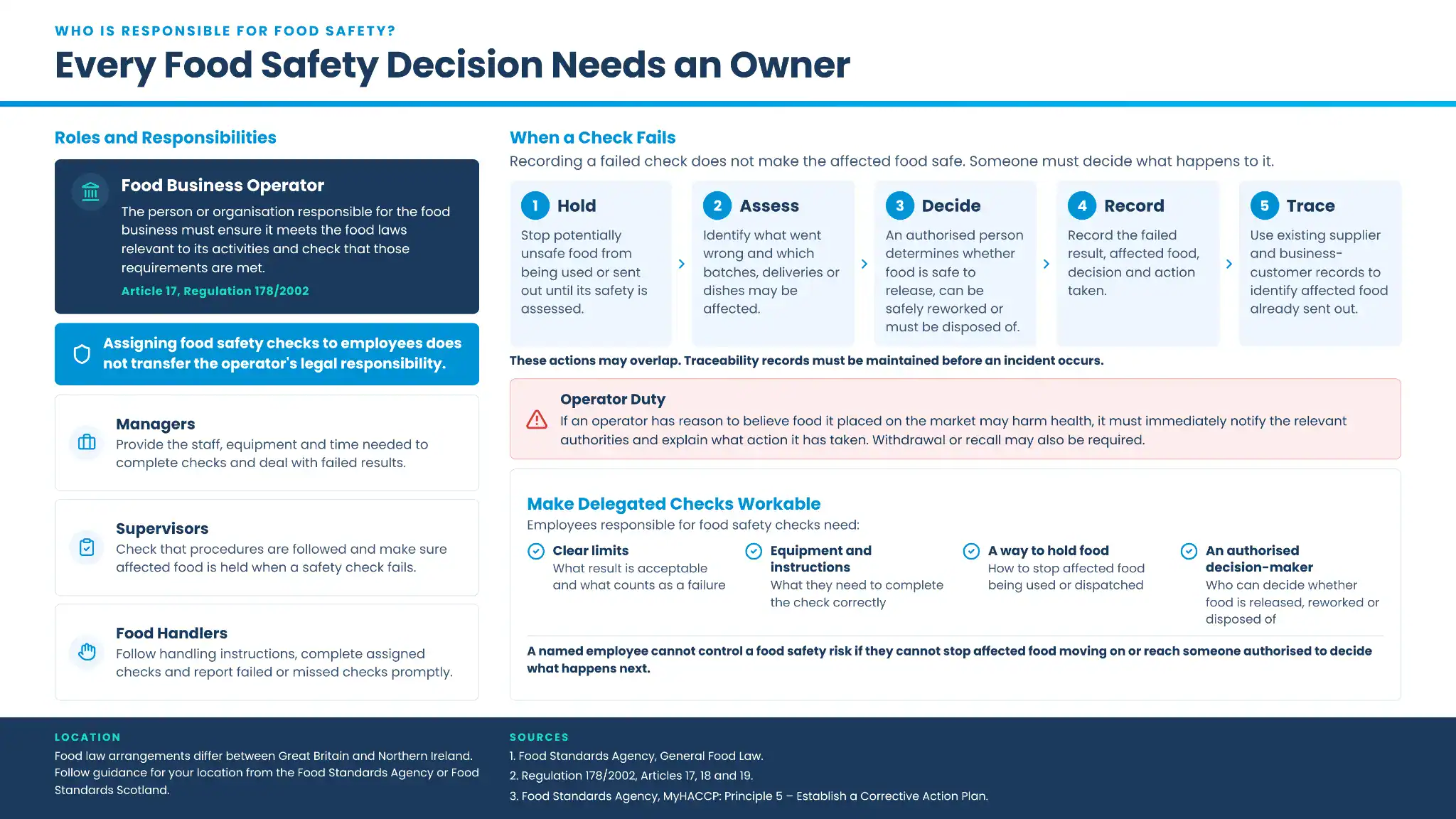
The food business operator is the person or organisation responsible for meeting food law within the business it controls. Article 17 of Regulation 178/2002 requires operators to meet the food-law requirements relevant to their work. They must also check that they meet those requirements (Regulation 178/2002, Articles 3 and 17).
An operator can ask someone else to check deliveries. It can delegate other food safety responsibilities too, but the duty to ensure compliance stays with the operator. Whoever carries out the check needs a clear method, agreed standards and a way to report a problem.
Managers provide resources and organise the work. Supervisors check how staff apply procedures and respond when problems arise. Food handlers follow instructions, use the controls provided and report concerns.
In a small business, the same person may do several of these jobs. Each key decision still needs someone clearly responsible for it.
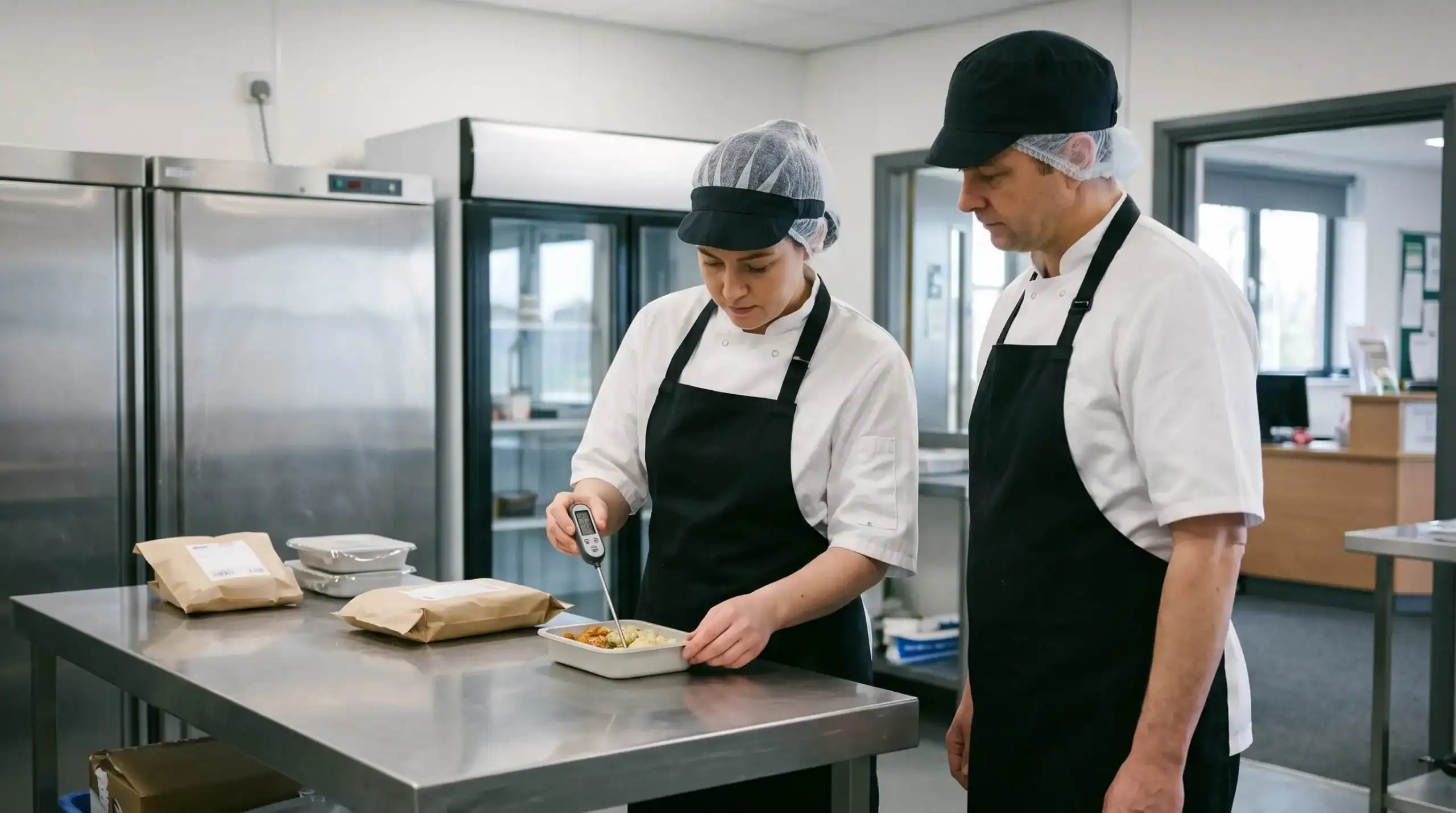
Take a chilled delivery arriving in the middle of a busy service. Whoever receives it needs to know how to check it and which results are acceptable. If a concern arises, they also need somewhere to hold the food and someone who can decide what happens next.
Putting that person’s name in a procedure does not settle the practical questions. The operator needs to make sure the employee can carry out the check during a normal shift.
Legal arrangements differ between Great Britain and Northern Ireland. Businesses should use guidance for their location. The Food Standards Agency provides guidance for England, Wales and Northern Ireland. Food Standards Scotland provides Scottish guidance (Food Standards Agency, 2018).
A food safety management system (FSMS) sets out how the business keeps food safe. It brings together the procedures and responsibilities, along with the checks and records that support the work.
Food businesses must use procedures based on Hazard Analysis and Critical Control Point (HACCP) principles. The point is to identify significant food hazards and decide how to control them, using procedures that fit the food and tasks involved. For very simple operations, official guidance recognises that good hygiene practice may be enough (Food Standards Agency, 2026b).
The food safety management system needs to follow the food through the work. Receiving staff check supplies against the business’s requirements, and storage controls then keep the food in the conditions it needs.
During preparation, staff must control hazards already present and avoid introducing new ones. The people serving or dispatching food must maintain those controls and pass on accurate information.
Cleaning, cooking, chilling and preventing cross-contamination are the 4 Cs of food safety. Cleaning removes food residues and dirt, with disinfection where needed. Suitable cooking controls harmful bacteria; chilling limits their growth. Preventing cross-contamination stops hazards passing between food, people or equipment (GOV.UK, n.d.-a).
Supplier checks and personal hygiene matter as well, along with illness reporting, pest prevention and allergen management. A cleaning schedule, for example, needs to match the equipment and tasks staff actually perform.
Suppose a supplier sends a workplace canteen a replacement sauce containing mustard, which is absent from the usual sauce. The delivery is cold enough and the pack is intact, yet the ingredient change still needs checking before use. Food and information can move separately during a handover.
The employee receiving the sauce should pass its specification to the person who assesses ingredient changes. The team needs to update the recipe and allergen information. It must also agree any handling changes and tell staff who prepare and serve the meal.
The next shift needs that information as well. If staff cannot confirm what is in the sauce or whether it is suitable, they should hold it back while they check (Food Standards Agency, 2026a).
A supervisor can check the handover by asking the next shift which sauce they are using and getting them to find its allergen information. Their answers show whether the information reached the people who need to act on it.
When a check finds a result outside the agreed standard, staff need to act on it. They need to know which food to hold and who can assess it, and must also know who can authorise its release.
The records need to show both the problem and what was done about it. If the food has already left the business, staff also need records that let them trace it.
Smaller businesses have official tools they can use. The Food Standards Agency provides guidance packs for England, Wales and Northern Ireland. In Scotland, caterers have CookSafe, while retailers handling unwrapped high-risk food have RetailSafe (Food Standards Scotland, n.d.-b).
Food handlers need suitable supervision, with food hygiene instruction, training or both matched to the work. Anyone developing or maintaining HACCP-based procedures needs adequate training in applying those principles (Regulation 852/2004, Annex II, Chapter XII).
A particular food hygiene certificate is not a requirement for food handlers. Courses are one way to learn, alongside workplace instruction, self-study and relevant experience. Passing a course can show that someone has learnt its content; it does not prove that the business meets food law (GOV.UK, n.d.-b).
The work comes first when choosing training. Someone working around food may need basic awareness, while a person preparing open food needs to know how to handle it safely. For supervisors, the job includes checking controls and deciding how to respond to concerns. The catering, retail or manufacturing setting matters too.
Human Focus’s food hygiene training courses offer options for those different roles and sectors. Managers can select courses to match staff needs, alongside the instruction and supervision needed in their own workplace.
After training, look at how staff do the job. Ask delivery staff what would make them hold food back and watch how preparation staff separate raw and ready-to-eat food. Ask service staff to find current allergen information and explain when they would seek advice.
If someone struggles with an instruction, another course may not be the answer. Find out why first. They may need practice or clearer guidance, or the problem may be space, equipment or getting access to someone who can make a decision.
Take these questions on a walk-through with the team. The records matter, but ask staff to show how the controls work as well.
- Do staff check approved suppliers, incoming food and ingredient changes before use?
- Do storage and stock controls suit the food, and do staff act on failed checks?
- Do staff keep raw and ready-to-eat food separate throughout the work, including the equipment used for each?
- Can staff show how they clean and disinfect, store chemicals safely and report signs of pests?
- Do staff follow personal hygiene rules and know which illness symptoms to report before handling food
- Does allergen information match the ingredients in use, and has each change reached preparation and service staff?
- Do instruction and training suit each person’s work, and has a supervisor checked their practice?
- When a check fails, do staff hold food that may be affected and report the concern? Can records identify the supplies and business customers involved if withdrawal or recall is needed?
Then go back to the last concern the team reported and follow what happened to the food. Check whether the response resolved the problem. Ultimately, the test is whether a warning led to action before someone faced harm.