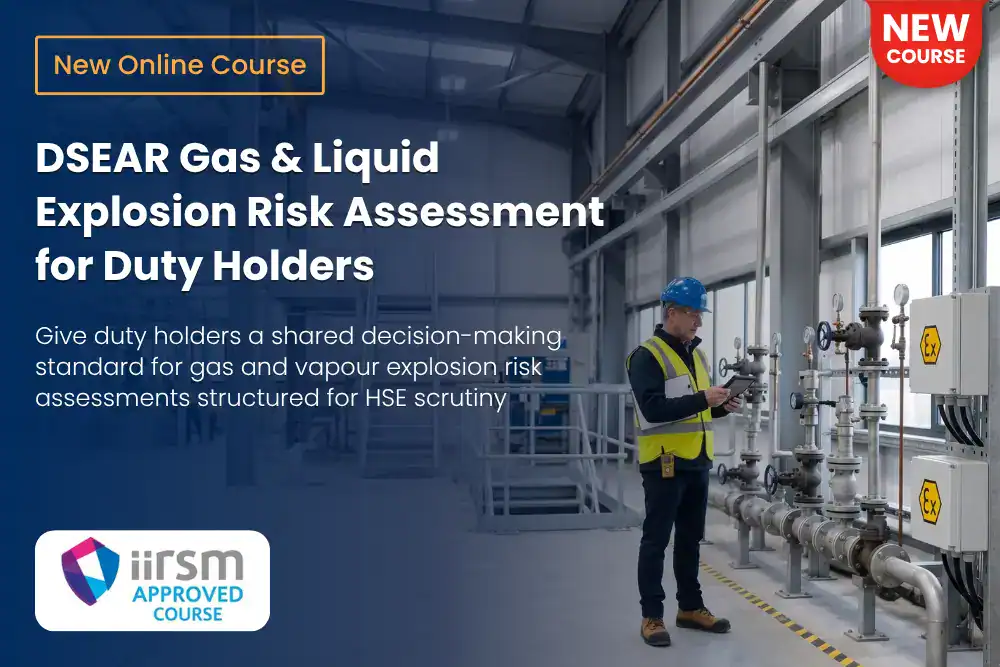
We’re pleased to introduce our fully online course: DSEAR Gas and Liquid Explosion Risk Assessment Training for Duty Holders.
Flammable gases and vapours released from liquids can create explosive atmospheres during routine work. Solvent transfer, drum filling, storage, cleaning and maintenance all involve conditions where a release can occur. If that release reaches the right concentration and finds an ignition source, the result can be severe.
The risk is not always obvious. A small vapour release can become serious if it accumulates in a poorly ventilated area, travels to an ignition source or forms during a fault condition that has not been considered. In practice, many organisations already have a DSEAR risk assessment on file. The weakness is often in the quality of the decisions behind it. Assessments may fail to show whether vapour could realistically form, whether ventilation is sufficient, whether ignition sources have been properly controlled or whether the final conclusions would withstand scrutiny.
This IIRSM-approved course gives duty holders a practical, structured framework for assessing gas and vapour explosion risk under the Dangerous Substances and Explosive Atmospheres Regulations (DSEAR).
Across four modules, learners cover how explosive atmospheres form, how to use gas and vapour data to judge hazard severity, how to apply DSEAR’s hierarchy of controls and how to document findings clearly under Regulation 5. A practical case study follows the full gas and vapour risk assessment process from hazard identification to recording findings.
DSEAR places specific duties on employers and responsible persons. Dangerous substances must be identified, the risk of fire and explosion assessed, hazardous areas classified where required, and suitable controls put in place. Where significant findings exist, they must be recorded and the reasoning behind key decisions must be capable of clear justification.
Those duties extend beyond having an assessment on file. Duty holders must be able to demonstrate that release and ignition scenarios were assessed with sufficient rigour — that normal and fault conditions were considered, that ventilation assumptions were tested, that ignition source controls were suitable, and that hazardous area classification was based on clear evidence rather than guesswork. When inspectors or investigators ask how a decision was reached, the assessment must provide the answer.
This course builds that capability across teams. It gives duty holders a shared, structured approach to gas and vapour explosion risk assessment that is consistent, documented and grounded in the requirements of Regulation 5.
Organisations that complete this training are better placed to:
- Build a consistent approach to gas and vapour explosion risk assessment across teams, departments and sites
- Improve recorded findings by linking substances, tasks, release points, ignition sources and controls
- Support defensible decisions on hazardous area classification, ventilation, equipment selection and ignition source control
- Recognise when an assessment can be managed in-house and when specialist support is required
- Align DSEAR assessments with wider duties under health and safety, fire safety, COSHH, PUWER and chemical safety legislation
- Keep training records that support audits, inspections and regulatory checks
- Reduce variation between assessors by giving duty holders a shared process for identifying hazards, evaluating risk, applying controls, reviewing changes and recording decisions
This training is ideal for:
- Site managers and operations managers
- Health and safety managers and advisers
- Compliance officers and environment, health and safety (EHS) leads
- Facilities engineers and maintenance managers
- Process and production managers
- DSEAR duty holders and responsible persons
By the end of this course, trainees will understand:
- What DSEAR requires in workplaces where flammable gases and vapour released from flammable liquids create a fire or explosion risk
- How gas and vapour explosive atmospheres form, including how flash point, LEL and vapour density affect the risk in practice
- The dangerous substances, release points and ignition sources that must be considered in a thorough gas and liquid DSEAR risk assessment
- How to use gas and vapour data, including flash point, LEL, upper explosive limit (UEL), auto-ignition temperature (AIT) and minimum ignition energy (MIE), to judge hazard severity and support proportionate control decisions
- The DSEAR hierarchy of control as it applies to gas and vapour risks and which measures matter most in practice
- How hazardous area classification is carried out, how gas and vapour zones are defined and how equipment selection is matched to zone requirements
- How to structure, evaluate and document a DSEAR risk assessment under Regulation 5 for gas and vapour hazards so that key decisions are clear and justifiable
- The full gas and vapour explosion risk assessment process, applied through a practical workplace example
To read the complete course outline, click here.
For more details about this course, please contact us.