In short: Wet floor signs can form part of slip-risk control in Great Britain, but there is no automatic rule that a sign must be used whenever a floor is wet. Under the Health and Safety (Safety Signs and Signals) Regulations 1996, an appropriate sign is required where a significant risk of harm, judged by its magnitude and nature, remains despite other relevant measures and cannot otherwise be avoided or adequately reduced without the sign. Regulation 12 of the Workplace (Health, Safety and Welfare) Regulations 1992 separately requires floors and traffic routes used by people or vehicles to be kept free from obstructions and substances that may cause a slip, trip or fall so far as is reasonably practicable, meaning after the level of risk is balanced against the time, trouble and cost of further controls.
Wet Floor Sign and Contamination Control: What the Law Actually Requires
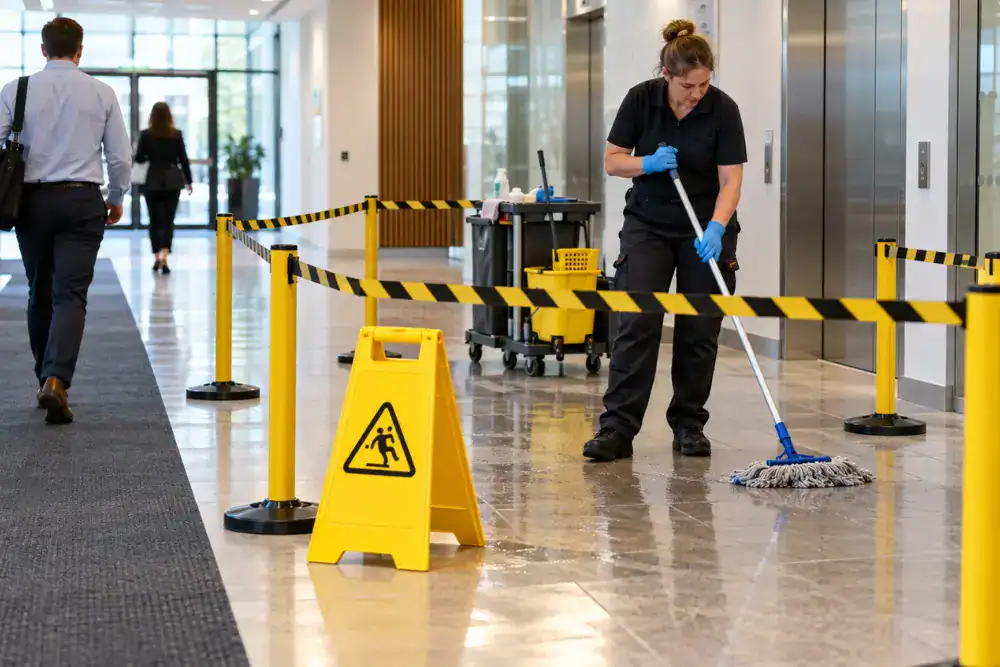
Wet floor signs are familiar, but their role can be misunderstood. This article explains how signage fits with contamination control, meaning the measures used to prevent, contain or remove substances that can make a floor slippery. The aim is to help facilities, cleaning and health and safety teams choose a response that matches the actual conditions.
The key distinction is simple: a sign communicates a hazard, while cleaning, repair, containment or keeping people away from the area changes the hazard itself or people’s exposure to it.
The legal references below apply to Great Britain (England, Scotland and Wales). Northern Ireland has separate workplace safety legislation, so this article does not state the Northern Irish legal position.
What Does the Law Require for Wet Floor Signs and Contamination Control?
In Great Britain, the legal position comes from duties on floor condition, assessment of risk and safety signs rather than from a single rule about wet floor cones.
Regulation 12 of the Workplace (Health, Safety and Welfare) Regulations 1992 deals directly with floor condition. It requires workplace floors and traffic routes, meaning routes used by pedestrians, vehicles or both, to be kept free from obstructions and substances that may cause slips, trips or falls, so far as is reasonably practicable (Legislation.gov.uk, 1992). The Health and Safety Executive (HSE) explains that “reasonably practicable” means balancing the level of risk against the time, trouble and cost of the measures needed to control it (HSE, n.d.).
The Health and Safety (Safety Signs and Signals) Regulations 1996 deal with the warning itself. Regulation 4 starts with the employer’s assessment of risk. The employer must first adopt all appropriate measures that protect people collectively, such as barriers, and relevant measures that change how work is organised. If a significant risk of harm, judged by its magnitude and nature, still cannot be avoided or adequately reduced without an appropriate sign, the sign is required (Legislation.gov.uk, 1996). HSE summarises the position by saying signs are needed where a significant risk remains despite other relevant measures (HSE, 2015).
The wider legal framework matters as well. Section 2 of the Health and Safety at Work etc. Act 1974 sets out employers’ general duties towards their employees, while section 3 addresses duties towards people who are not employees but may be affected by the undertaking (Legislation.gov.uk, 1974). The Management of Health and Safety at Work Regulations 1999 add duties to assess workplace risks and organise preventive measures (Legislation.gov.uk, 1999).
HSE publication L24 brings the 1992 workplace regulations together with an Approved Code of Practice (ACOP), which gives practical advice and has a special legal status, and accompanying guidance (HSE, 2013). These sources help explain what good floor management looks like in practice. A sign may be relevant evidence of a response, but the wider circumstances determine whether the applicable duties have been met.
When May a Wet Floor Sign Be Appropriate?
A wet floor sign may be appropriate when a temporary slip risk remains and the warning can help people avoid it while the area is being made safe.
A fresh spill is a straightforward example. HSE says warning signs can be effective before a spill can be cleaned, particularly when the spill is visible and the sign is properly used. The sign should then be removed once the area is safe (HSE, 2005).
Cleaning can call for a different response. A floor that stays wet while cleaning is under way may need stronger access controls than a small spill waiting for prompt clean-up. The practical access options are covered in the control sequence below.
Recurring contamination calls for more than a temporary warning. A refrigerator that drips onto the same patch every week is not simply a series of unrelated wet-floor events. The repeated wetness may point to a maintenance, drainage or cleaning problem. Repairing the leak, catching the drip, changing the route or reviewing the floor surface may be more appropriate than leaving a permanent cone beside it.
Day-to-day housekeeping also matters. Our guide to floor safety tips looks at routine measures that support safer walking surfaces, including maintenance and housekeeping.
How Should a Wet or Contaminated Floor Be Controlled?
A practical response is to deal with the source first, then consider containment, access and warning. The four steps below show how that reasoning can work in practice.
1. Prevent or Remove the Contamination
Where possible, stop the water or other substance reaching the walking surface. A leaking pipe can be repaired. Rainwater at an entrance can be reduced with suitable matting, canopies or drainage. A process that splashes may need a guard or a change in layout.
When a spill has already happened, prompt cleaning and proper drying can restore the surface. Prompt removal also reduces how long the slip hazard remains.
2. Contain or Isolate the Contamination
Immediate removal is not always possible. In that case, limiting the spread can keep the problem away from normal walking routes while a fuller response is arranged.
A drip tray can catch a small leak. Absorbent material can stop a spill spreading. Bunding, meaning a raised edge or barrier used to contain liquid, may be suitable in some process areas. Temporary measures still need checking so that they do not become the permanent answer to a repairable problem.
3. Restrict Access While the Floor Is Unsafe
Physical access control can be stronger than a warning when people do not need to enter the wet area. Barriers, cordons, temporary closures or a redirected route can keep people away from the surface altogether.
HSE’s floor-cleaning guidance specifically recommends physically excluding people from wet cleaning areas and providing alternative routes. It also suggests cleaning in sections so that a dry path remains available (HSE, 2005). This is especially useful in busy workplaces where staff, visitors or customers may approach from several directions.
4. Use a Warning Sign When It Adds Protection
A clear warning can be useful when a relevant risk remains and people need information before they approach it. HSE guidance says safety signs should be positioned where they are clearly visible, taking account of obstructions and the viewer’s field of vision (HSE, 2015).
The warning should also match a current hazard. Once the floor is safe, the sign should be removed. HSE notes that cones left in areas that are already dry may be ignored and can lose their effectiveness (HSE, 2005).
Why Does the Wet Floor Control Sequence Reflect Good Risk Control?
The law does not prescribe a four-step “prevent, contain, restrict, warn” formula. The sequence is a practical way to apply established prevention principles to a wet floor. Schedule 1 of the Management of Health and Safety at Work Regulations 1999 includes avoiding risks, dealing with risks at their source where possible, and giving priority to measures that protect people as a group over measures aimed only at individuals (Legislation.gov.uk, 1999).
The same logic appears in HSE’s cleaning guidance. Cleaning in sections, excluding pedestrians from wet areas and providing alternative routes are practical examples of applying these principles during floor cleaning.
Why Does a Wet Floor Sign Have Limits as a Control?
A wet floor sign has limits because its effectiveness depends on being visible, correctly positioned and noticed before someone reaches the affected area.
- Visibility matters. A sign placed behind, beside or beyond the wet patch may not warn someone before they reach the affected area.
- Open access remains possible. A cone does not stop a person entering the area, so the warning still depends on the person seeing and responding to it.
- Overuse can reduce attention. HSE notes that cones left out after cleaning has finished or after the floor has dried may be ignored (HSE, 2005).
- The warning can be disrupted. A sign that is moved, knocked over or hidden may provide little useful information to someone approaching the hazard.
The four limitations above do not mean wet floor signs have no value. They show why a sign should be used for a current warning need rather than as an automatic response. For a wider look at flooring, housekeeping, footwear and other slip controls, see our guide on how to prevent slips, trips and falls in the workplace.
How Should You Balance Wet Floor Signs and Risk Control?
Control decisions should be based on the actual conditions and the residual risk, not on a blanket rule about wet floors. The appropriate response depends on the source and duration of the wetness, who may be exposed and which controls are reasonably practicable. Facilities and cleaning teams should therefore match cleaning, repair, containment, access restriction and signage to those conditions.
If your team needs to strengthen how staff recognise common slip hazards and understand relevant controls, Human Focus’s Slips, Trips and Falls Training covers slip hazards, preventive measures and effective control measures (Human Focus, n.d.). The course can support staff knowledge. It should sit alongside the workplace’s own assessment of risk, cleaning, maintenance and supervision arrangements.