In short: this article explains how to specify suitable personal protective equipment (PPE) for abrasive-wheel work, including eye and face protection and wider health hazards that may need separate controls. Eye and face protection must match the impact, coverage and fit the work requirements. The article also explains the current eye-protection standard and what Health and Safety Executive (HSE) guidance HSG17 says for grinding.
PPE Requirements for Abrasive Wheel Work: Eyes, Face and Beyond
This article explains how mechanical and health hazards associated with abrasive-wheel work affect the PPE specification for the task.
Some abrasive-wheel injuries are immediate, such as those caused by a burst wheel or an ejected fragment. Other exposures can cause serious ill health that develops over time.
The sections below move from the legal and technical basis for PPE selection to a practical specification process.
What Role Does PPE Play in Abrasive Wheel Safety?
PPE plays a supporting role in abrasive-wheel safety. In Great Britain, the Provision and Use of Work Equipment Regulations 1998 (PUWER) control the suitability, use and safeguarding of work equipment and revoked the remaining provisions of the Abrasive Wheels Regulations 1970 (legislation.gov.uk, 1998).
HSG17: Safety in the use of abrasive wheels remains HSE’s specific guidance on abrasive-wheel safety. Following HSG17 is not compulsory, although inspectors may refer to it as illustrating good practice (HSE, 2000). For general eye, face and other PPE in Great Britain, the Personal Protective Equipment at Work Regulations 1992 (PPER 1992) apply as amended by the 2022 Regulations (legislation.gov.uk, 1992; legislation.gov.uk, 2022; HSE, 2022). The amendment extended duties to limb (b) workers, meaning people working under certain contracts for personal service who are not employees. PPER 1992 does not apply to certain risks where PPE duties are governed by more specific legislation. For example, respiratory protection for hazardous substances and hearing protection for occupational noise are regulated under the Control of Substances Hazardous to Health Regulations 2002 (COSHH) and the Control of Noise at Work Regulations respectively.
Health and Safety at Work etc. Act 1974 provides the overarching duty, while the Management of Health and Safety at Work Regulations 1999 require a suitable and sufficient risk assessment (legislation.gov.uk, 1974; legislation.gov.uk, 1999). For the wider legal picture, our guide to abrasive wheels regulations explains how the 1970 Regulations were replaced.
What Eye and Face Protection Is Required for Abrasive Wheel Work?
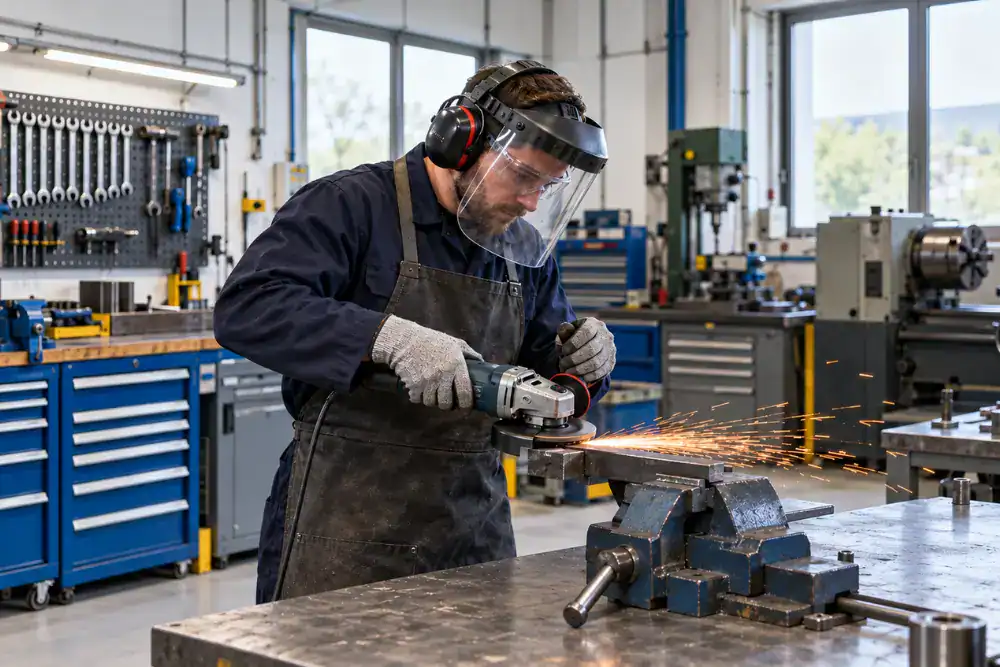
Suitable eye and face protection depends on the task, the likely direction and energy of particles or fragments, the coverage needed and the protector’s certified performance. The label “safety glasses” does not show whether a product is suitable for a particular grinding or cutting task.
HSG17 gives specific eye-protection advice for dry grinding and says eye protection should conform to the relevant BS EN standard; it cited BS EN 166, which was current when HSG17 was published (HSE, 2000). BS EN 166:2002 is now withdrawn by the British Standards Institution (BSI) (BSI, 2002).
For new specifications, BS EN ISO 16321-1:2022+A1:2025 is the current general-requirements standard for occupational eye and face protectors (BSI, 2025b). Legacy EN 166 products used F, B and A impact markings. The newer standard uses high-speed impact classes including C (45 m/s), D (80 m/s) and E (120 m/s) (BSI, 2025a). BSI’s transition arrangements mean valid EN 166-certified products may still be encountered until their certification expires, up to five years from issue. A withdrawn standard therefore does not mean every valid legacy product must be discarded immediately.
HSG17 does not set a universal former EN 166 “Grade B” requirement for all grinding or cut-off work. It also does not require a face-shield-over-goggles combination for every heavy task. Select protection from the risk assessment, taking account of the machine and guard, wheel, material, operating speed, likely fragment size and direction, and the coverage provided.
| Task | Eye and Face Protection | Why |
|---|---|---|
| Dry grinding on a fixed machine | Suitable eye protection with performance matched to the assessment, or a suitable transparent screen where HSG17 permits. | HSG17 says eye protectors should be worn for dry grinding or, on fixed machines, a transparent screen should be fitted to intercept sparks and particles. |
| Portable grinding / cut-off work | Impact-rated eye and/or face protection with performance and coverage matched to the task. | Portable work may involve changing work angles and less enclosure. |
| Overhead or awkward angles | Eye protection plus face protection where the assessment identifies a whole-face risk. | Debris trajectory can be less predictable at awkward angles. |
Whatever protection is selected, it must fit the wearer and be maintained in an effective condition. Scratched, damaged or ill-fitting eye protection should be cleaned, adjusted or replaced as necessary so that it continues to provide the intended protection and clear vision (HSE, n.d.a).
Product appearance alone does not show impact performance or coverage. Check that the product marking is legible and that the certification matches the intended use.
What Other Hazards Should Abrasive Wheel PPE Assessments Cover?
Beyond eye and face protection, the assessment should consider respiratory, noise, vibration and other task-specific hazards.
Respiratory: Dust and Silica
Grinding and cutting can generate fine dust. Cutting stone, concrete or masonry can release respirable crystalline silica (RCS) where the material contains crystalline silica. RCS is carcinogenic. Under the Control of Substances Hazardous to Health Regulations 2002 (COSHH), exposure must be prevented or, where that is not reasonably practicable, adequately controlled. For RCS, exposure should be kept as low as reasonably practicable and below the workplace exposure limit of 0.1 mg/m³ as an 8-hour time-weighted average (legislation.gov.uk, 2002; HSE, 2024).
Engineering controls such as water suppression or on-tool extraction should be used where appropriate, with suitable respiratory protective equipment (RPE) as additional protection when needed. For stone or concrete cutting with cut-off saws, HSE specifies RPE with an assigned protection factor (APF) of at least 20, meaning the respirator is expected to reduce the concentration inside the facepiece to one twentieth of the outside concentration when it is correctly selected, fitted and used.
Examples include an FFP3 filtering facepiece, which is a high-protection disposable particulate respirator, or a half-mask respirator fitted with a P3 high-efficiency particulate filter. HSE specifies these options even when water suppression or extraction is used (HSE, 2010). Any tight-fitting facepiece must be fit tested to the individual wearer. The successful make, model, type and size must then be available for that person’s use (HSE, 2025).
Hearing: Noise
Angle grinders and cut-off saws can generate hazardous noise. Under the Control of Noise at Work Regulations 2005, the lower exposure action value is 80 dB(A), using the A-weighted decibel measure for occupational noise exposure, and the upper exposure action value is 85 dB(A). These values are based on daily or weekly personal exposure. The exposure limit value is 87 dB(A), taking account of the reduction provided by hearing protection. It is not simply an ambient sound level that must never be exceeded. At 85 dB(A), employers must provide hearing protection and hearing-protection zones. Risk assessment, information and training duties apply from 80 dB(A) (HSE, n.d.c).
Vibration: Hand-Arm Vibration Syndrome
Prolonged or repeated use of vibrating grinders can contribute to hand-arm vibration syndrome (HAVS). Continued exposure can cause permanent, disabling damage. The Control of Vibration at Work Regulations 2005 set a daily exposure action value of 2.5 m/s² A(8), where A(8) is daily vibration exposure normalised to an eight-hour reference period. At this level, technical and organisational measures are required to reduce exposure.
The daily exposure limit value is 5.0 m/s² A(8) and must not be exceeded. Controls can include lower-vibration tools, maintenance, reduced trigger time — the time a vibrating tool is actually operating in the worker’s hands — and changes to work organisation. Health surveillance — systematic health checks used to identify work-related ill health at an early stage — must be provided where the risk assessment identifies a risk to health from vibration and the relevant legal criteria for health surveillance are met. Anti-vibration gloves should not be relied on to control vibration exposure;
HSE states that gloves are not effective protection against hand-arm vibration (HSE, n.d.d; HSE, n.d.e).
Also Foreseeable: Fire, Sparks and Hot Fragments
Sparks and hot debris can cause burns and may ignite combustible materials. Suitable protective clothing and control of the work area should therefore be considered in the same task-specific risk assessment, alongside any fire precautions required by the environment and the materials present.
How Should You Specify PPE for Abrasive Wheel Work?
Abrasive-wheel PPE should be specified from the task-specific risk assessment after the equipment and work controls have been checked.
1. Start From the Risk Assessment
Specify PPE from an assessment of the actual work, material, wheel, environment and duration. The Management of Health and Safety at Work Regulations 1999 require a “suitable and sufficient” assessment (legislation.gov.uk, 1999). HSE’s current risk-management guidance covers hazard identification, risk assessment, control measures, recording and review (HSE, n.d.f). Our companion piece on conducting an abrasive wheels risk assessment explains that process in full.
2. Confirm the Equipment Controls First
Before finalising PPE, verify that the equipment and work controls identified by the assessment are in place and effective. Any gap should be corrected rather than treated as something PPE can compensate for.
3. Specify Compatible Combinations
Eye and face protection, RPE, hearing protection and any head protection must work together without compromising fit, seals, field of view or the intended protection. Check compatibility during selection rather than after separate items have already been bought.
4. Train, Supervise and Maintain
PUWER Regulation 9 requires adequate training for people who use work equipment and for those who supervise or manage its use (legislation.gov.uk, 1998). HSG17 also says people who use, mount or manage abrasive-wheel operations need suitable training in safe use (HSE, 2000). PPE must be used correctly, checked, maintained and replaced when necessary. Training should also cover the site procedures that apply to the work.
A generic kit list can result in inadequate impact protection, poor RPE fit or interference between head-worn items. The specification should identify a compatible, maintained set of equipment based on the assessment and the manufacturer’s instructions.
What Should You Remember About PPE for Abrasive Wheel Work?
Abrasive-wheel PPE is one part of a wider control system. The finished specification should make clear what protection operators need and how it should be used and maintained. It should also identify the equipment controls, training and supervision that sit alongside the PPE.
If operators need a clear introduction to abrasive-wheel hazards and the controls they are expected to understand, Human Focus’s Abrasive Wheels Training covers safe selection, setup and use of abrasive-wheel equipment. The online course builds awareness of the main risks and control principles.