Workplace First Aid Kit Contents: What Supplies Do You Need?

workplace first aid kit contents

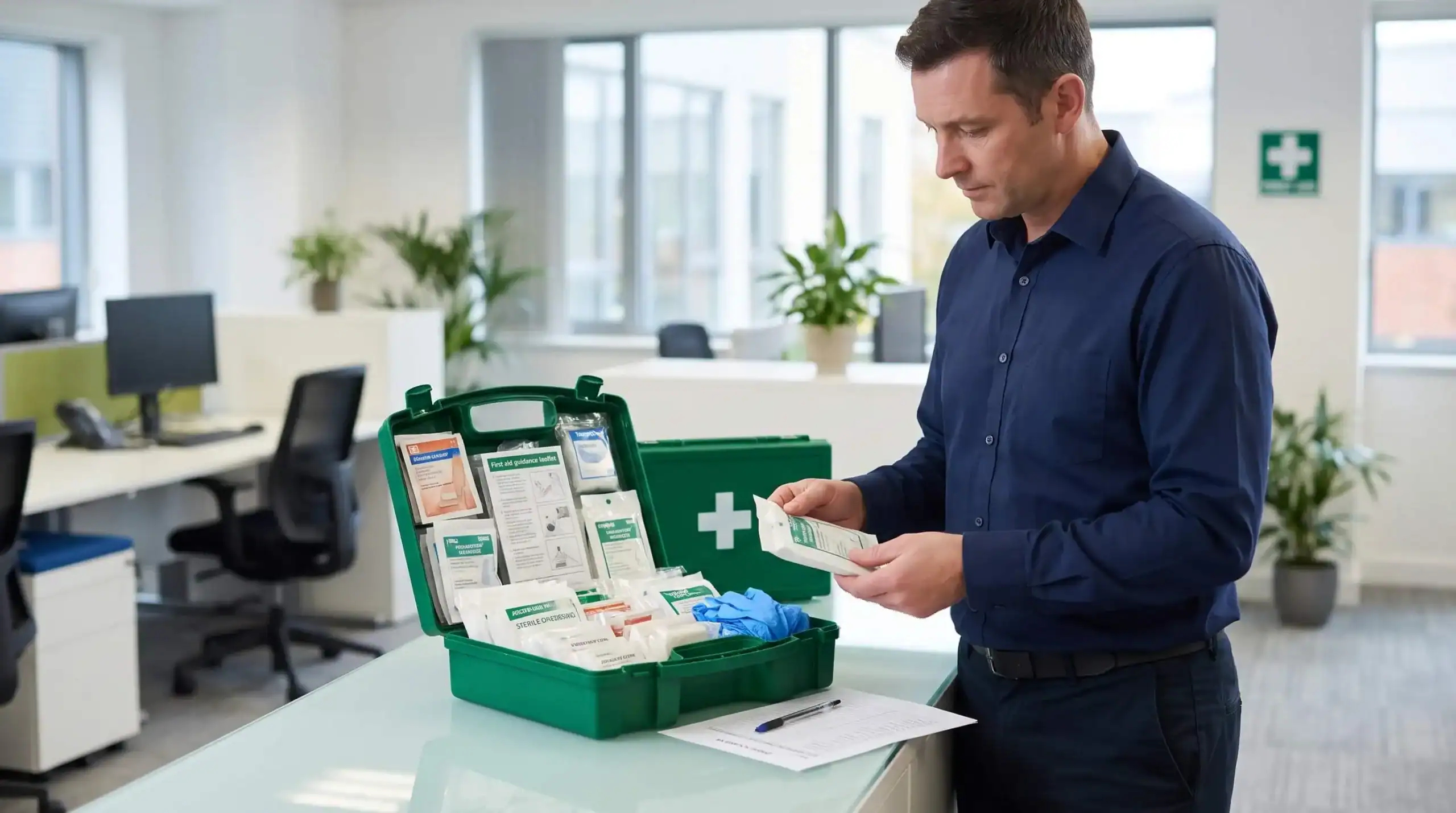
Workplace first aid kit contents should follow your needs assessment. For low-hazard work, the Health and Safety Executive (HSE) suggests plasters, sterile dressings, eye pads, triangular bandages, safety pins, disposable gloves and a guidance leaflet. There is no universal legally prescribed contents list.

An off-the-shelf box can make ordering straightforward. It tells you less about whether the supplies suit a workshop, remain accessible during the late shift or are replaced after use.

Getting the provision right means connecting the contents with the people and working arrangements they are intended to serve. Selection, location and upkeep all need attention.

What Should a Workplace First Aid Kit Contain?

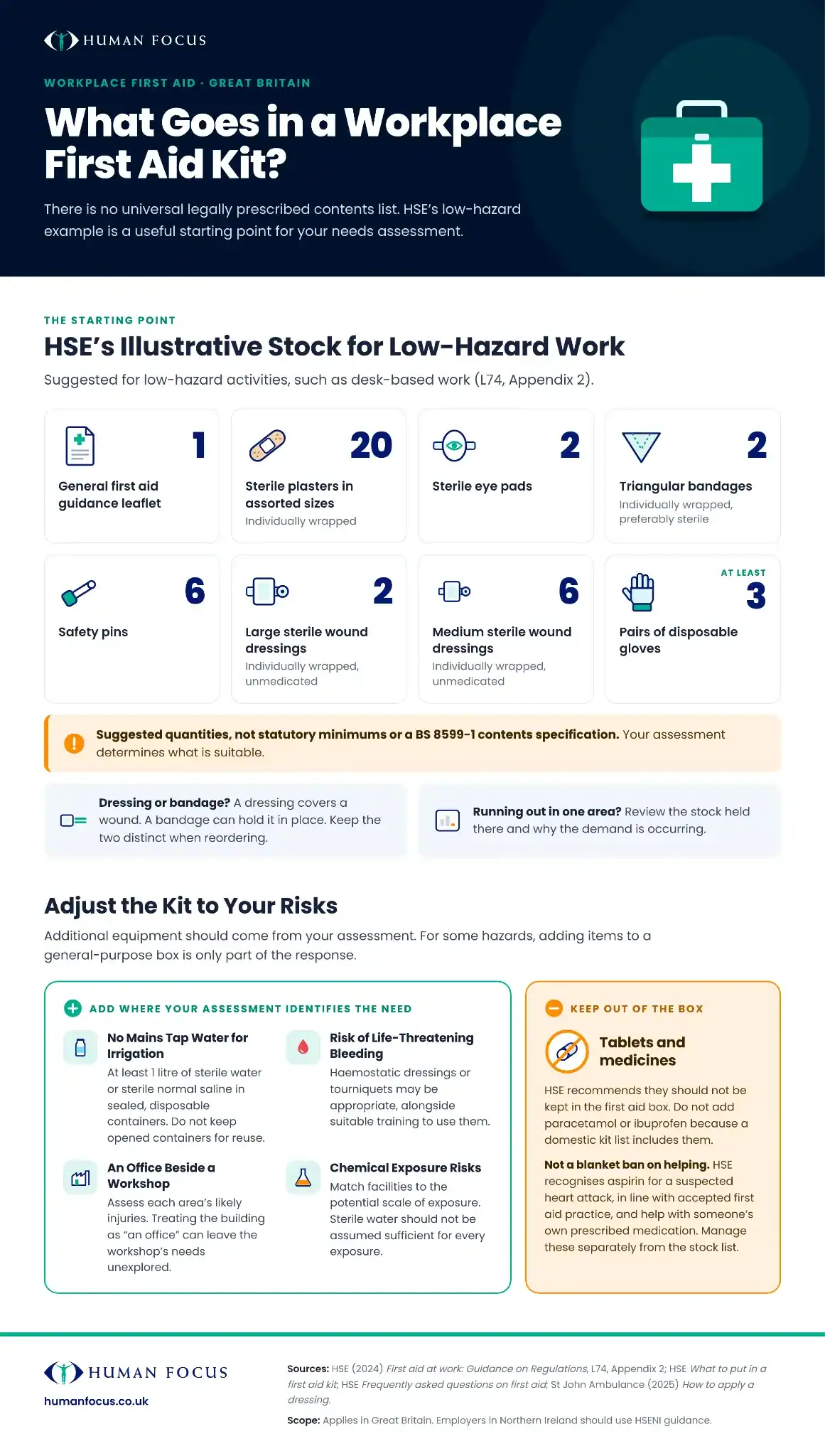
For desk-based work, HSE’s suggested first aid supplies list provides a useful starting point. Its L74 guidance gives the following example of stock for low-hazard activities.

Suggested Item Illustrative Quantity
General first aid guidance leaflet 1
Individually wrapped sterile plasters in assorted sizes 20
Sterile eye pads 2
Individually wrapped triangular bandages, preferably sterile 2
Safety pins 6
Large sterile, individually wrapped, unmedicated wound dressings 2
Medium sterile, individually wrapped, unmedicated wound dressings 6
Disposable gloves At least 3 pairs

Source: HSE (2024), L74, Appendix 2. These are suggested quantities, not statutory minimums or a BS 8599-1 contents specification. Your assessment determines what is suitable.

Keep the distinction between a dressing and a bandage clear when ordering replacements. A dressing covers a wound; a bandage can hold it in place. They perform different functions, even where supplied together (St John Ambulance, 2025).

The quantities also deserve attention. Reordering the same assortment without considering how it is used can preserve a shortage. If one area repeatedly exhausts particular supplies, review the stock held there and why the demand is occurring.

What Should a Workplace First Aid Kit Contain

What Must Employers Provide by Law?

In Great Britain, the Health and Safety (First-Aid) Regulations 1981 require employers to provide equipment, facilities and suitable personnel that are adequate and appropriate for employees injured or taken ill at work. Regulation 4 also requires employees to be informed about arrangements, including the location of equipment, facilities and personnel (Great Britain, 1981).

Those employers’ first aid duties extend beyond buying a box. The organisation needs to establish what injuries and illness it should be prepared for, who can respond and how help can be reached during the working day.

A workplace first aid needs assessment connects those decisions. Consider hazards, workforce needs, incident history, shifts, premises layout and employees working away from the main site. Headcount is one factor within that judgement.

For some small, low-risk workplaces, HSE says a first aid box and an appointed person may be sufficient. The appointed person looks after arrangements and calls the emergency services when required; formal first aid training is not required for that role. A trained first aider is a different role, provided where the assessment identifies the need (HSE, n.d.-a).

Northern Ireland has separate legislation, the Health and Safety (First-Aid) Regulations (Northern Ireland) 1982, as amended. Employers there should use HSENI’s guidance (HSENI, n.d.).

Does a Workplace Kit Have to Meet BS 8599-1?

No. BS 8599-1 is a voluntary standard that can help employers select workplace first aid kits. HSE explains that employers can use a kit meeting the standard or an alternative, provided the contents reflect their first aid needs assessment (HSE, n.d.-b).

The current reference is BS 8599-1:2019+A1:2026, published on 24 April 2026. Check the version quoted in a supplier’s specification, particularly where purchasing documents still refer to an older edition (BSI, 2026).

A standard kit can provide consistency across purchasing and replenishment. Local suitability still needs checking. The same product specification may be used in two buildings where the work, access arrangements and people present differ substantially.

When Are Extra Supplies or Separate Kits Needed?

Consider an office beside a workshop. Both may belong to the same business, but the injuries that could arise from desk work and machinery are different. Assessing the building simply as “an office” could leave the workshop’s needs unexplored.

The consequences of that kind of mismatch are visible in HSE’s account of an incident at Flowchem UK in Nottingham.
On 2 November 2023, an agency worker was decanting corrosive drain unblocker from bulk containers. When an adjacent container’s uncapped outlet valve was opened, liquid sprayed onto her face and upper body. She suffered burns to her face, eye, neck and arm.

Eyewash bottles were available. However, HSE found that the first aid arrangements did not account for the potential scale of exposure, including the absence of a shower. Flowchem was fined £50,000 on 12 February 2026 following broader failings involving working methods, training, supervision, protective equipment and first aid arrangements (HSE, 2026).

For the person specifying supplies, the relevant point is that equipment had been provided, but its suitability had not been established against what could happen. The case does not show how much the missing shower affected the injuries. It does show why counting available items cannot settle whether provision is adequate.

HSE’s guidance allows for additional equipment identified through assessment. Where mains tap water is not readily available for wound and eye irrigation, it advises at least one litre of sterile water or sterile normal saline in sealed, disposable containers. Opened containers should not be kept for reuse. That provision should not be assumed sufficient for every chemical exposure (HSE, 2024).

Where life-threatening bleeding is an identified risk, specialist supplies such as haemostatic dressings or tourniquets may be appropriate, alongside suitable training. Buying them without establishing the need and competence to use them leaves an important part of the decision unresolved.

The assessment therefore needs to connect the likely injury with the equipment and facilities required to respond. For some hazards, adding items to a general-purpose box is only part of that response.


Should Medicines Be Kept in a Workplace First Aid Kit?

HSE recommends that tablets and medicines should not be kept in the first aid box. Routine supplies of paracetamol, ibuprofen or other medicines should therefore not be added simply because they appear in a domestic kit list.

This recommendation should not be confused with a blanket prohibition on helping someone with medication. HSE distinguishes routine treatment of illness from specific emergency circumstances, including aspirin for a suspected heart attack in accordance with accepted first aid practice. It also recognises assistance with an individual’s own prescribed medication (HSE, n.d.-b).

Keep decisions about personal medication and any specialist emergency arrangements separate from the routine stock list. The supplies checklist should not become an informal system for choosing or administering medicines.

How Many Kits Do You Need and Where Should They Be Kept?

HSE advises providing at least one first aid kit for each workplace, with more where circumstances require them. Kits should be easily accessible and contain sufficient suitable materials (HSE, n.d.-a).

Its illustrative office assessment considers 80 employees distributed across two floors, alongside their health needs and incident history. The example identifies at least two containers, one on each floor. This is an assessment scenario, not a universal ratio for offices with 80 staff (HSE, n.d.-c).

The useful principle is distribution. A larger box in one location may hold enough stock while leaving someone elsewhere with an avoidable journey to retrieve it.

Access also changes through the day. If a kit sits inside an office locked after the administration team leaves, its location may be unsuitable for people still working elsewhere. Check arrangements against actual shifts, access restrictions and work locations. Identify kits clearly and protect their contents from dust and damp.

Employees travelling, working remotely or working alone may need personal or vehicle-carried kits, as identified by the assessment. Include those kits in replenishment arrangements. A box in a van can be overlooked if the checking routine only covers containers mounted on workplace walls.

How Often Should First Aid Supplies Be Checked?

Check supplies regularly and replenish them soon after use. HSE does not specify a universal review timetable, so a monthly inspection should not be presented as a statutory requirement (HSE, n.d.-b).

The routine should establish whether the agreed contents are present, usable and in date. Examine packaging and seals, replace damaged items and check that storage conditions have not affected them. Replace sterile items by their expiry dates. If a sterile item has no date, ask the manufacturer how long it can be kept. Assess undated, non-sterile items for continued fitness for purpose.

Frequency alone does not solve replenishment. Consider a kit used shortly after its scheduled check. Unless somebody reports and replaces the items taken, it could remain depleted until the next inspection. Arrange for use to trigger replacement as well as setting a routine checking date.

Give somebody responsibility for each kit and arrange cover for absence. Make ownership explicit for mobile kits too, particularly where a vehicle is shared between employees. A simple record of checks, shortages and replenishment can help establish what needs attention; it is a management practice rather than a prescribed statutory stock log.

Keep stock checking distinct from reviewing the assessment. Replacing dressings restores the agreed provision. Changes to machinery, staffing, work locations or access arrangements may require the organisation to reconsider what provision is appropriate.

First Aid Supplies Checklist for Employers

Before signing off provision, check that the following decisions have been made.

  • Confirm the need. Relate supplies and facilities to the hazards, workforce and working arrangements.
  • Set the stock. Agree suitable contents and quantities for each kit, including additions identified by assessment.
  • Check access. Make provision available across relevant locations, shifts and mobile work.
  • Allocate responsibility. Name who checks and replenishes each kit, with cover for absence.
  • Restore used supplies. Make replacement part of the response after a kit is used.
  • Review condition. Check dates, packaging, storage and continued suitability.
  • Connect the arrangements. Confirm appropriate personnel are available and employees know how to obtain help.

For managers responsible for these decisions, Human Focus’s First Aid Risk Assessment Training covers identifying hazards, examining existing arrangements and determining further equipment, facilities and training needs. The course supports the assessment process. Employers still need to implement suitable arrangements and provide practical first aider training where the assessment requires it.

About the author(s)

Human Focus Editorial Staff comprises a dedicated collective of workplace safety specialists and content contributors. The team shares practical guidance on human factors, risk, and compliance to support safer, more effective workplaces.

Share with others
You might also like

Popular Courses

Legionella Risk Assessment Training
Legionella Risk Management Principles for Responsible Persons
View Course Details
IOSH Managing Safely
View Course Details
GDPR Awareness Training Course
GDPR Training
View Course Details
LOTOTO online training course
Safe Isolation – Lock Out, Tag Out, Try Out (LOTOTO) Training
View Course Details
spill kit training
Spill Kit Hazardous Substances Training
View Course Details

Recent Articles

gdpr rights
GDPR Rights Explained: A Practical Guide for UK Employers
Why Is Food Safety Important
Why Is Food Safety Important? Key Risks, Responsibilities and Controls
abrasive wheel ppe requirements eye face
PPE Requirements for Abrasive Wheel Work: Eyes, Face and Beyond
children act 1989 and 2004
Children Acts 1989 and 2004: Key Differences and Safeguarding Duties
Wet Floor Signs Legal Requirements & Contamination Control
Wet Floor Sign and Contamination Control: What the Law Actually Requires

Current Offers

near miss reporting for effective learning
Managing Near Miss Reporting for Effective Learning

Original price was: £895.00.Current price is: £595.00. +VAT

Sustainability and Environmental Management Training
Sustainability & Environmental Management Training

Original price was: £895.00.Current price is: £595.00. +VAT

harness and lanyard inspection training online
Harness & Lanyard Inspection

Original price was: £95.00.Current price is: £75.00. +VAT

colour blind test
Colour Blind Test

Original price was: £25.00.Current price is: £15.00. +VAT

Icon-PNG
Home Working Bundle Pack (4 in 1)

Original price was: £100.00.Current price is: £49.00. +VAT