Recording And Investigating Near-misses on Site: Why Traditional Systems Don’t Work — and How to Fix Them

recording and investigating accidents

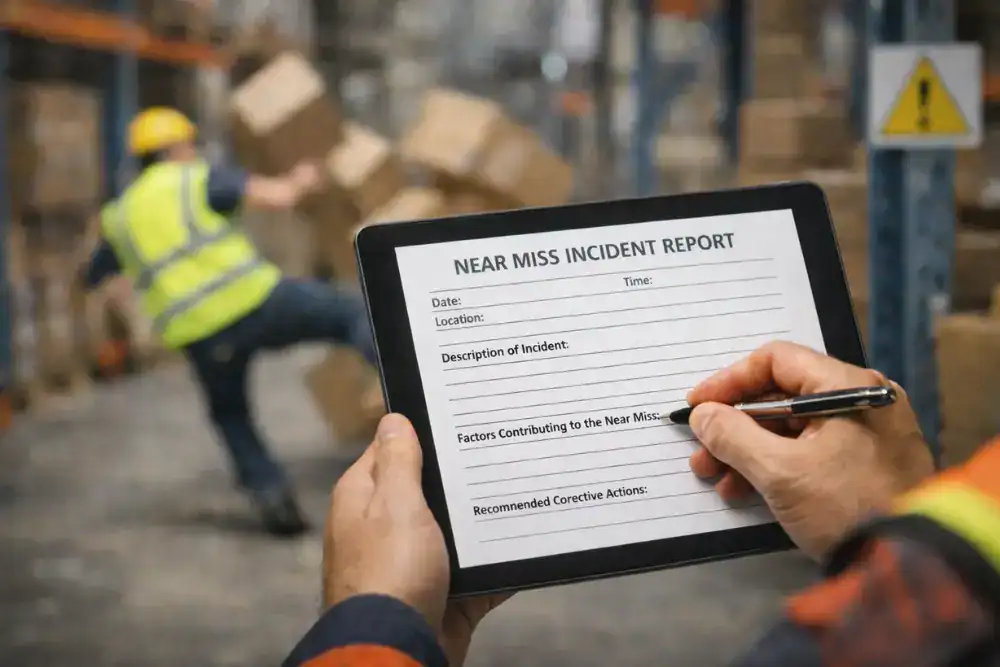
Most organisations already record near-misses on site, and many do so in significant volumes. Forms are completed, dashboards fill up, and numbers are reported upward, which means that on paper the system can look healthy.

Yet serious accidents still happen, often to the surprise of senior teams. When they do, it becomes clear that all that reporting activity delivered little insight into what really mattered at the point of harm.

This is what Gregory Smith describes as “Paper Safe” — systems that generate extensive documentation and apparent control, while doing little to improve real risk control where work is actually carried out (Smith, 2018). In these situations, organisations accumulate evidence of the work of safety (forms, registers, metrics) while seeing limited improvement in the safety of work itself.

The aim of this article is to analyse why many near-miss reporting systems fail to deliver meaningful learning, and what needs to change if recording and investigating near-misses is to contribute to genuine improvement in the safety of work.


What Near-Miss Reporting Was Built on — and Why That Matters

Most near-miss systems still rest, often implicitly, on ideas that originated almost a century ago.

Herbert Heinrich’s work in the 1930s introduced two influential models: the domino model of accident causation and what later became known as the accident triangle. The logic was straightforward. Accidents were seen as linear chains of events (from the bottom of the triangle), and serious injuries as the result of many smaller failures accumulating over time.

The practical implication was simple and attractive: reduce the number of minor incidents and near-misses, and serious accidents should reduce as well. That logic remains deeply embedded in many near-miss reporting systems today, even where organisations would not consciously describe their approach in those terms.

Why the Evidence No Longer Supports a Single Near-miss System

Modern safety research has steadily challenged this assumption.

Rasmussen’s work on risk in dynamic systems showed that linear accident models fail to capture how work actually happens in real organisations. In complex socio-technical systems, the conditions that contribute to serious accidents are often normal features of everyday work, rather than obvious deviations that can simply be removed (Rasmussen, 1997).

Subsequent research in resilience engineering and Safety-II has reinforced a critical finding: the causal pathways that lead to serious accidents are not the same as those that lead to minor injuries or no-injury events.

Serious accidents are emergent outcomes of interacting pressures, constraints, adaptations, and decisions, rather than scaled-up versions of small failures (Hollnagel, 2014; Dekker, 2014).

This matters because it means that a single, high-volume near-miss reporting system cannot reasonably be expected to serve two very different purposes at once.

Near Miss Training

Our Near Miss Training course helps line managers extract valuable lessons from near misses to drive safety improvements. Users learn to work effectively with front-line staff to reveal problems and analyse the underlying contexts that cause human errors.

Original price was: £895.00.Current price is: £595.00. +VAT

Why Near-Miss Reporting Often Becomes “Safety Clutter”

When near-miss reporting is treated as a universal solution, predictable problems follow.

Systems generate large volumes of reports, many of which focus on obvious, low-consequence issues. Administrative effort increases, targets are introduced, reporting becomes performative, and feedback weakens. Over time, the organisation becomes increasingly occupied with the work of safety, while those exposed to risk see little improvement in the safety of work itself.

This is not because people do not care, or because they lack awareness. It is because the system is being asked to produce insight it was never designed to generate.

Minor Near-Misses: Useful — But Only in the Right Way

For minor incidents, many organisations already have well-established reporting systems that capture high volumes of obvious issues, such as trailing cables, poor housekeeping, damaged hand tools, or minor access problems.

Fixing these issues is worthwhile. However, it is important to be clear about what this information can (and cannot) tell you.

A report about a trailing cable on the floor may help prevent a minor trip, but it does not provide meaningful predictive insight into serious injury or fatal risk. As we will see in the next section, the systemic contributors that drive serious harm (planning decisions, competence, resourcing, coordination between teams, authority gradients, and time pressure) are largely absent from these existing high-volume near-miss reports.

Existing reports have value, but only if this value is intelligently extracted and applied. This means minor near-miss reports have to be analysed for trends. This goes well beyond the traditional individual “fix and forget” approach. Patterns, hot spots, and recurrence across sites, tasks, or roles need to be used to target specific interventions, such as bespoke training, supervision focus, or local design changes across the wider organisation. Without that analytical step, high-volume reporting quickly becomes noise.

What the Data Shows: Volume Does Not Equal Early Warning

Human Focus has tested this directly.

In one organisation, we analysed over 12 months of near-miss data — more than 3,500 reports — following a serious lifting accident that resulted in life-changing injury and could easily have been fatal. Using AI analytical tools to interrogate the dataset, we looked for reports that might have provided early warning of the conditions that led to the accident.

Only two reports were even loosely related to the type of lifting task involved in the accident, and neither contained any meaningful systemic contextual information that were implicated in the accident. Both reports focused on isolated minor equipment issues.

The serious accident, however, was shaped by a much broader set of factors, including task planning, competence, resourcing, coordination between teams, and communication across organisational boundaries. The conclusion was clear – in this system: the high-volume near-miss reports had not produced usable early warning of serious harm.

Serious Risk Requires a Different Approach

For serious injury and fatal risk, relying solely on workers to submit near-miss reports is not an optimal strategy.  The signals that matter are often subtle, distributed, and embedded in how work is actually done, which means accessing them requires proactive engagement focused on critical tasks — those with the potential for life-changing or fatal outcomes.

This is where Contextual Inquiry becomes essential.

Contextual Inquiry is a structured approach to understanding work as it is actually performed in complex adaptive systems, rather than as it is imagined in procedures (Beyer & Holtzblatt, 1998; Usability Body of Knowledge, n.d.). In safety applications, it is used to surface the decision environment, trade-offs, and adaptations that shape risk.

Practical techniques include Walk-Through / Talk-Through (WTTT), which involves facilitated exploration of a task with experienced workers to understand what they attend to, how decisions are made, and where difficulties arise (NHS England, 2022; Human Performance Oil & Gas, n.d.), and Systemic Contributors and Adaptations Diagramming (SCAD), which maps how organisational pressures create systemic conflicts that lead to local adaptations. SCAD facilitates time and distance analysis, and highlights where the informal ways in which risk is actually being managed through local adaptations occur (Jefferies et al., 2022).

The good news about this approach is that it involves a low-volume, deeper dive. It is critical that contextual inquiry and other techniques are focused on critical tasks — those that have the potential for serious harm. It involves proactively going out and engaging resident experts to surface work as done, including all of the messy adaptations that are used in daily successful work.

Used together, these methods provide insight that traditional near-miss reporting cannot: why work normally succeeds, where it is reaching the edge of safe boundaries, and how serious harm could plausibly emerge.

Designing a Near-Miss System That Improves the Safety of Work

The implication is clear. Organisations need to stop treating near-miss reporting as a single system.

Effective approaches separate minor near-miss systems, designed for high-volume trend learning and local improvement, from serious risk learning systems, designed for proactive, contextual understanding of critical tasks. Both are necessary. There is also a need to improve the effectiveness of low-risk, high-volume reporting — to go beyond fix and forget, to learn and improve across the wider organisation.

Summary

Most near-miss reporting systems in use today are still rooted in ideas developed over a century ago, particularly the assumption that reducing large numbers of minor incidents will automatically reduce the likelihood of serious accidents. Research and practical evidence now show that this assumption does not hold. Lower-risk and higher-risk events do not share the same causal pathways, which means a single, high-volume near-miss system cannot effectively address both.

For lower-risk events, existing near-miss reporting systems do have value. They help identify common, recurring issues such as housekeeping problems, minor equipment defects, or access issues. However, that value is often diluted because reports are treated as isolated events rather than analysed for patterns and recurrence. As a result, lower-risk issues are frequently fixed locally and then reappear elsewhere, rather than being used to improve how those risks are controlled across the organisation.

For serious injury and fatal risk, the limitations are more fundamental. High-risk outcomes are shaped by systemic conditions such as planning, resourcing, competence, coordination, authority gradients, and time pressure. These conditions are largely absent from traditional near-miss reports, which focus on obvious incidents and isolated failures. Waiting for early warning of serious harm to emerge from high-volume near-miss reporting is therefore unrealistic and can create false confidence.

The implication is straightforward. Organisations need to operate two distinct near-miss systems, each with a clear and different objective. One system should focus on lower-risk events, using high-volume reporting and trend analysis to strengthen control of those risks wherever they occur. The second should focus on serious risk, using a low-volume, proactive approach that deliberately targets critical tasks and seeks deeper insight into how work is actually carried out. Without this separation, near-miss reporting remains active and well documented, but poorly aligned to the risks it is expected to manage.

How Human Focus Can Help

Human Focus supports organisations to design and implement effective near-miss reporting systems for both minor incidents and serious risk.

This includes reviewing existing systems to identify where learning is being lost, strengthening trend analysis and targeted intervention for minor incidents, designing and implementing proactive serious-risk learning using Contextual Inquiry, Walk-Through / Talk-Through and SCAD, and supporting the training and capability development needed to sustain these systems.

We offer a free, no-obligation discovery to provide an initial review of your current near-miss arrangements and identify where changes would deliver the greatest safety benefit.

About the author(s)

Ian Pemberton is a Chartered Ergonomist and Human Factors Specialist (CIEHF, MCIEHF) and Managing Director of Human Focus. He specialises in serious risk, systems thinking, and understanding why traditional safety controls often fail under real operational pressure.

Share with others
You might also like

Popular Courses

GDPR Awareness Training Course
GDPR Training
View Course Details
LOTOTO online training course
Safe Isolation – Lock Out, Tag Out, Try Out (LOTOTO) Training
View Course Details
IOSH Managing Safely
IOSH Approved Managing Safely e-Learning
View Course Details
spill kit training
Spill Kit Hazardous Substances Training
View Course Details
Legionella Risk Assessment Training
Legionella Risk Management Principles for Responsible Persons
View Course Details

Recent Articles

Noise Risk Assessment on Small Construction Projects
Noise Risk Assessment on Small Construction Projects: Why Controls Fail Under Change, Not on Paper
employer face fit testing duties
Face Fit Testing Responsibilities for Employers
Top-Rated Health and Safety Training Programs for SMEs
human factors in accident investigation
Human Factors in Accident Investigation: Why Tacit Expert Knowledge Is A Critical Missing Piece
Course Announcement Introduction to ISO 9001
Course Announcement: Introduction to ISO 9001

Current Offers

near miss reporting for effective learning
Managing Near Miss Reporting for Effective Learning

Original price was: £895.00.Current price is: £595.00. +VAT

Sustainability and Environmental Management Training
Sustainability & Environmental Management Training

Original price was: £895.00.Current price is: £595.00. +VAT

Icon-PNG
Home Working Bundle Pack (4 in 1)

Original price was: £100.00.Current price is: £49.00. +VAT

driving for work
Driver Training Pack (5 in 1)

Original price was: £100.00.Current price is: £60.00. +VAT

driving for work
Highway Code Updates Awareness Training

Original price was: £25.00.Current price is: £15.00. +VAT