Barriers to communication are factors that prevent information from being shared, received or understood clearly.
Common communication barriers at work, such as ambiguous instructions and a reluctance to ask questions, can contribute to issues like disagreements and mistakes. Recognising these barriers can help prevent misunderstandings and correct those issues.
This guide explains common communication barriers, how to recognise them in everyday work, and how to address them to improve communication at work.
A communication barrier is anything that obstructs the exchange or understanding of a message. It can affect what someone says, how information reaches another person or how that person interprets it. It can also prevent questions and feedback from reaching the sender.
For example, a manager asks for a task to be completed “soon”. The employee understands this as sometime during the week, while the manager expects it that afternoon. The ambiguous wording is the barrier; the missed expectation is the result.
Understanding does not necessarily mean agreement. Someone may understand an instruction and still question it or lack the resources to carry it out. Establish which problem exists before treating it as a communication failure.
The following categories provide a practical way to examine communication problems. They can overlap: a rushed conversation may involve background noise, unfamiliar terminology and no opportunity to ask questions.
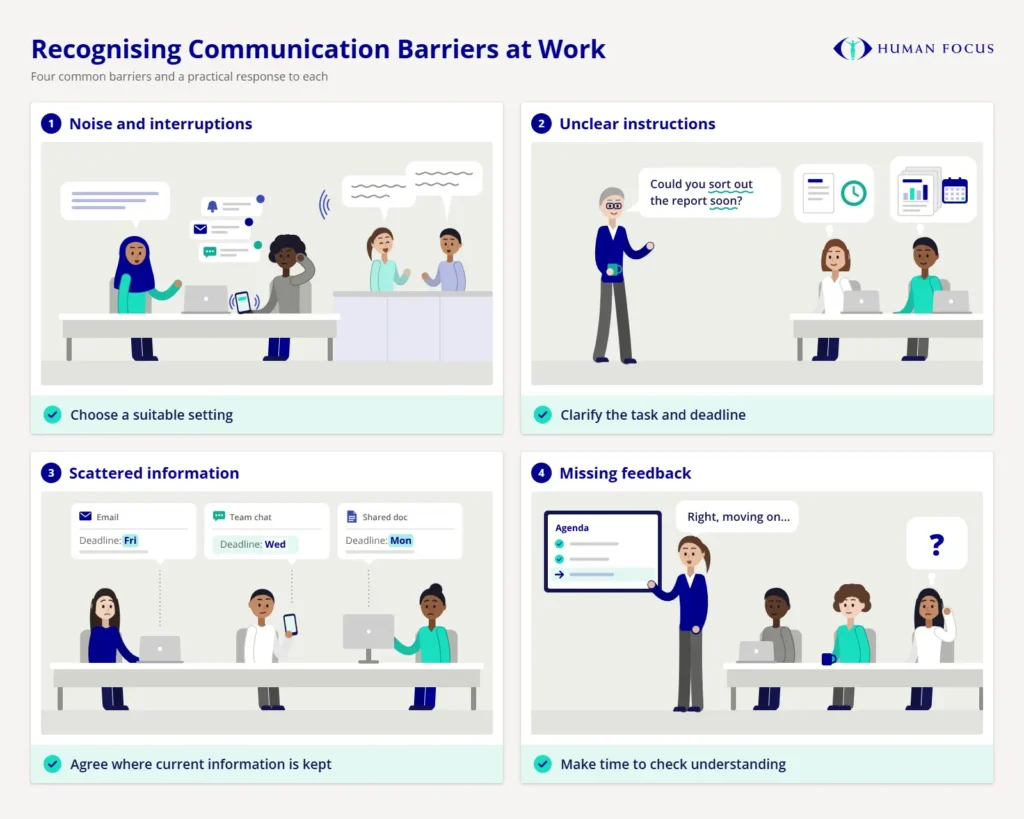
Noise, interruptions, distance and a lack of privacy can make it difficult to hear, concentrate or discuss a concern openly.
For example, a supervisor gives a handover while colleagues repeatedly interrupt with unrelated questions. The incoming worker hears parts of the update but misses a change to the work plan.
Choose a suitable time and place for important exchanges. Reduce interruptions and allow enough time for questions. For shift handovers, HSE recommends a two-way exchange supported by both spoken and written information, with incoming staff checking the information as they take over responsibility.
Semantic barriers involve differences in meaning. Jargon, unexplained acronyms and vague requests can cause confusion even when everyone speaks the same language.
A new starter told to “follow the usual process” may have no way of knowing which steps their manager expects. Replace assumptions with clear instructions, explain unfamiliar terms and specify any relevant deadline.
Where workers use different first languages, consider suitable interpretation, translation or demonstrations. HSE’s guidance on language issues explains that workers need understandable information about instructions, risks and precautions; it does not necessarily have to be in English. Check understanding instead of relying solely on whether information has been provided.
People may interpret a message differently because of their experience, expectations or communication preferences. A direct statement may seem helpful to one person and abrupt to another.
For example, an employee says a proposed deadline “might be difficult”. Their manager hears a minor concern, while the employee is trying to explain that the work cannot be completed in time.
Ask what the person means and discuss the practical issue: which part of the work is difficult, and what would need to change? Avoid assuming that someone’s background determines their preferences. Clarify the message with the individual instead of judging their intention from tone or body language alone.
Stress, frustration or fear of a negative response can affect how people participate in a conversation. Previous experiences may also influence whether they feel comfortable asking for help.
An employee who was criticised for asking a question may stay silent when the next instruction is unclear. Repeating “ask if you need help” may have little effect if questions still receive an impatient response.
Allow time to explain concerns, respond respectfully and follow up on what is raised. In its guidance on involving employees in health and safety, HSE highlights the importance of approachable managers who act on concerns. A private discussion may also make it easier to raise an issue.
Information can become delayed, filtered or lost as it passes between departments or management levels. Unclear responsibilities can also leave everyone assuming that someone else has shared an update.
For example, a revised procedure reaches the day shift, but nobody is assigned to brief the evening team. The second team continues using the previous version.
Identify who needs the information, who will communicate it and when it must reach them. Include a route for questions to travel back. Acas’s consultation guidance emphasises communication in both directions and keeping line managers informed when senior leaders speak directly with employees.
A message can be heard without being fully considered. Interruptions, divided attention and assumptions may leave important details unexplored.
For example, a manager assumes an employee is describing a familiar problem and offers a solution before hearing what has changed. Both leave the conversation believing the issue has been addressed when it is not.
Allow the speaker to finish, clarify uncertain points and summarise the agreed action. Ask “What will happen next?” where this would be more useful than a simple “Understood?”
Active listening techniques can help with these exchanges. Confirmation should give both people an opportunity to correct the message and raise practical concerns.
Important information can be difficult to identify when it is buried in long emails, frequent notifications or several competing sources. The chosen channel may also make discussion unnecessarily difficult.
For example, a deadline changes in a group chat while the project document still shows the original date. Different team members follow different instructions.
Keep the current information in an agreed location and highlight what has changed. Make the required action easy to find. Consider which type of communication suits the situation: a discussion can resolve uncertainty, while a written record can preserve the decision. Explain which source people should follow if messages conflict.
Poor connections, unreliable audio, unavailable devices and access restrictions can interrupt communication regardless of how clearly a message is written or spoken.
A remote employee might hear a discussion about a document but be unable to open the link. An employee working away from a desk may not see an update posted only on an intranet.
Check that intended recipients can access the chosen system and its content. Test links and permissions before important meetings, provide a suitable alternative when technology fails and establish how urgent updates will reach people. A message appearing in the sender’s outbox does not establish that everyone has received it.
Information may be available but presented in a form someone cannot readily use. For example, a video with a heavy accent may be hard to understand without captions, and instructions written in dense language may not help someone with reading difficulties.
Ask the person what would help. Acas’s guidance on adjustments for neurodiversity includes breaking instructions into clear steps and allowing additional reading time, while recognising that needs differ between individuals.
For videos, provide accurate captions where needed. W3C’s accessibility guidance cautions that automatic captions need checking because errors can change the meaning. Review whether the format works for the recipient rather than assuming the difficulty reflects a lack of interest or effort.
Start with an observable problem and explore possible explanations with the people involved. Repeated errors or quiet meetings can prompt investigation, but neither establishes a particular cause.
Useful questions to ask include:
- What was the sender trying to communicate?
- What did the recipient understand?
- Could everyone access the information when they needed it?
- Was there an opportunity to question or correct the message?
- Did workload, conflicting instructions or missing resources affect what happened?
Use a specific example, such as a recent handover or email exchange. This gives people something concrete to examine and helps avoid broad judgements about someone being a “poor communicator”.
Choose changes that address the barrier identified. Asking everyone to communicate more frequently can create extra messages without resolving why the original information was missed.
- Review a specific breakdown. Establish what was shared, through which channel and at what point understanding differed. Ask those involved to explain their interpretation before deciding what went wrong.
- Agree what needs to change. Separate problems with the message from problems with access, timing or the work itself. A clearer email will not resolve a situation where the recipient cannot access the system.
- Choose a proportionate response. This might mean rewriting an instruction, providing another format, changing a handover arrangement or clarifying responsibility for updates. Involve the people who will use the revised approach.
- Assign responsibility and check understanding. Make clear who will introduce the change and when. Confirm the expected action, allow questions and address any practical obstacles. Where an individual needs further practice, use guidance on improving communication skills to support that specific need.
- Review whether the change helps. Check subsequent examples with the team. Are the same details still being missed? Has the change created extra work or another access problem? Adjust the approach based on what happens.
For example, if two teams keep using different delivery dates, they might agree one shared schedule and make a named person responsible for updating it. The next review should establish whether both teams can find and use the current date, rather than simply confirming that another reminder was sent.
Some apparent communication problems arise because work has not been organised realistically. An employee may understand two managers’ instructions perfectly but be unable to meet both deadlines.
In that situation, managers need to agree on priorities, change the workload or provide additional resources. Explaining both requests more clearly will not make them compatible.
HSE’s Management Standard on role addresses clear responsibilities, compatible demands and ways for employees to raise concerns about conflicting requirements.
Before prescribing training, check whether employees have the information, time, tools and authority needed to act. Where the underlying issue involves staffing, unrealistic targets or unresolved management decisions, assign responsibility for addressing that issue alongside any relevant skills development.
Identifying a barrier helps employers decide where additional practice or training would be useful. Human Focus’s Communication Skills Training covers listening, speaking, non-verbal communication, empathy and the choice of communication methods.
The online training can support employees and managers in developing clearer workplace exchanges. It should be used alongside practical action on any access, workload or organisational issues identified, with opportunities to apply the learning and receive feedback at work.