Safeguarding in health and social care means protecting people’s rights and wellbeing by preventing and responding to abuse and neglect. Staff need to recognise concerns, act on immediate danger and report what they see or hear, while involving the person in decisions. Call 999 if someone is in immediate danger or needs emergency medical help.
A care worker does not need to prove abuse before raising a concern. They need to say what they saw or heard, why it worried them and who needs to know.
hat sounds straightforward. It can feel less clear during a busy shift, especially when the person asks staff not to tell anyone. Workers need to know who to contact and what to do if their usual manager is away.
The person’s choices matter too. The adult safeguarding duties under the Care Act 2014 and the Care Quality Commission (CQC) requirements discussed here apply to England. Services elsewhere in the UK need to follow their national frameworks and local procedures.
The Information Commissioner’s Office (ICO) uses a care example in its data-sharing code. In the illustration, staff from different organisations were supporting older adults. When they shared changes they had noticed in one person’s behaviour, a pattern of possible abuse emerged. They passed the information to the person’s social worker (ICO, 2021).
A worker may see only part of what is happening. Something that seems unclear on one visit may become more significant when the right people can consider it alongside other information.
For staff, the task is to deal with any immediate risk and pass on what they know. The service then needs to make clear who reviews the concern, involves the adult and decides what should happen next.
Safeguarding applies across care homes, home care, supported living and healthcare. Having care and support needs does not mean someone is unable to make their own decisions.
Section 42 of the Care Act 2014 sets out when a council must make or arrange a safeguarding enquiry. In England, that duty applies when the council has reasonable cause to suspect that an adult in its area:
- Has care and support needs, including needs the council is not meeting.
- Is being abused or neglected, or is at risk of this.
- Cannot protect themselves from that abuse or neglect because of those care and support needs.
All three conditions matter. The enquiry allows the council to decide whether action is needed and who should take it (Care Act 2014, s.42).
A worker who is unsure should still report the concern and seek advice through the safeguarding procedure. The council decides whether a statutory enquiry is needed. Staff do not have to settle that question before speaking up.
Concerns about children follow separate safeguarding procedures. In England, these are supported by the Children Acts 1989 and 2004 and Working Together to Safeguard Children 2026. A concern about someone under 18 should be reported through the children’s safeguarding route (Department for Education, 2026).
A person may tell staff about abuse. At other times, a worker notices an injury, a change in behaviour or missing money. The Social Care Institute for Excellence (SCIE) stresses that one warning sign does not prove abuse (SCIE, 2020).
Adult safeguarding statutory guidance identifies ten types of abuse and neglect. The examples below show what staff might notice.
These types can overlap. A home-care worker might notice missing money and find that someone is preventing the person from speaking privately. In supported living, taking away a communication aid could stop a person explaining what is wrong.
These observations need to be recorded and reported. Staff should explain what they noticed without assuming they know the cause. They do not need to wait for another incident before reporting something serious.
The Department of Health and Social Care’s pressure-ulcer protocol makes a further distinction. Poor care is not automatically a section 42 safeguarding matter. The care problem still needs to be addressed, with safeguarding advice if abuse or neglect may be involved (Department of Health and Social Care, 2025).
Start with the risk to the person. Someone describing abuse during routine care needs prompt attention. An assault in progress needs emergency action.
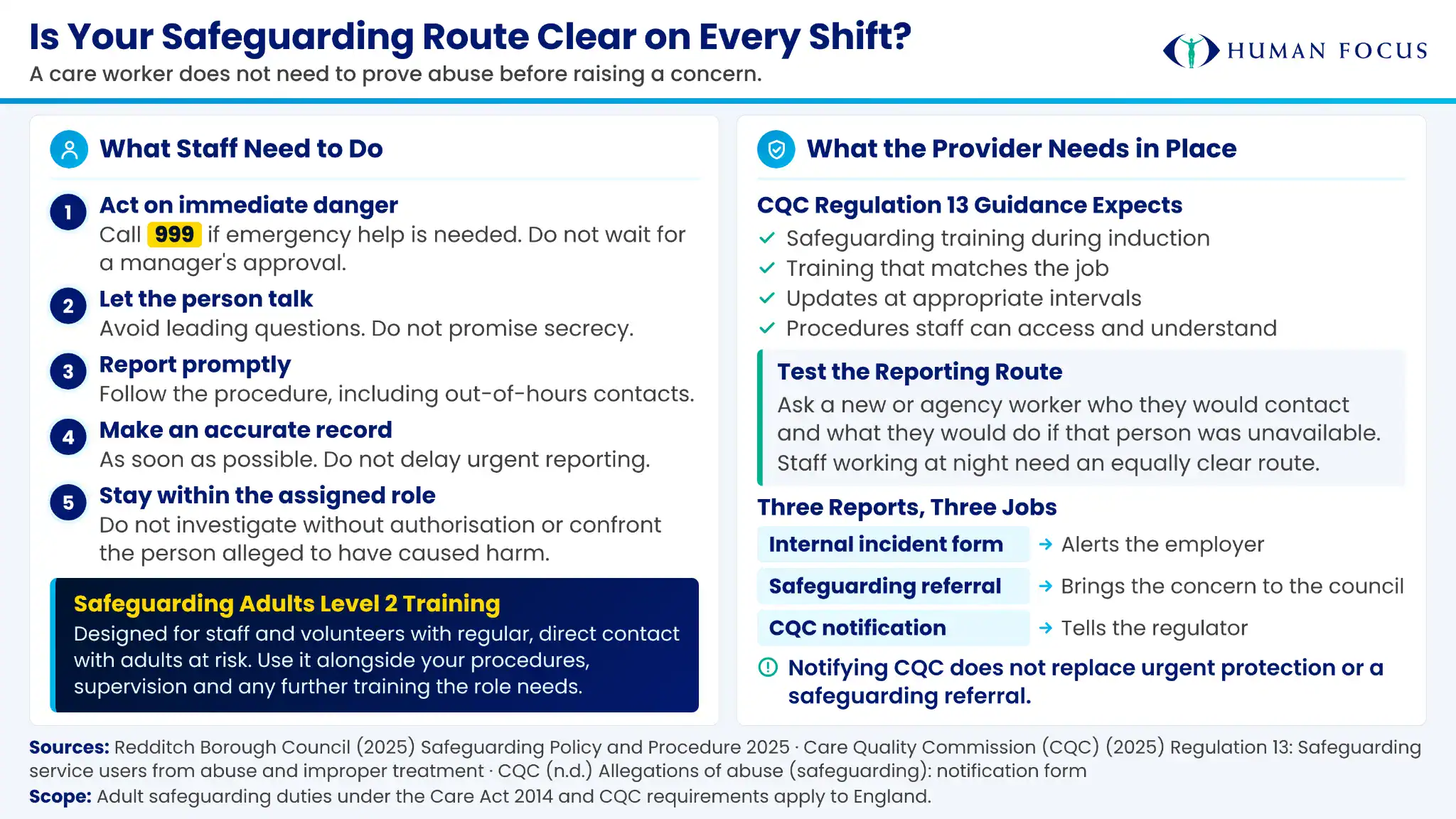
- Act on immediate danger. Call 999 if emergency help is needed. Staff should not wait for a manager’s approval to make that call.
- Let the person talk. Ask only enough to understand the basic concern and immediate risk. Avoid questions that suggest an answer. Do not promise to keep the information secret.
- Report promptly. Follow the safeguarding procedure, including who to contact outside normal working hours. Explain what was seen or heard and what action has been taken.
- Make an accurate record. Write it as soon as possible. Do not delay urgent reporting while completing it.
- Stay within the assigned role. Do not start an investigation without authorisation or confront the person alleged to have caused harm.
The first report should give the safeguarding lead enough information to act, without turning the worker into an investigator (Redditch Borough Council, 2025).
Providers have wider duties. CQC Regulation 13 requires systems to investigate allegations or evidence of abuse and appropriate action without delay. The provider needs to decide who should examine the concern and which agencies need to be involved (CQC, 2025).
The ICO example shows why the next person needs to understand what each worker has noticed. A clear record explains what happened, what is still uncertain and what has already been done.
A useful record should include:
- The date, time and place, with the names of those involved.
- What the worker saw and what other people reported.
- The person’s own words where relevant and what they want to happen.
- Immediate risks, action taken and advice received.
- Who received the report, when it was passed on and what still needs to happen.
Keep what staff saw separate from what they were told and what they think may have happened. Use the person’s exact words where possible and explain the circumstances in which they spoke (Swindon Safeguarding Partnership, n.d.).
For example, an entry such as “The person became quiet when the visitor arrived” records an observation. “The visitor is abusive” states a conclusion that the observation alone cannot support.
Store the record securely in the service’s approved system and pass it through the agreed reporting route. Completing the form is one part of that handover.
An adult may fear losing a relationship, their independence or control over what happens next. Ask what they want to happen and what worries them about seeking support.
If they ask staff not to tell anyone, follow the safeguarding procedure and seek advice. Explain who needs to know, unless doing so would increase the risk. A refusal does not automatically end the safeguarding response (SCIE, 2019).
Consent is not the only legal basis for sharing personal information. Decisions also have to respect the duty of confidentiality. The safeguarding lead should consider the adult’s wishes, whether anyone is pressuring them and whether other people are at risk. Sharing information without the person’s agreement needs a clear legal justification, with specialist advice where needed (ICO, 2021; SCIE, 2019).
Share only what is needed, with the people who need it, through secure channels. Record why the decision was made.
Capacity is a separate question. It concerns the person’s ability to make the particular decision. The Mental Capacity Act 2005 starts from the assumption that an adult can make that decision unless shown otherwise. Support the person to make their own decision before concluding that they cannot.
A diagnosis or a choice staff consider unwise does not, by itself, show that someone lacks capacity. If they lack capacity for the particular decision, decisions made on their behalf must follow the Act, including its best-interests requirements (Office of the Public Guardian, 2026).
The usual manager may be away, involved in the allegation or dismissive of the concern. Staff need another contact they can use in those circumstances.
Follow the service’s alternative reporting route or raise the concern with a more senior person. If those arrangements are ineffective or unsafe, staff can contact the council’s adult safeguarding team for advice or to make a referral. Possible crime may also need police involvement. Decisions about sharing information still need the care described above (SCIE, 2019).
Different reports have different jobs. An internal incident form alerts the employer. A safeguarding referral brings the concern to the council. A CQC notification tells the regulator about an event that must be reported. The provider must make any notification required for its service. Notifying CQC does not replace urgent protection or a safeguarding referral (CQC, n.d.).
The Care and Support Statutory Guidance warns professionals against assuming someone else has passed on important information. Staff should check that the concern has reached the right person and escalate further if the risk continues (Department of Health and Social Care, 2026).
The six principles of adult safeguarding are set out in statutory guidance. They guide decisions about how to protect someone, involve them and share information (Department of Health and Social Care, 2026).
CQC’s Regulation 13 guidance expects safeguarding training during induction. Training should match the job and be updated at appropriate intervals. Providers also need procedures that staff can access and understand (CQC, 2025).
Managers can ask a new or agency worker who they would contact and what they would do if that person was unavailable. The answers can reveal whether the reporting route is clear. Staff working at night need an equally clear route.
Regular supervision in health and social care gives staff time to discuss difficult decisions and review how concerns were handled. Those conversations should support learning, without becoming a reason to put off reporting.
Recruitment checks should suit the role. Reviewing incidents and complaints can also reveal concerns that need safeguarding action.
Human Focus’s Safeguarding Adults Level 2 Training is designed for staff and volunteers with regular, direct contact with adults at risk. It explains the types and signs of abuse and what to do when a concern arises. It should sit alongside the service’s own procedures, supervision and any further training needed for the role.
The report needs to reach someone who can act. Staff should know who has received it, what needs doing now and how to escalate if the person remains at risk.