How Long Does Food Poisoning Last? Symptoms, Recovery and When to Return to Work

How Long Does Food Poisoning Last Symptoms & Recovery

Food poisoning usually gets better within a week, although the duration varies by cause and person. Vomiting often settles within 1 to 2 days, while diarrhoea may continue for 5 to 7 days.

Recovery time and time away from work are different. Anyone with vomiting or diarrhoea should stay off work until at least 48 hours after their last episode.

This guide explains symptom duration, recovery, medical warning signs and safe return-to-work arrangements for employees and food businesses.

How Long Does Food Poisoning Last?

Most food poisoning improves within a week. Some cases settle sooner, but there is no guaranteed 24-hour or 48-hour recovery time. (NHS, Food Poisoning)

The cause of the illness and the person’s health matter. Young children, older adults and people with weakened immune systems can be more vulnerable and may need closer monitoring or advice. (Royal Devon NHS, Food Poisoning Advice)
The duration of symptoms alone cannot establish which infection is responsible. A clinician may need to assess the illness and, in some cases, arrange testing.

Food Poisoning Timeline: When Symptoms Start and How Long They Last

The time between eating contaminated food and developing symptoms is called the incubation period. This is different from how long the illness lasts once symptoms begin.

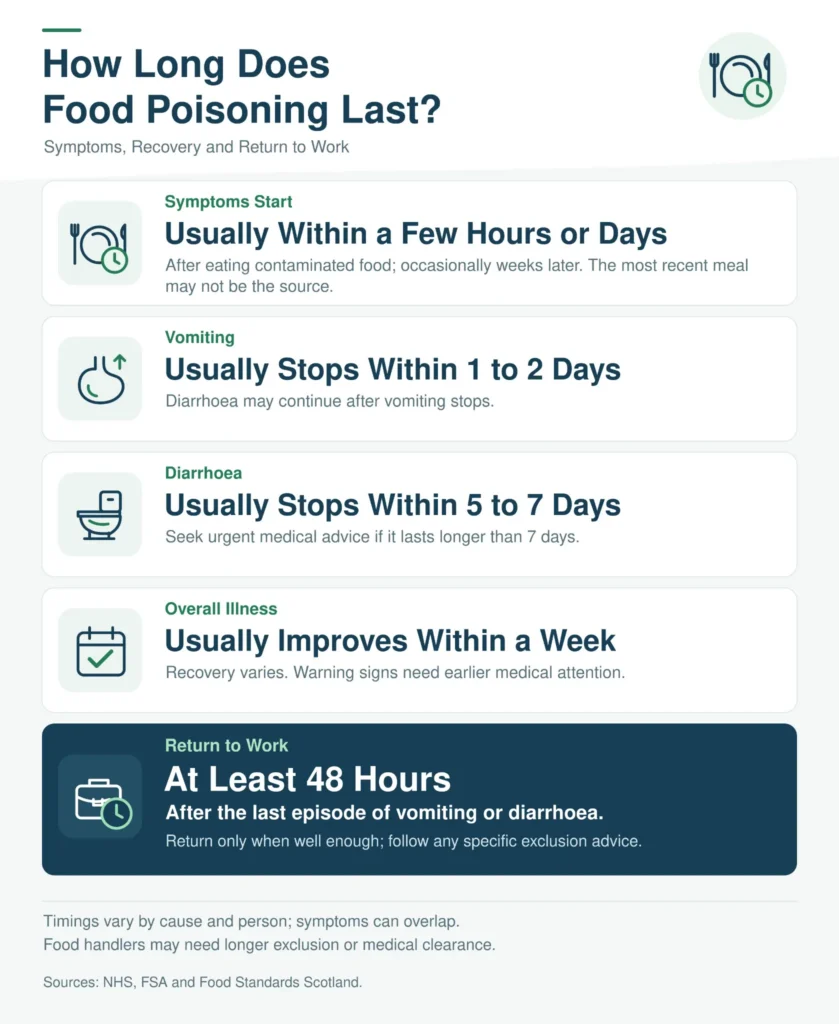
Stage or Symptom Usual Timing What This Means
Symptoms start Within a few hours or days, occasionally weeks later The most recent meal is not necessarily the source.
Vomiting Usually stops within 1 to 2 days Diarrhoea may continue after vomiting ends.
Diarrhoea Usually stops within 5 to 7 days Seek advice if it continues beyond 7 days.
Overall illness Usually improves within a week Recovery varies, and concerning symptoms need earlier attention.

These are general NHS timings, rather than a schedule for every infection. (NHS, Diarrhoea and Vomiting; NHS, Food Poisoning)

Vomiting may stop while diarrhoea continues. The 48-hour return-to-work waiting period only starts after both have stopped.

How Long Does Food Poisoning Last

What Are the Common Symptoms of Food Poisoning?

Common food poisoning symptoms include:

  • Nausea, or feeling sick
  • Vomiting
  • Diarrhoea
  • Stomach pain or cramps
  • A high temperature
  • Feeling generally unwell or lacking energy

Symptoms can occur in different combinations. However, vomiting and diarrhoea also have other causes, including other infections, medicines and food intolerances. Symptoms after a meal do not, by themselves, confirm food poisoning. (NHS, Food Poisoning; NHS, Diarrhoea and Vomiting)

What Should You Do While Recovering?

Rest and Replace Lost Fluids

Most uncomplicated cases can be managed at home with rest and fluids. Small, frequent sips may be easier to tolerate when nausea makes drinking difficult. Eat when able; fatty or spicy food may be less comfortable, and fruit juice or fizzy drinks can worsen diarrhoea. (NHS, Food Poisoning)

Dehydration is the main concern because vomiting and diarrhoea cause fluid loss. Warning signs include darker urine, urinating less often, thirst, a dry mouth and dizziness. A pharmacist can advise on oral rehydration sachets to replace lost fluid, salts and minerals. (NHS, Dehydration)

Older adults and people with weakened immunity or health conditions that increase dehydration risk should seek advice from a pharmacist. Babies and children need advice appropriate to their age. (NHS, Food Poisoning)

Reduce the Risk of Spreading Infection

Hands should be washed thoroughly using soap and water, particularly after using the toilet. Avoid preparing food for others while ill. Clean shared toilets and frequently touched surfaces, and avoid sharing towels or utensils. (NHS, Diarrhoea and Vomiting)

Alcohol hand gel is not a substitute for handwashing: it does not kill norovirus, one possible cause of food poisoning. (NHS, Norovirus)

When Should You Get Medical Help?

Get Urgent Medical Advice

Call NHS 111 in England, Scotland and Wales. In Northern Ireland, contact a GP or GP out-of-hours service for urgent advice. (nidirect, GP Out-of-Hours Service)

Seek urgent advice rather than waiting for recovery if there is:

  • Repeated vomiting that prevents fluids staying down
  • Diarrhoea containing blood or bleeding from the bottom
  • Diarrhoea continuing beyond 7 days or vomiting beyond 2 days
  • Dehydration that persists despite oral rehydration sachets

Persistent dizziness on standing, reduced urination or unusual tiredness can also indicate dehydration needing urgent medical advice. (NHS, Diarrhoea and Vomiting; NHS, Dehydration)

Seek urgent advice if concerned about a baby under 12 months, a child stops breast or bottle feeding, or a child under 5 shows signs of dehydration.

Call 999 or Go to A&E for Emergency Symptoms

Emergency signs include:

  • Blood in vomit or vomit resembling coffee grounds
  • Green-coloured vomit in adults, or green or yellow-green vomit in children
  • Severe abdominal pain that starts suddenly
  • Severe breathing difficulty, confusion or abnormal responsiveness

A severe headache beginning suddenly, or neck stiffness with pain when looking at bright light, also needs emergency attention. Suspected swallowing of a poisonous substance requires emergency help. (NHS, Food Poisoning)

Follow the NHS guidance on diarrhoea and vomiting for the full emergency list. Do not delay help only because symptoms began after eating.

When Can You Return to Work After Food Poisoning?

General Workplace Advice

NHS advice is to stay off work until at least 48 hours have passed since the last episode of vomiting or diarrhoea. This applies even if only one of those symptoms occurred. A high temperature or feeling too unwell for normal activities is also a reason to remain at home. (NHS, Diarrhoea and Vomiting)

For example, if the last episode occurs at 10 am on Monday, the 48-hour period ends at 10 am on Wednesday, provided there are no further episodes. If symptoms recur, count again from the latest episode.

Employees should inform their employer and follow any relevant sickness, infection-control or public-health instructions.

Food Handlers and Staff Working Around Open Food

The Food Standards Agency (FSA) says managers must exclude staff with vomiting or diarrhoea from work with or around open food, normally for 48 hours after symptoms stop naturally. This includes staff whose presence could contaminate food indirectly, rather than only those preparing meals. (FSA, Fitness to Work)

Food Standards Scotland gives similar advice. Its guidance also explains that medication suppressing diarrhoea does not establish fitness to return: staff should be symptom-free for at least 48 hours after stopping it. Some diagnosed infections require medical clearance. (Food Standards Scotland, Fitness to Work)

Food handlers should tell healthcare professionals what their work involves and follow any specific exclusion advice.

What Should a Food Business Do If a Food Handler Is Ill?

Food business operators must prevent people with illnesses likely to spread through food from handling food or entering food-handling areas where contamination could occur. The 48-hour exclusion period is guidance supporting that duty, rather than proof that every person is safe to return. (FSA, Fitness to Work)

Managers should:

  1. Act on symptoms promptly. Staff with vomiting or diarrhoea should report it immediately and stay at home or go home if already at work.
  2. Check food that may be affected. FSA guidance advises throwing away unwrapped food handled by staff who were not fit for work.
  3. Clean affected areas effectively. Review the surfaces and equipment the person touched and follow the business’s cleaning and disinfection procedures.
  4. Confirm the return arrangements. Establish when symptoms stopped and whether specific medical or public-health advice applies.
  5. Review reporting and supervision. Make sure new starters, agency staff and existing employees understand which symptoms to report and who to contact.

The FSA’s personal hygiene guidance includes illness reporting, exclusion and corrective actions. (FSA, Personal Hygiene and Fitness to Work)

Staff should feel able to report illness without pressure to continue handling food. Seek advice from environmental health or the relevant health protection service if return arrangements are uncertain. (FSA, Fitness to Work; Food Standards Scotland, Fitness to Work)

For wider workplace hazards, our guide to conducting a kitchen risk assessment for restaurants and catering businesses explains how to review risks to staff alongside food safety controls.

How Can Food Poisoning Be Prevented at Work?

Food poisoning prevention depends on everyday controls being followed consistently. FSA business guidance centres on the four Cs: cleaning, cooking, chilling and preventing cross-contamination. (FSA, Food Hygiene for Businesses)

Cleaning

Wash hands at appropriate points during food handling. Clean and disinfect food-contact surfaces and equipment using the correct products and procedures. Cleaning schedules should identify what needs attention, how often and which products to use. (FSA, Cleaning)

Cooking

Cook food thoroughly and check the business’s required time and temperature combination. FSA standard advice is a core temperature of 70°C for 2 minutes, or an equivalent safe combination. Use a clean probe where temperature checks are required. (FSA, Cooking Food Safely)

Chilling

Follow the storage instructions on food packaging. The legal maximum temperature for chilled food is 8°C in England, Wales and Northern Ireland. In Scotland, 8°C is the recommended maximum. The FSA advises setting fridges to 5°C or colder to help food stay within the 8°C limit, even when the fridge temperature fluctuates. (FSA, Chilling and Freezing)

Our guide to the food temperature danger zone explains temperature controls and includes a free reference chart.

Cross-Contamination

Separate raw meat, fish and poultry from ready-to-eat food. Use separate boards and utensils, and clean and disinfect equipment and preparation areas between uses where separation is not possible. (FSA, Avoiding Cross-Contamination)

Dates and Storage Instructions

Use-by dates concern safety; best-before dates concern quality. Do not serve food after its use-by date unless it was appropriately cooked or frozen by that date, safely stored and used within safe storage limits. Follow instructions for storage and use after opening. (FSA, Best Before and Use-by Dates)

Our guide to use-by and best-before dates explains the distinction in more detail.

These controls should sit within the business’s food safety management system. Managers reviewing formal controls can also read what a HACCP decision tree is and how it helps identify critical control points.


Frequently Asked Questions

Can Food Poisoning Last 24 Hours?

Some cases may settle within a day, but 24 hours is not a reliable recovery deadline. Even after a short illness, the return-to-work waiting period still starts after the last episode of vomiting or diarrhoea.

Can Food Poisoning Last a Week?

Yes. Food poisoning commonly improves within a week, and diarrhoea may take 5 to 7 days to stop. Diarrhoea lasting longer than 7 days needs urgent medical advice.

How Long After Eating Contaminated Food Do Symptoms Start?

Symptoms commonly begin hours or days later, although some take weeks to appear. Timing alone cannot identify the responsible food or infection.

How Long Should Someone Stay Off Work With Food Poisoning?

Until at least 48 hours after the last episode of vomiting or diarrhoea. Food handlers also need to follow their employer’s exclusion procedure and any specific medical or public-health advice.

Can Someone Prepare Food for Other People While Recovering?

Avoid preparing food for others while ill. Food handlers should stay away from work with open food during the normal 48-hour exclusion period and for longer if specifically advised.

When Should Someone Seek Medical Help for Food Poisoning?

Seek urgent advice for inability to retain fluids, bloody diarrhoea, ongoing dehydration, diarrhoea beyond 7 days or vomiting beyond 2 days. Emergency signs such as sudden severe abdominal pain or blood in vomit require 999 or A&E.

Support Safer Everyday Practice

Food handlers need to understand contamination risks, temperature control, personal hygiene and illness reporting, then apply that knowledge through their workplace procedures.

Human Focus’s online Level 2 Food Safety in Catering course covers these topics alongside safe food handling, cleaning, storage and HACCP principles. It helps catering staff understand the controls relevant to preparing and serving food safely.

Online training supports knowledge but does not replace workplace instruction, supervision or the business’s own food safety management procedures.

About the author(s)

Human Focus Editorial Staff comprises a dedicated collective of workplace safety specialists and content contributors. The team shares practical guidance on human factors, risk, and compliance to support safer, more effective workplaces.

Share with others
You might also like

Popular Courses

Legionella Risk Assessment Training
Legionella Risk Management Principles for Responsible Persons
View Course Details
IOSH Managing Safely
View Course Details
GDPR Awareness Training Course
GDPR Training
View Course Details
LOTOTO online training course
Safe Isolation – Lock Out, Tag Out, Try Out (LOTOTO) Training
View Course Details
spill kit training
Spill Kit Hazardous Substances Training
View Course Details

Recent Articles

business email compromise
Business Email Compromise: A Guide for UK Businesses
What is vishing
What Is Vishing? How Voice Phishing Scams Work
when is a dynamic risk assessment used
When Should You Use a Dynamic Risk Assessment? 7 Workplace Situations
Work-Life Balance Policy
Work-Life Balance at Work: How Employers Can Personalise Flexibility Without Creating Unfairness
What Does the Corrosive Symbol Mean
What Does the Corrosive Symbol Mean? How to Read the Chemical Label

Current Offers

BSA course
Building Safety Act Training

Original price was: £35.00.Current price is: £28.00. +VAT

PUWER
PUWER Leadership Skills for Supervisors

Original price was: £125.00.Current price is: £100.00. +VAT

PUWER
PUWER Inspector Training

Original price was: £495.00.Current price is: £396.00. +VAT

PUWER
PUWER Essentials for Maintenance and Support Staff

Original price was: £125.00.Current price is: £100.00. +VAT

carbon literacy course
Carbon Footprint Reduction

Original price was: £95.00.Current price is: £76.00. +VAT