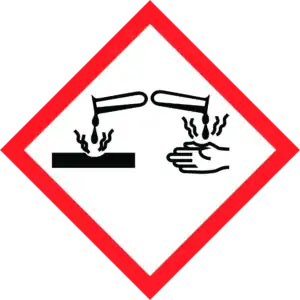
The corrosive symbol shows liquid dripping from test tubes onto a hand and a metal surface inside a red diamond on a white background. It can indicate skin corrosion, serious eye damage or corrosivity to metals. Read the hazard statements to establish which warnings apply to the product (European Parliament and Council, 2008).
What Does the Corrosive Symbol Mean? How to Read the Chemical Label
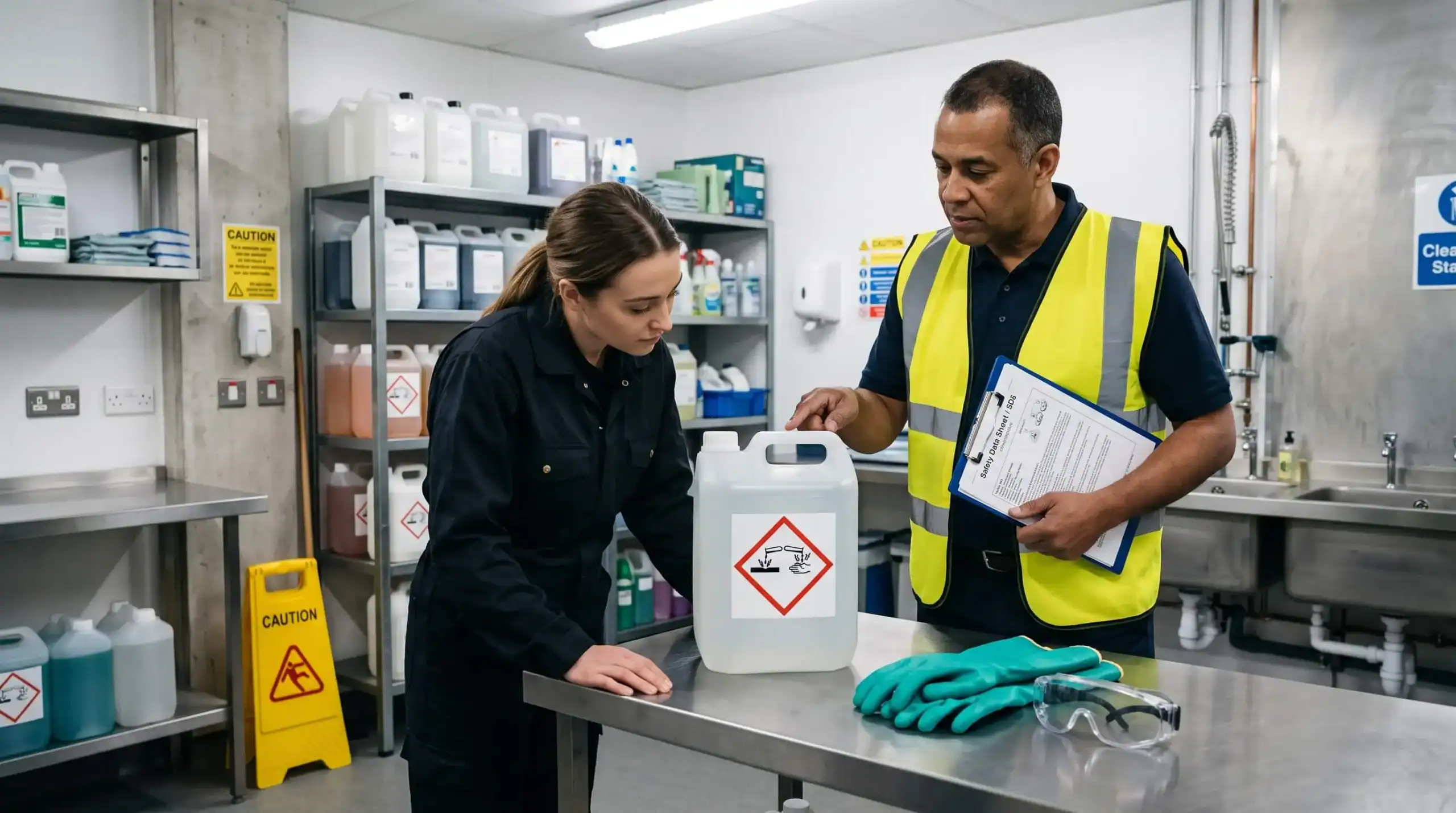
On 2 November 2023, an agency worker at Flowchem UK Ltd was filling smaller containers with drain unblocker. The bulk containers were at shoulder height. She opened the valve on an adjacent container. Its outlet had no end cap, and liquid sprayed onto her face and upper body. She suffered chemical burns. HSE found unsafe working arrangements, inadequate training and supervision and insufficient first-aid provision. The company was fined £50,000 on 12 February 2026 (HSE, 2026c).
HSE’s report does not say the worker misunderstood a chemical symbol. Its findings concern how the chemical was handled. Understanding the label should lead to checking those working arrangements, including what happens if the product escapes.
What Hazards Can the Corrosion Pictogram Indicate?
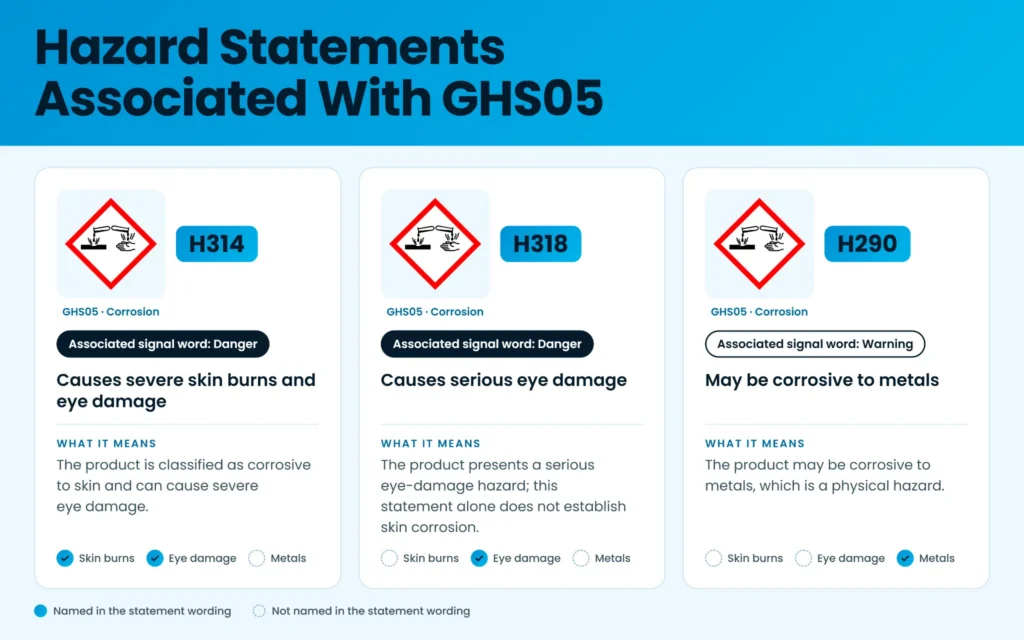
The corrosion pictogram can represent three hazards. A product may have one or more of them, so read its hazard statements to identify which apply (European Parliament and Council, 2008).
| Hazard Statement | What It Means |
|---|---|
| H314 – Causes severe skin burns and eye damage | The product is classified as corrosive to skin and carries an eye-damage warning. |
| H318 – Causes serious eye damage | The product presents a serious eye-damage hazard; this statement alone does not establish skin corrosion. |
| H290 – May be corrosive to metals | The product can attack metals, which is a physical hazard. |
If H318 appears on a cleaner, the warning concerns serious eye damage. The product need not also be classified as corrosive to skin. A briefing focused only on skin burns could miss the eye-damage warning (HSE, 2026a).
H290 concerns damage to metals. On its own, that classification does not establish a health hazard under COSHH. Any other health hazards and the ways people could be exposed still need to be assessed (HSE, 2025a).
The pictogram comes from the Classification, Labelling and Packaging system, shortened to CLP. Great Britain uses GB CLP, while Northern Ireland uses EU CLP (HSE, 2026b).
People often call these “COSHH symbols”. COSHH stands for Control of Substances Hazardous to Health and concerns controlling workplace exposure (HSE, 2025a). The other chemical hazard pictograms cover a wider range of warnings. Here, the particular hazard statement tells you whether the warning concerns skin, eyes or metals.
How to Read a Chemical Label with the Corrosive Symbol
Read the product name, all pictograms, the signal word, hazard statements and precautions. Check that the product matches the task instructions. A bottle’s appearance or usual shelf position cannot confirm its contents.
Check the signal word as well. “Danger” identifies more severe hazards and “Warning” less severe hazards within the classification system. The corrosive pictogram can accompany either word, depending on the classification (HSE, 2022b; European Parliament and Council, 2008).
Continue to the hazard statements for the specific warning. The precautionary statements describe measures to prevent or minimise harm during use or disposal. Both need to be read before deciding how the product should be handled (HSE, 2022b).
Imagine a cleaning team being issued a new product. The following extract is hypothetical, not a complete label from a real cleaner.
| Label Extract | How to Read It |
|---|---|
| Corrosion pictogram and “Danger” | The product has a more severe hazard; read the statement to identify it. |
| H318 – Causes serious eye damage | The warning concerns serious eye damage, even though the picture shows a hand. |
The supervisor needs to explain the eye-damage warning and confirm the precautions for using this cleaner. Instructions about protection must come from the product information and the workplace assessment. The pictogram alone cannot specify suitable gloves or eye protection.
If the label information is unclear, the supplier’s name, address and telephone number provide a route for asking about the product. Ask the supplier to clarify unclear product information before use (European Parliament and Council, 2008).
What Is the Difference Between Corrosive and Irritant?
For skin, corrosion means irreversible tissue damage, while irritation means reversible damage. The eye classifications make a similar distinction between serious eye damage and eye irritation (European Parliament and Council, 2008).
H318 goes with the corrosion pictogram. H319, “Causes serious eye irritation”, goes with the exclamation mark. Eye irritation concerns effects that are reversible within the classification’s assessment period; serious eye damage includes effects that are not fully reversible within that period (HSE, 2026a).
Suppose the supervisor describes the hypothetical H318 cleaner as “just an irritant”. The team would receive a milder eye-hazard warning than the label carries. Using the actual wording keeps the briefing focused on the damage the product can cause and the precautions required.
An irritant product can still cause harm. The exclamation mark also covers other hazards, including harmful acute toxicity, so it should not be read as an irritant-only symbol (HSE, 2021).
Which Workplace Products May Carry the Corrosive Symbol?
Examples include some drain cleaners, acidic descalers and strong alkaline cleaning products. HSE’s guidance identifies drain-cleaning products, oven cleaners and descalers among the substances employers need to assess, and explains that many cleaning substances can cause corrosive injury (HSE, 2017).
Two cleaners used for the same job may contain different ingredients or concentrations and carry different warnings. Check the actual product’s label and safety data sheet (SDS) to establish its hazards (European Parliament and Council, 2008).
When a replacement product arrives, check its label and safety data sheet against the existing instructions. Do not carry over a dilution method or choice of protection simply because the new container also says “descaler”.
What Should You Check Before Using a Product with the Corrosive Symbol?
Confirm the product and readable label, check the task instructions and make sure the required controls are available. Know what to do if the product spills or someone is exposed.
The SDS provides fuller information about hazards, handling, storage and emergency measures. It supplies information for the employer’s assessment; it is not the assessment itself (HSE, 2025b).
Safety data sheets and COSHH assessments serve different purposes. The assessment must consider how the chemical is used, who could be exposed and which controls are needed. Dispensing a small quantity through an approved system and pouring from a bulk container create different opportunities for exposure (HSE, 2025a).
At Flowchem, the position of the bulk containers and the unprotected outlet affected what happened when a valve was opened. The investigation also found weaknesses in training, supervision and first-aid arrangements (HSE, 2026c). Those findings show why an explanation of the label must connect with the equipment and method used for the job.
- Confirm the product identity and readable label, including after any authorised transfer into another container.
- Check the relevant SDS and workplace assessment or instructions for the hazards and approved method.
- Follow the approved handling or dispensing method, including any specified dilution instructions, without improvising a transfer or mixing method.
- Confirm that required control equipment and suitable personal protective equipment (PPE) are available and that you know how to use them.
- Know the spill and exposure arrangements, including how to raise the alarm and obtain first aid.
The employer needs to provide workable controls and instructions. Workers should not have to devise their own precautions before starting a job (HSE, 2025a; HSE, 2025c).
If information is missing, a container is damaged or a required control is unavailable, stop and refer it to the supervisor. Never use an unidentified product. Follow the site’s container-identification procedures and handling, storage and disposal arrangements for that product (HSE, 2017).
Applying Chemical Hazard Knowledge at Work
Employers need workers to understand the hazards, precautions and emergency arrangements relevant to their work (HSE, 2025d). A useful follow-up is to ask a worker to explain their product’s warning and show the approved method. Difficulties may reveal unclear instruction or a working arrangement that needs reviewing.
Human Focus COSHH Awareness Training provides foundational awareness of hazardous substances, handling, storage, disposal and emergency procedures. Employers can build on that foundation with instruction on their own products and equipment, reinforced through supervision. Course completion alone does not establish that the controls are suitable or that a worker can apply them during the task.