When Should You Use a Dynamic Risk Assessment? 7 Workplace Situations

when is a dynamic risk assessment used

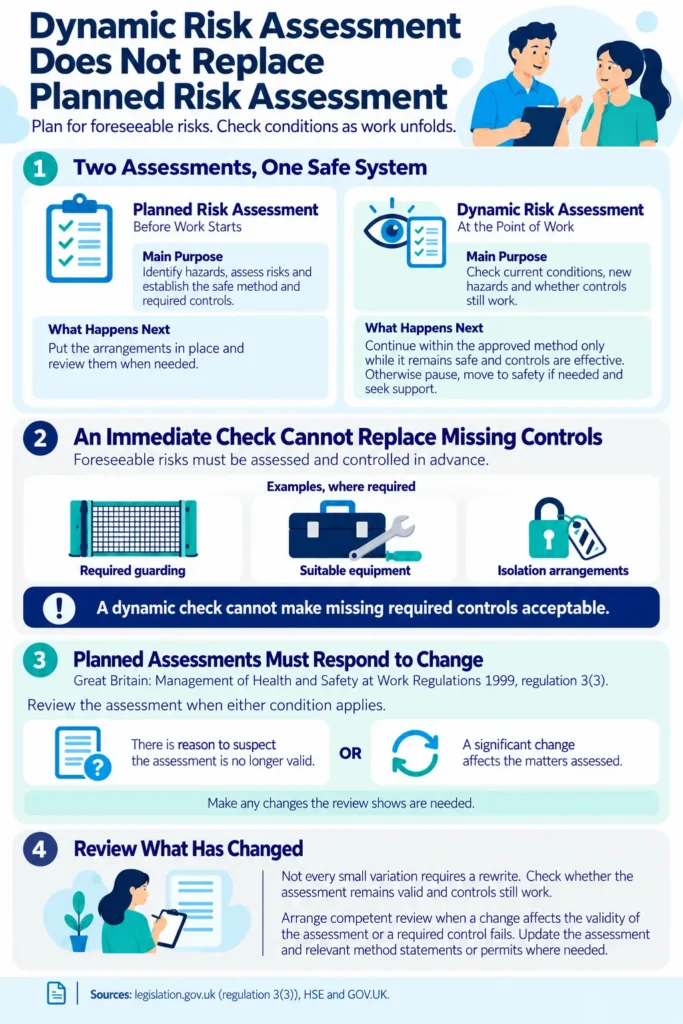
Use a dynamic risk assessment before or during work when changed conditions, new hazards or failed controls could make the planned method unsafe. Check whether controls still protect people, even if the task is unchanged. It supplements planned assessment. Continue only within the approved method and your authority, or pause, withdraw and seek support.

An agreed method may work until something changes on site. A delivery route is blocked, a required handling aid is missing or machinery starts making an unfamiliar noise. The worker then needs to check whether the task can still proceed safely.

That decision depends on the controls available and the authority to act. A worker who pauses needs a safe next step, whether that means restoring access, obtaining equipment or asking a supervisor to arrange an investigation.

When Routine Cleaning Became a Machinery Investigation

On 15 October 2024, a Duncan Farms worker was carrying out routine cleaning when he heard an unusual noise from an egg-collection conveyor.

He climbed between two manure conveyor belts to investigate while the machinery was running. His clothing caught between a roller and the upper belt. A colleague used an emergency stop to halt the machinery. The worker suffered nerve damage in both arms (HSE, 2026b).

HSE found that the worker had been trained to stop the machinery. The company had risk assessments covering entanglement, but no fixed or interlocking guarding to prevent access to the dangerous moving parts at the conveyors’ drive end (HSE, 2026b).

The task had shifted from cleaning to investigating a possible fault. That needed a safe method for stopping and making the machinery safe. Dynamic risk assessment could support the decision to pause, while guarding had to prevent access to dangerous parts.

When Should You Use a Dynamic Risk Assessment?

A dynamic risk assessment is an immediate check of hazards and controls where work is taking place. Use it before or during work when actual conditions could make the planned method unsafe, or when a safeguard the task relies on stops working.

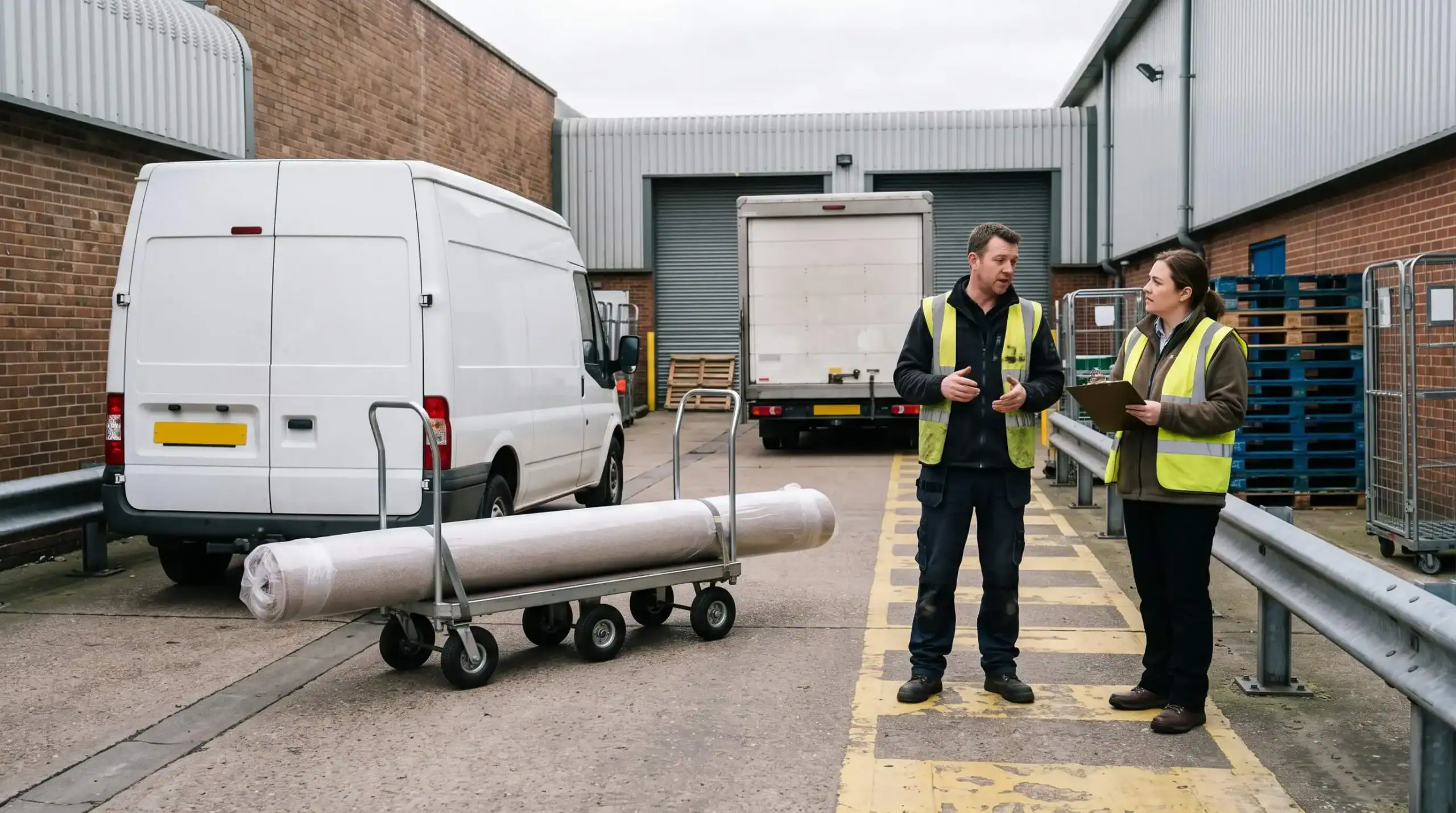
HSE’s carpet-retail guidance describes unexpected access problems on arrival, including obstructions and other deliveries (HSE, 2015).

If risk remains high and controls cannot be applied, HSE recommends contacting the line manager. The delivery may need to change or be abandoned (HSE, 2015).

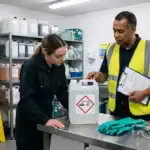
The supervisor needs to explain the eye-damage warning and confirm the precautions for using this cleaner. Instructions about protection must come from the product information and the workplace assessment. The pictogram alone cannot specify suitable gloves or eye protection.

If the label information is unclear, the supplier’s name, address and telephone number provide a route for asking about the product. Ask the supplier to clarify unclear product information before use (European Parliament and Council, 2008).

7 Workplace Situations That Call for a Dynamic Risk Assessment

These dynamic risk assessment examples are illustrative situations, rather than reported incidents.

1. Access at the Worksite Differs From the Plan

A carpet delivery is planned around a trolley and clear access. On arrival, another vehicle blocks the driver’s agreed unloading route. A longer route could expose people to moving vehicles or require more carrying.

Check whether there is a clear route for the trolley and whether people can be kept separate from vehicle movements.

If the retailer can clear the agreed route safely, the driver can check it before unloading. If no suitable route is available within the approved arrangements, pause the delivery and contact the manager. A different carrying method needs competent review.

2. An Unexpected Hazard Appears During the Task

A maintenance worker opens a panel and finds leaking fluid. The substance has not been identified, so the worker cannot yet judge the exposure risk. Anyone approaching the area might also slip in the spill.

Pause and avoid contact. Warn others and make the area safe only where the worker has the competence and instructions to do so.

The task needs to wait until the leak has been identified and an authorised response agreed. Guessing from its appearance does not provide enough information to continue.

3. A Planned Control Is Unavailable

A team is ready to move a load, but the handling aid specified in the method is unavailable. Moving it by hand would expose workers to a handling risk the aid was intended to control.

Check what the approved method requires. If it depends on the aid, arrange the equipment or obtain a competent review of an alternative before moving the load.

The same principle applies when a required second worker is absent. Asking one person to manage alone changes the arrangements on which the assessment relied.

4. Another Work Activity Changes the Risk

A contractor starts moving plant through an area where another team is working. People who were separated from vehicles may now be in their path.

Pause the affected work and contact the supervisors responsible for both activities. Check whether people and plant can still be separated, or whether the jobs need to happen at different times.

Agree the arrangements, tell everyone affected and check they are in place before restarting.

5. Weather or Environmental Conditions Deteriorate

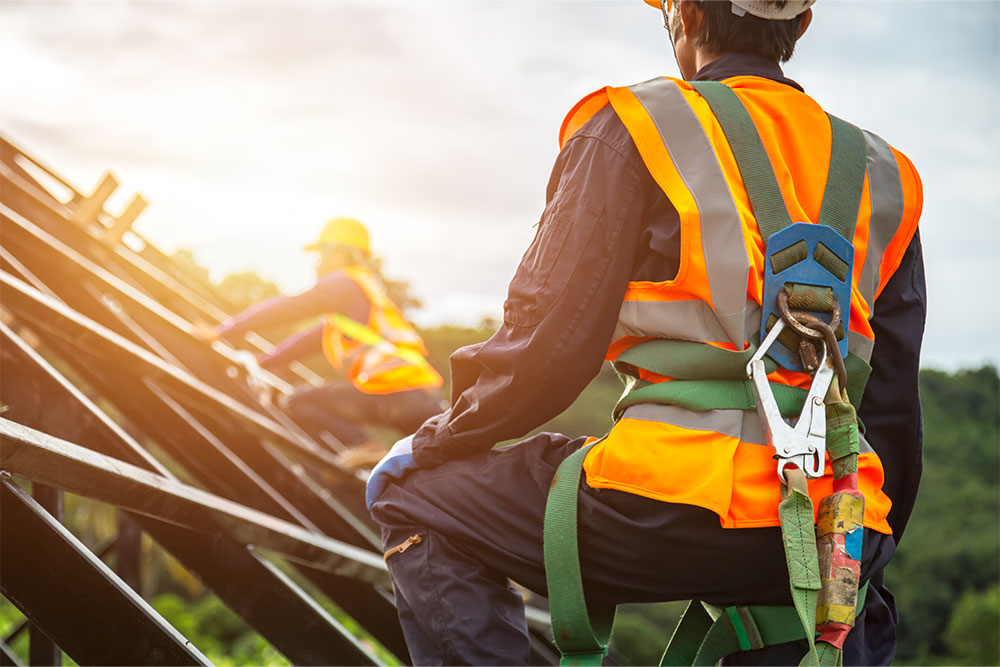
Rain starts during outdoor access work. A surface that was dry is now slippery; increasing wind may also affect stability and expose workers to falls.

Check the equipment instructions, the task’s weather limits and the safe method. If the necessary controls cannot be maintained, suspend the work and use the agreed route to safety.

For roof work, HSE advises against access in poor weather or slippery conditions (HSE, 2026a). These changes need to be considered in the working-at-height risk assessment for the task.

6. Equipment Develops a Fault During Use

A tool’s guard is damaged while the tool is being used. The tool may still run, but the operator could now reach dangerous moving parts or be struck by ejected material.

Stop using it and follow the reporting and authorised isolation procedure. Tell others that the equipment is unavailable for use. Do not improvise a repair.

HSE advises against using faulty or damaged equipment and says maintenance should be carried out by competent people (HSE, 2024a). Use the equipment again only once the fault has been addressed and it is confirmed safe under the relevant procedure.

7. A Lone Worker’s Contact Arrangements Fail

A lone engineer loses the communication link used for agreed check-ins during a remote repair. If that link is also needed to summon assistance, the worker could be left without support in an emergency.

Follow the agreed loss-of-contact procedure. If no approved alternative is available, pause or withdraw as instructed and arrange support before restarting.

HSE advises employers to set limits on lone work and regularly test contact and emergency systems (HSE, n.d.). The repair task may be unchanged, but the arrangements that made working alone acceptable have changed.

How to Carry Out a Dynamic Risk Assessment

How to Carry Out a Dynamic Risk Assessment

The delivery driver needs to make the check before moving the load. These practical steps apply general assessment guidance to the conditions on arrival (HSE, 2024b).

In serious and imminent danger, go to safety first. Regulation 8 requires procedures enabling people to stop work and reach safety in serious, imminent and unavoidable danger (UK Government, 1999b). Assessment and paperwork must not delay withdrawal.

  1. Pause safely before the changed conditions expose anyone to harm.
  2. Identify what changed and who could be harmed, including people nearby.
  3. Check the risk and controls, considering how likely harm is, how serious it could be and whether the required safeguards work.
  4. Continue only if the controls work and the approved method is within your competence and authority; otherwise stop and seek support.
  5. Tell those affected and record relevant findings, including the change, action, responsible person and restart decision, as required by procedures.
  6. Check before restarting that controls are in place, then keep checking as conditions change.

These are practical steps, not a prescribed HSE six-step method. Not every observation needs a new form. If you lack the information or competence to judge a hazard, seek advice.

What Managers Need to Put in Place Before Workers Make Dynamic Decisions

At one water utility, researchers observed crews frequently stopping their own work by handing a job to another crew. The workers saw these decisions as finding a suitable way to complete the job (Havinga et al., 2021).

The study suggests that workable alternatives could support stopping decisions. It cannot demonstrate fewer injuries, but raises a practical question about the options workers have after stopping.

For the carpet driver, that means a manager who can contact the retailer and arrange suitable access or a different delivery.
For machinery work, it means a reporting procedure and competent people who can investigate a fault using the appropriate isolation and other safety precautions (HSE, 2024a).

For the lone engineer, it means a tested contact system, suitable monitoring and someone able to arrange support (HSE, n.d.).

Before assigning work, make the assessment and safe method available. Provide instruction for the task, the equipment needed and clear limits on changes workers may make.

Set reachable escalation contacts and agree who can authorise restarting. Support workers who pause unsafe work.

Repeated reports of blocked access or failed check-ins need changes to the arrangements before another worker encounters the same conditions.

Build the Knowledge to Contribute to Risk Assessments

Prepare managers, supervisors and employees to contribute to risk assessments and recognise when changing work calls for a review. Human Focus Risk Assessment Training builds their understanding of how to judge which hazards need action and whether the chosen controls are suitable.

Apply this learning alongside task-specific instruction, practical experience and supervision. Employers need to confirm that those carrying out assessments are competent for the work involved.

Frequently Asked Questions

Is a Dynamic Risk Assessment a Legal Requirement?

In Great Britain, the legal requirement is for suitable and sufficient risk assessment and relevant review. The Regulations do not prescribe a separate method called “dynamic risk assessment” (UK Government, 1999a). Whether immediate reassessment is needed depends on the work and the changes encountered. The employer must still control the risks.

Does a Dynamic Risk Assessment Need to Be Recorded?

Calling an assessment “dynamic” creates no recording exemption. Great Britain employers with five or more employees must record significant findings and employee groups especially at risk (UK Government, 1999a). Smaller employers still need to assess risks. Other duties and company procedures may require records. Prioritise safety, then record what is required.

References

(HSE, 2015) Reducing manual handling risks in carpet retail, INDG439(rev1), September 2015, especially pp. 7–8.

(HSE, 2026a) Construction: work at height, roof-work weather guidance; page dated 11 March 2026.

(HSE, 2026b) Egg farm fined after worker trapped in running conveyor machinery. Published 13 May 2026; incident on 15 October 2024.

(HSE, 2024a) Maintenance of work equipment; updated 19 November 2024.

(HSE, 2024b) Steps needed to manage risk; updated 10 June 2024.

(HSE, n.d.) Lone working: training, supervision and monitoring.

(UK Government, 1999a) Management of Health and Safety at Work Regulations 1999, regulation 3.

(UK Government, 1999b) Management of Health and Safety at Work Regulations 1999, regulation 8.

(HSENI, n.d.) Risk assessment; identifies the separate Northern Ireland 2000 Regulations.

(Havinga et al., 2021) Havinga, J., Bancroft, K. and Rae, A. “Deciding to stop work or deciding how work is done?” Safety Science, 141, 105334. DOI 10.1016/j.ssci.2021.105334.

About the author(s)

Human Focus Editorial Staff comprises a dedicated collective of workplace safety specialists and content contributors. The team shares practical guidance on human factors, risk, and compliance to support safer, more effective workplaces.

Share with others
You might also like

Popular Courses

Legionella Risk Assessment Training
Legionella Risk Management Principles for Responsible Persons
View Course Details
IOSH Managing Safely
View Course Details
GDPR Awareness Training Course
GDPR Training
View Course Details
LOTOTO online training course
Safe Isolation – Lock Out, Tag Out, Try Out (LOTOTO) Training
View Course Details
spill kit training
Spill Kit Hazardous Substances Training
View Course Details

Recent Articles

Work-Life Balance Policy
Work-Life Balance at Work: How Employers Can Personalise Flexibility Without Creating Unfairness
What Does the Corrosive Symbol Mean
What Does the Corrosive Symbol Mean? How to Read the Chemical Label
what is ransomware
Ransomware: What It Is and How Businesses Can Reduce the Risk and Impact
what is smishing
What Is Smishing and How Does It Work?
social engineering attacks
Social Engineering Attacks: Types, Examples and Prevention

Current Offers

BSA course
Building Safety Act Training

Original price was: £35.00.Current price is: £28.00. +VAT

PUWER
PUWER Leadership Skills for Supervisors

Original price was: £125.00.Current price is: £100.00. +VAT

PUWER
PUWER Inspector Training

Original price was: £495.00.Current price is: £396.00. +VAT

PUWER
PUWER Essentials for Maintenance and Support Staff

Original price was: £125.00.Current price is: £100.00. +VAT

carbon literacy course
Carbon Footprint Reduction

Original price was: £95.00.Current price is: £76.00. +VAT