In short: Proportionate safety is a practical approach that helps small businesses meet their health and safety duties by matching controls to actual risk levels. Rather than copying the complex systems built for large organisations, small businesses can use their direct access to the work and the people doing it to build simple, effective safety arrangements that comply with the Management of Health and Safety at Work Regulations 1999.
Proportionate Safety: Why Small Businesses Do Not Need Big Systems
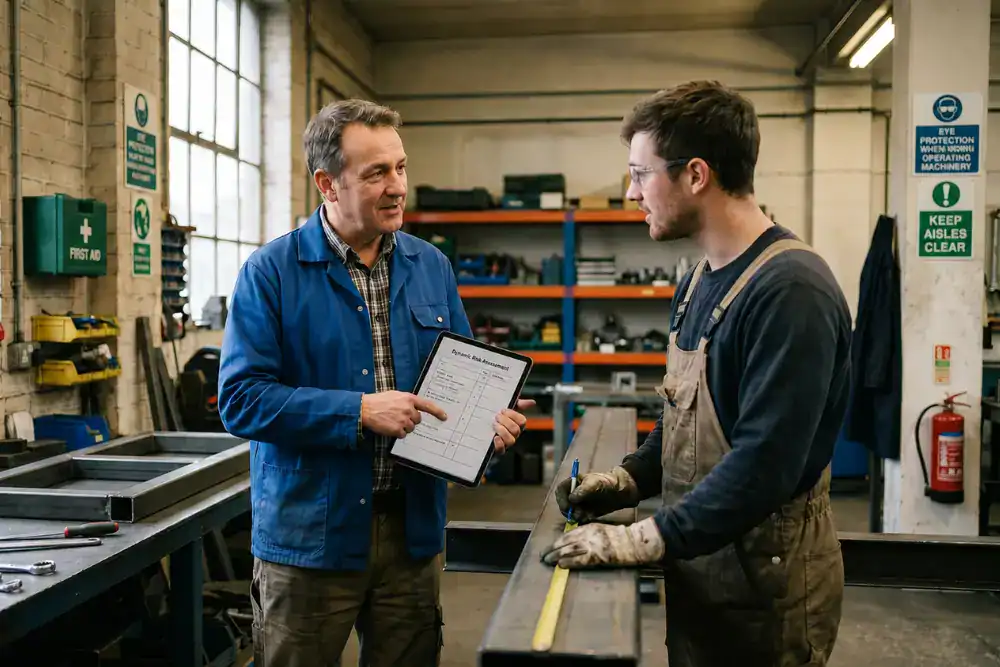
A health and safety small business proportionate approach helps owners meet their duties by matching controls to the real risks in their work, rather than copying the complex systems used by larger organisations. This article explains what it means, why it works for smaller organisations and how to put it into practice by matching controls to how work is actually carried out rather than copying the paperwork built for larger organisations.
In many organisations, safety guidance and templates are designed for large employers – built to bridge a gap between senior management and day-to-day work that often does not exist in a smaller setting.
The sections below set out what proportionate safety means in practice, what direct advantage small businesses already have and how to use that access to build arrangements that meet the Management of Health and Safety at Work Regulations 1999 – without importing the complexity those regulations were never designed to require of smaller employers.
Key Takeaways
- Small businesses often have direct visibility of the work – the same day-to-day understanding of how tasks are actually carried out that larger organisations try to rebuild through inspections, audits and workforce engagement.
- A proportionate safety approach means matching the level of control to the actual risk, not reducing the effort to the lowest possible level.
- Controls are unlikely to work reliably if they are designed without seeing how the task is carried out in practice.
- Watching the work and speaking to the team requires strong safety knowledge because managers must judge whether the controls are likely to hold up in real conditions.
Why Do Large Organisations Depend on Systems?
Large organisations depend on safety management systems because their size creates a distance between the people doing the work and those responsible for managing health and safety. Systems help them maintain control across that gap.
Senior health and safety professionals may cover several sites, shifts and departments. They cannot see every task being carried out, so they rely on reports, audits and management systems to understand how work is being done.
That account of the work changes as it moves through the organisation. A worker reports what they consider relevant. A supervisor interprets it and decides what to escalate. By the time the information reaches senior managers, it may no longer describe the task as carried out. It may describe the version of the task that has survived each layer of reporting.
A large safety management system is not, by itself, evidence that risk is being managed well. In large organisations, such systems are often needed because senior managers do not have direct sight of day-to-day work. The system helps maintain control where direct observation is limited.
That pattern of accumulation matters for small businesses because these are the systems they are most likely to copy. Research on large-organisation safety management systems found that they tend to grow through accumulation – new checks, forms and procedures are added after incidents, while older requirements stay in place long after they have stopped improving safety (Rae et al, 2018). The system becomes a record of every concern the organisation has ever had, rather than a practical guide to managing the risks that exist today.
So, when a small business downloads a template or borrows a procedure from a larger organisation, it is not inheriting a clean, well-designed system. It is inheriting that accumulation, built for an organisation with multiple sites, layers of management and a gap between the people responsible for safety and the people doing the work. That gap is precisely what the system was designed to bridge. In a small business, where the owner can watch the work directly and speak to the team without going through layers of reporting, that gap often does not exist. Copying the system does not remove the problem. It imports one.
Health and Safety Courses
Our health and safety courses support legal compliance and effective risk management. They raise awareness of common workplace hazards and teach the fundamentals of safe working.
What Advantage Do Small Businesses Already Have?
Small businesses already have the direct oversight that large organisations often pay consultants or build audit teams to recreate. An owner gains this simply by being present in the workplace each day. The distance that drives large organisations towards complex safety systems is often absent in a smaller setting – an owner can watch the work, talk to the people doing it and notice when something is not working, without going through layers of reporting.
Research on health and safety in small businesses supports this: effective approaches tend to be simple, low-cost and based on direct contact with the work and the people doing it (Hasle and Limborg, 2006). That is not a lower standard. It is a description of how safety works well in a smaller setting.
Direct contact with the work is the starting position for small businesses. It is a better one than most small business owners realise. But it only becomes useful when treated deliberately.
When Does Proximity Stop Being a Safety Advantage?
Proximity alone does not make work safer. The same research that identifies direct contact as a strength also finds that workers in small businesses can face higher risks than those in larger organisations, and that controls are often weaker (Hasle and Limborg, 2006). Being close to the work provides the opportunity to manage it well. It does not do the managing on its own.
The reason proximity can fail is straightforward. When there is little distance between the owner and the workforce, workers may find it harder to raise concerns, not easier. The person they need to speak to is also the person who sets their hours and signs their wages. If the relationship is under any strain, concerns tend to stay unspoken.
Most owners assume this is not a problem because nothing has been raised recently. That is not evidence that the team feels comfortable speaking up. It may be evidence of the opposite.
Proximity only works as a safety control when it is used actively. That means asking specific questions about specific tasks, not leaving a general open door. Workers are far more likely to raise a problem when asked directly about something concrete than when given a broad invitation to speak up.
What Does “Proportionate” Actually Mean?
A health and safety small business proportionate approach means having safety arrangements that accurately match the work and the level of risk involved – not producing more paperwork than the job needs, nor less control than the job requires.
The Management of Health and Safety at Work Regulations 1999 (MHSWR, 1999) require risk assessments to be “suitable and sufficient”. A detailed template, long method statement or policy copied from a larger organisation may look thorough, but it does not prove the assessment is right. The real test is whether the hazards have been understood and the controls are enough to protect people doing the work.
For a small business, proportionate does not mean building a scaled-down corporate safety system. It means having arrangements that fit the way the work is actually done.
The risk is mistaking “proportionate” for “minimal.” A high-risk task, such as working at height, operating plant or using hazardous substances, still needs proper assessment and effective controls. It should not be treated with the same brief checklist used for a low-risk office task.
Being small does not lower the standard of protection required. It only changes how you meet that standard. The controls can be simple, but they must still be suitable for the risk.
How Should a Small Business Build Effective Safety in Practice?
Good safety in a small business is built into the work by following five practical steps: watch the job, focus on what matters, keep controls realistic, involve the team and lead it visibly. Each step is set out below.
1. Watch the work before writing any control.
Watch how workers actually do the task before setting any controls. Ask where the job becomes difficult, where people have to adapt, and where the documented method does not match real conditions. A procedure written from memory describes the job as the owner thinks it happens. It may not describe the job as workers actually do it. If no one has watched the task, important hazards can be missed.
Writing the procedure before observing the work is where many small businesses go wrong. Writing the procedure is quicker than observing the work, so the document gets done first. The result is paperwork that describes a safer version of the task than the one being carried out. A template risk assessment can look complete even when no one has checked the work. The real test is whether the assessment identifies the hazards workers actually face and sets controls they can follow.
2. Focus time and attention on where things actually go wrong.
Not every task needs the same level of attention. More time should go into tasks where someone could be seriously harmed, or where workers regularly change the method to get the job done.
Applying the same level of paperwork to every task can look organised, but it can waste time. A business may end up spending too much effort on low-risk activities while giving too little attention to work at height, workplace transport, machinery, plant or hazardous substances. The question is not, “Have we assessed everything in the same way?” The better question is, “Have we spent the most time on the work that could hurt someone most seriously?”
3. Keep controls practical and easy to follow.
If a control is hard to follow during normal work, workers are less likely to use it. Short, clear instructions are more likely to be followed than long documents that people do not read or cannot apply on the job. Controls are often bypassed when they require equipment that is unavailable, add unnecessary steps or slow the job down without a clear safety reason.
This does not mean the team is careless. It often means the control was written at a desk and never tested where the task happens. A good control should fit the job closely enough that workers can follow it under normal time pressure.
4. Involve the people doing the work.
The best way to check whether a control is likely to work is to ask the people expected to use it. Workers usually know where the job becomes awkward, where existing controls do not fit and how the task is actually completed when time, space, tools or staffing are not ideal.
If the owner writes the documented procedure without speaking to them, the document may not match the work. HSE guidance is clear that employers must consult employees during risk assessment because the people doing the work know the risks, possible shortcuts and practical problems (HSE, n.d.).
Consultation turns the control from something imposed on workers into something they can understand, use and challenge when it does not work.
5. Lead safety visibly – do not just document it.
In a small business, safety needs visible leadership. The owner does not need to create a formal management system, but they do need to show that safety matters during the working day. That means checking equipment, asking about problems, watching higher-risk tasks and acting when workers raise concerns. If the owner only completes the paperwork and files it away, the team is likely to take a clear message from that: safety is something to document, not something to manage.
Done properly, safety should clarify the job. If workers see the controls as unnecessary, impractical or impossible to follow, the control needs reviewing.
Why Does Keeping Safety Simple Require Trained Workers?
Keeping safety simple requires trained workers because a proportionate approach depends on the people closest to the work being able to recognise unsafe conditions as they arise – and training is what gives them that ability.
A worker may know when a task has become awkward, when equipment is missing or when the usual method has changed. But knowing the job well does not always mean knowing when to stop, report the issue or use a different control. Training gives workers that ability. It helps them recognise that an improvised lift, a missing guard or poor ventilation is not just inconvenient – it may mean the task should not continue until the problem has been fixed.
Regulation 13 of the Management of Health and Safety at Work Regulations 1999 (MHSWR, 1999) requires employers to provide adequate health and safety training. In a small business, adequate training must be specific to the work being done. Workers need to know the main hazards in their tasks, the controls they must use and what to do when those controls are missing, damaged or no longer effective.
General awareness training is not enough. A worker may know that risk assessments are required, but still not know that a damaged guard, missing access equipment or failed extraction must be reported before work starts. Training must make clear what workers are expected to check, what they can deal with themselves and when they must stop and escalate the problem.
Direct access to the work is only useful when the people watching it know what unsafe work looks like. Without that competence, hazards can be seen every day and still go unchallenged.
How Does Human Focus Help Small Businesses Build Proportionate Safety Competence?
Human Focus helps small businesses build proportionate safety competence by providing awareness training targeted at the hazards small businesses encounter most – giving workers and supervisors the knowledge to recognise unsafe conditions, question controls that do not fit the task, and raise concerns before shortcuts become routine.
Human Focus’s awareness library is built around the risks that small businesses encounter most regularly. Courses cover manual handling, working at height, fire safety, hazardous substances and display screen equipment – the areas where workers are most likely to be seriously harmed and where controls most often fail in practice.
Explore the Human Focus awareness library to build practical health and safety knowledge and competence across your team.