Two people on the same team can want very different things from their working week. A parent might need to finish at 3pm for the school run, while a colleague with a long commute would rather work fewer, longer days on site. A single work-life balance policy will rarely suit both of them.
Judging each request on its merits gets round that, though a yes for one person and a no for the next can easily look unfair. This guide shows employers how to personalise flexibility fairly while keeping the work covered.
Work-life balance at work means employees can meet the demands of their job without those demands regularly crowding out their health, rest, relationships and responsibilities outside work. It depends on workload, location, control, recovery time and boundaries as well as hours.
That is why fewer hours or more homeworking do not automatically improve it. Someone working from home can still be stretched if they are expected to answer messages late into the evening. A site-based worker with predictable shifts and a manageable workload can have good balance without ever working from home.
What people need from work changes with life stage, caring responsibilities, disability or health conditions, commuting and personal preference. Role matters too: a policy built around homeworking offers little to someone running a production line or working rotating shifts.
Access to flexibility is often uneven. In CIPD’s 2025 survey of 2,050 HR professionals, two-fifths (40%) of employers offering flexible working said just some or only a few employees are able to use it. A separate CIPD survey of 5,017 working adults suggests around 1.1 million UK workers left a job in the year to early 2025 because of a lack of flexible working.
Employees can ask for the arrangement they would prefer, but a fair decision weighs what the role needs alongside what the person needs.
Colleagues in the same team can end up with different arrangements and still be treated fairly, provided their requests were judged against the same criteria and the reasons were written down.
Before any individual conversation, write down what each role has to deliver and any fixed times or places involved.
Typical non-negotiables include minimum cover, service hours, safety-critical tasks, supervision, core collaboration times and any days on site.
Clear boundaries make it easier to say yes to flexibility within them, and to explain a no consistently.
Homeworking only helps people whose job can be done from home, so offer a wider choice:
- flexible start and finish times
- compressed hours
- part-time working and job shares
- remote or hybrid working where the role suits it
- shift swaps and self-scheduling windows
- predictable rotas published well in advance
- task-based flexibility, such as protected focus time
Home and hybrid working still carry health and safety duties, so check our guide to managing the health and safety of homeworkers.
The table below matches common needs to options, with the check to make first.
The same job title can cover quite different work. Break each role into its main tasks and ask of each whether it is tied to a set time, place or both.
A warehouse supervisor’s time on the floor is fixed by shift and location, but rota planning and reporting may not be. A care team has to keep minimum staffing levels, though shift swaps or self-scheduling within agreed windows may still be possible. Mapping tasks this way shows where flexibility is possible and gives frontline staff real options.
Ask what problem the employee is trying to solve before discussing solutions. “I need to be home by 4pm on Tuesdays” opens up more options than “I want to work from home”.
Avoid assuming what someone needs from the group they belong to. Parents, carers, older workers and disabled employees vary as much as anyone else: one parent may want shorter days, while another wants the same hours on a different pattern. Explore a couple of options together, and agree a trial with a review date where the impact is uncertain.
If one manager approves almost every request and another refuses by default, staff soon notice, and personalised flexibility starts to look like favouritism. Give managers:
- shared decision criteria linked to each role’s non-negotiables
- a simple template to record the request, options discussed, decision and reasons
- an escalation route for borderline or competing requests
- a schedule for reviewing arrangements
Requests from people in similar roles should get consistent answers, for reasons a manager could explain to everyone involved.
Well-trained managers are also better placed to support employee wellbeing, including better mental health in the workplace.
Flexible hours do not reduce an excessive workload. Someone on compressed hours with an unrealistic workload is still overloaded, just across four days instead of five.
HSE estimates that 964,000 workers in Great Britain were suffering from work-related stress, depression or anxiety in 2024/25, which accounted for 22.1 million working days lost. Workload pressures and a lack of managerial support are the main causes workers cite.
Employers have a legal duty to protect workers from stress by assessing the risks and acting on them. HSE’s Management Standards offer employers a recognised way to assess and manage work-related stress. Our guide on how to deal with stress at work explains how employees can spot and respond to harmful pressures at work.
Training can help alongside these changes. Our online Stress Management Training helps staff and managers tell normal pressure from harmful stress, and act when pressure becomes a problem.
At least once a year, check how flexibility is working in practice by reviewing:
- who requests flexibility and who is approved, by team, role, site and, where you hold the data, protected characteristics
- overtime and out-of-hours working
- sickness absence, including stress-related absence
- retention and exit interview themes
- engagement and wellbeing survey results on balance and fairness
If office staff are approved far more often than frontline staff, or one manager refuses most requests, find out why and put it right.
Personalisation needs boundaries, and not every request can be met as asked. Legitimate operational factors include minimum staffing levels, service hours customers rely on, collaboration that needs people together, health and safety (including supervision and lone working) and business continuity.
A useful test is whether you can back the reason with specifics. “It would set a precedent” is weak. “We need two forklift-trained staff on the early shift, and a later start would leave us with one” is clear.
Where a request cannot work as asked, look for a partial yes, such as the same pattern on a different day or a three-month trial.
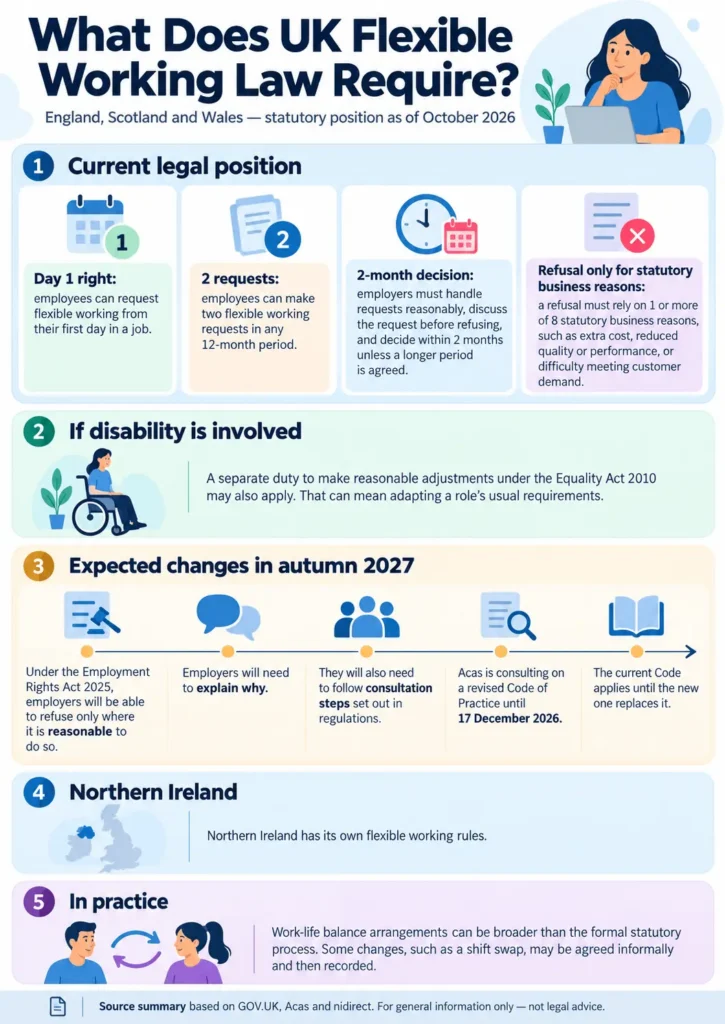
As of October 2026, the statutory position in England, Scotland and Wales is:
- employees can make a flexible working request from their first day in a job
- they can make two requests in any 12-month period
- employers must deal with requests in a reasonable manner, discuss a request with the employee before refusing it and decide within two months, unless the employee agrees to longer
- a refusal must rest on one or more of eight statutory business reasons, such as extra costs that will damage the business, or a negative effect on quality, performance or the ability to meet customer demand
If a request is linked to a disability, the separate duty to make reasonable adjustments under the Equality Act 2010 may also apply, and may mean adapting a role’s usual requirements.
Changes are expected in autumn 2027. Under the Employment Rights Act 2025, employers will be able to refuse only where it is reasonable to do so. They will also need to explain why and follow consultation steps to be set out in regulations. Acas is consulting on a revised Code of Practice until 17 December 2026, and the current Code applies until the new one replaces it. Northern Ireland has its own rules.
Personalised work-life balance is broader than this statutory process. Many arrangements, such as a shift swap, can be agreed informally, then recorded.
Watch for these warning signs:
- Flexibility exists on paper but is rarely requested or approved. CIPD’s 2025 research found three in 10 employees would not feel comfortable requesting formal flexible working.
- Overtime and long hours are still normal.
- People are routinely available outside their agreed hours.
- Different managers make different decisions on similar requests.
- Frontline or site-based teams feel flexibility is only for office staff.
- Sickness absence, stress indicators or staff turnover remain high.
Use this cycle to keep personalised flexibility fair and practical:
- Define business needs, starting with each role’s non-negotiables.
- Understand employee needs by asking what problem each person is trying to solve.
- Match workable options to both business and employee needs.
- Document the boundaries of each arrangement and when it will be reviewed.
- Review outcomes across the workforce and adjust where access or workload looks uneven.
A good work-life balance is one where the demands of your job do not regularly crowd out your health, rest, relationships or responsibilities outside work. What that looks like varies from person to person.
It all starts with setting clear requirements for each role. Then, agree flexible working arrangements with employees individually against shared criteria. Stay on top of any changing requirements and check that workloads stay reasonable.
Common examples include flexible start and finish times, compressed hours, part-time work, job shares, hybrid working, shift swaps, predictable rotas, protected focus time and sensible workloads.
It can, when the arrangement fits both the person’s need and the role. If the underlying problem is excessive workload, reducing the demands themselves will help more than a new pattern.
Managers can start by asking what problem the employee needs to solve, then weigh options against shared criteria. Once an arrangement is agreed, they should respect it and watch for signs of overload.
Yes. Different arrangements can be fair if every request is judged against the same criteria and the real requirements of the role.
Judge every request against the same criteria and keep a record of the reasons. Then check regularly whether some teams or sites are getting less access than others.
Responsibility is shared, but employers have specific legal duties. They must deal with statutory flexible working requests reasonably and respect working time limits and rest breaks. The law also requires them to assess and act on work-related stress risks.