Employers must give workers the right level of information on the hazards they face, the controls in place, and what to do in an emergency (HSE, n.d.-d). That information has to be understandable to the people receiving it and reflect the work as it is actually done—not as it was when the materials were first written.>
Training materials that no longer match current hazards, equipment, or working practices are a serious operational risk. It represents a gap between what workers are being told and what they need to know to work safely.
This article provides practical, evidence-based guidance on closing that gap — structured around when to update, how to approach the content and design, and how to manage the update process over time.
The Health and Safety at Work etc Act 1974 and its supporting regulations require employers to provide information, training, instruction and supervision that ensures the health and safety of employees (as far as is reasonably practicable). HSE guidance makes clear that this includes giving workers the right level of information on hazards, risks, measures in place, and emergency procedures (HSE, n.d.-d).
Producing materials once and leaving them in place is not enough to meet this duty. Where hazards change, new equipment is introduced, or working practices are altered, the materials supporting that training need to change with them.
There is no universal legal requirement to update all training materials annually or at any other fixed interval. Rather, the obligation is to review them when there is reason to do so.
Training material reviews should be triggered by changes to working practices, equipment, or procedures, rather than by a fixed schedule. HSE is clear that new equipment and changed working practices require additional training, and that employers need to check their arrangements are actually working (HSE, n.d.-d; HSE, 2013).
Examples of triggers that should prompt a review of relevant training materials include:
- New or modified equipment, substances, or processes
- Changes to working practices, procedures, or site layout
- An incident, near miss, or enforcement action that reveals a gap in understanding or behaviour
- Findings from inspections, audits, or health and safety monitoring that indicate controls are not being followed as intended
- New or amended legislation or industry guidance
- Changes in the workforce – new starters, role changes, contractors, or workers with different language or literacy needs
Treating these as active review triggers, rather than waiting for a scheduled review date, aligns with HSE’s Plan, Do, Check, Act approach to managing health and safety (HSE, 2013).
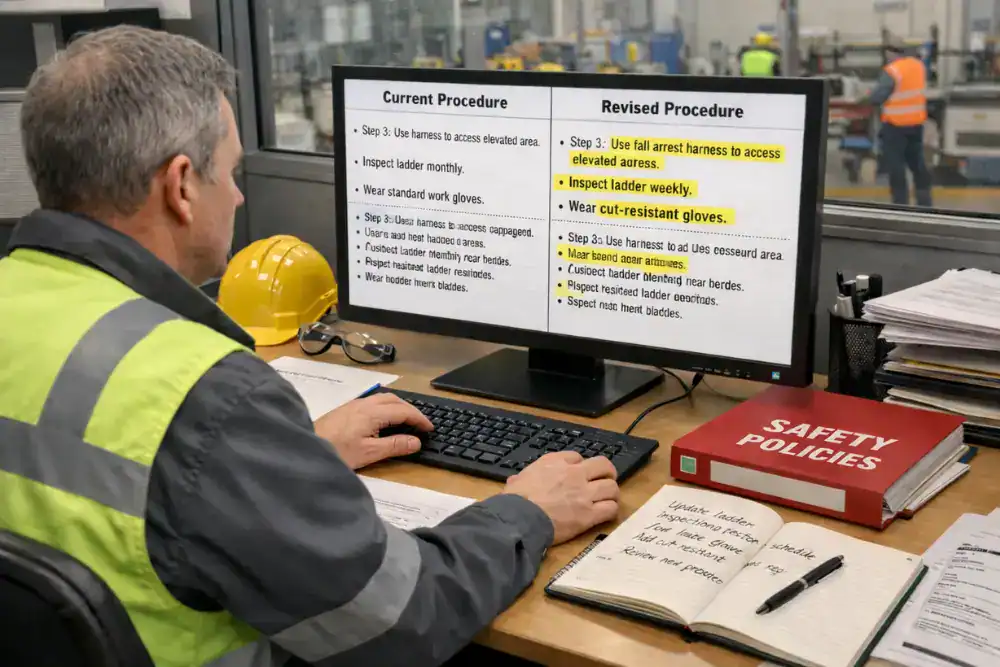
Before updating any training materials, it is important to focus on what has changed in the work itself. The most effective updates are based on current hazards, controls, procedures, and workforce needs.
The question to ask is not “how old is this?” but “does this still reflect how the work is actually done?”
This standard is rarely met, and the reason is structural. Training materials capture what the work was supposed to look like at the time of writing. They do not update themselves as actual practice evolves, and most organisations have no formal mechanism for comparing the two.
Most organisations review risk assessments separately, on a different schedule, through different people. As a result, line managers who know the materials no longer match their team’s conditions often lack the authority or resource to correct them. Nobody owns the fix. It happens not because the gap goes unnoticed, but because it falls between functions.
Review triggers built into the management system catch that drift before it appears in an incident investigation.
HSE guidance states that workers need the right level of information on the hazards they face, the risks from those hazards, the measures in place to control them, and what to do in an emergency (HSE, n.d.-d).
Burke et al. (2011) found that training effectiveness was moderated by the degree to which content reflected actual hazard exposure conditions. Training that was not anchored to the specific hazards, equipment, and procedures of the learner’s role produced weaker knowledge and performance outcomes than task-specific content. The closer the training conditions are to the conditions under which performance is required, the more likely the learning will transfer.
The default when updating materials is to revise existing content rather than rebuild from current sources. This perpetuates legacy risk framings and legacy control logic, even where these have been superseded.
HSE’s Plan, Do, Check, Act approach says employers should have arrangements to check whether their health and safety measures have been implemented and are working effectively, then review performance and take action on what they learn from monitoring, incidents, audits and inspections (HSE, 2013; HSE, n.d.-c).
The NIOSH (2010) systematic review found that many organisations lacked mechanisms for applying learning from adverse events to training systems. Incident investigation findings are produced by safety teams.
Training materials are owned by HR, L&D, or line management. The recommendation to update training appears in the investigation report. Whether it reaches the person with authority to act on it depends on a formal handoff that most management systems do not explicitly build in. The recommendation is documented. The material is not updated. The next investigation finds the same gap.
HSE says that everyone who works for you needs to know how to work safely and without risk to their health, including contractors and self-employed people. It also says some workers may have particular training needs, including new recruits, people changing jobs or taking on extra responsibilities, young employees, and health and safety representatives (HSE, n.d.-e; HSE, n.d.-b).
Burke et al. (2011) found that training produced its largest gains precisely for workers with the highest hazard exposure. Generic materials fail the workers most at risk.
Generic materials persist not because organisations are unaware that roles differ, but because maintaining separate versions requires coordination between safety, operations, and L&D that most management systems do not routinely produce. A central function writes materials to a generalist standard.
Line managers who know the content does not match their team’s specific conditions lack the authority or resource to correct it. The materials pass a compliance audit because they cover the topic.
The workers who needed role-specific content receive the same slides as everyone else. Updating materials is an opportunity to build that coordination in rather than replicate the shortcut.
HSE requires that training be easy to understand (HSE, n.d.-d). An instruction that workers cannot follow under pressure is no instruction at all.
Workers who answer post-training assessment questions correctly may still fail to retrieve and apply the same procedure under the cognitive load of an actual emergency. That failure is most likely where the procedure was written in language that required active translation — dense paragraphs, technical jargon, or abstractions with no operational grounding.
The materials are almost always written by people who understand the subject well. That is precisely the problem. Familiarity with the content makes it difficult to experience how it reads to someone without that background. The assessment tells you the learner can repeat the content. It does not tell you whether they can use it when it matters. Most training delivery does not distinguish between those two questions.
Hutchinson et al. (2022) found that safety training produced its strongest performance gains in higher-hazard industries. Good news, in theory. The problem is that the workers who most need that training are also operating in conditions that make careful engagement with it nearly impossible. They face challenges like:
- Noisy environments
- Time pressure
- Fatigue
The content has to work despite all of that, not assume it away. This is why simple and easy to understand content is a functional requirement, not as a stylistic preference. In demanding work environments, what gets retained is what’s short, concrete, and tied to a specific moment of decision. Everything else fades.
Here’s what tends to happen instead. Each review cycle adds content. New risks get coverage. New regulations get folded in. Incident findings generate new sections. But old content rarely gets cut. Over time, materials become more thorough and less useful — which aren’t the same thing, and in training design, often pull in opposite directions.
Burke et al. (2011) traced poor training outcomes directly to design — specifically, the assumption that more content produces better results. It doesn’t. Materials that grow denser with each revision cycle produce worse recall. The update looks responsible. The performance data disagrees.
Fewer, clearer points, with the most critical actions given prominence, are what actually transfer from training to performance.
Burke et al. (2011) found that participatory training methods consistently outperformed passive delivery on safety outcomes. The reason comes down to what kind of knowledge each format actually builds.
E-learning is reasonably good at two things:
- Teaching workers that a hazard exists
- Explaining what the procedure requires
What it doesn’t build is the ability to execute that procedure correctly under operational conditions. That takes practice, in conditions close enough to the real ones to matter. A screen-based module doesn’t provide that, regardless of how well it’s designed.
Most organisations aren’t making a deliberate trade-off. They’re not choosing e-learning over practical training with any awareness that something is being lost. The module gets assigned, someone clicks through it, and the record shows complete. That’s where the process stops. Nobody asks what the completion actually proves.
Completing training like this only proves that the worker sat through the module. Nothing more. The question of equipping staff to perform the job correctly in challenging circumstances still remains answered. If the learning objective is practical, the assessment needs to be practical too.
Baldwin and Ford found that the gap between completing training and actually changing behaviour was far larger than attendance records suggested (Baldwin and Ford, 1988). A significant share of training investment produced no measurable shift in job performance.
The reason that finding persists is straightforward. Most training objectives are written to describe content coverage, not worker performance. An objective like “workers will understand manual handling procedures” confirms a topic was addressed. It doesn’t give a trainer, a manager, or an auditor anything to observe or test. Nobody can look at a worker and determine whether understanding has occurred.
An observable objective works differently. It specifies what a worker should be able to do when training ends, in terms that can actually be checked:
- Workers will correctly demonstrate a two-person lift using the equipment in their work area
- Workers will identify and report three specific fault conditions on the machinery they operate
- Workers will complete the pre-shift inspection checklist without prompting within the first week of return
Those objectives create a basis for assessment. They also define competence in practical terms rather than administrative ones. Competence is not a signature on a training register. It is demonstrated ability under the conditions where performance will be required.
Focus on observable objectives first when updating materials. Build content around them. Design assessment to test them directly. That sequence gives the update a clear purpose and produces evidence that goes beyond a completion record.
HSE advises that training records support decisions about refresher training (HSE, n.d.-d). Most organisations keep records. The failure isn’t usually a lack of them.
The problem is records that confirm training happened without capturing which workers received which version of the materials. When content gets updated and rolled out progressively across teams or sites, some workers are working from the old version while others have the new one. If something goes wrong during that window, a generic delivery log won’t show what the affected workers were actually trained on.
Version control means treating training materials the way any regulated document gets treated. Each release gets a version number. Changes get logged. And the rollout record ties specific employee groups to specific versions. In practice, that means tracking:
- Which version was in use at the time of each training event
- Which roles and individuals received it
- When delivery occurred, relative to the change that triggered the update
That level of specificity is what turns a record into evidence. A signature and a date confirm an event. A versioned, cohort-level rollout record confirms that the right people had the right information before the point at which it mattered. Those are different documents, and only one of them holds up when an enforcement officer or incident investigator starts asking questions.
A systematic review by the National Institute for Occupational Safety and Health found that safety training can improve knowledge, attitudes, skills, and behaviour, but it did not find evidence that training alone reduces injuries or symptoms (NIOSH, 2010).
HSE presents health and safety management as an ongoing Plan, Do, Check, Act process, not a series of isolated activities (HSE, 2013). ISO 45001 is built around participation, legal requirements, monitoring, and continual improvement, and HSE notes that while certification may help demonstrate compliance, inspectors look at wider evidence than certification alone (HSE, n.d.-a; ISO, 2018).
Updated training materials are an important control. They are not a substitute for safe systems of work, adequate supervision, properly maintained equipment, or a management system that monitors whether controls are working. Organisations that treat retraining as the default response to every safety gap, without addressing the underlying system, are likely to find that the same gaps recur.
A review schedule does not close the gap this article describes. What closes it is someone with the authority and the knowledge to act on what the review actually finds.
Human Focus provides 300+ certified health and safety e-learning courses designed to support organisations in meeting their training obligations. Courses cover core compliance topics and are structured to provide verifiable records of completion, supporting your audit trail. You can see the full list at the Human Focus course library.
Where off-the-shelf courses do not match the specific hazards, roles, or working environment covered by your risk assessments, Human Focus also develops bespoke training tailored to your organisation. Bespoke training supports the role-based, audience-specific approach described in this article, ensuring that what workers receive reflects the work they actually do.