In short: A confined space risk assessment is a structured analysis of a workplace and a planned task that identifies hazards, evaluates the likelihood and severity of harm, and sets out the controls required before anyone enters the space. Under the Confined Spaces Regulations 1997, employers and duty holders must carry out this assessment, document it, and keep it current as conditions change. The HSE’s five-step framework – identify hazards, assess risks, control risks, record findings, review controls – gives the practical structure for producing an assessment that protects people and stands up to scrutiny.
How to Carry Out a Confined Space Risk Assessment
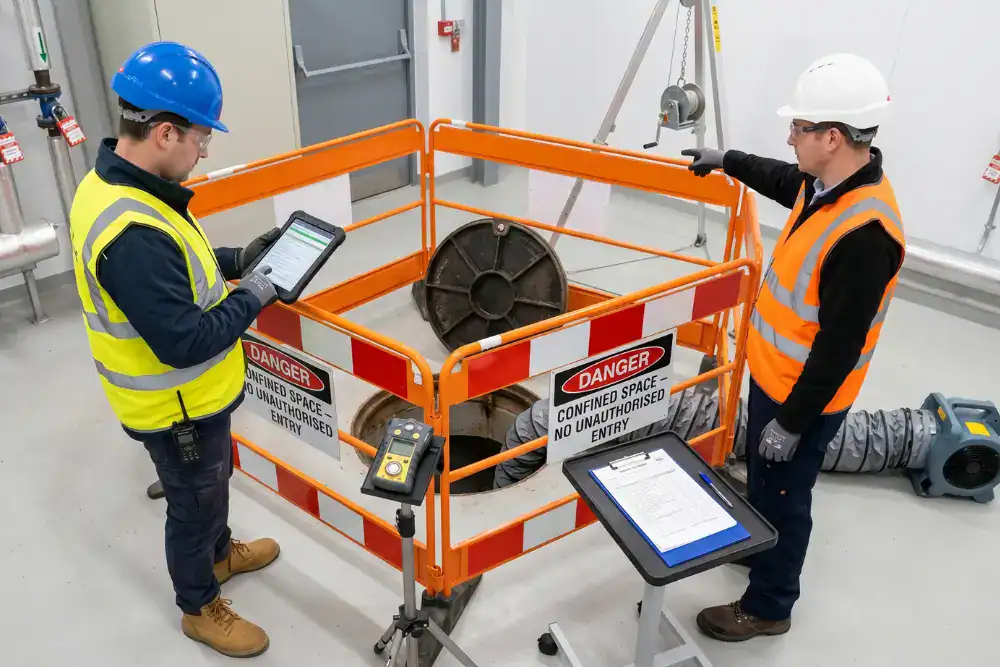
A confined space risk assessment identifies what could harm someone before they enter an enclosed space such as toxic gas, oxygen depletion, flooding, restricted escape. It is the foundation on which every other control depends.
This blog takes managers and duty holders through each step of the confined space risk assessment process, and highlights the failure patterns that recur most often in HSE investigations.
Key Takeaways
- A confined space risk assessment identifies hazards, evaluates risk, and sets controls that are specific to the space, task and people involved.
- The Confined Spaces Regulations 1997 place responsibility on employers and others in control of confined space work to assess and control risks before work begins.
- The Health and Safety Executive (HSE) five-step risk assessment process – identify hazards, assess risks, control risks, record findings, review controls – applies the standard risk assessment framework to the specific conditions of confined space work.
- A defensible assessment must be kept current because changes in people, equipment, substances, methods or incidents can make existing controls inadequate.
What Is a Confined Space Risk Assessment?
A confined space risk assessment is a formal, documented analysis of a specific space and a specific planned task. It must:
- identify the hazards arising from a confined space
- determine the likelihood and severity of harm those hazards could cause
- establish the controls needed to eliminate or reduce that risk
The legal definition of a confined space is any space of an enclosed nature, where there is a risk of serious injury or death from dangerous conditions or hazardous substances (UK Government, 1997). If you need a fuller breakdown of what is a confined space – and what doesn’t qualify – start there.
The purpose of the assessment is not administrative compliance. The assessment is there to ensure the people planning the job have rigorously considered what could harm someone entering that space, and that the controls they put in place reflect those specific hazards. Without a sound assessment, the permit to work (the formal document authorising a named person to do a defined task in a specific space under set conditions) can be reduced to an administrative formality, and the rescue plan can become a document no one has tested against the real internal layout of the space.
Health and Safety Courses
Our health and safety courses support legal compliance and effective risk management. They raise awareness of common workplace hazards and teach the fundamentals of safe working.
Why Is a Confined Space Risk Assessment Necessary?
A confined space risk assessment is necessary because a failure to properly assess a confined space is rarely a small failure – it tends to produce serious harm, criminal liability and substantial financial penalty. Three cases illustrate the pattern.
Stoke-on-Trent, 2011
A maintenance engineer was carrying out repairs inside an industrial cooker when steam from connected equipment fed into the area where he was working. He was badly scalded and died from his injuries the following day. The company was fined £660,000 at the court after admitting health and safety breaches, and ordered to pay £187,000 in costs. The HSE investigation found that precautions had not been taken to isolate the avenues through which steam could feed back into the cooker (BBC News, 2015).
Leicestershire, 2016
Two workers were operating around a tanker of pig feed when one of them fell in. The second worker tried to rescue him; both drowned. Investigators found a lack of risk assessment, inadequate training, and no system to ensure safety at the task. The responsible manager was sentenced to 13 years in prison and the company was fined £2 million (Jackson, 2022).
Kettering, 2022
A maintenance worker at a hospital was tasked with clearing blocked drains. He fell unconscious from severe poisoning by sulphate gases released during the drain work, and was left with ongoing memory loss and nerve damage. The investigation found that the drainage system had not been identified as a confined space at all, the risk assessment was insufficient, and there were no safe systems of work in place. The organisation paid £484,286 in fines and costs (HSE, 2024b).
Three different failure modes – an inadequate assessment, no assessment, and a space that was never even classified as confined. The rest of this article is structured to help you avoid each of them.
What Does the Law Require for a Confined Space Risk Assessment?
The law requires duty holders (employers and others in control of confined space work) to carry out a suitable and sufficient risk assessment for any work in a confined space, to put controls in place that eliminate or reduce the identified risks, and to keep the assessment current as conditions change. In England, Wales and Scotland, confined space work is governed by the Confined Spaces Regulations 1997, supported by the HSE’s Approved Code of Practice (L101) – the official guidance document that inspectors refer to when judging compliance with the Regulations. The Regulations set out who is responsible, what must be assessed, and what controls must be in place (HSE, 2014) (UK Government, 1997).
Who Carries the Duty
The duty falls on employers and on anyone in control of confined space work – managers, supervisors, and principal contractors (the lead contractor appointed to manage health and safety on a construction project). If you plan, authorise or supervise the work, you carry the legal responsibility for ensuring it is properly assessed and controlled (HSE, 2025b).
What the Regulations Require
Duty holders must:
- carry out detailed risk assessments to identify the hazards of the planned work
- adopt suitable measures to eliminate or reduce those risks
- keep risk assessments current as work methods, plant or substances change
- ensure work equipment is fit for purpose and properly maintained
- provide information, instruction and training to everyone involved
- check equipment regularly
- document the findings of the assessment and the controls put in place
Permit to Work
Where there is a reasonably foreseeable risk of serious injury from entering or working in the confined space, a permit-to-work system is legally required to authorise a named person to do a specific task in the space under defined conditions (HSE, 2014). For the steps a supervisor needs to follow when issuing a permit, see our guide to the confined space entry procedure.
Delegation and Competence
The duty holder may delegate the risk assessment to a competent person, but remains legally accountable. The Regulations require the assessor to have the training, skills, experience and knowledge to do the job properly – competence is not a job title but evidence of capability (HSE, 2025c).
Consequences of Getting It Wrong
Breaches can attract unlimited fines, imprisonment, civil claims and enforcement notices requiring corrective action within a set timeframe. Beyond the direct sanctions, the indirect costs of a breach – legal fees, damaged plant, business disruption, lost contracts – typically exceed the fine itself by a wide margin (UK Government, 2008) (HSE, 2026b).
What Are the Five Steps of a Confined Space Risk Assessment?
The five steps of a confined space risk assessment are the HSE’s standard risk assessment framework, applied to confined space work (HSE, 2024a):
- Identify the hazards
- Assess the risks
- Control the risks
- Record your findings
- Review the controls
Each step is covered below. The assessment is likely to look different in every workplace because the hazards, people, and available controls are typically specific to the site.
How Do You Identify the Hazards in a Confined Space?
To identify the hazards in a confined space, start with a list of all confined space work being carried out on site, then work each space through the recognised hazard categories – atmospheric, physical, biological and human-factor. Some confined spaces are obvious – storage tanks, sewers, manholes, silos and vats are clearly enclosed and clearly dangerous (HSE, 2014).
Other confined spaces are less obvious but fall within the legal definition: service ducts, open-topped chambers, cellars, underground chambers, roof spaces, and areas inside plant and equipment rooms. Drains, manholes and ducts on long-running maintenance routines often fall within this definition without being formally identified as such (HSE, 2025a).
For each space, work through the hazard categories:
- Lack of oxygen. Often caused by chemical or biological processes consuming oxygen. Groundwater passing through chalk or limestone, or organic loads such as decaying vegetable matter in a shipping container, will both deplete oxygen levels.
- Toxic gas, fume or vapour. Common in sewers, manholes and pits, and can also enter through connected pipework or systems.
- Free-flowing solids. Powders or grain in silos can engulf a worker. The material can form a hardened crust or arch over an empty pocket inside the silo and collapse suddenly when disturbed.
- Liquids and drowning. Sewers can flood quickly in wet weather. Tanks and silos can be inadvertently filled when valves and controls are not isolated.
- Flammable substances. Sewers commonly contain methane and can be contaminated by chemical effluent. Flammable gas can leak from adjacent pipework or from cylinders taken into the space. High dust concentrations can be explosive.
- Excessive heat. Restricted space, low airflow and hot processes drive core body temperature up. Heat stress (fatigue, dizziness, loss of concentration) can progress to heat stroke (confusion, loss of consciousness) if not controlled.
- Access and egress restrictions. Limited entry and exit points compound every other hazard, particularly emergency rescue.
- Vulnerable workers. Workers with claustrophobia or limited mobility may struggle to exit safely under emergency conditions.
Two practical points the HSE consistently emphasises. First, involve frontline workers – they typically know the site, the hazards and the workarounds in a way that few remote assessors do. Second, conduct a site walkthrough. Ask the people who do the work to take you through it in the actual space, with the actual access points, so you can observe the hazards and controls as they exist in practice (HSE, 2026a).
How Do You Assess the Risks in a Confined Space?
To assess the risks in a confined space, once hazards are identified, work through five questions in order (HSE, 2024a):
- Who might be harmed and how? The list usually goes beyond direct entrants – employees, contractors, maintenance staff, visitors, members of the public. Consider how often and for how long each group is exposed.
- What controls are already in place? Audit existing personal protective equipment (PPE), ventilation, entry procedures and training. Look for shortcomings, not just presence: ventilation may be installed, but is its capacity sufficient for the conditions inside the space? Gas detection may be in use, but is it being calibrated to the right schedule?
- What further action is needed? Use the hierarchy of controls – a ranking that orders interventions from most effective to least effective – covered in detail in the next section. Document each action, assign an owner, and set a deadline.
- Who needs to carry out the action? Name the individual – not “the team” or “site management.” In many cases, accountability holds more firmly when it is assigned to a named person.
- When is the action needed by? Set deadlines that are realistic but tight enough to actually reduce risk before the work starts. Prioritise by risk level: the controls protecting against the most severe and most likely hazards come first.
How Do You Control the Risks in a Confined Space?
To control the risks in a confined space, apply the hierarchy of controls, working from most effective to least effective (HSE, 2024a):
- Eliminate the hazard. The strongest control is to remove the need to enter the confined space altogether. Modify the layout to open the space up, or use tools and technology that allow the task to be completed from outside – robotic inspection of tanks, remote sampling, externally operated valves. Elimination is the level most often skipped, yet the one most worth pursuing.
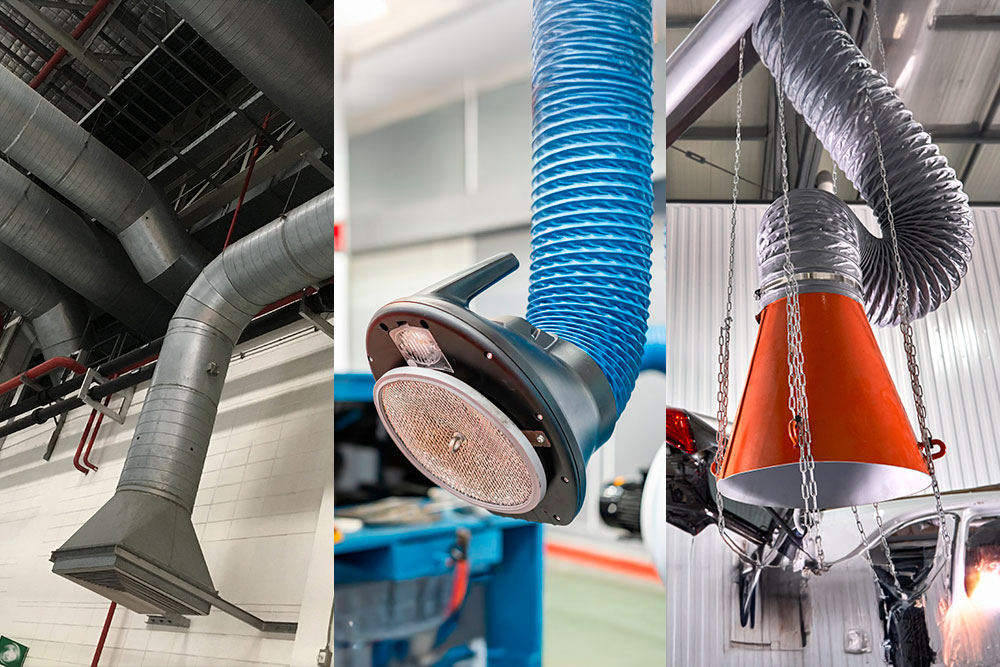
- Reduce the hazard. Where elimination is not feasible, reduce the hazard at source. Extraction fans and ventilation systems remove airborne contaminants and improve oxygen levels. Substituting toxic substances with less hazardous alternatives prevents the atmosphere becoming dangerous in the first place. Atmospheric controls are a substantial topic on their own – for the standards managers need to set on testing, sampling and continuous monitoring, see our guide on confined space gas testing.
- Prevent contact with the hazard. Secure access doors and lock off entry points to prevent unauthorised entry. Only trained, authorised personnel should be able to get into the space.
- Implement safe systems of work. Anyone entering needs a defined safe system of work – the documented set of procedures, roles and equipment governing how the task is carried out. This includes the permit-to-work system, clear emergency protocols with named roles, training in hazard recognition and safe entry, and lockout/tagout procedures (physical locks and warning tags fitted to valves, switches and isolators so they cannot be re-energised) to isolate energy and substances before entry.
- Mitigate the consequences. When something does go wrong, the controls at this level typically decide whether it becomes a fatality. Mitigation controls include communication devices so workers can call for help, appropriate respiratory protection and other PPE, and a credible rescue plan. Rescue is where over half of confined space deaths happen, so this layer of mitigation deserves treatment as a safety-critical control (NIOSH, 1986). Our guide to confined space rescue covers what a credible plan looks like.
A Worked Example
A team is assigned to maintenance work inside a sewer system. Hazards include hydrogen sulphide (a toxic gas that causes rapid unconsciousness at low concentrations), methane, possible low oxygen, risk of engulfment by sewage, and restricted access and egress. Existing controls include gas detectors, ventilation fans, harnesses and lifelines, a standby rescue team, gas masks and waterproof PPE, and communication devices.
The risk assessment identifies one residual concern: a serious incident could occur if pre-entry checks are skipped or done inconsistently. The duty holder adds further controls – a mandatory pre-entry checklist covering equipment function and PPE fit, refresher training on the updated procedure, and named owners (the site safety officer and team leads) responsible for implementation. The duty holder sets deadlines to complete training and procurement before the next maintenance cycle.
The worked example above shows what control looks like in practice: existing measures audited, a specific gap identified, a specific action assigned to a specific person by a specific date.
How Do You Record the Findings of a Confined Space Risk Assessment?
To record the findings of a confined space risk assessment, you must – if you employ five or more people – produce a written record covering the assessment details, hazards, risk evaluation and controls, and retain it for the period specified by the HSE. For smaller employers it remains good practice, and recording is the only way to demonstrate compliance to an inspector or in a civil claim (UK Government, 1999) (HSE, 2024a).
Records should cover:
- Assessment details – date of the assessment, names and roles of the assessors, location and description of the confined space, and the specific tasks evaluated.
- Hazards identified – what they are and where they originate (chemical processes, adjacent pipework, atmospheric conditions, and so on).
- Risk evaluation – likelihood and severity of each hazard.
- Control measures – both existing and newly implemented, including safe systems of work, training and competence records, equipment lists (PPE, communication devices, gas detection), and roles and responsibilities.
Duty holders should keep records for the period specified by the HSE, typically a minimum of five years, and review them regularly – covered in the next section.
When Should You Review a Confined Space Risk Assessment?
You should review a confined space risk assessment whenever conditions change – risk assessments are not one-off documents. Controls commonly drift and sites change, and what was adequate twelve months ago may not be adequate today (HSE, 2024a) (UK Government, 1999).
When to review. Trigger a review when:
- a control stops being effective
- new staff join the team or roles change
- work processes change
- new substances or materials are introduced
- new tools or equipment come into use
- there is an incident or near-miss
How to review. To carry out a review, work through the following steps:
- Re-test whether the controls still match the risks the assessment identified.
- Talk to the workers actually doing the job – in many cases they know what is working and what is failing in ways the paperwork does not record.
- Check for new information: updated safety data sheets, new HSE guidance, supplier bulletins (HSE, 2024a).
- Update the records to reflect any changes.
A review that confirms nothing has changed is still a valid review, provided it has been done honestly. A review that exists only as a date on a form is not.
What Are the Common Failures in a Confined Space Risk Assessment?
The common failures in a confined space risk assessment are five recurring patterns that appear repeatedly in HSE prosecutions and in published reviews of confined space incidents. Recognising these patterns early is the most cost-effective form of risk control (HSE, 2026b).
- Generic risk assessment. The assessment is written for confined spaces in general, or for a similar space, or for the task in normal conditions – not for this job, in this access point, under these conditions. Generic content is straightforward to identify: it does not say anything that would change if the location changed.
- Misclassification of the space. In many cases, routine maintenance work conceals confined spaces that have never been formally classified as such. If a space has limited access and a foreseeable risk of serious harm, it is a confined space – regardless of what it has been called for the past ten years.
- Untested rescue feasibility. The rescue plan exists, but no one has walked it through in the actual space with the actual equipment. Internal layout, fixings used to attach rescue lines, and the path used to bring a casualty out can all work on paper but fail in practice.
- Frontline disconnect. The assessor completed the assessment without involving the people who do the work. In many cases, the hazards listed are the ones the assessor thought to ask about rather than the ones the operators encounter every shift.
- Stale records. The assessor completed, signed and filed the assessment. No one has reviewed the assessment since, despite changes in plant, team composition or methods.
What Are the Key Conclusions on Confined Space Risk Assessment?
The key conclusions on confined space risk assessment are that legal compliance, procedural rigour and honest engagement with the workplace each carry equal weight – none compensates for failure in the others. The preceding sections have covered what a confined space risk assessment is, the duties imposed by the Confined Spaces Regulations 1997, the five HSE steps for carrying one out, and the recurring failure patterns documented in HSE prosecutions, equipping managers and duty holders to assess confined space work to a defensible standard (HSE, 2025b) (HSE, 2024a).
Three points are worth carrying forward:
- Recognition precedes assessment – a space the team has never classified as confined will never be assessed as one.
- Rescue capability separates incidents from fatalities, and cannot be assumed without practical verification.
- An assessment loses validity as soon as conditions change without a corresponding review.
How Can Managers Get Trained on Confined Space Risk Assessment?
Managers and duty holders can get trained on confined space risk assessment through Human Focus – where the Confined Space Risk Assessment Training develops the hazard identification, recording and review capabilities most often missing from assessments cited in HSE prosecutions.
The Confined Space Risk Assessment Training develops those capabilities through hazard identification in real workplace settings, defensible recording practice, and the specific review triggers that close the gaps repeated most often in HSE prosecutions. Enrol to build the competence to carry out confined space risk assessments to a standard that meets regulatory requirements.