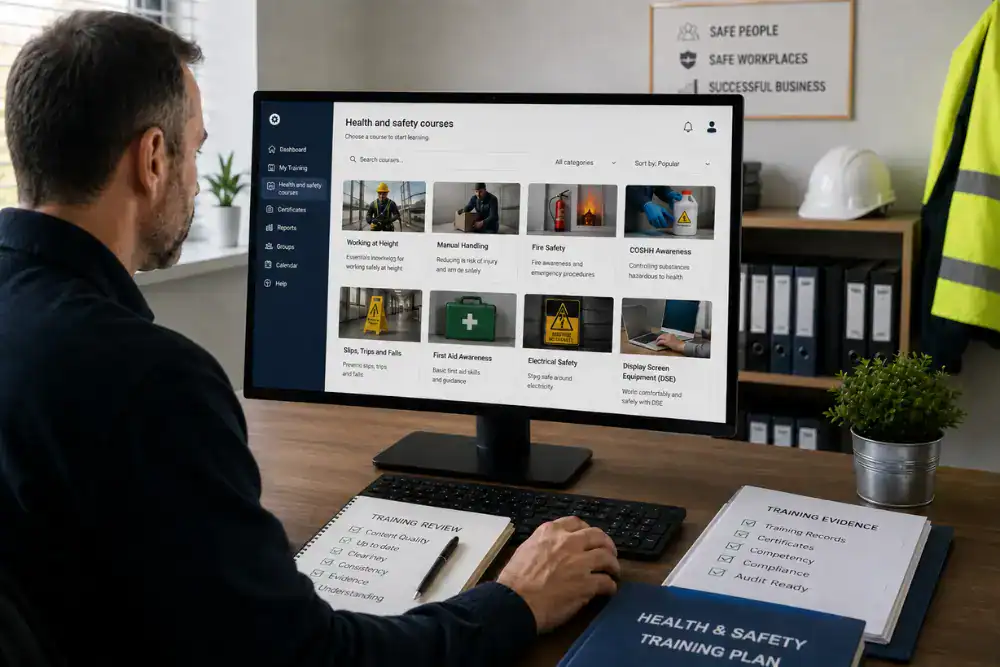
Basic safety training has an important role when it helps people understand your organisation’s procedures, site rules and operational controls. Toolbox talks, local briefings, internal slides and task-specific instruction can all support that aim.
But relying on that training to meet mandatory health and safety requirements is different. Once safety training is being used as evidence that legal duties have been met, the standard it needs to reach is higher.
After an accident, audit, client challenge or legal review, the question is unlikely to be simply: “Did we deliver some safety training?”
The harder question is:
“Can we show that the safety training was suitable, current, consistent, understood, delivered to the right people and credible enough to stand up if challenged?”
The signs below are designed to help you assess whether your current offline safety training is sufficient on its own or should be supplemented by an approved online safety training system.
Core idea
Internal training is valuable where the content is specific to your organisation. Mandatory health and safety training carries a different burden because it may need to be defended after an audit, incident, tender or legal challenge. The strongest approach is not internal training or online training alone, but the right split between approved online training for common mandatory topics and bespoke training for site-specific procedures.
Signs this may be a problem:
- Safety training has grown from slides, toolbox talks or local briefings rather than a structured review of mandatory requirements
- It may be unclear which legal, regulatory, client or sector requirement each item of safety training is intended to address
- Some mandatory safety training topics may be covered informally, inconsistently or only when an issue arises
- The organisation may not be able to easily show how its safety training maps to roles, risks and responsibilities
What to Look for in an Online Safety Training Provider
Look for an online safety training provider whose approved course library is clearly mapped to common mandatory health and safety requirements.
- Check that courses are linked to specific legal, regulatory or sector requirements
- Look for a library organised around safety domains so you can identify which mandatory topics are covered
- Ask how the provider helps you map courses to the roles and risks in your organisation
The important question: Could we clearly show how our safety training maps to the mandatory requirements that apply to our people and the risks they face?
Signs this may be a problem:
- Health and safety teams may already be stretched across audits, incidents, contractors, inspections and reporting
- Safety training content may be created when a need becomes urgent rather than as part of a planned programme
- Responsibility for updating safety training content may be unclear
- The same internal slides may be reused year after year without formal review
- Keeping content current across multiple mandatory safety topics may have become unrealistic for the team
What to Look for in an Online Safety Training Provider
Look for an online safety training provider that maintains approved content on your behalf, so internal teams can focus on company-specific risks and procedures.
- Ask how frequently the provider reviews and updates course content
- Check whether updates are made when legislation, guidance or standards change
- Look for a provider that takes responsibility for content currency across the full approved library
The important question: Do we have the time, resource and specialist capability to build and maintain mandatory safety training properly across all the topics we need to cover?
Signs this may be a problem:
- Slides may refer to old procedures, old equipment, old legislation or superseded guidance
- Different versions of the same safety training may be circulating across the business
- Updates to regulations or good practice may not be systematically reflected in the safety training
- Refresher safety training may repeat old material without checking whether it is still current
- Workers in different locations may receive different versions depending on site, team or manager
What to Look for in an Online Safety Training Provider
Look for a provider that actively maintains approved safety training content and removes obsolete versions from circulation.
- Confirm how often content is reviewed and updated
- Ask whether updates are triggered by changes in legislation, guidance or regulatory expectations
- Check that a single approved version is used consistently across the organisation
The important question: Could we show that the safety training our workers received was current at the time it was delivered?
Signs this may be a problem:
- Different sites may have created their own versions of similar safety training
- Managers may adapt slides locally, removing or adding content without central control
- Workers in different locations may receive different levels of detail on the same topic
- There may be no single approved baseline for common mandatory safety training content
What to Look for in an Online Safety Training Provider
Look for a provider that gives every worker the same approved safety training baseline for common mandatory topics, regardless of site or team.
- Check that approved courses are delivered consistently across all sites and teams
- Ask whether local content can be added alongside approved courses without replacing them
- Look for a single source of approved content for common mandatory safety training topics
The important question: Could we show that people across our organisation received a consistent safety training message on common mandatory topics?
Signs this may be a problem:
- Safety training slides may be dense, text-heavy or difficult to read
- Language may be too legalistic, complex or abstract for the workforce
- Important points may be buried in long blocks of text rather than supported by visuals and examples
- Workers may disengage because the safety training is difficult to follow
- Annual refresher safety training may repeat identical content year after year, reducing engagement over time
- Assessment may rely on attendance signatures rather than checks of genuine understanding
What to Look for in an Online Safety Training Provider
Look for a provider that uses video-based, interactive safety training content designed around how people actually learn.
- Check that courses use video and active participation rather than text-heavy slides
- Ask whether annual refresher content is updated to maintain engagement across repeat training cycles
- Look for assessments that test genuine understanding, not just recall or attendance
The important question: Is our safety training designed so that workers can genuinely understand, remember and apply the key safety message?
Signs this may be a problem:
- Internal safety training may not be independently approved or accredited by any recognised body
- If safety training is challenged after an accident, audit or legal review, it may be difficult to demonstrate that the content met a recognised standard
- Clients, contractors or principal contractors may expect evidence of approved safety training rather than internal briefings
- The organisation may be unable to show that content was developed against recognised guidance or regulatory expectations
What to Look for in an Online Safety Training Provider
Look for a provider whose safety training courses carry independent approval from recognised bodies.
- Check which courses are approved and by which recognised bodies
- Confirm that approval applies to specific courses, not just to the provider generally
- Ask whether approved training records would be accepted by clients, auditors and insurers
The important question: If our safety training were challenged, could we show it was based on a recognised and independently approved standard?
Signs this may be a problem:
- Attendance may be recorded but understanding may not be assessed
- Toolbox talks may rely on signatures rather than learning checks
- Questions may be too easy, too obvious or may only test memory of wording rather than genuine understanding
- Supervisors, managers or duty holders may not be assessed at a level that reflects their responsibilities
- After an incident, a worker may be able to say they attended safety training but may not have understood the key message
What to Look for in an Online Safety Training Provider
Look for a provider whose approved safety training includes structured assessment of understanding, not just completion records.
- Check that assessments test comprehension and application, not just recall
- Look for role-relevant scenarios that reflect the decisions workers need to make
- For higher-responsibility safety training, ask whether proctoring or identity verification is available to confirm who completed and passed the assessment
The important question: Could we show that workers understood the safety training, not just that they attended or clicked through it?
Signs this may be a problem:
- Renewal and refresher dates for safety training may be tracked in spreadsheets or manually maintained lists
- Expired safety training may only be discovered when a client, auditor or incident exposes the gap
- The administrative burden of tracking renewals across multiple roles and sites may fall on one or two people
- Errors and omissions in manual tracking may mean some workers are unknowingly overdue
What to Look for in an Online Safety Training Provider
Look for an online safety training system that tracks renewal and refresher dates automatically across roles, responsibilities and individuals.
- Check that the system sends automated alerts when safety training is approaching expiry or becoming overdue
- Ask whether the system can track renewals for both online course completions and external certificates
- Look for dashboards that give managers a live view of safety training status across their teams
The important question: Could our system automatically alert us when safety training is due for renewal, or do we rely on manual tracking that may contain errors?
Signs this may be a problem:
- Safety training records may be held across folders, spreadsheets, email inboxes and local site files
- Producing a complete safety training record for a worker, site or team may take significant time and effort
- Records may be incomplete, inconsistently maintained or dependent on one person knowing where everything is kept
- External certificates and offline safety training evidence may sit entirely outside any central system
What to Look for in an Online Safety Training Provider
Look for an online safety training system that brings all safety training evidence into one place, reducing manual record management.
- Check that the system holds online course completions, external certificates and offline safety training records in a single competency record
- Ask whether AI-assisted certificate loading can reduce the manual work of digitising paper or PDF records
- Look for reporting tools that allow managers to see who is trained, current and evidenced without manual compilation
The important question: If an accident, audit or legal review happened tomorrow, could we quickly produce a complete and credible safety training record for our people?
Signs this may be a problem:
- Workers may rely on paper certificates or attendance records that are difficult to carry and easy to lose
- Clients or principal contractors may request safety training evidence before work starts and the process may be slow
- Site managers may not be able to verify a worker’s safety training quickly when they arrive on site
- There may be no simple way for workers to share their safety training evidence without involving the office
What to Look for in an Online Safety Training Provider
Look for a system that gives workers a digital safety training record they can access and share from a mobile device.
- Check that workers can access and share safety training records via a mobile app or QR code
- Confirm that shared records include both online course completions and external certificates
- Ask whether clients and site managers can verify safety training quickly without contacting the office
The important question: Could our workers share their safety training records instantly at the point of work or with clients, without involving the office?
Signs this may be a problem:
- Getting workers into the same room at the same time may be difficult across multiple sites or shift patterns
- Safety training may be delayed or deferred because of scheduling constraints rather than safety priorities
- New starters may begin work before completing mandatory safety training while waiting for the next scheduled session
- Refresher safety training may lapse because arranging sessions is logistically difficult
- Taking workers off the job for safety training may create significant operational and cost pressures
What to Look for in an Online Safety Training Provider
Look for an online safety training provider that delivers approved safety training on demand, so workers can complete it without unnecessary disruption to operations.
- Check that safety training is accessible on web, Android and iOS so workers can complete it at a time and place that suits them
- Ask whether new starters can be assigned and complete safety training from day one without waiting for a scheduled session
- Look for a system that sends automated reminders so refresher safety training is completed when it is due, not when it is convenient
The important question: Could we deliver mandatory safety training to all our workers without the scheduling constraints, costs and operational disruption of classroom sessions?
Signs this may be a problem:
- Workers may be based across multiple sites, working remotely or rarely in the office
- Mobile or field-based workers may miss safety training because they are not present when sessions are delivered
- Safety training coverage may be inconsistent across sites because some locations are harder to reach
- Contractors may start work without completing mandatory safety training because coordination is difficult
What to Look for in an Online Safety Training Provider
Look for an online safety training provider that can reach every worker regardless of location, shift or working pattern.
- Check that safety training is accessible on mobile devices so workers can complete it on site, at home or between jobs
- Ask whether the system supports contractors and temporary workers as well as permanent employees
- Look for role-based group allocation so the right safety training reaches the right people automatically
The important question: Could we deliver consistent mandatory safety training to all our workers, regardless of where they are based or when they work?
Signs this may be a problem:
- The workforce may include people whose first language is not English
- Safety training may only be available in English, regardless of worker needs
- Completion records may exist but it may be unclear whether the safety message was genuinely understood
- Language barriers may mean workers attend safety training without comprehending the key hazards, controls or emergency procedures
- After an incident, it may be difficult to demonstrate that safety training was understood, not just attended
What to Look for in an Online Safety Training Provider
Look for an online safety training provider that supports multilingual delivery so every worker can complete safety training in a language they properly understand.
- Check how many languages are supported and whether audio, subtitles or both are available
- Ask whether language support applies across the full approved safety training library
- Confirm whether additional languages can be added on request for specific workforce needs
The important question: Could every worker in our organisation complete their safety training in a language they can genuinely understand — and could we show that the safety message was understood, not just that training was attended?
Signs this may be a problem:
- Internal health and safety teams may have limited experience of designing or structuring a formal safety training programme
- It may be unclear which approved safety training courses are most appropriate for specific roles or risk areas
- The organisation may not know how to build a safety competency framework around approved and bespoke safety training
- When questions arise about safety training suitability or coverage, there may be no expert resource to consult
What to Look for in an Online Safety Training Provider
Look for an online safety training provider whose support team understands health and safety training, not just the software.
- Ask whether the support team can help identify which approved safety training courses suit specific roles and risk areas
- Check whether the provider can help structure a safety training programme around your organisation’s mandatory requirements
- Ask for evidence of the provider’s safety training expertise, not just platform support capability
The important question: Could our provider help us build a stronger safety training programme — or would support be limited to technical platform issues?
If you answer no to several of these questions, your offline safety training may benefit from the support of an approved online safety training system:
Interpretation
If several of these feel familiar, it does not mean your internal safety training has no value. It means your offline safety training may be doing a job it was not designed to do. Internal safety training remains important for company-specific procedures, local rules and task-specific controls. But for common mandatory health and safety requirements, an approved online safety training system may provide a stronger, more credible and more manageable foundation.
The strongest approach combines approved online safety training for mandatory requirements, bespoke training for company-specific procedures and a training records system for evidence and assurance.
Book a free demo to see how Human Focus can connect your training content, competency records and specialist support in one safety competency system, making evidence easier to present during audits, tenders and investigations.