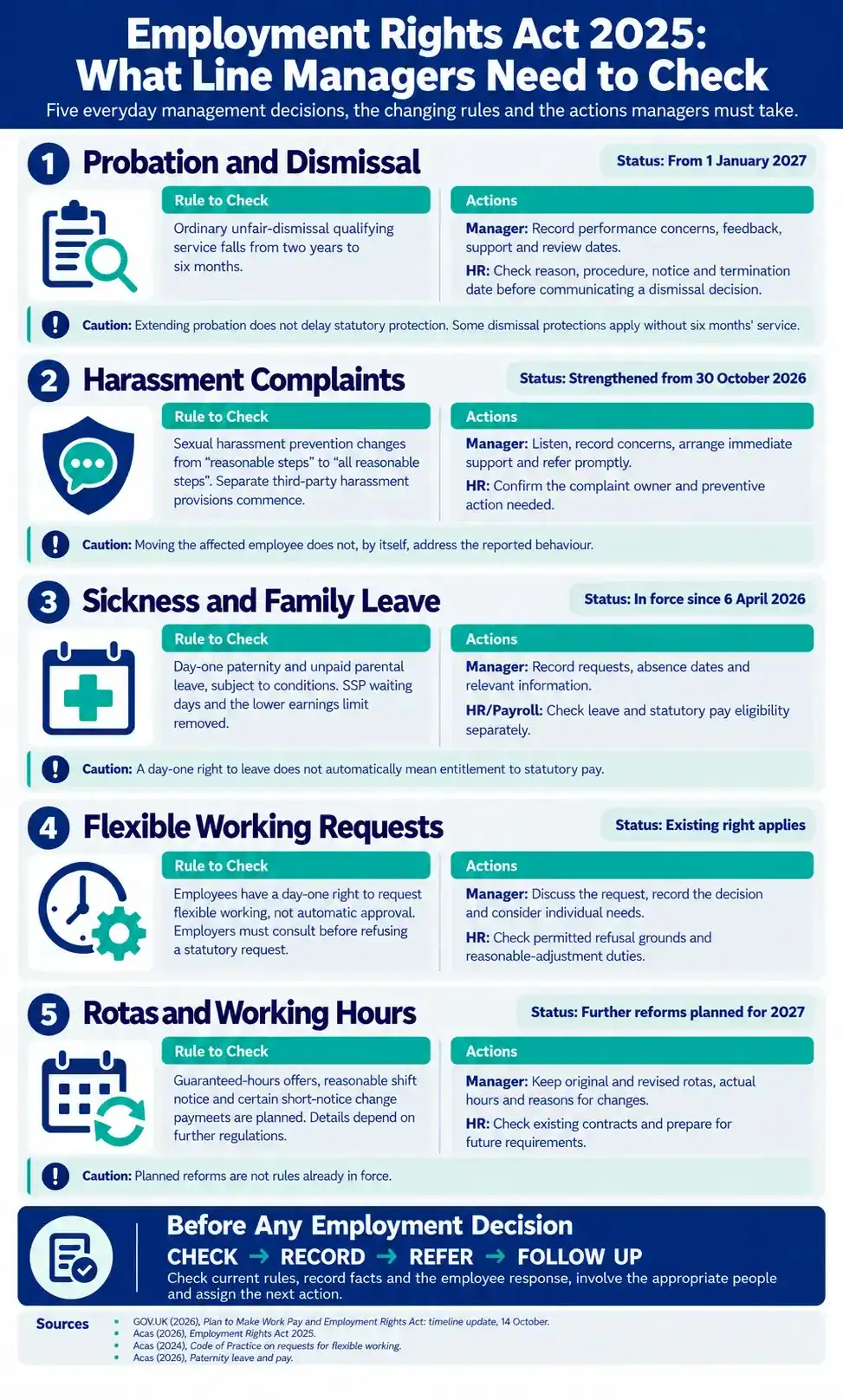
The new employment rights matter to line managers in Great Britain because everyday decisions about probation, complaints, leave and rotas put those rights into practice. The Employment Rights Act 2025 makes it more important to check current procedures and recognise when HR advice is needed.
Consider Sam, a hypothetical employee who starts work on 1 July 2026. By October, Sam’s manager is still finding errors in the work. The manager extends probation into January and plans another review after Christmas, assuming there is more time before unfair-dismissal protection applies.
The extension gives more time to assess Sam’s work. It cannot postpone the rights attached to Sam’s length of service.
From 1 January 2027, the qualifying period for ordinary unfair-dismissal protection falls from two years to six months. Employees who already have six months’ service on that date will be covered (Acas, 2026g).
Sam reaches that point when the new rule begins. Whether the employer has finished assessing Sam is a separate matter. An extended probation does not restart continuous service.
Now imagine HR opens Sam’s file. The only explanation for the extension is a brief note saying “needs more time”. There is nothing about the errors, what Sam was told or what support was offered.
The note records a decision. It gives the next person little basis for understanding it.
The manager needs to discuss the errors with Sam and hear what is getting in the way. They can then agree the improvement needed, arrange relevant support and set a review date.
Acas recommends clear expectations and regular reviews that take account of the job and individual circumstances. That includes making reasonable adjustments where required for a disabled employee (Acas, 2026a).
The manager also needs to understand that unfair dismissal during probation is not the only legal consideration. Discrimination protections and certain automatically unfair reasons for dismissal, such as whistleblowing, do not depend on the ordinary qualifying period (Acas, 2026f).
Equally, reaching six months does not make every dismissal unfair. Employers can still dismiss fairly (Acas, 2026g).
If dismissal is being considered, HR should check the reason, procedure and notice before the manager communicates an outcome. The January transition depends on the effective termination date. A dismissal communicated in December may therefore fall under the new rules if employment ends in January (SI 2026/559, regs. 3–4).
Sam’s example shows why these reforms reach beyond the HR department. The employer carries the legal duties, while the line manager often handles the conversations and decisions through which employees receive their rights.
The 2025 Act amends existing legislation, including the Employment Rights Act 1996. It does not replace the 1996 Act or introduce every reform at once (Employment Rights Act 2025; Department for Business and Trade [DBT], 2026b).
Managers therefore need current procedures and a clear route to advice. The practical checks vary with the decision:
Northern Ireland has a separate employment-law framework. Some measures, including the Statutory Sick Pay (SSP) reforms, apply across the UK (DBT, 2026a, 2026c).
Suppose a receptionist tells their supervisor that a regular customer keeps making sexual comments. The supervisor offers to put someone else on the desk.
That may change who encounters the customer. It leaves the behaviour unaddressed and another colleague potentially exposed.
The manager needs to consider immediate support for the receptionist and what should happen before the customer returns. Assessing sexual harassment risks should lead to practical decisions about intervention and prevention.
Employers already have a duty to take reasonable steps to prevent sexual harassment, including risks from customers and other third parties (Acas, 2026c).
From 30 October 2026, that becomes an “all reasonable steps” duty. Separate provisions scheduled for the same date address employers permitting third-party harassment and extend beyond sexual harassment (Acas, 2026d, 2026e).
When a complaint arrives, listen without deciding in advance whether it is true. Record what is reported, discuss immediate support and explain who needs the information to deal with it. Absolute secrecy is not a promise a manager should make.
Follow the relevant procedure and confirm who will handle the complaint. Receiving a report does not automatically make the manager the right person to investigate it (Acas, 2026b).
Informal resolution can be appropriate, but serious allegations may need a formal process even when the person is reluctant to raise a grievance. Seek advice and avoid pressuring them to confront the person complained about (Acas, 2026b).
After referral, check that someone owns the next step. The employee needs updates and protection from being disadvantaged for reporting. The organisation also needs to consider what will prevent a recurrence.
The first response matters for routine requests too.
Take a recent starter asking about paternity leave. A manager who remembers the old service requirement might reply, “You have not been here long enough.” The conversation could end before anyone checks the current rule.
Paternity leave and unpaid parental leave became day-one rights on 6 April 2026. Notice and other eligibility conditions still matter (DBT, 2026a).
The manager should record the request and relevant dates, then arrange an eligibility check. Statutory paternity pay needs a separate assessment because service and earnings conditions remain. A right to leave does not automatically bring a right to statutory pay (GOV.UK, n.d.).
Sickness absence requires a similar check against old habits. Since 6 April 2026, SSP waiting days and the lower earnings limit have been removed. Eligible employees can receive SSP from the first full day of sickness absence, regardless of earnings (DBT, 2026c).
Accurate absence information needs to reach payroll. Managers should avoid giving an answer based on the former three-day waiting rule.
Employees also already have a day-one right to request flexible working. A statutory request must be handled through the proper process. It does not guarantee the arrangement sought.
Employers must consult before rejecting a statutory request and can refuse only for a permitted business reason. Disability-related requests may also engage the separate duty to make reasonable adjustments (Acas, 2024).
Further flexible-working reforms are planned for 2027. Until then, managers should use the current process, recording the discussion, decision and follow-up while keeping sensitive details to what is needed (DBT, 2026b).
Suppose a six-hour shift is shortened to four hours after employees arrive. A rota showing only the final hours loses the original arrangement. HR needs both versions, the timing of the change and the reason to assess the situation properly.
Reforms covering guaranteed-hours offers, reasonable shift notice and payments for shifts cancelled, moved or curtailed at short notice are planned for 2027. Details depend on regulations, so managers should not treat these future requirements as active rules (DBT, 2026b).
Preparation can start now. Retain scheduled and actual hours, record changes and communicate them promptly. Repeated reductions or cancellations should reach the person responsible for reviewing them.
Existing contractual and legal obligations still apply. Managers should involve HR before proposing contractual changes rather than assuming that editing a rota settles the matter.
The useful management routine is to connect each decision with a clear next action:
- Check the current policy and the reform’s legal status before acting.
- Record facts, the employee’s response and agreed support, with an owner and review date.
- Refer harassment concerns promptly and confirm who will provide updates and support.
- Retain rota changes and actual hours so recurring difficulties can be reviewed.
- Handle requests consistently while considering individual needs and checking leave separately from pay.
- Complete relevant learning and clarify which decisions require HR advice or approval.
Return to Sam’s January review. The manager should be able to discuss the work against clear expectations, explain the support provided and hear Sam’s response. HR should be involved before any dismissal decision.
The probation extension has allowed further assessment. It has not delayed statutory protection. Better records make the decision easier to understand and review; they cannot make an unfair decision lawful.
Human Focus’s Employment Rights Act Awareness Training for Managers supports awareness of these decisions and when to seek advice. Managers need suitable workplace policies, reporting routes and HR support to put that learning into practice.