The Employment Rights Act 2025 strengthens workplace harassment protections and introduces further trade union rights on 30 October 2026. Employers will need to take all reasonable steps to prevent sexual harassment and may face liability when customers, clients or other third parties harass their employees.
For managers, preparation means understanding the risks staff face, knowing how to respond to concerns and following the correct process for union requests. This guide explains the October changes and the practical steps organisations should consider. It focuses on Great Britain: England, Scotland and Wales.
The main changes concern sexual harassment prevention, harassment by third parties, trade union access and recognition, and support for union representatives. The legislation also activates powers concerning sexual harassment prevention and provisions on seafarers’ working conditions.
The date is set by regulation 3 of the Employment Rights Act 2025 Commencement No. 6 Regulations. The provisions commencing are:
The union provisions commence to the extent they are not already in force. Transitional rules affect some existing cases and representatives, so organisations should check which rules apply to matters already under way.
Since 26 October 2024, employers have had a positive duty to take reasonable steps to prevent sexual harassment. Acas guidance on prevention explains that this already includes risks involving colleagues and third parties. Employers must anticipate risks and act before an incident occurs.
From 30 October 2026, section 20 of the Employment Rights Act 2025 strengthens that duty by inserting the word “all” before “reasonable steps” in section 40A of the Equality Act 2010.
In practice, employers should identify the measures that are reasonable in their circumstances and take each of them. What is reasonable depends on factors such as the organisation’s size, resources, working environment and the risks employees face.
Acas’s guidance on the change emphasises prevention across the organisation. It covers online conduct as well as behaviour in person. Updating a policy or arranging a training session may contribute, but employers also need to address how people behave and how concerns are handled.
An organisation already taking every reasonable preventive measure may already meet the stronger standard. It should still review its arrangements and check that those measures work in practice.
Sexual harassment involves unwanted conduct of a sexual nature intended to undermine someone’s dignity or create a degrading or hostile environment, or which has that effect. The legal test also covers intimidating, humiliating or offensive environments.
Examples include unwanted sexual comments, sexual images shared through work messaging channels and unwanted touching. Conduct can qualify even when the person responsible describes it as a joke. A single incident can be enough.
Section 22 gives the government power to specify reasonable steps in future regulations. These could concern risk assessments, policies, reporting arrangements and complaint handling.
Bringing this power into force does not itself introduce a complete statutory checklist. Employers should assess what the strengthened duty requires in their workplace and monitor further regulations. Any prescribed steps will sit alongside the wider obligation to take all reasonable steps.
Section 21 introduces a duty on employers not to permit third parties to harass their employees. Under the new provision, an employer permits harassment where:
- A third party harasses an employee in the course of their employment.
- The employer failed to take all reasonable steps to prevent that harassment.
A third party is someone other than the employer or one of its employees. Depending on the working arrangements, this can include customers, clients, patients, service users and contractors.
The change covers more than sexual harassment. Government guidance on third-party harassment confirms that it covers the forms of harassment prohibited by the Equality Act 2010. These include harassment related to age, disability, gender reassignment, race, religion or belief, sex and sexual orientation.
For example, racist abuse directed at a receptionist by a customer can engage the new duty. Employers should consider foreseeable risks from people staff encounter through work and establish how those risks will be managed.
Acas recommends reviewing contact with third parties, assessing risks and recording incidents and responses. Depending on the circumstances, prevention measures might include customer conduct rules, contract terms, suitable staffing and ways to summon assistance.
Staff should know when to seek help and what managers will do. Arrangements in healthcare or social care will also need to account for service users’ needs and the organisation’s other responsibilities.
Section 59 creates a statutory framework through which independent trade unions can request access to workplaces and communication with workers. Access can be physical, digital or a combination of both.
The permitted purposes include supporting and representing workers, recruitment and facilitating collective bargaining. Organising industrial action is excluded from the access purposes under this framework.
Employers and unions can negotiate access terms. Where agreement cannot be reached, the Central Arbitration Committee (CAC) can determine whether access should take place and on what terms.
The government’s published access arrangements describe a 15-working-day response period and a 25-working-day negotiation period. They also explain that the CAC cannot impose an access agreement on an employer with fewer than 21 workers.
Organisations should nominate someone to receive requests, monitor the relevant contact channels and obtain advice promptly. Some supporting regulations and codes are still described in official guidance as subject to parliamentary approval, so the final procedures should be checked before handling a request.
Further recognition reforms cover earlier access to workers during the recognition process and earlier application of rules against unfair practices. These rules address conduct such as threats or inducements intended to influence workers’ decisions.
Under Schedule 6, workers who join the bargaining unit after the CAC receives the recognition application are excluded from specified recognition calculations and ballots. The bargaining unit is the group of workers for whom a union seeks recognition.
Some recognition changes already took effect in April 2026. The government’s implementation timetable distinguishes those earlier changes from the remaining October measures. Existing proceedings may be subject to transitional rules.
Section 64 strengthens support for eligible union officials and learning representatives. Where the statutory conditions apply, employers must provide reasonable accommodation and other facilities on request for the duties or training covered by their time off.
Section 65 introduces rights to reasonable paid time off for qualifying equality representatives of recognised independent unions. It also provides for reasonable facilities on request. Notice and training conditions apply, with transitional arrangements for some existing representatives.
The changes also place the burden on employers in relevant tribunal complaints to show that the amount of time off proposed was unreasonable. Managers should therefore record requests, their decisions and the reasons for them.
Section 56 and Schedule 5 amend the Seafarers’ Wages Act 2023 and provide a framework for further requirements on wages and working conditions.
The commencement of these provisions should be distinguished from the detailed Seafarer Protection Regulations, which the government timetable schedules for December 2026. Maritime employers should check the regulations relevant to their services before drawing conclusions about specific obligations.
The extension of the usual time limit for most employment tribunal claims from three months to six months took effect on 1 October 2026. It is separate from the 30 October commencement regulations.
Government guidance on tribunal time limits explains that the new limit generally applies where the relevant workplace problem occurred on or after 1 October. Earlier events generally remain subject to the previous limit. The extension for breach of employment contract claims in Scotland takes effect on 9 November 2026.
The precise deadline depends on the type of claim and applicable rules, including Acas early conciliation. Employers should retain relevant evidence under an appropriate retention policy and preserve it when a dispute arises. The claim window is not a universal deadline for deleting employment records.
Government guidance also schedules stronger protection against detriment for taking protected industrial action from 30 October, subject to parliamentary approval. This is a separate part of the implementation programme and is not one of the provisions listed in regulation 3 of Commencement No. 6.
Any management decision connected with industrial action should be referred promptly for appropriate HR or legal advice.
The latest government timetable places the duty to inform workers of their right to join a trade union in January 2027. Employers should prepare their worker communications for that later start date.
The reduction of the ordinary unfair dismissal qualifying period to six months, removal of the statutory cap on compensatory awards and fire and rehire protections are also scheduled for January 2027. Employers should prepare for these separately while addressing the October duties.
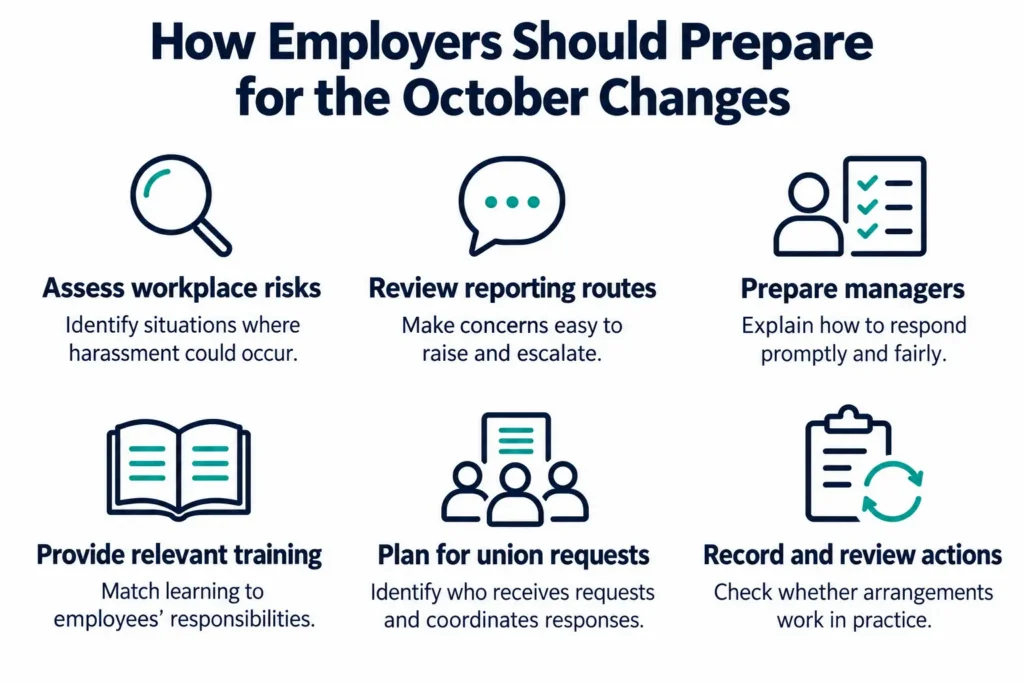
Review roles, locations and working arrangements. Consider lone working, customer contact, work travel, social events, online communication and situations where one person controls another’s hours or opportunities.
Consult employees and their representatives about situations that concern them. A lack of complaints does not establish that there is no risk. Record the measures chosen, who will implement them and when they will be reviewed.
The Equality and Human Rights Commission’s prevention guide provides practical guidance on assessing risk, engaging staff and evaluating preventive measures.
Workers need clear options for raising concerns, including an alternative to their line manager. This matters when the concern involves that manager or when staff work outside normal office hours.
Explain who will receive a report, how it will be handled and where support is available. The EHRC’s checklist and action plan includes practical prompts for identifying responsible people and making reporting arrangements work across shifts.
appropriate person promptly. They should avoid dismissing behaviour as harmless or deciding the outcome before an investigation.
Follow Acas guidance on handling sexual harassment complaints: act promptly, investigate fairly and provide appropriate support. Consider protective measures without penalising the person who raised the concern. Confidential information should be handled carefully throughout the process.
Employees need to understand unacceptable conduct and how to report it. Managers also need guidance on risk prevention, receiving complaints and escalation. Those conducting investigations need preparation appropriate to that role.
Use examples that reflect the organisation’s work. Record completion, check understanding and review whether staff can apply what they have learnt. Refresher needs should reflect changes, identified gaps and the effectiveness of existing arrangements.
Identify who can respond to access requests and who authorises representative time off and facilities. Brief managers so requests reach those people without avoidable delay.
Plan how meeting space, digital communication and operational requirements can be considered. Keep records of proposals, agreed arrangements and the reasons for decisions.
Check whether staff know the reporting routes, whether managers follow the process and whether repeated concerns reveal gaps. Review arrangements after incidents and when work changes.
Keep policies, risk assessments, training records and investigation records organised and accessible to authorised staff. Records should show what the organisation actually did, including how it responded when a preventive measure proved ineffective.
Parts of the Act are already in force, while others commence in stages. The 30 October 2026 package includes stronger harassment duties and further trade union reforms. Employers need to check the commencement date of the particular provision rather than assume the whole Act started at once.
Yes. There is no general small-business exemption from the preventative duty. The steps that are reasonable depend on the circumstances, including the organisation’s size, resources and risks. The separate threshold for CAC-imposed union access agreements does not limit harassment duties.
No. The new duty also covers other forms of harassment prohibited by the Equality Act 2010, including harassment related to race, disability and other relevant protected characteristics. Employers should consider these risks when reviewing contact with customers, clients and service users.
No. Training is one part of prevention. Employers also need appropriate policies, working arrangements, reporting routes and effective responses to concerns. Whether all reasonable steps have been taken depends on the measures required in the particular workplace and how they operate in practice.
The EHRC can take enforcement action. Where a tribunal upholds a sexual harassment claim and finds a breach of the preventative duty, it can increase compensation by up to 25%. This is an uplift to compensation, rather than a fixed fine automatically imposed on every employer that breaches the duty.
Human Focus’s Employment Rights Act Awareness Training for Managers helps managers understand the main reforms and how they affect day-to-day decisions. It covers harassment prevention, pay and working hours, family-related rights, flexible working, contract changes and unfair dismissal.
The course focuses on consistent, evidence-based management, documenting decisions and recognising when to escalate issues to HR or senior leadership. Explore the course to support managers as workplace policies and procedures are updated.
Awareness training should be supported by workplace policies, suitable reporting arrangements and role-specific guidance. It does not replace legal advice or establish compliance on its own.