Symptoms of asbestos-related diseases can take 15–60 years to appear after exposure. This delay is known as the asbestos latency period. HSE gives this timeframe as a broad guide, not a prediction for an individual. Diseases linked to asbestos exposure include mesothelioma, asbestosis and asbestos-related lung cancer (HSE, 2024b).
A person may feel completely well even if they have inhaled asbestos fibres. The absence of symptoms cannot confirm or rule out exposure.
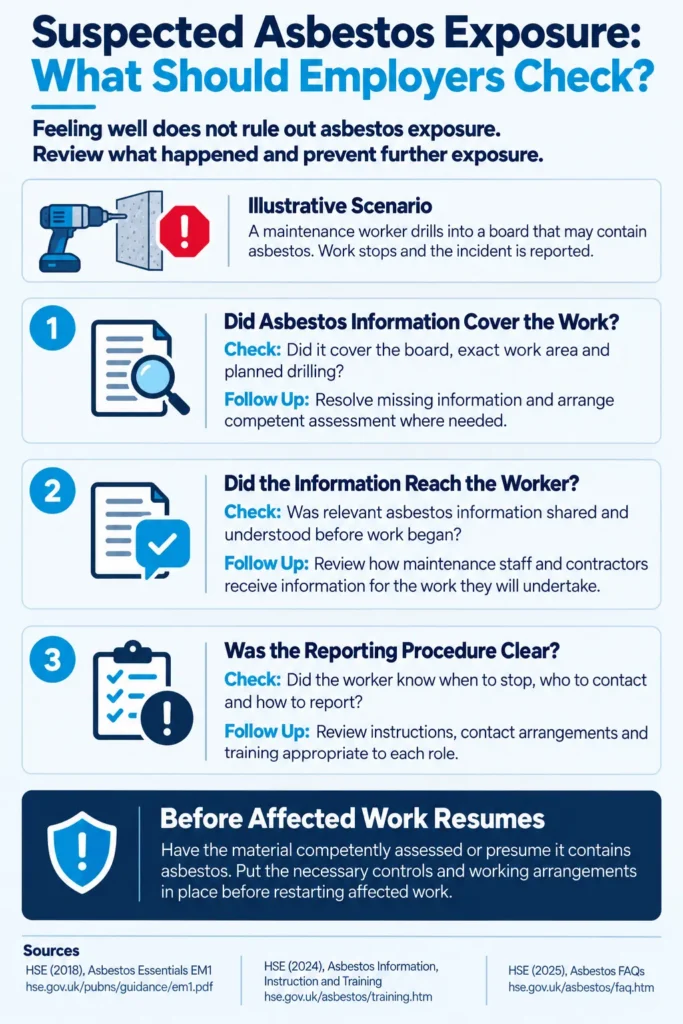
For example, a maintenance worker drills into an unidentified board. Even if the worker feels fine, the supervisor must stop the work, keep others out of the affected area and check the asbestos records. The material must be identified or presumed to contain asbestos, with appropriate controls established before work resumes.
The asbestos latency period is the delay between exposure and disease developing or becoming apparent. Inhaled asbestos fibres can cause damage that develops over time, so exposure and its possible health consequences can be separated by decades (HSE, 2025b).
That delay needs explaining carefully. Disease development, the first noticeable symptoms and a diagnosis are different events. Sources may describe different points in that sequence, so their figures should not be treated as interchangeable.
The mesothelioma latency period in this comparison describes disease development. The asbestosis figure describes symptom onset. Neither tells an individual when they will become ill, or establishes that they will become ill at all.
For someone looking back at an old job, these long intervals explain why past work can matter during a medical assessment. For someone concerned about yesterday’s maintenance task, they explain why waiting to see how they feel cannot resolve the exposure question.
Asbestos-related disease does not develop immediately after a new exposure. A cough or chest discomfort appearing hours or days after a task cannot, on timing alone, be attributed to asbestos-related disease from that incident (HSE, 2025b).
Sudden symptoms still need appropriate medical attention. The long latency of asbestos-related disease is no reason to dismiss breathing difficulties or other concerning symptoms. Seek medical advice for health concerns following possible exposure; UKHSA advises contacting a GP or NHS 111 (UKHSA, 2025).
The reverse assumption is equally unhelpful. Our maintenance worker might feel entirely normal after drilling the board. That gives the supervisor no basis for deciding that the board was safe or that work can resume. Those decisions depend on the material and the working arrangements, which need competent assessment.
A single incident cannot be declared harmless simply because it happened once. Equally, possible exposure does not mean that disease will follow. An article cannot establish an individual’s risk from the number of incidents alone.
HSE says many inadvertent short exposures probably involve very few fibres and carry a low likelihood of long-term health effects. That general assessment cannot establish what happened in a particular case (HSE, 2025a).
The amount inhaled and duration of exposure matter, alongside the form of asbestos involved (UKHSA, 2025). Material condition and the way it was disturbed affect the opportunity for fibres to become airborne. A brief description such as “I was only there for a few minutes” leaves those questions unanswered.
For the worker and employer, the useful response is to preserve the facts. What was being worked on? Was the material cut, drilled or broken? What information already exists about it? Record uncertainty honestly. A confident label of “low exposure” adds little if nobody has established what supports it.
Symptoms cannot confirm that asbestos fibres were inhaled. What people often call “asbestos exposure symptoms” are symptoms of possible disease, rather than a distinctive response that identifies a recent exposure.
Possible asbestos-related disease symptoms include:
- Persistent cough
- Breathlessness
- Chest pain
- Unexplained weight loss
However, these symptoms also occur in other conditions. Having them does not establish an asbestos-related diagnosis, but persistent or worrying symptoms should be assessed by a GP (NHS, 2026b).
Explain your work history, including older jobs and any known or suspected asbestos contact. NHS guidance on asbestosis describes work history as part of the GP’s assessment (NHS, 2023). A current symptom and a recent incident should not cause earlier work to disappear from that conversation.
An X-ray cannot show whether fibres were inhaled, and HSE does not recommend routine X-rays after inadvertent exposure. A normal early image cannot provide an “all clear” about that exposure (HSE, 2025a).
This is different from investigating symptoms. A clinician may arrange imaging where appropriate; NHS guidance describes X-rays among the possible investigations for suspected mesothelioma (NHS, 2026c).
For our maintenance worker, a request for an immediate scan may feel like the most definite next step. HSE’s guidance points towards something more useful for documenting the incident: ask the GP to note possible exposure in the personal medical record. That preserves the history without pretending that imaging can answer whether fibres entered the lungs.
Stop the affected work, follow the workplace emergency arrangements and report the concern promptly. HSE’s emergency guidance starts with stopping work and informing the person in charge (HSE, 2018). Follow the procedures after suspected accidental asbestos exposure for the detailed response.
Once the immediate response is underway, make a clear workplace record. Useful details include:
- The date, time and exact location of the suspected exposure.
- The task, tools and way the material was disturbed.
- How long the activity lasted and who may have been affected.
- The material and asbestos type, where confirmed, with unknowns labelled clearly.
- Available survey, sampling or exposure information, plus the actions taken.
HSE advises people concerned about possible work-related exposure to consult their GP and request a note covering dates, duration, asbestos type and likely exposure levels where known (HSE, 2025a).
The employer’s incident record and the GP’s personal medical record serve different purposes. Recording the event at work does not mean it has been added to a medical record. Conversely, speaking to a GP does not resolve the workplace conditions that allowed the disturbance.
The employer should arrange competent follow-up and establish the controls needed before affected work resumes. Workers should not take samples or attempt a clean-up on the strength of this article. HSE’s emergency guidance requires the response to reflect the material and circumstances (HSE, 2018).
Long latency means that the absence of illness today cannot demonstrate that today’s asbestos precautions are working. Waiting for symptoms would leave the employer without timely evidence about whether workers are being protected.
HSE warns that repeated exposure has a cumulative effect, including exposure from regularly undertaking small jobs (HSE, 2024b). A succession of minor maintenance tasks therefore deserves attention even when none has produced an immediate health complaint.
In Great Britain, HSE’s guidance emphasises identifying asbestos before work starts and planning suitable controls (HSE, 2024b). Employers need information relevant to the proposed task. Understanding the fibre-release risks from asbestos-containing materials supports that planning. Where a worker encounters unexpected material, clear reporting and escalation arrangements should lead to competent assessment.
Returning to the drilled board, the supervisor needs to establish why the task reached that point. Did the available asbestos information cover the board? Had the worker received it? Was there a clear person to contact when the material was uncertain? These are questions the organisation can investigate now, while the details remain available.
Training needs to fit those arrangements. HSE makes clear that attending a course alone does not establish competence, and awareness training does not prepare workers to carry out asbestos work (HSE, 2024a).
Human Focus’s UKATA Asbestos Awareness Training covers health effects, likely asbestos locations and emergency procedures. It supports maintenance workers and supervisors in recognising potential asbestos risks, avoiding disturbance and following reporting arrangements. Employers need to connect that learning with relevant site information, supervision and effective controls. Awareness training does not qualify anyone to disturb, sample or remove asbestos. The practical aim is to recognise uncertainty and act before further exposure occurs.