Some older textured coatings, including products sold under trade names such as Artex, may contain asbestos. You cannot confirm asbestos content by appearance alone. Before drilling, sanding, scraping, cutting or repairing a textured coating, maintenance teams need to check the available asbestos information and establish whether the work could disturb an asbestos-containing material.
That matters because asbestos fibres can become airborne when asbestos-containing materials are drilled, cut or otherwise damaged. Buildings built or refurbished before 2000 may still contain asbestos-containing materials.
For maintenance teams, the safest starting point is simple: do not assume an Artex-style finish is asbestos-free because it looks modern, has been painted over or appears to be in good condition. Check before disturbing it.
Some Artex and other textured decorative coatings used in the UK contained asbestos.
Artex is one trade name associated with textured decorative coatings used to create patterned finishes on ceilings and walls. These coatings can form peaks, swirls and other decorative textures, and many have since been painted over. Some older commercial textured coatings contained chrysotile asbestos, commonly known as white asbestos (HSE: Locations of asbestos and taking the right action).
That does not mean every Artex ceiling or textured wall contains asbestos. Formulations changed over time, asbestos-free products were also available and similar-looking finishes can be made from different materials. The trade name alone does not prove what is in a particular coating.
The age of a building can help indicate whether asbestos is possible, but it cannot provide a definite answer on its own.
HSE survey guidance notes that asbestos-containing formulations for decorative textured coatings had been prohibited by 1988 and that some suppliers had voluntarily stopped using asbestos earlier. It also advises that post-1990 construction can generally support a presumption that decorative textured coatings are asbestos-free. These dates remain guides rather than a substitute for reliable building information or analysis where uncertainty remains (HSE: Asbestos survey guide HSG264).
Appearance is even less reliable. Textured coatings can have swirls, stipples, peaks and many other patterns. They may also have been painted several times since installation. An asbestos-containing coating and an asbestos-free coating can therefore look very similar.
For readers asking ‘what does asbestos look like’, appearance alone is not enough to identify a textured coating as asbestos-containing. See the Human Focus guide to what asbestos looks like and its common uses for a broader overview of materials and locations.
Textured decorative coatings were widely used as finishes in buildings and are most commonly associated with ceilings and walls. HSE includes textured decorative coating, such as Artex, among the asbestos-containing materials that may still be found in residential premises.
The familiar patterned ceiling is probably the best-known use of Artex-style coating. Maintenance teams may encounter it when installing:
- smoke alarms
- lighting
- detectors
- cable routes
- fixings
- access panels
The work may look minor, but drilling through the coating still counts as disturbing the material. HSE specifically lists drilling and boring through asbestos-containing textured coatings among tasks covered by its Asbestos Essentials guidance.
Textured finishes were also applied to walls. This can become relevant during routine jobs such as fixing shelves, moving electrical equipment, replacing signs or carrying out local repairs.
The presence of a decorative coating does not automatically make the work unsafe. The important question is whether asbestos is present or presumed to be present and, if so, how the planned task will affect the material.
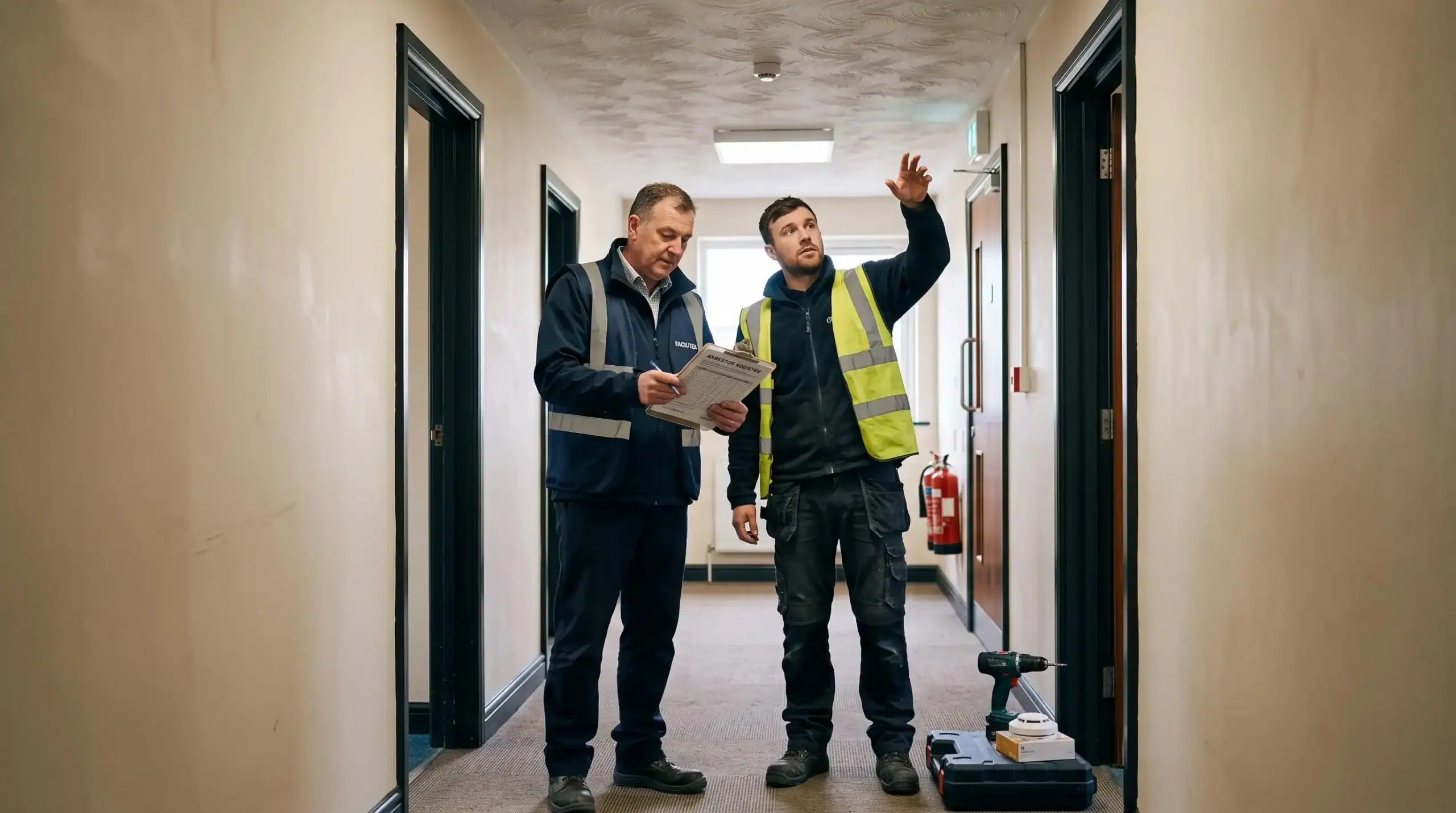
Maintenance work often starts with what appears to be a simple task: drill two holes, replace a fitting or repair a damaged area. In an older building, the first step should be checking whether the material may contain asbestos.
For non-domestic premises covered by the duty to manage asbestos, the asbestos register and management information should identify known or presumed asbestos-containing materials and their condition.
Before work begins, maintenance teams should have access to relevant information about the area they are about to disturb. That may include:
- the asbestos register
- previous survey findings
- marked-up building plans
- records of earlier asbestos removal or remediation
- information supplied by the person managing the premises
In April 2026, HSE highlighted weak asbestos management as an ongoing enforcement concern. Inspectors reported recurring problems with inadequate management plans, insufficient information and training, and poor arrangements for work that could disturb known or presumed asbestos-containing materials.
That is directly relevant to everyday maintenance. A register that exists but never reaches the person holding the drill is not controlling the risk.
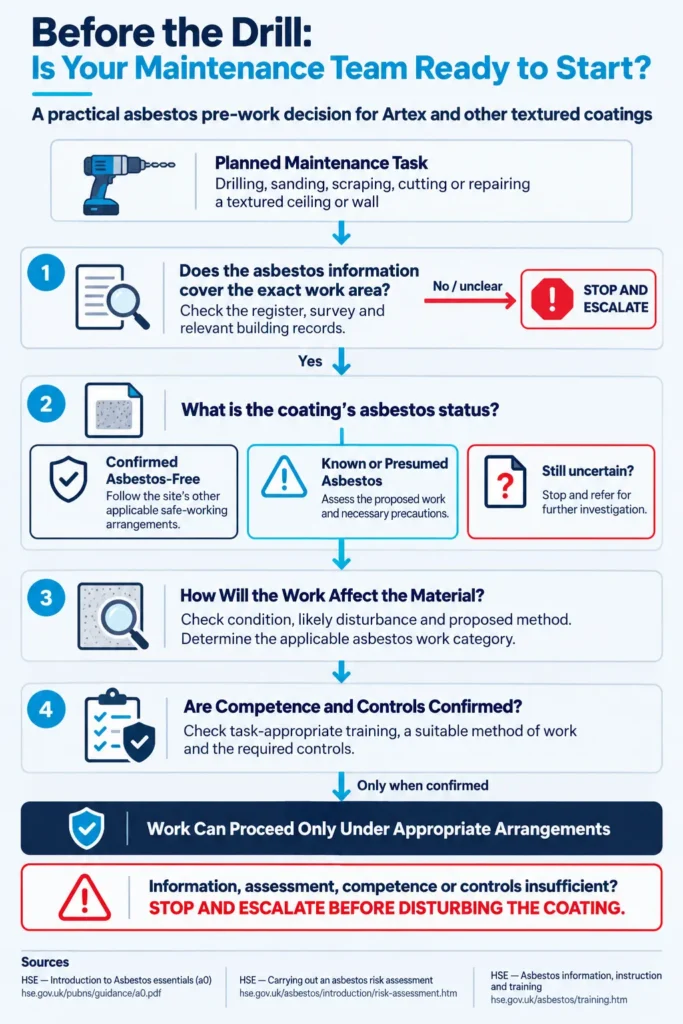
The next question is what the job will actually do to the material. Drilling, sanding, scraping and cutting can disturb a textured coating. Some removal methods can damage it much more extensively.
HSE distinguishes between types of work according to factors including the material, its condition and the way it will be disturbed. For example, drilling through asbestos-containing textured coating for a fixture can fall within non-licensed work when the correct controls and competence are in place. Large-scale removal using steaming or gelling may instead become notifiable non-licensed work (HSE: Textured coatings and work categories).
This is why maintenance teams should not decide that a job is safe simply because it is short. The method matters.
If the asbestos information does not cover the area being worked on, or there is uncertainty about the coating, do not guess. HSE tells workers who encounter a material they think may contain asbestos to stop work immediately.
The issue should then be referred to whoever controls the asbestos arrangements for the building. Further investigation may be required before work resumes. Workers should not take their own samples unless they have the appropriate training and arrangements to do so.
Where analysis is needed, it should be carried out through appropriate asbestos sampling and laboratory procedures. A maintenance team does not need to solve the uncertainty at the point of work. It needs to recognise the uncertainty and prevent disturbance until it has been resolved.
Sometimes, but the answer depends on the task.
Work with textured coatings containing asbestos is not automatically licensed work. HSE describes a number of activities involving these coatings that may be carried out as non-licensed work, provided the people involved have the necessary training and use appropriate controls. Examples include drilling through textured coating to install fixtures and fittings.
Other work may need to be treated differently. Large-scale removal of textured decorative coatings using steaming or gel methods can fall into the category of notifiable non-licensed work. More hazardous circumstances may require a licensed contractor, particularly where other asbestos-containing materials are involved or the proposed method creates greater risk.
The correct category therefore depends on the material, its condition and the nature of the work. Maintenance teams should not use the phrase “non-licensed” to mean “low concern” or “anyone can do it”.
HSE states that workers carrying out work on asbestos-containing materials need task-appropriate training and controls.
If a worker unexpectedly damages a coating that may contain asbestos, the immediate priority is to prevent further disturbance and keep others away.
HSE accidental-disturbance guidance starts with a clear instruction: stop work immediately. It then directs workers to keep others out of the area, report the problem and arrange for the material to be assessed (HSE: Asbestos Essentials emergency guidance).
Do not continue drilling to finish the hole or sweep up dust using ordinary cleaning methods. The response will depend on what has happened and how much contamination may have occurred.
If dust or debris is present on clothing or equipment, additional decontamination steps may be required. The incident should also feed back into the building’s asbestos management information so the same mistake is not repeated.
Human Focus has a separate guide explaining what to do after suspected accidental asbestos exposure in more detail.
This check should happen before tools come out.
Many accidental disturbances do not begin with major demolition work. They begin with ordinary jobs.
A maintenance operative needs to drill a ceiling for a new detector. An electrician needs to run a cable. A contractor needs to remove a fitting from a textured wall.
The person carrying out that work needs enough awareness to recognise when asbestos may be present and know when not to proceed.
HSE’s 2026 asbestos campaign reinforced this point. It identified tradespeople carrying out construction, maintenance and repair work as being at particular risk of disturbing asbestos and stressed the need for suitable information, training and procedures before work starts.
Asbestos awareness training does not qualify someone to carry out every type of work with asbestos. Its purpose is to help people recognise where asbestos may be encountered, understand the risks and avoid disturbing suspected materials inadvertently.
Human Focus UKATA Asbestos Awareness Training is intended for people whose work may bring them into contact with asbestos-containing materials, including maintenance and building trades.
The important question is not simply does Artex contain asbestos? Some older textured coatings do. Others do not.
For maintenance teams, the useful question is whether the coating they are about to disturb has been properly identified and whether the planned work has been assessed.
Check the building information. Check the material. Check the task. If the information is missing or unclear, stop and escalate the issue before work begins.
That is far safer than trying to identify asbestos by pattern, colour or age once drilling has already started.
There is no single date that proves whether every Artex-style coating is asbestos-free. HSE states that asbestos-containing formulations for decorative textured coatings were prohibited in 1988, while some suppliers had stopped using asbestos voluntarily earlier. HSE considers post-1990 construction useful evidence when assessing decorative textured coatings, although building and product history still needs to be considered.
No. If you are asking ‘what does asbestos look like’, the texture or pattern of Artex cannot reliably confirm whether it contains asbestos. HSE notes that textured coatings came in many decorative finishes and were often painted over. Reliable building records, survey information or appropriate analysis may be needed where the content is uncertain (HSE: Locations of asbestos and taking the right action).
Do not drill into an older textured ceiling until you have checked whether it contains or is presumed to contain asbestos and established the correct method of work. HSE does classify some controlled drilling of asbestos-containing textured coatings as non-licensed work, but the people carrying it out still need suitable training and controls.
No. Not all textured coating contains asbestos. Some older products did, while asbestos-free formulations also exist. You should not decide based on appearance or the word “Artex” alone.
Stop work immediately, prevent other people entering the affected area and report the incident to the person responsible for asbestos management. Do not continue disturbing the material or use ordinary dry cleaning methods on suspected asbestos dust. HSE provides specific emergency guidance for accidental asbestos disturbance.