In short: After a needlestick injury, encourage the wound to bleed gently under running water, wash and cover it, and seek urgent medical advice; this guide also explains how discarded sharps should be dealt with safely. If a discarded sharp is found, do not handle it unless the employer’s procedure authorises trained workers to remove it; trained staff should use a suitable pick-up tool and an appropriate sharps container. In Great Britain, the Reporting of Injuries, Diseases and Dangerous Occurrences Regulations 2013 (RIDDOR) apply only where specific reporting criteria are met.
Needlestick Injury and Sharps Clean-Up: Workplace Procedures
Needlestick injuries and discarded-sharps incidents require different responses. This article explains the immediate first-aid and reporting steps after an exposure, and how trained, authorised workers should remove a discarded sharp safely.
People outside healthcare can also encounter discarded needles at work. Cleaners, waste handlers, grounds teams, housing staff and others need a procedure that makes clear when to stop, who may collect a sharp and how an exposure incident is escalated.
The legal discussion focuses on Great Britain. Healthcare-specific duties under the Health and Safety (Sharp Instruments in Healthcare) Regulations 2013 apply only within their defined scope; other employers remain subject to wider duties under the Health and Safety at Work etc. Act 1974, the Control of Substances Hazardous to Health Regulations 2002 (COSHH) and the Management of Health and Safety at Work Regulations 1999.
Why Does Needlestick Injury Risk Extend Beyond Healthcare Settings?
Needlestick injury risk extends beyond healthcare because a sharp contaminated with another person’s blood can transmit blood-borne viruses such as hepatitis B, hepatitis C or HIV. Not every exposure results in infection, and the level of risk depends on factors including the virus, the source, the depth of the injury and whether the needle had been in a vein or artery (HSE, n.d.a.); (UKHSA, 2025).
The risk is not confined to clinical work. HSE notes that needles collected in public places can be contaminated with blood-borne viruses and that refuse and recycling workers should be aware of discarded-needle risks; separate construction guidance addresses work in derelict buildings or areas where drug misuse is known (HSE, n.d.b.); (HSE, n.d.e.).
What Does the Law in Great Britain Require for Needlestick and Sharps Injuries?
In Great Britain, health and safety law requires employers to assess and control workplace risks from needlestick and sharps injuries. The Health and Safety at Work etc. Act 1974 requires employers, so far as is reasonably practicable, to ensure the health, safety and welfare of employees and to conduct their undertaking, meaning their business or work activity, so that people not in their employment are not exposed to health and safety risks (Legislation.gov.uk, 1974). HSE describes the 1974 Act as the primary piece of occupational health and safety legislation for Great Britain, with more specific regulations addressing particular hazards (HSE, n.d.c.).
The Control of Substances Hazardous to Health Regulations 2002 (COSHH) treat blood-borne viruses as biological agents. Under Regulation 7, employers must prevent exposure to substances hazardous to health or, where prevention is not reasonably practicable, adequately control that exposure; safe arrangements for contaminated waste form part of the wider control framework (Legislation.gov.uk, 2002). HSE classifies HIV, hepatitis B and hepatitis C as hazard group 3 biological agents for these purposes (HSE, n.d.d.). For a broader explanation of the regulations, see our introduction to COSHH. The Management of Health and Safety at Work Regulations 1999 also require employers to assess workplace risks and identify who may be affected (Legislation.gov.uk, 1999).
In healthcare, the Health and Safety (Sharp Instruments in Healthcare) Regulations 2013, which implement EU Directive 2010/32/EU in Great Britain, impose responsibilities on healthcare employers and healthcare contractors. These regulations require employers to avoid the use of medical sharps whenever it is reasonably practicable, use safer sharps where reasonably practicable, prevent recapping after use unless a risk assessment shows it is required to control a risk and the injury risk is effectively managed by suitable equipment, and arrange prompt medical advice and any treatment advised following an injury (Legislation.gov.uk, 2013a); (HSE, 2013). HSE states that the Sharps Regulations apply to employers, contractors and workers in the healthcare sector (HSE, n.d.a.). A healthcare contractor is an employer whose main activity is not healthcare but which provides services to a healthcare employer under contract; the Regulations apply where its workers are exposed to a risk of injury from medical sharps in relation to those services, subject to the limits in Regulations 3 and 4. Employers outside that scope still have duties under the 1974 Act, COSHH and the Management Regulations to assess and control the risk and provide suitable information, instruction and training to workers who may be exposed.
What Should You Do Immediately After a Needlestick Injury?
Immediately after a needlestick injury, encourage the wound to bleed gently, wash it, cover it and seek urgent medical advice. The five steps below set out the immediate response in order.
1. Immediate First Aid
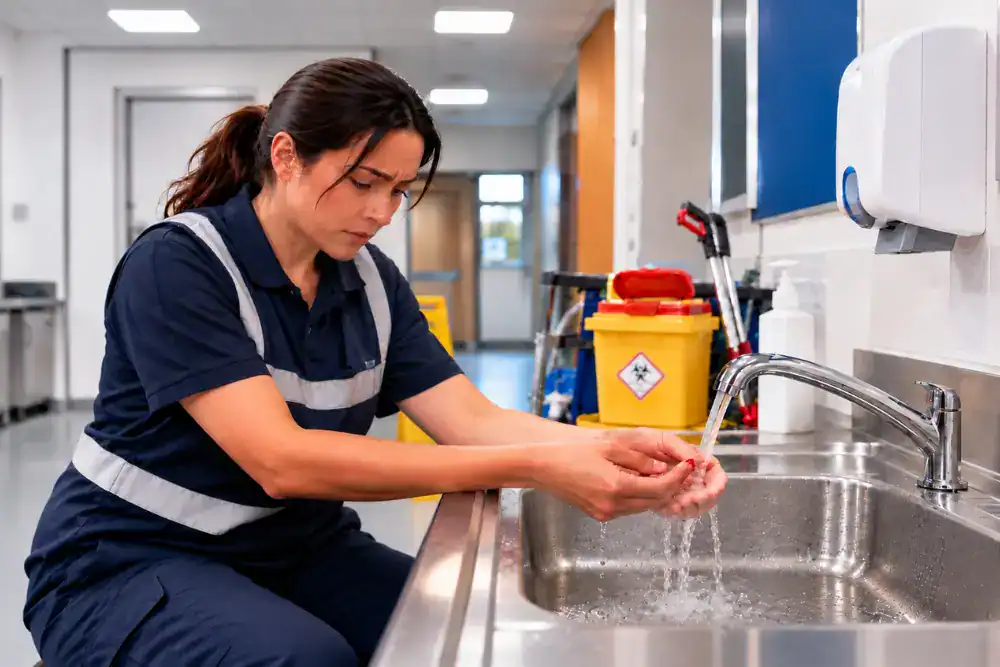
Encourage the wound to bleed gently, ideally holding it under running water, but don’t suck it. Wash it thoroughly with soap and running water and don’t scrub it. Then dry it and cover it with a waterproof dressing. If blood or body fluid has splashed into the eyes, nose or mouth, rinse thoroughly with plenty of water; if the mouth is affected, do not swallow the rinse water (HSE, n.d.a.; HSE, n.d.e.).
2. Seek Urgent Medical Advice
Contact occupational health, NHS 111 or the nearest accident and emergency (A&E) department promptly (NHS, n.d.). Do not wait for symptoms before seeking clinical assessment; an appropriate clinician should assess whether post-exposure treatment or follow-up is needed (HSE, n.d.a.).
3. Record the Exposure Details
Record the circumstances of the exposure for the employer and healthcare professional, including what happened and where and when it occurred. Do not handle or retain the needle or sharp for laboratory testing (HSE, n.d.h.).
4. Report and Record Internally
Report the exposure through the employer’s incident-reporting arrangements so it can be recorded, investigated and assessed against any applicable RIDDOR criteria.
5. Support the Person
Needlestick injuries can cause significant anxiety even where the eventual clinical risk is low. HSE notes that the injury itself and the side effects of preventive treatment can have a substantial personal impact (HSE, n.d.a.). Where appropriate, counselling or other support may form part of the response.
The employer’s exposure procedure should identify who workers report to and how urgent clinical assessment can be accessed (HSE, n.d.h.).
How Do You Clean Up a Discovered Sharp Safely?
If a discarded sharp is found, do not handle it unless the employer’s risk assessment and procedure authorise you to remove it and you have been trained to do so. If you are not authorised, keep people away and follow the site’s arrangements for appropriate collection. Where trained collection is part of the job, use the five steps below (HSE, n.d.b.); (HSE, n.d.e.).
1. Use a Suitable Pick-Up Tool
Do not pick up a needle with bare hands or attempt to recap it. Use suitable equipment such as pincer tools, tongs, forceps, a litter picker or a dustpan and hand brush. Wear gloves with a high degree of puncture resistance; HSE describes them as secondary protection rather than a substitute for safe tools and handling methods (HSE, n.d.e.).
2. Place It Directly into a Sharps Container
Place the sharp directly into an appropriate sharps container positioned close to the collection point. Do not use plastic sacks or other unsuitable waste packaging because sharps can puncture it and expose other people to injury (HSE, n.d.e.).
3. Deal with Any Contamination
If blood or body fluid contamination is present, make the area safe as soon as possible, wear suitable personal protective equipment (PPE), and follow the site’s spill procedure using a disinfectant appropriate for the spill and the manufacturer’s instructions. Dispose of contaminated cleaning materials through the appropriate waste route. Good basic hygiene, including hand-washing and avoiding hand-to-mouth or hand-to-eye contact, remains an important control (HSE, n.d.e.; HSE, n.d.f.).
4. Wash and Check Afterwards
Remove and dispose of gloves safely, wash your hands thoroughly and check whether any injury or contamination occurred during the clean-up. If an exposure did occur, follow the needlestick injury response above and seek prompt clinical advice.
5. Have the Equipment Ready in Advance
At-risk teams should have ready access to a suitable sharps container, a pick-up tool such as tongs or a litter picker, puncture-resistant gloves and any spill-cleaning materials identified by the risk assessment. Mobile teams should have this equipment available where and when discarded sharps are reasonably foreseeable.
For onward collection and disposal requirements, see our companion guide on the safe disposal of sharps and needles.
When Must a Sharps Injury Be Reported Under RIDDOR?
A sharps incident is reportable under RIDDOR only when a specific reporting category is met. In Great Britain, relevant routes include a sharps injury involving known blood or body fluid infected with a blood-borne virus (BBV), an occupationally acquired BBV infection, or an injury that independently meets a RIDDOR injury-reporting threshold (Legislation.gov.uk, 2013b). The reporting tests are separate, so each incident should be assessed against the applicable criteria:
- A needlestick or sharps injury involving known blood or body fluid infected with a blood-borne virus, such as hepatitis B, hepatitis C or HIV, is reportable as a dangerous occurrence (HSE, n.d.d.).
- If a worker acquires a blood-borne virus infection attributable to an occupational exposure, the infection is reportable as an occupational disease (HSE, n.d.d.).
- If the injury itself is a specified injury, or results in more than seven consecutive days of incapacity, meaning the worker is away from work or unable to perform normal duties for that period and excluding the day of the accident, it is reportable on those grounds (HSE, n.d.g.).
If contamination is not known and no other RIDDOR category is met, the incident is not reportable solely because a sharps injury occurred. It should still be recorded and investigated through the employer’s arrangements, and a later occupational infection may create a reporting duty (HSE, n.d.d.); (HSE, n.d.h.).
How Should You Prepare for a Needlestick Injury Before It Happens?
Preparation means agreeing responsibilities before an incident occurs: who provides first aid, how urgent clinical advice is accessed, who is authorised to collect discarded sharps, where the necessary equipment is kept and how incidents are recorded and escalated.
Three points should be clear:
- Workers who may be exposed need clear first-aid, reporting and urgent-clinical-assessment arrangements.
- Discarded sharps should only be collected by trained, authorised workers using suitable tools, protective equipment and sharps containers under the employer’s procedure.
- RIDDOR reporting depends on the specific reporting category, while exposure incidents should still be recorded and investigated through the employer’s arrangements.
If your team needs to recognise and respond safely to needlestick and sharps risks, Human Focus’s Biohazard Cleaning Training provides awareness-level guidance for non-healthcare staff on cleaning blood, body fluids and contaminated sharps, including PPE, cleaning steps and waste handling. It supports knowledge but does not replace employer-specific procedures, practical instruction, risk assessment, supervision or clinical advice after an exposure.