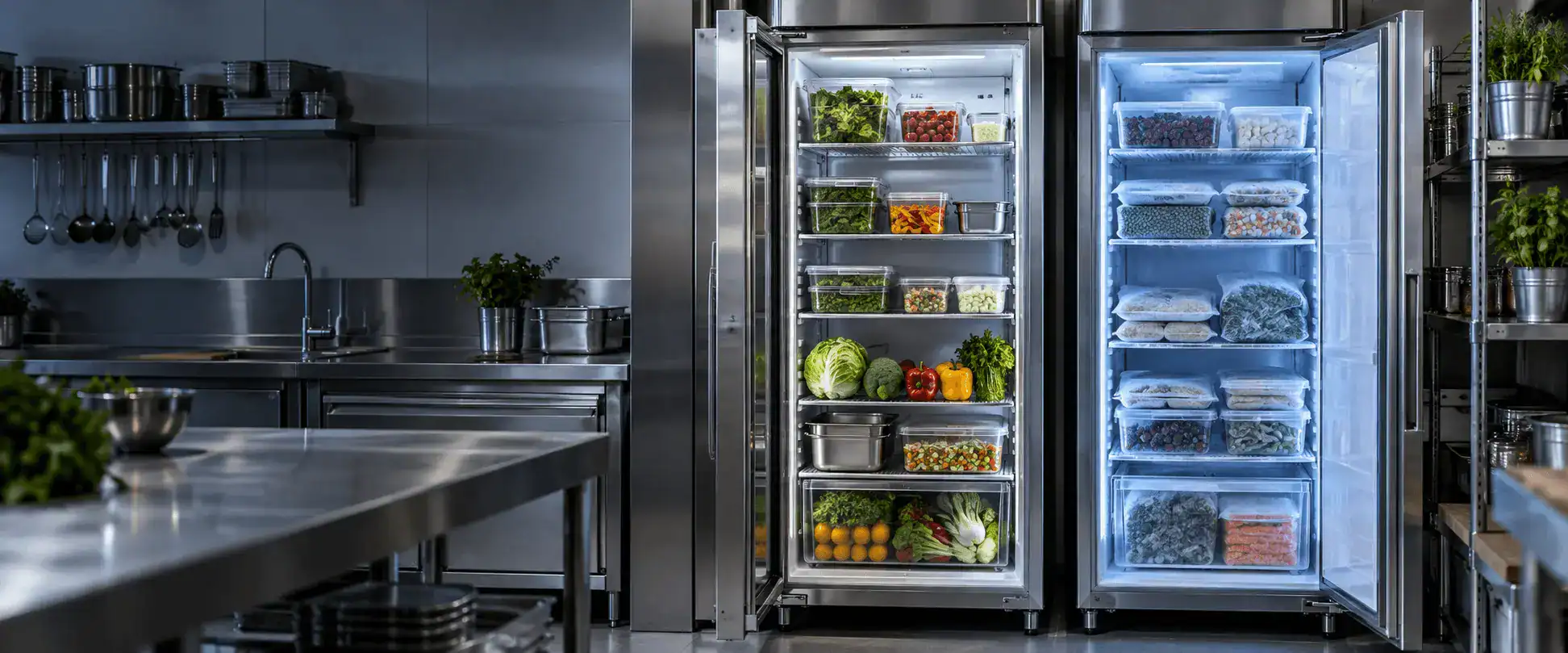
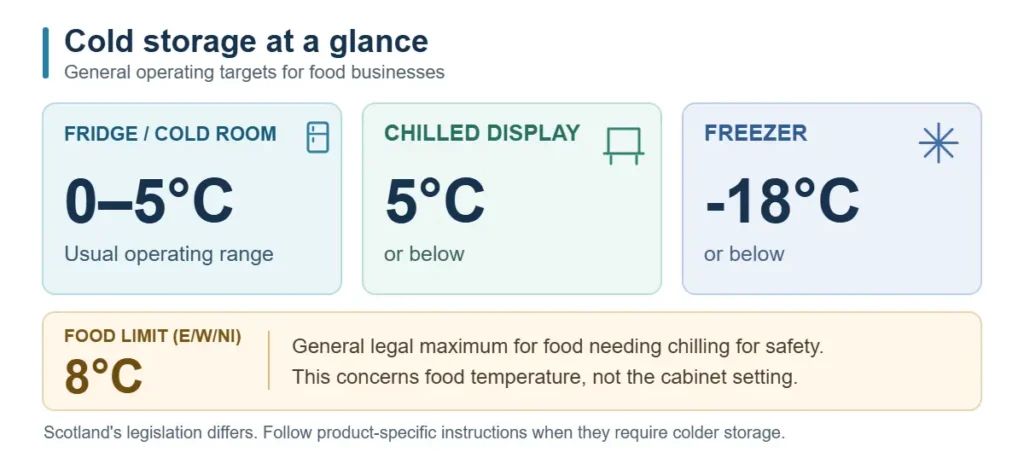
A freezer should generally operate at -18°C or below, while food-business fridges should operate at 5°C or below. In England, Wales and Northern Ireland, 8°C is generally the legal maximum for food that needs chilling for safety. Scotland recommends this limit, but its legislation uses different wording.
These figures serve different purposes. The fridge setting helps equipment maintain suitable conditions, while the legal chilled-food limit concerns the temperature of the food itself. Cold food storage procedures should explain how staff check temperatures and respond when readings rise.
The Food Standards Agency’s business guidance recommends setting fridges at 5°C or below. For food intended to stay chilled, a practical operating range is normally 0°C to 5°C, subject to the product’s storage instructions.
Operating a fridge at 5°C or below provides a margin for temperature changes during normal use. However, a thermostat setting alone cannot confirm that every item is cold enough. Staff should check the fridge’s internal air temperature with a suitable thermometer and, where necessary, check food temperatures using a clean, disinfected probe.
Foods requiring refrigeration include prepared sandwiches, cooked dishes, chilled desserts and products labelled “keep refrigerated”. Some products need temperatures below the general maximum, so staff should follow their storage instructions.
In Scotland, the official temperature-control guidance explains that the legislation requires appropriate refrigerated or cool storage, subject to exemptions. It does not set the same general 8°C statutory chilled-food limit. Food Standards Scotland still recommends operating fridges at 5°C or below.
For most food-business frozen storage, the recommended operating target is -18°C or below. Food Standards Scotland’s CookSafe guidance explains that freezing at these temperatures prevents bacteria from multiplying.
This is general guidance. Product-specific legal requirements and manufacturers’ storage instructions can also apply.
Freezing does not sterilise food. Bacteria can survive and begin multiplying again as food defrosts, as the FSA’s freezing guidance explains. Food should therefore be handled hygienically before freezing and defrosted using a safe method.
Freezing cannot be relied on to remove food contamination. Food must be safe and suitable before it enters frozen storage.
These are general operating targets. Fridges and cold rooms normally run within 0°C to 5°C, chilled display units at 5°C or below and freezers at -18°C or below. Follow any stricter product instructions.
The general 8°C chilled-food limit in England, Wales and Northern Ireland concerns food temperature, not simply the cabinet display. Scotland’s legislation uses different wording, although its guidance also recommends 8°C as a maximum for chilled food.
Chilling slows the growth of harmful bacteria in foods that require refrigeration. It is one of the 4 Cs of food safety, alongside cleaning, cooking and avoiding cross-contamination.
Some bacteria, including Listeria, can grow at refrigeration temperatures. Keeping food cold must therefore work alongside use-by dates, shelf-life controls and hygienic handling.
Food businesses need a food safety management system, or FSMS, based on Hazard Analysis and Critical Control Point (HACCP) principles. HACCP means identifying food safety hazards and establishing controls, checks and corrective actions to manage them. Government FSMS guidance includes temperature monitoring and record-keeping within this system.
For example, a sandwich retailer needs procedures covering deliveries, refrigerated storage and chilled display. The procedures should state acceptable temperatures, who checks them and what happens if a limit is exceeded.
Checks should confirm that equipment is maintaining safe storage conditions. Staff should understand the difference between a thermostat setting, cabinet air temperature and food temperature.
The FSA’s chilled-storage guidance for retailers advises checking built-in displays or dials regularly against a separate fridge or probe thermometer. A display can support routine monitoring, but its accuracy should be verified.
For chilled food, a clean, disinfected probe placed between packs can provide a useful check without puncturing packaging. Where the procedure requires an actual food-temperature measurement, staff should use an appropriate probe correctly.
Set checking frequency through the business’s FSMS. FSA guidance recommends checking fridges and chilled displays at least once a day, beginning with opening checks. Food Standards Scotland’s RetailSafe guidance suggests checking at the start of the day and again later. These are guidance examples rather than one universal statutory schedule.
Position the thermometer to check the warmest relevant part of the cabinet where food is stored, following equipment instructions. A reading from one especially cold spot can miss warmer areas.
Allow readings to stabilise. Routine checks taken immediately after prolonged door opening or during defrosting can give an unrepresentative picture of normal operation. Investigate unexpected readings rather than dismissing them.
Keep measuring devices maintained. The FSA’s advice on checking probes recommends following the manufacturer’s accuracy-check instructions. Clean and disinfect probes before and after food contact.
A useful temperature log should identify:
- The date and time of the check
- The fridge, cold room, display unit or freezer checked
- The measured temperature
- Whether the reading concerns cabinet air, between-pack temperature or food itself
- The person completing the check
- Any problem, corrective action and follow-up result
The FSA’s cold-storage record template includes unit identification, readings, comments, actions and signatures.
Keep records for an appropriate period under the business’s food safety management system. Managers should review repeated deviations and confirm that corrective actions were completed.
A high reading requires a prompt response. A brief rise in cabinet air temperature does not necessarily mean all food has reached the same temperature, but staff need to establish what happened.
- Verify the reading. Recheck with a suitable independent thermometer and assess food temperatures where necessary. Note whether the door was left open, stock was recently loaded or the unit was defrosting.
- Protect the food. Minimise door opening. If necessary, move food to suitable working refrigeration. Identify and hold affected stock separately from food available for use while its safety is assessed.
- Check operation and loading. Confirm that the door closes properly, vents are clear and stock is within the equipment’s loading limits.
- Assess the exposure. Establish which foods were affected, their temperatures and how long they may have been outside safe conditions. Follow the FSMS, product instructions and applicable requirements. If safety cannot be established, do not serve or sell the food. Seek local authority environmental health advice where needed.
- Correct and record the problem. Arrange repairs where necessary, document the food decision and action taken, then verify suitable temperatures before returning the unit to normal use.
The FSA’s chilled-storage safe method covers alternative storage, obtaining environmental health advice and recording failures. Permitted periods outside chilling have specific conditions. They should not be treated as an automatic allowance for every breakdown.
For freezer faults, the FSA’s freezing safe method advises moving food that remains hard and icy to another freezer immediately. Food beginning to thaw needs a safe defrosting procedure and an assessment of its suitability for use.
Common causes include:
- Overfilling cabinets or blocking internal airflow
- Frequent door opening or doors left ajar
- Loading hot food into ordinary storage refrigeration
- Damaged door seals
- High surrounding temperatures or nearby heat sources
- Dirty condensers, overdue servicing or faults in temperature controls
A commercial refrigerator manufacturer’s troubleshooting manual identifies these operating conditions and equipment problems as causes of poor cooling performance. Staff should follow the instructions for their own unit.
Cooked food needs a planned cooling method. The FSA’s guidance on chilling hot food includes smaller portions and blast chilling where appropriate. Ordinary storage fridges should not be overloaded with hot food or used as a substitute for a suitable cooling process.
Staff carrying out food hygiene temperature checks need instruction on the equipment, thermometer method, acceptable readings and escalation procedure.
The FSA’s training and supervision guidance recommends showing staff the relevant methods, asking them to demonstrate their understanding and supervising their work.
Human Focus’s Food Hygiene Training Courses cover food storage, temperature control and contamination prevention, with options for different duties and responsibilities. Online learning can support understanding alongside workplace instruction and supervision. It does not replace the business’s own FSMS or establish competence in a site’s procedures by itself.
There is no single UK-wide legal fridge thermostat setting. In England, Wales and Northern Ireland, food requiring chilling for safety must generally be kept at 8°C or below, subject to exemptions and specific requirements. Scotland uses different legislative wording and recommends 8°C as a maximum. Fridge operating guidance is generally 5°C or below.
A 7°C cabinet reading is above the usual recommended operating target of 5°C or below. Some food may remain within the general 8°C limit, but other products require colder storage. Check actual food temperatures and product instructions, investigate the reading and restore suitable conditions.
A commercial freezer should generally operate at -18°C or below. The chosen setting must keep the products at their required storage temperature, taking account of loading and normal use. Follow the manufacturer’s instructions, product labels and any specific rules applying to the food being stored.
FSA guidance recommends checking fridges and chilled display equipment at least once daily, starting with opening checks. Businesses should set their own monitoring schedule through the FSMS, considering the food, equipment and working conditions. Higher-risk operations or recurring problems may require more frequent checks.
Verify the reading and check affected food temperatures where necessary. Protect or move stock, establish how long safe conditions may have been lost and follow the FSMS corrective procedure. A cabinet reading alone cannot determine whether food is safe. Hold uncertain stock from use and obtain environmental health advice if needed.
Freezing does not reliably kill harmful bacteria or sterilise food. It prevents bacterial multiplication while food remains properly frozen, but surviving bacteria can grow again during thawing. Safe freezing therefore depends on hygienic handling beforehand, appropriate frozen storage and a controlled defrosting method.