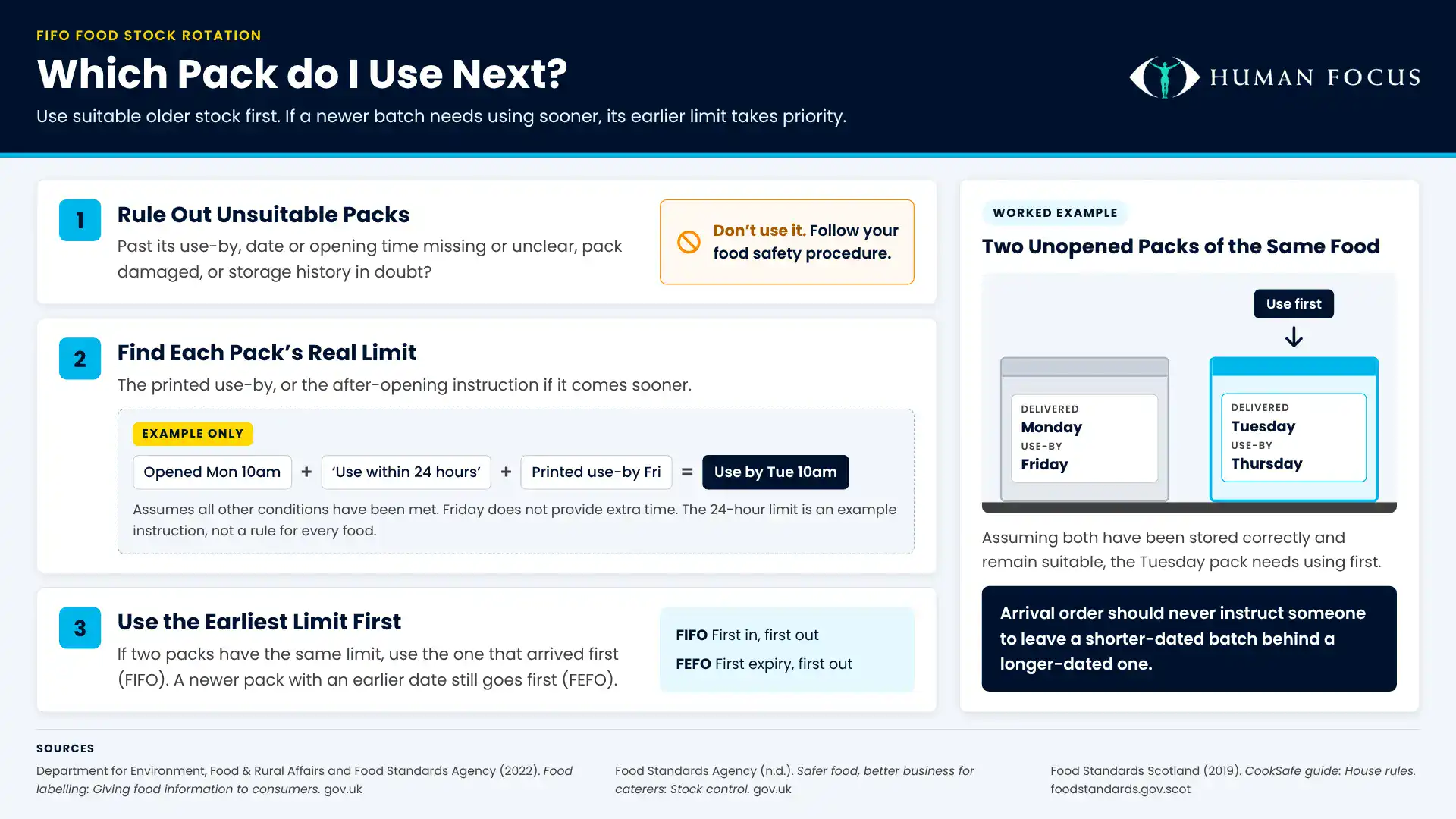
FIFO means first in, first out. In food storage, it means using suitable older stock before newer stock to reduce avoidable waste. Staff must still check use-by dates, instructions after opening and storage conditions. If a newer batch needs using sooner, its earlier limit takes priority.
Stock rotation should make it easy for a food handler to choose the right food next. That matters in a busy kitchen or food shop, where ingredients pass between people and yesterday’s delivery may sit alongside food opened this morning.
The familiar instruction is to put new stock behind old stock. That is a useful starting point, but it leaves some important decisions unresolved. A later delivery may have an earlier use-by date. An opened pack may need using before an unopened pack that arrived first.
A reliable system keeps those differences visible. It connects delivery checks and shelf placement with the decisions staff make when opening, preparing and using food. It also gives supervisors a way to check that the arrangement is working.
In January 2023, an environmental health officer bought a packet of roast chicken breast from a convenience store in Merthyr Tydfil. Its use-by date had passed two days earlier. Laboratory testing found its microbiological quality unsatisfactory.
A follow-up inspection uncovered 27 food items beyond their use-by dates, including a chicken product nine days past its date. The business had already received a formal caution in December 2021 and advice about daily checks. It was convicted in November 2023 and fined £10,000, with additional costs and a surcharge (Merthyr Tydfil County Borough Council, 2023).
The council specifically identified missing daily stock-rotation checks. Its account does not establish that customers became ill. It does show that an earlier warning had not translated into reliable removal of out-of-date food.
For a supervisor, that raises a practical question. When someone says the stock has been checked, what has actually been checked? Moving products forward and finding that the shelf looks orderly cannot establish whether each item is still suitable for sale or use.
FIFO normally gives priority to stock received or produced earlier. First expiry, first out (FEFO) gives priority to the earliest expiry, regardless of arrival order.
Consider two unopened packs of the same food. Monday’s delivery has a Friday use-by date. A pack delivered on Tuesday has a Thursday use-by date. Assuming both have been stored correctly and remain suitable, the Tuesday pack needs using first.
Food businesses often use FIFO as shorthand for rotation that also considers dates. The useful distinction is the decision itself. Arrival order should never instruct someone to leave a shorter-dated batch behind a longer-dated one.
Storage history matters too. In a US experiment, researchers exposed packaged chicken breast to simulated delivery-temperature abuse. Packs in different pallet positions warmed differently, and the exposed chicken reached microbial spoilage thresholds sooner than refrigerated controls (Herron et al., 2022).
That experiment measured spoilage indicators, not illness. Its relevance is that products handled together can experience different conditions. It provides no basis for staff to extend a use-by date or decide that mishandled food can simply be used sooner.
The difference between use-by and best-before dates affects what staff should do when checking stock.
A use-by date concerns safety. Food must not be sold after that date, even if it appears acceptable. Labels can also specify storage conditions and instructions after opening, which staff need to follow (Department for Environment, Food & Rural Affairs and Food Standards Agency, 2022).
A best-before date concerns quality. Passing it does not automatically make food unsafe or require disposal. The food’s suitability still needs assessing under the business’s procedures; a damaged pack or unsuitable storage history cannot be ignored because the date concerns quality (Department for Environment, Food & Rural Affairs, 2024).
This is why an instruction to throw away all ‘expired food’ is too imprecise. Staff need to recognise which date they are reading and what action it requires. Food beyond its use-by date must be removed from use. Food approaching that date needs a decision while there is still time to act safely.
The Food Standards Agency’s (FSA) Safer Food, Better Business stock-control method connects ordering, delivery checks, rotation and corrective action. The pack applies to England, Wales and Northern Ireland. Food Standards Scotland’s CookSafe guidance provides a corresponding approach for Scottish catering businesses (FSA, n.d.-a; Food Standards Scotland, 2019).
Start with what is already available and what the business expects to use or sell. Check quantities alongside remaining shelf life.
If the same ingredient repeatedly reaches its use-by date unused, ask whether order size or delivery frequency needs changing. Rotating surplus stock more carefully cannot create demand for it.
Check dates, packaging integrity and condition, alongside temperature where relevant. Make sure the remaining shelf life meets the business’s agreed requirements.
Give staff a clear route for rejecting unsuitable deliveries or raising concerns with the supplier. A short-dated delivery should prompt a decision at receipt, rather than leave the next shift to discover the problem.
Keep like products together within their appropriate storage areas. Position suitable earlier-use stock where staff can reach it, with labels visible. Put later-use stock behind it.
This needs to remain practical when storage is full. If selecting the right pack requires moving several heavy containers or searching behind unrelated products, review the layout and stock levels.
The next person should read the label and check any opening or preparation information. They should also confirm that the food’s condition and storage history remain acceptable.
A missing date, damaged pack or uncertain opening time needs resolving through the business’s food safety procedure. Do not replace missing information with a guess or assume the person who arranged the shelf has already made every necessary check.
Prevent unsuitable food from being selected, follow the required disposal or assessment procedure and record problems as appropriate.
Review repeated failures. Hidden labels suggest a different problem from excessive orders, short-dated deliveries or unclear shift responsibilities. The corrective action should address the reason the check failed (FSA, n.d.-a).
The printed date on an unopened product does not tell the whole story once the pack has been opened.
Take a hypothetical product labelled ‘use within 24 hours of opening’, with a printed use-by date of Friday. If it is opened at 10 am on Monday, the opening instruction requires use by 10 am on Tuesday, assuming all other conditions have been met. Friday does not provide extra time. The 24-hour limit here is an example instruction, not a rule for every food.
The next shift needs enough information to identify that limit. An opening date alone may be insufficient when the instruction is expressed in hours.
Decanting creates another opportunity to lose information. Keep the food’s identity, ingredients and allergen information available, together with relevant dates and the batch information needed for traceability. CookSafe specifically warns against losing product descriptions and traceability after unpacking, decanting and storage (Food Standards Scotland, 2019).
Prepared food also needs an appropriate storage period established through the business’s safe method. Staff should not invent a shelf life because a container has space for a date. FSA guidance for ready-to-eat food calls for a way to track when prepared or unpackaged food must be used or discarded (FSA, n.d.-b).
Avoid topping up a container of old stock with new stock. It becomes harder to identify which food is oldest, and applying the new batch’s date can conceal the older food’s history. CookSafe advises using existing dry stock first rather than topping up containers (Food Standards Scotland, 2019).
The same selection principle applies across storage areas, while the surrounding controls depend on the food and its condition.
Suitable food preservation methods support storage, but rotation still needs to work within those arrangements. Moving an item forward must not compromise food separation.
For frozen stock, freezer temperature and monitoring remain relevant alongside date labels. Freezing suitable food before its use-by date may be an option under an established safe method and the manufacturer’s instructions. It cannot rescue food already beyond that date (FSA, n.d.-a).
A useful check should establish whether someone starting the next shift can make the right decision without relying on a colleague’s memory.
- Can staff identify the next suitable batch to use?
- Does the shelf order reflect the relevant dates?
- Are opening and preparation details clear enough to establish the applicable limit?
- Has decanted food retained the information needed for safe use?
- Is unsuitable stock prevented from being used or sold?
- Have repeated problems led to action on ordering, suppliers, instructions or supervision?
Use these checks at relevant points in the work, including receipt, restocking and before use, supported by supervisory reviews. Set the frequency through the business’s food safety procedures so that checks occur while staff can still act on the findings.
The Merthyr Tydfil case shows why a warning or instruction needs follow-through. Someone still has to inspect the food, recognise the date and remove items that must no longer be sold.
Training contributes by giving staff the knowledge to understand those decisions. Human Focus’s Level 2 Food Safety in Catering includes delivery and receipt, storing and decanting food, labelling and storage procedures. The business still needs to show employees how those principles apply to its products, labels and routines.
Ask a member of staff to select the next pack and explain the choice. Then ask what would change if another pack expired sooner or had already been opened. Their answer can reveal whether the procedure is understood and whether the information needed to follow it is actually available.
FIFO is working when that decision remains clear after a delivery, during a busy service and at the next handover.