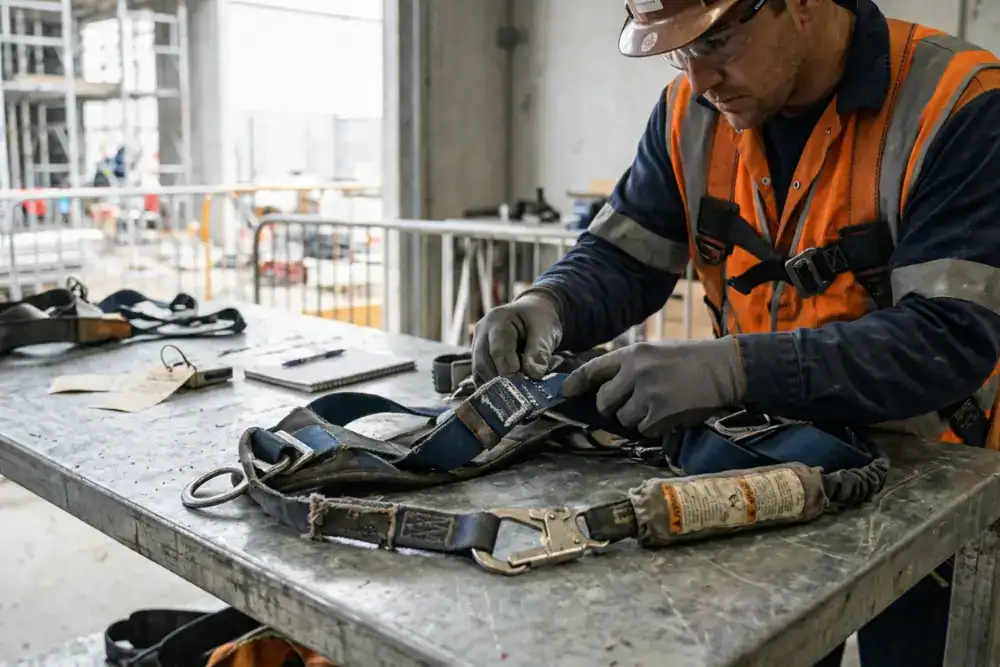
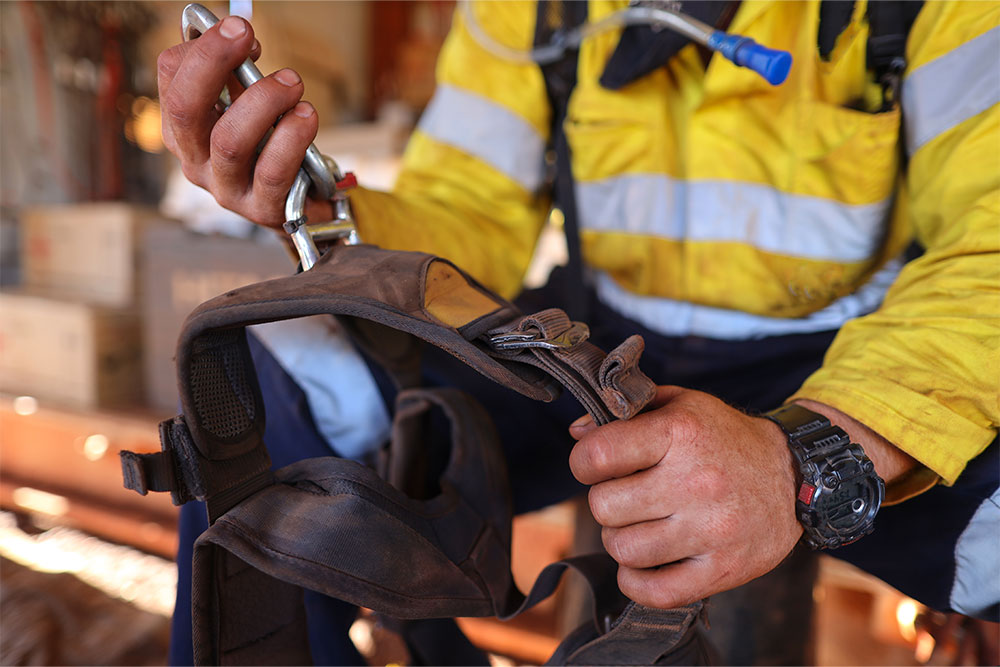
When a harness or lanyard fails during a fall, the consequences are catastrophic and irreversible. Fall arrest equipment is the last line of defence against fatal injury – and its integrity depends entirely on the quality of inspection carried out before use.
This article sets out the principal harness and lanyard defect categories that competent inspectors are trained to identify, grounded in UK regulatory guidance and industry standards. It also explains why some of those defects can be difficult to detect, and what the evidence tells us about the system-level conditions that allow defective equipment to remain in service.
Whether you are an employer with responsibility for fall protection programmes, a safety manager reviewing your inspection regime, or a competent person conducting detailed inspections, understanding both what to look for and why defects are sometimes missed is essential to discharging your legal duties effectively.
Regulatory basis: HSE INDG367, BS EN 365:2004, WAHSA PGN02, and the Work at Height Regulations 2005 collectively define the framework within which harness and lanyard inspections must be conducted in Great Britain (HSE, n.d.); (BSI, 2004); (WAHSA, 2021); (HMSO, 2005).
Harness and lanyard defect categories defined in regulatory guidance and manufacturer inspection protocols are based on risk severity and the consequences of failure during a fall – not on how frequently each defect type is observed. No UK regulator publishes prevalence data on individual defect types. The categories below reflect what competent inspectors are trained to look for, not a ranking of likelihood.
The load-bearing webbing of a harness or lanyard is the component most exposed to environmental and mechanical stress. HSE INDG367 identifies the following as grounds for withdrawal from service (HSE, n.d.):
- Cuts – including cuts so minor they are easily overlooked. Human Focus training materials note that a 1 mm cut on the edge of a lanyard can result in a 5 to 40% loss of tensile strength. Cuts on load-bearing edges and stitched zones are particularly significant because those areas carry the greatest forces in a fall.
- Abrasion – surface wear caused by repeated contact with rough or sharp edges. WAHSA PGN02 notes that minor visible surface abrasion can produce disproportionate reductions in strength, particularly at stitched load paths (WAHSA, 2021).
- Fraying – visible unravelling of fibres at edges or terminations, indicating mechanical breakdown of the textile structure.
- Heat or friction damage – characterised by shiny, stiffened or hardened fibres. Heat damage can occur from contact with hot surfaces, welding sparks, or friction generated during a fall event. Affected webbing may look superficially intact but has degraded structurally.
- Chemical contamination – acids, alkalis, solvents and paints can degrade nylon or polyester webbing without leaving an obvious visual trace. Contamination may cause localised weakening detectable only by feel or discolouration.
- Discolouration – a change in colour can indicate UV degradation, chemical exposure, or heat damage. Any unexplained discolouration should prompt withdrawal pending investigation.
- Loss of pliability or thinning – webbing that feels stiff, boardy or thinner than expected may have been subjected to excessive loading, chemical attack or prolonged UV exposure.
- Writing on webbing – marking webbing with permanent markers or paint pens introduces chemical contamination and is explicitly identified in inspection guidance as a reason for withdrawal.
Key point: Visual inspection alone is insufficient for webbing defects. HSE INDG367 advises inspectors to check by feel as well as sight, running fingers along the full length and width of webbing to detect stiffness, thinning or surface irregularities not visible to the naked eye (HSE, n.d.).
Stitching on harnesses and lanyards is not cosmetic – it is structural. Load-bearing stitching at attachment points, buckle terminations, and shock-absorber junctions carries critical forces during a fall. HSE INDG367 treats any damage to safety-critical stitching as grounds for immediate withdrawal (HSE, n.d.).
Defects to identify include:
- Broken or missing stitches – even a small number of broken stitches in a load-bearing zone is an automatic fail in manufacturer inspection protocols and consistent with INDG367 guidance (HSE, n.d.).
- Loose or distorted stitching – stitching that has shifted, puckered or appears under tension differently from adjacent sections may indicate prior overloading.
- Abrasion and contamination of stitching – stitching worn down by grit or contaminated by chemicals may have reduced strength even where individual threads appear superficially intact.
- Deployed or damaged load-bearing stitching, including shock indicators – some harnesses incorporate stitched impact indicators that visibly change when significant loading has been applied. Any sign of deployment is cause for immediate removal from service.
Stitching on most modern harnesses is coloured differently from the webbing to aid identification. Inspectors should check every stitched junction systematically, rather than relying on a general visual sweep.
Energy-absorbing lanyards contain a shock absorber pack designed to deploy during a fall, extending progressively to reduce peak arrest force on the body. Once deployed, the absorber is spent and must not be re-used. HSE INDG367 is unambiguous: any lanyard with a deployed shock absorber must be immediately removed from service (HSE, n.d.).
Defects to identify include:
- Deployed harness impact indicators – visible distortion of stitched indicators on the harness body signals that the equipment has been subjected to significant shock loading.
- Deployed or damaged shock absorber packs on lanyards – a deployed absorber pack will be noticeably longer than its undeployed state and may have visible tears in the pouch.
- Torn pouches or exposed absorber material – even where deployment is not confirmed, physical damage to the absorber pouch compromises its integrity and is a withdrawal criterion.
Real-world example: An IMCA Safety Flash (0324) identified defective harnesses during routine detailed inspection, including equipment that workers had continued to use without reporting the incident that caused deployment. This illustrates why regular detailed inspections are essential regardless of whether falls have been reported (IMCA, 2024).
The metal components of a harness and lanyard – connectors, buckles, carabiners, snap hooks and D-rings – are subject to mechanical wear, corrosion and impact damage. Hardware defects are often more straightforwardly visible than webbing defects, but require methodical checking of moving parts and locking mechanisms. HSE INDG367 identifies the following as rejection criteria (HSE, n.d.):
- Cracks, nicks or deformation – any visible deformation of load-bearing hardware indicates that the component has been subjected to forces beyond its design parameters. A deformed D-ring or buckle frame may not support rated loads.
- Corrosion – surface rust, pitting or scaling on metal components reduces material integrity. Even light corrosion on locking mechanisms can prevent reliable closure.
- Gate malfunction or incomplete closure – connectors must close and lock fully. Gates that are slow to close, fail to seat correctly, or do not produce an audible click when the locking sleeve engages must be withdrawn.
- Locking mechanism failure – a connector with a locking sleeve that spins freely, is seized, or does not fully engage provides no reliable gate retention in a fall.
- Heat discolouration – blue, purple or black discolouration on metal components indicates exposure to high temperatures that may have altered the temper of the alloy.
- Buckle malfunction – rollers, springs and friction adjusters within buckles should function smoothly. Bent or corroded components that prevent positive engagement must be replaced.
Hardware components should be checked both visually and functionally – operating gates, locking sleeves and buckle adjusters through their full range of movement.
Under BS EN 365:2004, fall protection equipment must carry legible, durable markings that enable traceability to the manufacturer, standard of manufacture, date of production, and unique serial number. HSE guidance confirms that equipment with missing or illegible labels cannot be reliably inspected – because without traceability, neither the age nor the service history of the equipment can be confirmed (BSI, 2004; HSE, n.d.).
Defects in this category include:
- Missing labels – complete absence of the manufacturer’s label is an automatic failure. The equipment cannot be authenticated or traced.
- Illegible or faded markings – labels worn to the point where the serial number, date of manufacture, or standard marking cannot be read must be treated as equivalent to missing.
- Untraceable serial numbers – inspection records must link to the serial number of each item. If that link cannot be established, the inspection record is invalid.
- Out-of-date equipment – most textile fall arrest equipment has a maximum service life of ten years from the date of manufacture, as stated on the label. Equipment that has reached or exceeded this limit must be withdrawn regardless of apparent physical condition.
- Missing CE or UKCA markings – equipment placed on the UK market must carry the UKCA mark (or CE mark under transitional arrangements). Equipment without conformity marking should not be in service.
Rope and wire rope lanyards are inspected under the same regime as webbing lanyards but present some distinct defect characteristics. HSE INDG367 provides specific guidance on rope and cable rejection criteria, supplemented by WAHSA PGN02 (HSE, n.d.; WAHSA, 2021).
- Core or sheath damage in rope lanyards – the outer sheath of a kernmantle rope lanyard protects the load-bearing core. Cuts, abrasions or melting of the sheath require the lanyard to be withdrawn even if the core appears unaffected, as the extent of core damage cannot be assessed without destructive testing.
- Broken wires in wire rope lanyards – individual wire breaks within a strand are a rejection criterion. Broken wires are identified by feel as well as sight, running a cloth along the rope length to detect protruding wire ends.
- Kinks or separated strands – a kinked wire rope has been permanently deformed and will have reduced load-carrying capacity at the kink.
- Corrosion or chemical exposure – rusting of wire rope or discolouration of rope fibre indicates environmental degradation.
- Knots in rope lanyards – a knot in a rope lanyard reduces strength by up to 50% at the knot point and is a straightforward rejection criterion.
Understanding the defect categories is necessary but not sufficient. The more challenging question is why defective equipment sometimes remains in service despite inspection regimes being in place. The evidence – from regulatory enforcement records, incident investigation literature, and industry guidance – points consistently to system-level failures rather than any single missed observation.
Falls from height account for around 25% of occupational fatalities in Great Britain over any five-year rolling period, and approximately 8% of non-fatal injuries, according to HSE statistics (HSE, 2024). These figures do not isolate harness or lanyard defects as a specific causal category – HSE published data does not report at that level of granularity. What the statistics do confirm is that fall protection systems as a whole remain critical to occupational safety, and that failures within those systems continue to contribute to serious and fatal outcomes.
The Work at Height Regulations 2005 require that inspections are conducted by a competent person (HMSO, 2005). BS EN 365:2004 and HSE guidance both define competence in terms of knowledge, training, and experience relevant to the specific equipment being inspected. However, the standard of inspection is directly dependent on the quality of the training that competent persons have received (BSI, 2004; HSE, n.d.).
Research identifies that PPE performance – including detection of defects during inspection – is materially influenced by the quality of training and the inspector’s understanding of degradation mechanisms. An inspector who has not been trained to check webbing by feel as well as sight, or who does not understand that a minor surface cut can produce a disproportionate strength loss, may pass equipment that a more comprehensively trained inspector would withdraw.
What this means in practice: Pre-use checks conducted by equipment users require a different – and simpler – level of training than detailed inspections conducted by competent persons. Conflating these two inspection types, or allowing detailed inspections to be conducted by individuals trained only for pre-use checks, is a common system failure.
Equipment that passes a detailed inspection can degrade significantly before the next inspection if it is stored or handled incorrectly. WAHSA PGN02 identifies UV exposure, chemical contact, heat, abrasion during storage, and mechanical damage during transport as degradation mechanisms that can occur between formal inspection events (WAHSA, 2021).
Equipment stored near paint spray, welding operations, or corrosive substances; equipment left in vehicles in direct sunlight; or equipment that is coiled tightly and stored under other loads, can develop defects in the interval between inspections that would not have been present at the point of the last recorded check.
This is one reason why pre-use checks – conducted by the user each time the equipment is used – are a regulatory requirement as well as a practical safeguard. Pre-use checks cannot replicate a detailed inspection, but they can identify degradation that has occurred since the last formal check.
HSE enforcement action following falls from height consistently identifies failures at the system level rather than attributing outcomes to any single missed defect. Prosecution summaries show that the most prevalent failure modes in prosecuted cases involve inadequate planning, insufficient supervision, failure to establish or maintain an inspection regime, and absence of training – not individual inspection errors in isolation.
This does not diminish the importance of harness and lanyard defect detection. It does suggest that the reliability of inspection – and therefore the probability that defects will be detected – depends on the robustness of the wider management system within which inspections take place. An inspection regime that exists on paper but is not supported by trained personnel, clear accountability, and consistent record-keeping will not reliably detect defects.
The evidence points in one direction: inspection reliability is not simply a function of how carefully an individual examines a piece of equipment. It is a product of training quality, competence standards, management systems, and the consistency with which inspection regimes are applied across an organisation.
Human Focus provides accredited online training designed to support employers in establishing and maintaining compliant inspection regimes for work at height equipment:
- Harness and Lanyard Inspection – a detailed inspection course covering all defect categories, inspection methodology, and recording requirements for competent persons conducting formal detailed inspections.
- Harness and Lanyard Awareness – a user-level course supporting pre-use checks, equipment familiarisation, and safe fitting.
Both courses are aligned with HSE INDG367, BS EN 365:2004, and the Work at Height Regulations 2005, and can be accessed online by workers across multiple sites and shift patterns (HSE, n.d.; BSI, 2004; HMSO, 2005).
Digital inspection checklists and training records can support the traceability and consistency requirements of BS EN 365:2004, complementing formal inspection regimes and providing auditable evidence that equipment has been systematically reviewed (BSI, 2004).
This article is intended for information purposes and does not constitute legal advice. Employers should consult the primary regulatory sources and seek specialist guidance appropriate to their specific work at height activities.