In short: There is no single UK-wide statutory maximum gap under every fire door. In England, the current GOV.UK fire-door guidance says the gap between the door and frame should never be more than 4mm, except at the bottom, where the gap should be as small as practicable while avoiding snagging. For many fire-only door assemblies, manufacturer instructions or supporting test evidence may permit a larger threshold gap, sometimes around 8–10mm, but that figure is not a universal legal rule. Where smoke control is required, the threshold needs a suitable, tested smoke-sealing arrangement that matches the door assembly’s supporting evidence.
What Is the Maximum Gap Allowed Under a Fire Door?
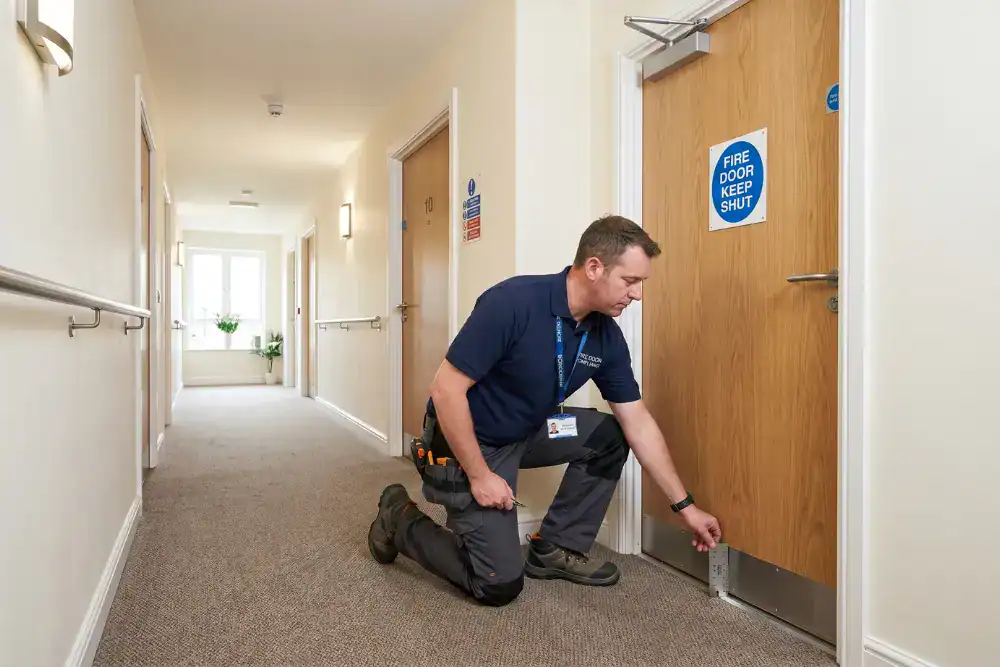
The maximum gap allowed under a fire door in England is not a single fixed figure: the correct tolerance depends on the door assembly’s supporting evidence, the manufacturer’s instructions and whether smoke control is required. Fire door gaps can also change after installation — building movement, hinge wear, floor covering changes and contractor activity can all push a compliant door outside its tested tolerances.
This article explains why no single universal figure applies to every fire door assembly and sets out what Responsible Persons need to check, record and remedy to keep fire doors compliant, with reference to Approved Document B, BS 8214:2026 and the Fire Safety (England) Regulations 2022 (HM Government, 2022a; HM Government (2022b); BSI, 2026).
What Are the Key Rules on Maximum Fire Door Gaps in England?
In England, the key rules on maximum fire door gaps are determined by the door assembly’s supporting evidence, the applicable guidance and the duty holder’s obligations under the Fire Safety (England) Regulations 2022.
- For some fire-only door assemblies, the permitted gap under the door may be up to around 8 to 10mm, but this is not a universal legal limit. If the door needs smoke control, the threshold must be sealed in line with the door assembly’s tested evidence rather than treated as an open gap.
- The correct gap depends on the specific door assembly. Check the manufacturer’s instructions, certification evidence and any applicable field-of-application reports (documents that extend a product’s fire-test evidence to cover permitted variations in configuration or installation).
- Fire door requirements in England are shaped by the Building Regulations, Approved Document B, BS 8214:2026 (the British Standard Code of Practice for fire-resisting and smoke-control door assemblies), the Regulatory Reform (Fire Safety) Order 2005, the Fire Safety Act 2021 (HM Government, 2021a) and the Fire Safety (England) Regulations 2022; different statutory regimes and guidance apply in Scotland, Wales and Northern Ireland.
- Fire door gaps can change over time because of settlement, worn hinges, flooring changes, damage or everyday use. Recording measurements can help identify issues before they become serious.
What Is the Maximum Gap Allowed Under a Fire Door?
For fire doors in England, GOV.UK guidance does not give a single universal maximum bottom gap (HM Government, 2022c). It says the door-to-frame gap should not exceed 4mm except at the bottom, where the gap should be as small as practicable while avoiding snagging.
Some fire-only door assemblies may have manufacturer or test evidence allowing a larger threshold gap, sometimes around 8–10mm, but that evidence must be checked for the specific door.
For doors required to control smoke, the threshold gap should not be assessed using a simple unsealed gap figure alone. The relevant question is whether the smoke-control arrangement matches the tested door assembly’s supporting evidence; these gap figures are starting points, not universal rules.
The authoritative number for any specific door set comes from the manufacturer’s fitting instructions.
Where a door has third-party certification, such as BM TRADA Q-Mark or Certifire, the certificate and manufacturer’s instructions help establish the tested configuration, compatible components and permitted installation tolerances (BM TRADA, n.d.; Warringtonfire, n.d.).
BS 8214:2026, the current Code of Practice for fire-resisting and smoke-control doors, gives the broader framework for specification, installation, inspection and maintenance (BSI, 2026). It focuses on complete door assemblies and supporting evidence rather than reducing compliance to a single on-site gap figure.
Fire Door Inspection Training
Ensure fire doors are safe, functional and compliant. This RoSPA-assured online Fire Door Inspection Training course explains the requirements and procedures for compliant fire door inspections. Recommended by the National Association of Fire Door Inspectors, it covers when to inspect, what to check and how to act on defects.
Why Does the Gap Under a Fire Door Matter?
The gap at the bottom of a fire door – the clearance between the door leaf and the floor or threshold – controls what passes between a fire-affected space and an area of relative safety: smoke, hot fire gases and flame can all cross where the door assembly no longer performs as tested.
Smoke spread is a major life-safety concern because fire doors help protect escape routes and limit the movement of fire and smoke between spaces (Home Office, 2025). Smoke can spread quickly, reduce visibility and expose occupants to toxic combustion products. A larger undercut may be acceptable where smoke control is not required and the door assembly’s supporting evidence permits it, but not where smoke control is required (HM Government, 2022c).
Where a fire door no longer matches its tested or assessed condition, its expected performance becomes uncertain (BSI, 2026). Intumescent (heat-expanding) seals on the frame expand under heat, but they cannot compensate for an undersized door leaf.
What Do Building Regulations Say About Fire Door Gaps?
Building Regulations 2010 do not prescribe a single maximum gap figure for fire doors. They set functional fire-safety requirements, and fire doors must perform as part of the design strategy for means of escape, compartmentation and limiting the spread of fire and smoke (HM Government, 2010).
Approved Document B provides statutory guidance on fire safety in England. It should be read alongside the door assembly’s supporting evidence, manufacturer instructions, the fire risk assessment and relevant standards such as BS 8214:2026 when assessing a specific fire door (HM Government, 2022a; BSI, 2026).
Approved Document F covers ventilation and may explain why an undercut exists in some dwellings. It does not, on its own, set the fire-safety tolerance for a fire door (HM Government, 2021b).
For fire performance specifically, the working reference for duty holders is BS 8214:2026, the current Code of Practice for fire door assemblies. The 2026 edition addresses fire-resisting and smoke-control doors as coordinated systems, with a focus on supporting evidence rather than simple prescribed on-site figures (BSI, 2026).
Who Is Responsible for Checking Fire Door Gaps?
Under the Regulatory Reform (Fire Safety) Order 2005, the Responsible Person has duties for fire precautions in non-domestic premises and the common parts of multi-occupied residential buildings in England and Wales.
In England, the Fire Safety (England) Regulations 2022 add specific fire-door information and checking duties for blocks of flats (HM Government, 2005). In most cases, the Responsible Person is the employer, the building owner or the managing agent.
Day-to-day inspections can be delegated to trained staff or a specialist inspector, but legal accountability stays with the Responsible Person.
The Fire Safety (England) Regulations 2022 sharpen this further (HM Government, 2022b). In blocks of flats in England where the top storey is more than 11 metres above ground level, Responsible Persons must use best endeavours to check flat entrance fire doors at least every 12 months and check communal fire doors at least every three months (HM Government, 2022b; HM Government, 2022c).
Routine Regulation 10 checks are simple visual checks that do not require tools and should not normally need a specialist; competence becomes critical when repairs or replacements are commissioned (HM Government, 2022c). The Responsible Person carries exposure for failing to carry out checks or failing to commission competent remediation.
Why Is 8 to 10mm Not the Universal Maximum Gap for All Fire Doors?
The 8 to 10mm threshold gap is not a universal maximum for all fire doors because the correct figure depends on several variables – including smoke-control requirements, floor finish, hinge condition and seal status – that differ from one door assembly to another (HM Government, 2022c).
The door’s certification is one variable. An FD30S door (fire and smoke) cannot rely on the same undercut – the designed gap between the bottom of the door leaf and the floor – as an FD30 (fire only) (BSI, 2026). Where smoke control is required, the threshold must be sealed by a tested sealing system matching the door assembly’s supporting test evidence.
Floor finish is another variable. A door installed over bare screed that later had carpet laid beneath it has lost its undercut relative to its tested configuration. A door installed over carpet that was later replaced with hard flooring has gained an undercut that it was never tested with. Either change can take the gap outside the manufacturer’s permitted range.
Hinge condition matters too. Worn hinges can cause uneven gaps, binding, latch failure or the door leaf dropping out of alignment. The measurement drifts out of tolerance without anyone touching the door.
Seal condition also matters. Damaged cold smoke seals or painted-over intumescent strips compromise certified performance even when the bottom gap appears correct.
What Should Responsible Persons Check on a Fire Door?
Responsible Persons should check seven elements on each fire door, including the threshold gap, the head and side gaps, the frame-to-wall gaps, the seals, the self-closing device, the certification label and any visible damage. For formal inspections, inspectors should carry out these checks with suitable measuring tools, such as a gap gauge or calibrated measure, rather than rely on visual assessment alone; this is separate from routine Regulation 10 checks, which GOV.UK describes as simple visual checks that do not normally require tools (HM Government, 2022c).
- Threshold gap: The gap at the bottom of the door leaf should be within the manufacturer’s certified range and supporting test evidence. For some fire-only door assemblies, this may be around 8-10mm, but it is not a universal legal limit. For smoke-control doors, the threshold arrangement must match the tested or assessed smoke-control evidence for that door assembly (HM Government, 2022c; BSI, 2026). This is the most frequently checked element and the one most often recorded in isolation.
- Head and side gaps: The head and side gaps should be no more than 4mm with the door closed (HM Government, 2022c). A wider gap allows smoke to bypass the leaf; a tighter gap can cause the door to bind under heat expansion. Also check that the door is aligned, the gaps are uniform, and, on smoke-control doors, that light is not visible around the closed door.
- Frame-to-wall gaps: The door leaf is only one part of the assembly. Inspectors should also consider whether the gap between the frame and the wall is properly filled and sealed, because a compliant-looking door can still fail if the frame has been poorly installed or inadequately sealed. Where inspection scope allows, concealed areas behind architraves may need checking because these are common failure points.
- Intumescent and cold smoke seals: Both seal types should be continuous, undamaged and correctly seated. Painting over an intumescent strip is a defect. A missing brush seal on a door specified with one is a defect (HM Government, 2022c).
- Self-closing device: The device should bring the door fully into the frame from any open position and engage the latch. Doors that close within a few millimetres of the latch are not closed for fire-safety purposes. For formal inspections, closing performance may also need to be measured, including whether the door closes and latches from different open positions and whether the opening force remains within acceptable limits.
- Certification label: The label on the top edge of the door should be present and legible. A missing or painted-over label puts the status of a modern certified door into doubt and cannot be replaced by the owner; for older existing flat entrance doors, suitability is determined through the fire risk assessment (HM Government, 2022c).
- Visible damage: Any damage to the leaf, frame or threshold should be recorded in enough detail to track changes over time. A 2mm dent today is the baseline for whether it has worsened in three months.
Why Do Fire Door Gaps Drift Out of Tolerance Over Time?
Fire door gaps drift out of tolerance over time because of building settlement, hinge wear, floor covering changes and maintenance or contractor activity that affects the door’s components.
Building settlement shifts frames out of alignment. Thermal cycling expands and contracts both the door and the frame. New floor coverings alter the gap in either direction, as described in the section above on variables that affect the threshold tolerance. Contractors working on unrelated plumbing or decorating jobs can damage seals, planted stops (the raised frame sections the door leaf closes against) or the door leaf itself without reporting the damage.
Resident and staff behaviour adds another layer. Wedging doors open, fitting unauthorised kick plates and DIY repairs all create non-compliance that the next inspection has to catch. Without a record of measurements over time, none of these changes gets noticed until something fails.
What Should You Do If a Fire Door Gap Is Too Large?
When a fire door gap exceeds permitted tolerances, the Responsible Person should record the defect, assess the risk and commission competent remediation before the door’s fire and smoke performance is further compromised (HM Government, 2022c).
- Record the defect: The door, location, measurement, date and inspector should all be captured in a written record linked to the door’s certification documentation.
- Assess the risk: A failed gap on a door protecting the only escape route from a sleeping risk area is a different problem from a failed gap on a stairwell door that backs onto a sprinklered atrium. Prioritise by risk level before commissioning remediation.
- Commission competent remediation: The manufacturer’s evidence sets the boundary. Drop-down threshold seals (mechanical devices fitted to the door bottom that lower to close the gap automatically when the door closes), intumescent strips and proprietary gap-remediation systems can bring a door back into compliance only when they have been tested with the door set in question (BSI, 2026). The installer should follow a like-for-like principle unless the manufacturer’s evidence supports an alternative. Mixing hinges, seals, locks or other components from different systems can undermine the door’s tested performance.
Trimming a fire door is not a remediation strategy for a gap that has developed in service. Manufacturers usually permit some trimming on the sides during installation, within specified limits set out in the fitting instructions. Trimming the top is generally avoided because the certification label sits on the top edge of the door leaf; any trimming must be within the manufacturer’s permitted limits and supported by the door assembly’s evidence.
A competent installer must carry out any remediation and produce documented evidence of the work completed.
How Can Responsible Persons Prevent Fire Door Gap Defects From Recurring?
Preventing fire door gap defects from recurring requires measurement-based inspections, staff reporting systems and contractor oversight to work in combination.
Scheduled inspection alone is not enough. Although Regulation 10 checks are primarily visual (HM Government, 2022b), capturing measurements rather than only pass or fail flags helps trends become visible between formal inspections.
A door measuring 8mm in January, 9mm in April and 10mm in July is on a trajectory. Inspection frequency should also reflect use and risk: a high-traffic door protecting vulnerable occupants needs closer monitoring than a rarely used door in a lower-risk area.
Staff and resident reporting is the next control. People using the doors every day may notice a door catching on the carpet or a self-closer losing tension before any formal inspection does. They are likely to report only what they recognise as a defect, which means basic fire door awareness among occupants and managing staff is an important supporting control.
Contractor oversight is the third control against recurring defects. Every contractor on site needs to understand that altering a fire door requires evidence of competence and an audit trail. Many gap failures originate with a tradesperson who did not recognise a fire door assembly as a certified system requiring specialist handling.
Common problem alterations include retrofitted locks, digital access controls, letterboxes, air transfer grilles and door viewers, all of which must be fire-rated, compatible with the door assembly and installed with any required intumescent protection (HM Government, 2022c).
This article has explained what the maximum gap allowed under a fire door is in England, why no single universal figure applies to every door assembly, and what Responsible Persons need to check, record and remedy to keep fire doors compliant.
The correct threshold gap depends on the door assembly’s supporting evidence, the manufacturer’s instructions and whether smoke control is required – not on a single statutory figure. When gaps drift out of tolerance through settlement, hinge wear, floor changes or contractor activity, recording the defect and commissioning evidence-based remediation keeps doors performing as tested. Legal accountability for fire door condition stays with the Responsible Person under the Regulatory Reform (Fire Safety) Order 2005, even when inspections are delegated.
What Training Do Responsible Persons Need for Fire Door Inspections?
Responsible Persons need training that covers gap measurement against assembly-specific evidence, inspection protocols under BS 8214:2026, and the record-keeping duties set out in the Fire Safety (England) Regulations 2022. Because no single qualification is prescribed, the burden of proof sits with the duty holder to demonstrate competence.
Human Focus offers IIRSM-approved (Institute for the International Risk and Safety Management) Fire Door Maintenance Training that gives staff the knowledge to keep fire doors in a safe, compliant condition between formal inspections. For duty holders who need to evidence formal inspection competence, the RoSPA-assured (Royal Society for the Prevention of Accidents) Fire Door Inspection Training covers inspection standards, current regulations and reporting requirements.
Both courses are available online and provide Responsible Persons with a documented basis for demonstrating competence to inspectors and enforcement authorities.