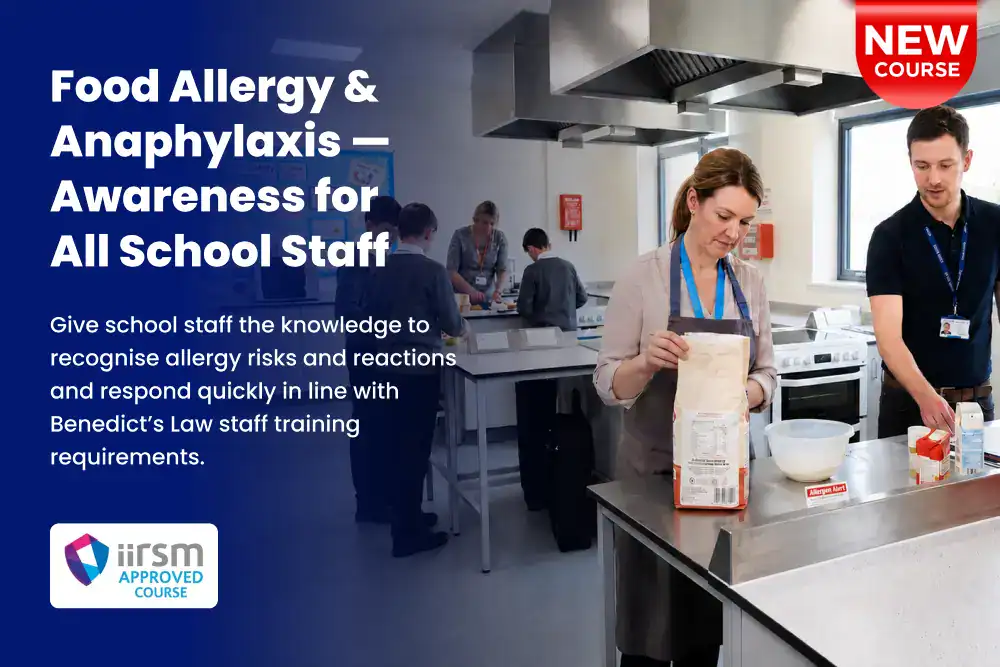
We are pleased to introduce our fully online course: Food Allergy and Anaphylaxis Awareness for All School Staff.
This IIRSM-approved course gives staff clear, practical guidance on allergy risks, warning signs and emergency response. It explains how allergic reactions and anaphylaxis develop, how pupils can be exposed to allergens, which symptoms to look for and how to respond quickly, including how an adrenaline auto-injector (AAI) is used.
The training supports a consistent, whole-school approach aligned with allergy policies, individual healthcare plans and emergency procedures. It also covers the 14 regulated food allergens, the difference between a food allergy, food intolerance and coeliac disease, and the everyday situations in which pupils can be exposed, during and outside mealtimes.
Schools in England already carry legal duties for pupils with allergies. They must carry out risk assessments that include allergen risks, hold a policy for supporting pupils with medical conditions, put appropriate arrangements in place for known allergies, maintain clear arrangements for emergency medication and label any pre-packed for direct sale (PPDS) food produced by the school or its caterer, where this applies.
A policy only protects pupils when every adult can apply it during everyday school activities. Allergic reactions are not confined to lunchtimes or to pupils with a known allergy. A reaction can begin in a classroom, a club, on a school trip, in wraparound care or after food is brought in from home, and any member of staff may be the first adult to notice the signs.
New statutory requirements commonly known as Benedict’s Law go further, requiring schools to provide allergy awareness training for all staff from September 2026. Individual staff are expected to be aware of allergen risks, follow school procedures and act quickly in an emergency.
This course links these duties to the legislation behind them, including the Health and Safety at Work Act 1974, the Management of Health and Safety at Work Regulations 1999 and the Children and Families Act 2014. It also covers Natasha’s Law, the Food Information (Amendment) (England) Regulations 2019, which govern allergen labelling for food that is pre-packed and sold on the same premises.
The course covers food allergens, legal responsibilities, exposure routes, whole-school controls, reaction recognition and emergency response.
Managing this risk consistently depends on every adult in the school knowing their role before a reaction starts. This training helps schools:
- Give staff in every role a shared understanding of their part in allergy safety
- Improve consistency in how allergy risks are managed across classes, clubs and mealtimes
- Reinforce your allergy policy, individual healthcare plans and emergency procedures
- Support compliance with Benedict’s Law and existing allergy duties
- Reduce the risk of a reaction being missed or managed inconsistently as part of wider controls
This course is designed for all school-based staff in England, whatever their role, including:
- Teachers and teaching assistants
- Cover supervisors
- Catering and kitchen staff
- Lunchtime and mid-day supervisors
- Breakfast and after-school club staff
- Site managers and caretakers
- Administrative and office staff
- Pastoral and welfare leads
By the end of this course, school staff will be able to:
- Recognise the signs of an allergic reaction and tell anaphylaxis apart from a mild reaction
- Identify the 14 regulated allergens and the everyday ways pupils can be exposed to them
- Understand how to respond to a suspected reaction using the airway, breathing and circulation (ABC) priority
- Understand the key steps for using an adrenaline auto-injector and why adrenaline is used in anaphylaxis
- Learn how hygiene, cleaning and supervision procedures reduce risk during and outside mealtimes
- Know how to access a pupil’s emergency medication and individual healthcare plan (IHP)
- Understand how a whole-school approach keeps pupils with allergies safe
For more details about this course, please contact us.