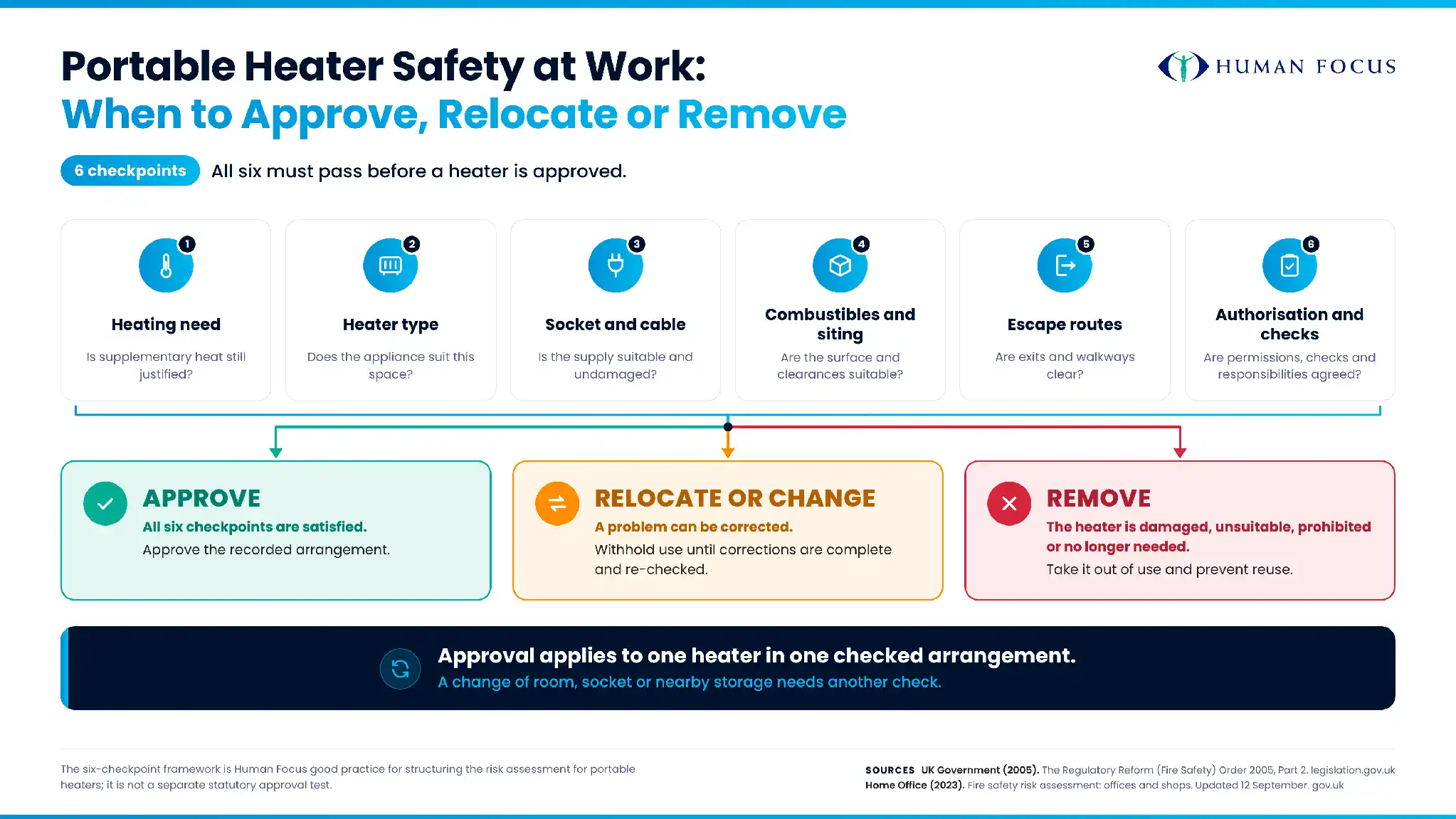
Portable heater safety at work means approving a heater only after a named person has confirmed that it is needed, suits the space, runs from a suitable supply and stands clear of combustibles and escape routes. Where a problem can be corrected, relocate or change the arrangement before use; where the heater is damaged, unsuitable, prohibited or no longer needed, remove it.
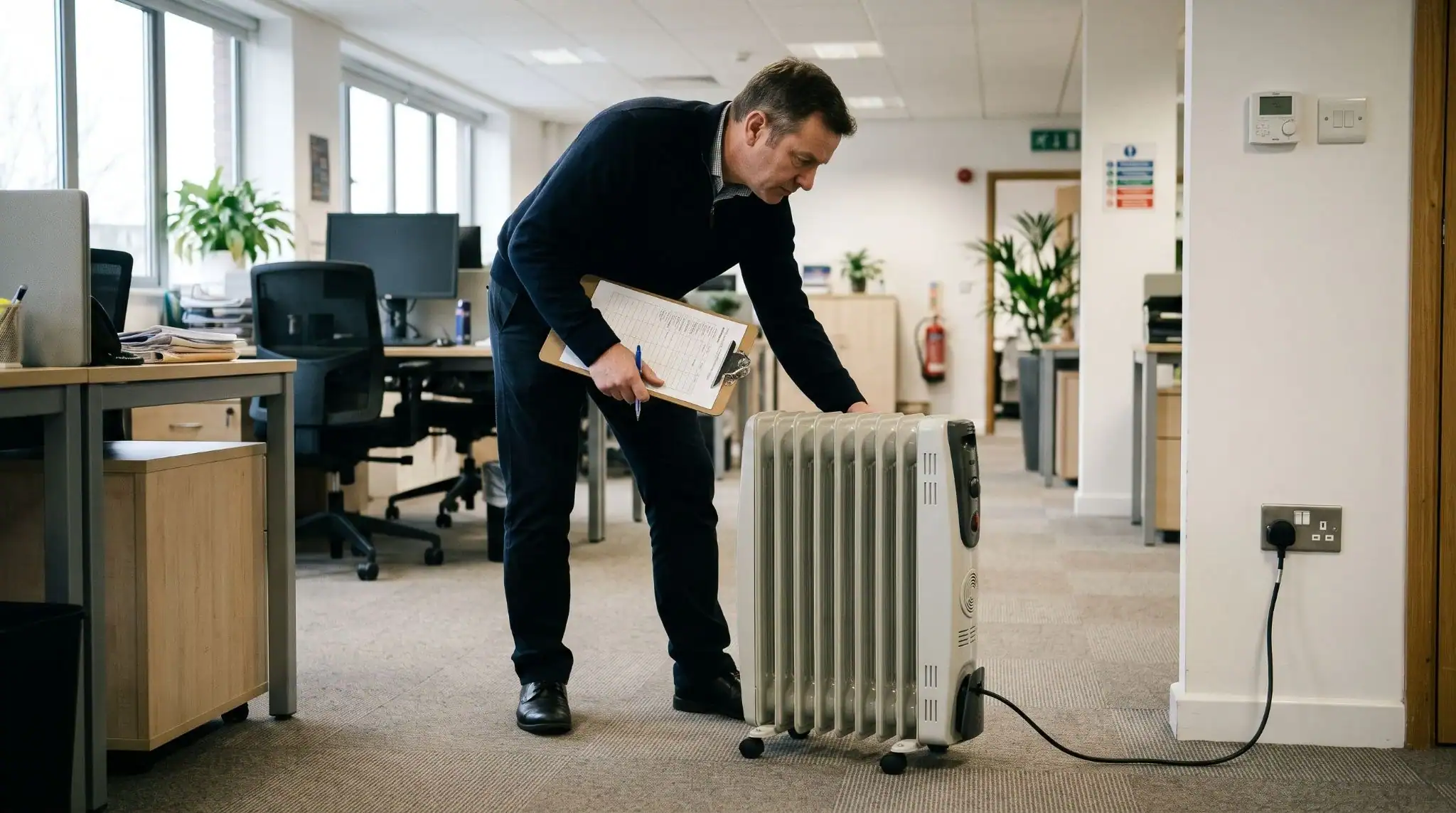
A common case starts with a cold desk: an employee brings in a heater from home and sets it beneath the desk beside a stack of cartons, plugged into a four-way extension lead that also powers a computer and monitor. The employee is warmer, but nobody has approved the arrangement.
Removing the heater can look like the safe answer, and sometimes it is. On its own, though, removal leaves the employee cold again, and doing nothing leaves the fire risk unmanaged. Neither response settles whether this heater, in this place, can stay.
Fire safety law does not ban portable heaters in the workplace. In England and Wales, the Regulatory Reform (Fire Safety) Order 2005 requires the responsible person to assess fire risks and take appropriate precautions. The fire risk assessment must reflect the equipment actually being used (UK Government, 2005).
The Order does not apply in Scotland or Northern Ireland, which have separate fire safety legislation (Scottish Government, n.d.; Northern Ireland Fire & Rescue Service, n.d.).
Official guidance goes further than the law. The Home Office guide for offices and shops discourages staff from bringing in their own heaters. It recommends safer alternatives to naked-flame and radiant heaters, restricting movement and fitting guards where appropriate (Home Office, 2023).
The heater at the cold desk is therefore not unlawful, but it is the kind of arrangement official guidance discourages.
The heating complaint carries legal weight too. The Health and Safety Executive (HSE) explains that the Workplace (Health, Safety and Welfare) Regulations 1992 require a reasonable indoor temperature in Great Britain. The Approved Code of Practice suggests normally at least 16°C, or 13°C for rigorous physical work; these are not fixed statutory minima (HSE, n.d.-a).
The employee at the cold desk may have a legitimate complaint, so the first question is whether the workstation needs supplementary heat at all, or whether building heating or draught control can resolve it.
All six checkpoints must pass before a heater is approved, and each row of the table shows what should trigger relocation or removal instead. The framework is Human Focus good practice for structuring the risk assessment for portable heaters; it is not a separate statutory approval test.
Relocate or change means withholding use until corrections are complete and re-checked. Remove means taking the heater out of use and preventing reuse while damage, unsuitability or a prohibition remains. Recording a problem does not correct it.
Run the cold desk through the table and it fails on siting, supply and authorisation: the cartons sit within the required clearance, the four-way lead is shared and no approval is recorded. All three can be corrected, so the initial decision is relocate or change.
Correction starts with the complaint, not the heater. If extra heating remains justified, check the heater type, move it clear of the cartons to a permitted position and arrange a suitable wall socket. Check the cable route, escape routes and required permissions, and record who approves the arrangement, who switches off and when it needs review.
Once all six checks pass, the decision becomes approve. A damaged cable found at any stage makes it remove, however cold the desk is.
Name an approver with authority under the employer’s arrangements and access to suitable fire and electrical expertise. Article 18 of the Order requires competent fire safety assistance; it does not automatically appoint a heater approver. The responsible person retains their duties (UK Government, 2005).
Outside the office, the same checkpoints apply with a different emphasis. In reception, check public routes; in a shop, nearby stock; in a warehouse welfare room, the supply and separation from operations. Shared buildings also need agreed permissions.
Heater type changes which hazards matter most, but no type is safe by default. Products sold as space heaters use different heating methods and protective features, so select a type for the location, then check its intended use and controls.
Residual heat is easy to overlook. Had the cold desk been given an oil-filled radiator, which stays hot after switch-off, cartons pushed back against it at close-down would undo the separation agreed at approval (Electrical Safety First, n.d.).
Protective features help. Check for thermostatic control, over-temperature protection and tip-over protection appropriate to the design and location, but none of them compensates for blocked vents or an unsafe supply. Do not introduce an ordinary office heater where flammable vapours or explosive atmospheres may occur; refer that heating need for specialist assessment.
Safe use depends on approved conditions that people can maintain for as long as the heater runs. Otherwise, the desk checked in the morning can look different by the afternoon, with the cartons back beside the heater.
A brief visual check of the heater before use is good practice. Look for plug or cable damage and signs of overheating; HSE advises removing defective equipment from use (HSE, n.d.-c). A test label records a past result, not current safety.
The Electricity at Work Regulations 1989 require necessary maintenance to prevent danger so far as reasonably practicable (UK Government, 1989), but they do not prescribe portable appliance testing (PAT) or an annual testing interval. Inspection and testing depend on equipment and environment (HSE, n.d.-b). Risk-based electrical inspection and testing should support these pre-use checks, rather than replace them.
Follow the manufacturer’s permitted positions and clearances, including any stricter employer or insurance conditions. There is no universal legal clearance for every heater. Use a stable, level surface, keep routes clear and prevent clothing or storage encroaching on the heater. At the cold desk, the cartons need a permanent home outside the clearance, not a temporary one. Maintaining separation between combustibles and heat sources is an ongoing housekeeping task.
A safety flash published in January 2023 described a delivery-unit manager switching on a fan heater in his office, then moving between the office and the operational floor. Roughly two hours later, staff discovered an electrical fire. It originated at the connected extension lead, which melted. The fire caused considerable damage within the office but remained contained there, and no workforce injuries were reported (Communication Workers Union, 2023).
The account does not establish a heater defect, overload or lack of authorisation. It does show that the fire began in the supply, not the appliance. At the cold desk, that is the shared four-way lead, which a check of the heater alone would miss.
Use a suitable permanent wall socket as the default. If an alternative supply is proposed, withhold use until a competent electrical person has assessed it and confirmed that manufacturer, employer, insurer and building conditions permit it. Do not daisy-chain leads or adaptors.
Make switching off when the room is left, and at close-down, the default rule. Give the rule a named owner, because ordinary work takes people out of the room. The safety flash lists the same rule among its lessons (Communication Workers Union, 2023).
Unplug where the manufacturer’s instructions permit and allow safe cooling. Do not permit timers or overnight operation through informal agreement. Any exception needs separate assessment and authorisation within all applicable conditions; a thermostat is not permission to leave a heater unattended.
A workplace heater policy should make the permission route clear before staff bring equipment in, so the next heater arrives through approval rather than under a desk. Provide a route for reporting cold conditions, favour employer-supplied equipment and require approval of the make, model, location, supply and intended hours. A ban on personal heaters still needs that reporting route and a suitable heating solution, or the cold desk is back where it started.
Include personal appliances in the office electrical equipment inspection arrangements. The Home Office guide says staff-owned equipment should be included in the assessment and inspected and tested at suitable intervals (Home Office, 2023). Apply the rules to managers too; the fire in the safety flash happened in a manager’s office.
Insurance conditions can be stricter than the general legal baseline. PIB Insurance publishes controls insurers may request, including direct socket supply, business-hours use, clearances and annual testing (PIB Insurance, n.d.). These are not universal policy terms. Check the actual policy and schedule with the broker; do not assume either permission or automatic loss of cover.
In shared premises, check lease and managing-agent rules. Article 22 of the Order requires responsible persons with shared premises duties to co-operate and co-ordinate precautions (UK Government, 2005).
This Human Focus good-practice checklist turns the six checkpoints into ten recorded checks. Complete it at the heater’s actual location, recording Yes or No and the completion date against each, so the record shows whether the agreed conditions exist there.
Keep a register of the heater identifier, make, model, ownership, heating need, approved location and supply, decision, conditions, approver and approval date. Add the last inspection and required test, outstanding action owner and re-check date, shutdown owner, review date and any insurer or building permission.
A change to the approved arrangement needs another check, with review of the fire risk assessment where its findings may no longer be valid. Consider replacement heaters, different sockets, layout changes, extra storage, heating failure, repeated tripping, near misses or changed occupancy. Brief staff on changed precautions; Article 21 of the Order requires adequate training when new equipment exposes employees to new or increased risks (UK Government, 2005).
Return to the cold desk the following winter. The cartons may have moved or the fixed heating may have been repaired, and either change sends the arrangement back through the checks. If fixed heating now keeps the desk warm, remove the supplementary heater. That was the outcome the first checkpoint was looking for.
The cold desk still needs a heating solution. If supplementary heating is justified, approve the heater only when all six checkpoints are satisfied. The recorded arrangement should establish:
- Authorisation: Who approves and records use.
- Location and supply: Where the heater can stand and which socket it can use.
- Equipment checks: Who carries out user checks and arranges inspection and testing.
- Shutdown: Who ensures the heater is switched off when required.
Approval applies to one heater in one checked arrangement. Moving it to another room, changing the socket or introducing nearby storage requires another check. If the building heating is repaired and supplementary heat is no longer needed, remove the heater.
These changes also matter to the workplace fire risk assessment. Human Focus’s IIRSM-approved Fire Risk Assessment Training covers identifying fire hazards, assessing existing precautions, recording findings and reviewing assessments when workplace conditions change. For employers, this supports more consistent identification of fire risks and helps keep recorded precautions relevant as equipment and working arrangements change.
Some workplaces prohibit portable heaters through the employer’s risk controls or policy, and insurer or building conditions may also restrict their use. Such a prohibition is a local decision, not a blanket ban under fire safety law. The employer must still address unreasonable indoor temperatures.
There is no universal workplace run-time figure. Follow manufacturer instructions and the agreed attendance, supply and shutdown conditions. An insurer may limit use to business hours and prohibit timers.
Switch it off, unplug if safe, take it out of use and report it. Do not reuse it until a competent person has checked it. If there is smoke or flame, follow the workplace fire procedure.
Yes. CE (Conformité Européenne) and UK Conformity Assessed (UKCA) marking concern product conformity when placed on the market, not its subsequent condition or use. Both routes remain available for relevant electrical equipment in Great Britain (Office for Product Safety and Standards, 2026).
Yes, before use. Check the plug, cable, vents and surroundings, and confirm that approval still applies. Stored items must not be piled against a heater simply because it has been switched off (Home Office, 2023).