RAMS should be reviewed when there is reason to suspect the risk assessment is no longer valid or a significant change affects the work. In Great Britain, Regulation 3(3) requires these reviews and any necessary changes to the assessment. There is no universal annual review interval under that regulation. A planned review date does not remove the need to act when site conditions change (Management of Health and Safety at Work Regulations 1999, reg. 3(3)).
RAMS in construction refers to risk assessments and method statements. Together, they identify the risks, precautions and safe work sequence. Their usefulness depends on whether those arrangements still fit the work being done.
On the morning of 27 July 2021, an earthworks team on an HS2 site near Uxbridge changed its working area. Material from the original location could not be used, so the excavator’s loading position moved and a new traffic route was created.
The change left an unprotected edge on the bank above.
One tipper truck driver used the higher-level bank instead of the intended new route. His vehicle slipped. The next driver followed the same path, but his truck went over the edge. It fell approximately two metres, landed on the driver’s side and injured him.
Inspectors from the Health and Safety Executive (HSE) found missing route signs and edge protection. The inspector said SCS Railways had detailed procedures, but had failed to properly plan and promptly communicate the route changes. The joint venture was fined £400,000 in June 2026 (HSE, 2026b).
HSE’s account does not identify a missed RAMS review as the offence. Its relevance here is the sequence of events. A practical change to the job altered the conditions drivers faced. The arrangements needed to make that change safe had not kept pace.
For a site manager, that raises a question well before the next review date. What must happen between deciding to move the work and allowing people to use the new arrangement?
Set planned reviews to suit the risks and stages of the job. Then review sooner whenever conditions give reason to question the assessment or a significant change occurs.
For a short maintenance job, that means checking the plan against the actual work area before starting and responding to relevant changes during the task. A longer construction project may also need reviews as work moves between locations, phases or contractors.
An annual date can form part of an organisation’s arrangements. It cannot establish that today’s method is still suitable. A document signed yesterday may already describe a route, piece of equipment or work sequence that no longer exists.
Reviewing RAMS does not automatically mean rewriting them. A review checks whether the existing assessment and method remain suitable. Revision follows where changes are needed. Keep a proportionate record of the decision and any actions.
The legal distinction matters. Regulation 3(3) concerns risk assessments, rather than a universally required combined document called RAMS. Written arrangements are required before demolition, dismantling or structural alteration begins, commonly through a method statement. Method statements also communicate safe methods for other construction work (HSE, 2026a).
A change matters when it affects the task, the people exposed or a precaution the work relies on.
HSE identifies potentially ineffective controls, workplace changes, worker concerns, accidents and near misses as reasons to revisit risk controls (HSE, 2024c). On site, those triggers can look like this.
Not every change requires a complete rewrite. A replacement worker may need a briefing and suitable supervision while the method remains valid. A different machine may require a revised method if its operating limits or hazards differ.
The decision should turn on what has changed and how people will be protected. Describing a change as minor does not answer either question.
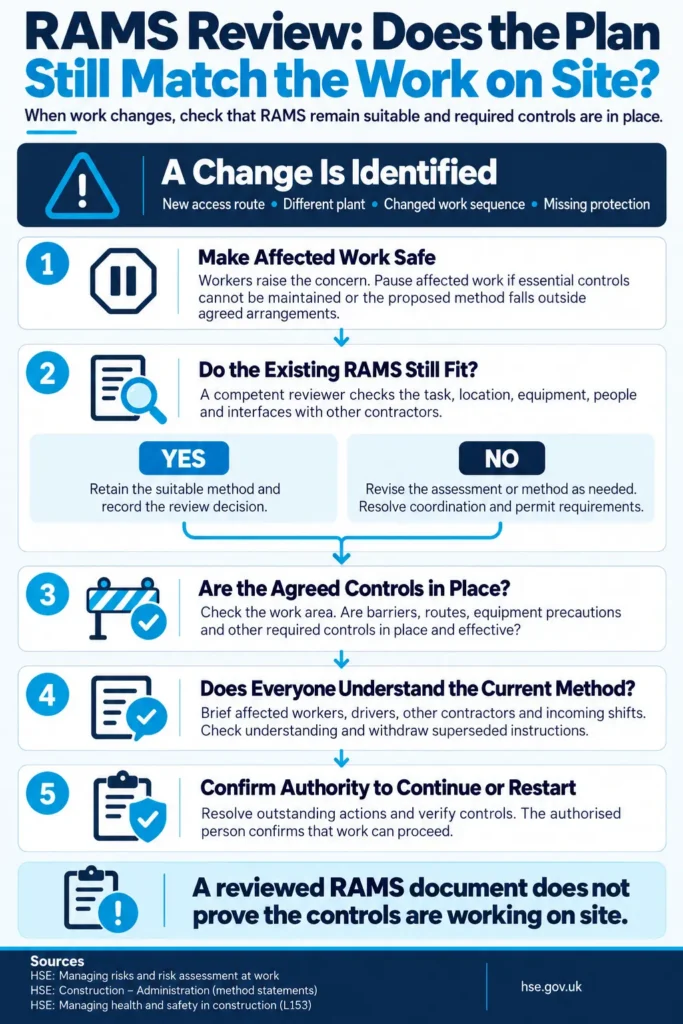
Pause affected work when necessary controls cannot be maintained or the proposed method falls outside agreed arrangements and authority. Make the activity safe, withdraw where needed and contact the named supervisor or responsible person.
Other work can continue if its safety is unaffected and it will not compromise the paused activity. The purpose is to control the consequences of the change, including effects on neighbouring teams.
An immediate dynamic risk assessment can support the decision to pause and seek assistance. It does not give a worker authority to approve a different method.
The next step needs to be practical. Research by Havinga and colleagues followed work at a water utility provider, where crews frequently stopped or handed jobs to another crew. Workers found these decisions easier when they offered a better way to complete the job (Havinga et al., 2021).
The study concerned one organisation. It does not establish how every construction crew will respond, but it suggests a useful management question. What can the crew do after raising the concern?
Give them an available contact and access to the decision, equipment or specialist support needed. Under programme pressure, a stop instruction without a workable next step leaves the job unresolved.
Where a permit applies, involve its issuer. Follow the site’s suspension, revalidation or reissue arrangements. HSE’s guidance for petroleum, chemical and allied industries recommends checking safety and revalidating or replacing the permit before suspended work resumes (HSE, 2005).
The reviewer needs sufficient knowledge of the task, hazards and current site conditions. Involve the contractor responsible for the work and obtain specialist advice where the change exceeds the team’s competence.
Under CDM 2015 in Great Britain, contractors must plan, manage and monitor their work. Where more than one contractor is involved, they must coordinate with others and follow the relevant parts of the construction phase plan (HSE, 2024a).
The principal contractor has wider responsibility for coordinating the construction phase and keeping that plan suitable (HSE, 2024b). A contractor can revise its own work method and still need site management to resolve a shared access route or conflict with another trade.
For a route change, the decisions might cover the route’s suitability, physical protection, other vehicle movements and instructions to drivers. These are recommended checks for such a situation, rather than a reconstruction of decisions made on the HS2 site.
Name who will assess the change, who will coordinate its effects and who can authorise restart. One person may fulfil more than one role if competent and authorised, but those decisions still need to be made.
There is no universal statutory role called the RAMS approver. Client acceptance also leaves the contractor’s responsibilities in place. Someone saying the document is acceptable does not establish that the changed work is ready to begin.
Explain what changed, why it changed and what people must now do differently. A revised method statement should make the work sequence and precautions easy to follow.
For drivers approaching a changed loading area, the useful information is concrete. Which route is open? Which route must not be used? Where should they wait if the route is obstructed? Who should they contact?
Reach everyone affected, including delivery drivers, neighbouring contractors and incoming shifts. They may rely on the same area without belonging to the team whose RAMS were revised.
Check understanding through conversation. Ask someone to explain the new arrangement or point out the correct route. A briefing signature records acknowledgement; it cannot show by itself that the instruction was understood.
Make the current version accessible and withdraw superseded instructions. Where work crosses a shift, carry forward outstanding actions and restart conditions through the shift handover. HSE recommends two-way communication and cross-checking by incoming personnel (HSE, 2024d).
Then check the work location. Are the barriers, signs, access arrangements or other specified controls actually in place? Do the conditions match the revised instructions?
Keep records proportionate to the change, including the decision, revision, briefing and checks. Where permits apply, check that their conditions agree with the revised method. HSE’s guidance stresses that issuing a permit does not itself make a job safe (HSE, 2005).
If the same difficulty keeps returning, look beyond the individual briefing. Repeated route obstructions may require different delivery times or storage space. Repeated requests to change a method may indicate that the original plan does not fit the task.
Adapt these six practical checks to the task and site. They are not a statutory sequence.
- The changed task, conditions and affected people are identified.
- The assessment and method remain suitable or have been revised where necessary.
- Technical decisions and coordination with other contractors are complete.
- Permit conditions and related site arrangements match the agreed work.
- Everyone affected understands the current instructions and when to escalate again.
- Controls are verified at the work location and restart authority is clear.
When a loading area moves, the review must reach the people using it. Managers need to resolve the change and verify the controls before allowing affected work to restart.
Human Focus’s RAMS in Construction for Frontline Employees covers RAMS at different project stages, generic assessments, controls that are not implemented and practical improvements. It supports workforce understanding of these common failures. Employers still need task-specific instruction, competent review and clear arrangements for changes and restart.