If you experience sexual harassment at work, put your safety first and seek support from someone you trust. You can record what happened and use your employer’s reporting procedure, choosing another contact if your manager is involved. You do not need complete proof or to confront the person before raising a concern (Acas, 2026b, 2026c).
Sexual harassment involves unwanted conduct of a sexual nature, including comments, messages or touching. This guidance covers England, Scotland and Wales, including temporary and agency workers.
In February 2023, McDonald’s signed a legal agreement with the Equality and Human Rights Commission (EHRC). The regulator had concerns about how sexual harassment complaints from staff in its UK restaurants were being handled.
By November 2025, serious allegations raised after that agreement had prompted a strengthened action plan. One agreed measure was to have complaints against managers investigated outside the restaurant. Another was external auditing of the new complaints handling unit (EHRC, 2025).
These were measures agreed specifically for McDonald’s. For an employee whose manager receives complaints and decides their shifts, the practical question is where else they can turn. A usable alternative route gives them somewhere to start.
Sexual harassment is unwanted conduct of a sexual nature that violates someone’s dignity or creates an intimidating, hostile, degrading, humiliating or offensive environment. Conduct intended to have either result can also qualify, even if it does not have that effect.
When assessing the effect, section 26 of the Equality Act 2010 requires consideration of your perception, the circumstances and whether it was reasonable for the conduct to have that effect (EHRC, 2024b).
Examples of sexual harassment can include:
- A colleague making unwanted sexual remarks about your body.
- A supervisor touching you in a sexual way against your wishes.
- Sexual images being shared in a work messaging group.
- A customer making unwanted sexual propositions while you serve them.
A single incident can qualify, including conduct not directed at you. Intent to offend is not required where the legal effect test is met (Acas, 2026i).
Sexual harassment in the workplace can include work-connected messages and social events. Other private contact between colleagues does not automatically fall within employment law (EHRC, 2024b).
Harassment related to sex, such as degrading remarks about women’s ability to do a job, is different. Other inappropriate conduct may breach workplace standards without meeting either legal definition.
You can raise a concern without deciding what is classed as sexual harassment. Describe what happened.
Make a factual note while your memory is fresh. Writing it down can make the experience easier to explain (Acas, 2026c).
A useful record includes:
- The date and approximate time of each incident.
- Where it happened, including any online platform.
- Who was involved and their relationship to your work.
- The words used or actions taken, as accurately as you remember them.
- Anyone who saw or heard the conduct.
- Existing messages, emails or other relevant material.
- Effects on your work, such as avoiding a shift or struggling to concentrate.
If the words or date are uncertain, say so. Separate what you observed from what you believe it meant.
Keep originals securely where you can lawfully retain them. Avoid editing or circulating messages. Identify any material your employer holds so the person handling the concern can consider preserving it.
Recording here means notes and existing material. Secret audio or video recordings can raise legal and workplace-policy risks. Seek advice before attempting them (Acas, 2026c).
Missing evidence does not prevent a report. Employers may need to assess competing accounts fairly without witnesses or screenshots (Acas, 2026b).
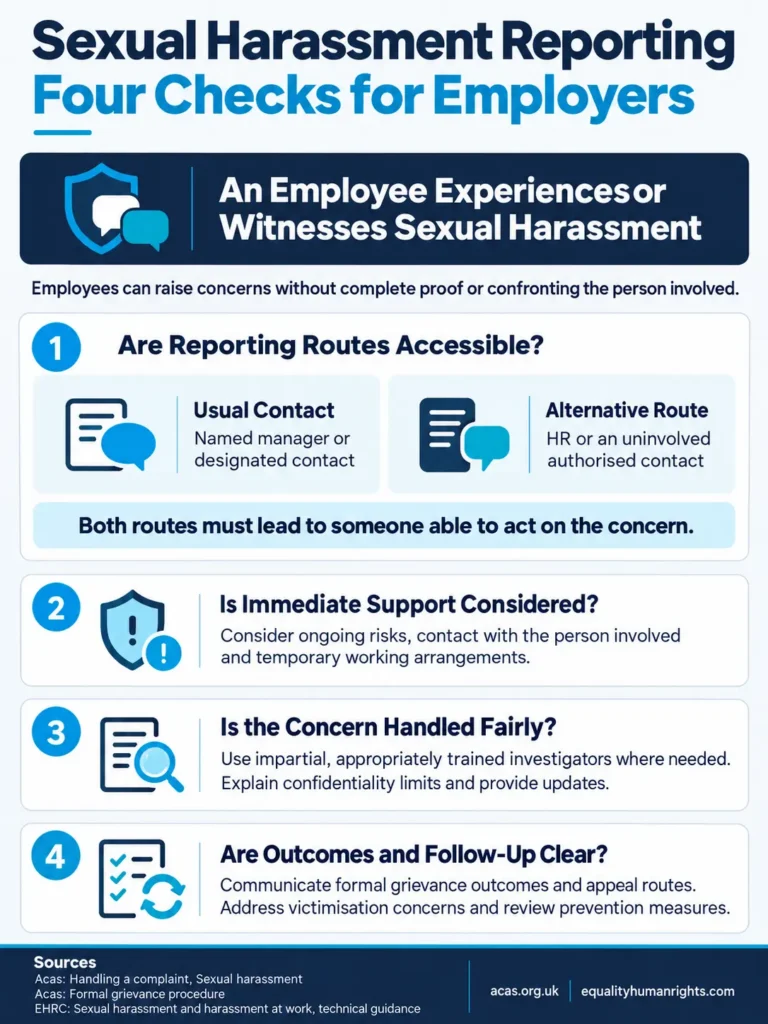
Use the contact named in your employer’s sexual harassment or grievance procedure. Explain what happened, whether the conduct is continuing and what support you need.
If you are unsure about reporting, you can still get advice about what to do if sexually harassed at work. A union representative or specialist adviser can discuss your options without committing you to a complaint (Acas, 2026c).
Informal resolution is optional. You can raise a formal grievance straight away if the matter is too serious for informal handling. A formal grievance is a written complaint setting out the concern, available evidence and what you want your employer to do (Acas, 2024a).
Include immediate working arrangements. If you are due to work alone with the person tomorrow, say so. The employer needs to consider that risk while deciding how to handle the complaint.
Ask who will deal with the concern and when to expect contact. Keep a copy of what you submit.
Approach another manager, HR or a designated contact. Without HR, an uninvolved owner or senior manager may be appropriate. Seek independent advice if no suitable contact is clear (Acas, 2024a).
The alternative contact needs to be someone who can act on the concern.
You can report third-party conduct internally. Explain when you are likely to encounter the person again and whether you will be working alone.
Employers’ existing prevention duty includes sexual harassment by customers, contractors and other third parties. EHRC guidance says this should be taken as seriously as harassment by a colleague (EHRC, 2024a).
Your employer should take the concern seriously and handle it fairly and sensitively. Where an investigation is needed, the investigator should be impartial and trained for the role. The process should examine the allegation without presuming it is true or false (Acas, 2026b).
Support may be needed before a decision is reached. Ask what arrangements will apply if you still work alongside the person involved. Acas advises against moving the complainant unless they request it, because doing so could appear to punish them for complaining. Suspension of the person accused is not automatic (Acas, 2026b).
Confidentiality means limiting unnecessary sharing. It cannot guarantee anonymity. A fair investigation may require sharing information with the person accused or witnesses, and the details may identify you (Acas, 2026f).
Useful questions include:
- Who is handling the concern and whom can I contact?
- What information will be shared, with whom and why?
- What support is available and when will I receive the next update?
After a formal grievance, your employer should tell you the outcome in writing and explain the appeal route (Acas, 2024b).
Daisy, an associate professor interviewed by Bull and Shannon, described a grievance involving around 15 people who had witnessed events or provided statements. It was not upheld.
According to her account, the outcome letter summarised her grievance and the other person’s explanations without explaining how the evidence had been weighed or credibility assessed (Bull & Shannon, 2025).
The UK study involved 18 staff and students in higher education. Its self-selecting sample cannot show how typical Daisy’s experience is. Her account illustrates why a complainant may need to ask how the decision was reached based on the evidence.
That explanation is separate from access to another person’s full disciplinary details, which may contain private information (Acas, 2026f). Also ask whom to contact if the conduct resumes or working relationships deteriorate.
Follow up in writing if your report receives no response or an agreed update passes. Explain any continuing risk and ask what happens next. Consider a formal grievance if informal reporting has led nowhere, or an appeal if you disagree with the outcome or process (Acas, 2024a, 2024b).
Watch for changes in how you are treated. Losing preferred shifts because you complained, for example, may be victimisation under section 27 of the Equality Act 2010. Record the change and any explanation given.
The law also protects people who support a complaint or give evidence. A complaint that is not upheld is not automatically false or made in bad faith (Acas, 2026h).
Whistleblowing protection is separate. Since 6 April 2026, sexual harassment has been expressly included among the types of wrongdoing you can whistleblow about.
Protection still depends on legal conditions. These include reasonable belief that you are disclosing qualifying wrongdoing and that doing so is in the public interest. A personal grievance is not automatically a protected whistleblowing report (Acas, 2026j).
Seek advice on the appropriate disclosure route. Acas, your union or a specialist adviser can discuss your options if the employer’s response is inadequate.
No. A grievance or appeal does not extend the tribunal deadline. As checked on 14 October 2026, the usual limit depends on when the relevant conduct occurred:
- Before 1 October 2026, it is generally three months minus one day.
- On or after 1 October 2026, it is generally six months minus one day.
Notifying Acas within the applicable limit can pause it for early conciliation. Multiple incidents, continuing conduct and cases spanning the October change can complicate the calculation. Get advice on your exact deadline while the internal process continues (Acas, 2026a).
Employers need clear contacts, an alternative when the usual contact is involved and people prepared to handle concerns. Temporary and agency workers need to understand the routes too. Reviewing reports should lead to improvements in prevention and working arrangements (EHRC, 2024a).
As at 14 October 2026, employers must take reasonable steps to prevent sexual harassment. From 30 October 2026, the duty becomes “all reasonable steps”, alongside new employer liability for third-party harassment where those steps have not been taken (Acas, 2026d, 2026g).
Human Focus’s Sexual Harassment Awareness Training for employees gives employers a consistent way to teach employees, new starters and temporary workers how to recognise sexual harassment and what to do if they experience or witness it. Workplace case studies show how harassment can occur, including behaviour that might otherwise be dismissed or excused.
Employers can assign the online course across teams and track completions to identify who has received this awareness training. They must still communicate their own reporting contacts and alternative routes, prepare managers to handle concerns fairly and act on reported risks.
Yes. You can report what you observed or support a colleague’s complaint with evidence. Discuss the support they want. You can make your own complaint if witnessing the conduct violated your dignity or created the relevant hostile or offensive environment for you. That does not require their permission (Acas, 2026k).
Workplace sexual harassment is unlawful under equality law. Some conduct can be criminal, including sexual assault. You can seek specialist support and consider contacting the police. Call 999 in an emergency or 101 for non-emergency police contact. You do not need to make a police report before raising an internal complaint (Acas, 2026b, 2026e).