In short: There is no fixed refresher period for Cable Avoidance Tool (CAT) and signal generator (‘Genny’) competence. It’d be best to treat the relevant certificate or scheme expiry date as a planned review point, and refresh or reassess earlier when equipment, work, responsibility or evidence of competence changes. The employer, or another relevant dutyholder where the Construction (Design and Management) Regulations 2015 (CDM) apply, should decide what is suitable by reference to the task, risk and current evidence, and should record the reason. A certificate supports but does not by itself establish current, task-specific competence.
How Often Should CAT and Genny Competency Be Refreshed?
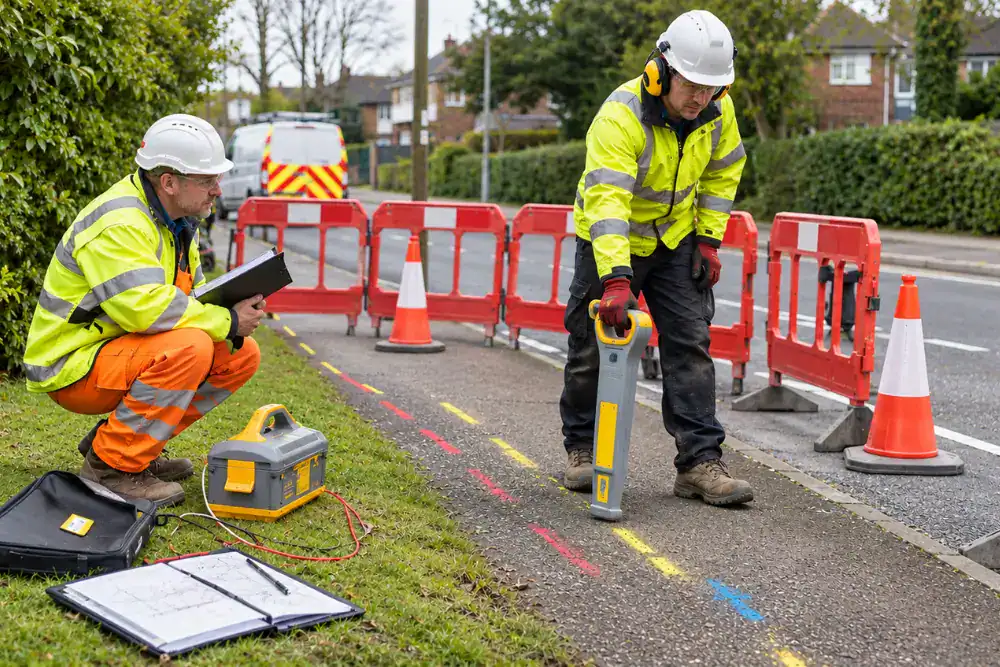
CAT and Genny competence should be reviewed through a planned cycle rather than certificate renewal alone. Employers and other relevant dutyholders in Great Britain need clear early-review triggers and current evidence that reflects the equipment, task and conditions in which the person works.
Current performance can change before a certificate expires because the equipment, frequency of use or site conditions have changed.
A sound policy combines a planned review cycle with practical observation and defined change triggers. This allows managers to act as soon as the evidence changes.
Does the Law Set a Fixed Refresher Period for CAT and Genny Competency?
No. Legislation applying in Great Britain does not prescribe a fixed CAT and Genny renewal date; it requires adequate training and, where applicable, competent performance and suitable controls. Northern Ireland has separate health and safety legislation and a separate regulator.
The Provision and Use of Work Equipment Regulations 1998 (PUWER) regulation 9 (HSE, 2025) requires people who use work equipment, and those who manage or supervise its use, to receive adequate training. HSE explains that adequacy depends on the job, the person’s existing competence, the circumstances of the work and the equipment involved. Training may need refreshing at suitable intervals, particularly after changes to equipment or systems of work.
The method can reflect the risk and complexity. It may involve competent in-house instruction and demonstration or formal external training with assessment.
CDM Regulation 8 (UK Government, 2015a) requires a designer or contractor to have the skills, knowledge and experience needed for the role and, where it is an organisation, the necessary organisational capability. In this context, organisational capability concerns whether the organisation has suitable policies, systems, resources and arrangements to carry out its role safely.
Anyone appointing a designer or contractor must take reasonable steps to satisfy themselves on those points. Under CDM Regulation 25(4) (UK Government, 2015b), construction work liable to create a health or safety risk from an underground service, or from damaging or disturbing it, must not be carried out unless suitable and sufficient steps have been taken to prevent the risk so far as is reasonably practicable.
Sections 2 (UK Government, 1974a) and 3 (UK Government, 1974b) of the Health and Safety at Work etc. Act 1974 underpin those duties. They cover employees and people affected by an employer’s undertaking, with section 2 including safe systems of work and information, instruction, training and supervision. Taken together, these provisions do not set a CAT-specific refresher interval. A client, scheme or company may still require a particular certificate.
What Does HSG47 Say About CAT and Genny Training and Retraining?
HSE guidance Avoiding danger from underground services (HSG47) (HSE, 2014) advises that anyone who uses a locator should receive thorough training in its use and limitations as part of a safe system of work. It gives no refresher interval, certificate life or list of retraining triggers. It describes three essential elements: planning the work, locating and identifying buried services and excavating safely.
Locator skill is only one part of this system. The operator needs usable plans and site information. The location survey has to inform clear markings and the planned excavation method. Those carrying out and supervising the work also need the knowledge and experience to recognise uncertain information.
HSG47 states that anyone who uses a locator “should have received thorough training in its use and limitations.” Confidence in a survey also depends on the operator’s training and experience, the locator’s characteristics and reliability, the service being traced, the ground and the use of a signal generator. A knowledge test alone does not demonstrate how a person interprets and responds to an uncertain result in practice. HSG47 focuses on control of the work; it does not administer qualifications.
How Often Should CAT and Genny Competency Actually Be Refreshed?
Refresh or reassess CAT and Genny competence at the required certificate or scheme review point, or earlier when a defined change occurs. Set the planned interval by considering risk, frequency of use, workforce experience, equipment and client requirements; evidence that emerges sooner should bring the review forward. Any of these six events justifies an earlier review.
- Refresh after a change of equipment, model or accessories. Controls, modes, warnings and limitations can differ. HSE guidance states that equipment changes may require additional training, so familiarisation should take place before independent use (HSE, 2025).
- Review after a near miss, service strike or unexpected result. Stop and investigate the planning, information, equipment use and supervision involved. HSE’s incident investigation guidance (HSE, 2004) supports learning from adverse events. Reassess people before they return to unsupervised work where the findings call their competence into question.
- Check retained skills after an extended absence or infrequent equipment use. HSE guidance sets no CAT-specific absence threshold. Use a supervised practical check to identify any gap in knowledge or technique, then target the refresher activity to the finding.
- Review when the site or service environment becomes more complex. Congested services, difficult ground, poor agreement between plans and site features or a demanding survey increase reliance on sound judgement. HSG47 recognises that ground, service and signal conditions affect confidence in the result (HSE, 2014).
- Review when the role or level of responsibility changes. Moving into planning, supervision or excavation authorisation changes what the person must understand. HSE guidance identifies changed jobs and added responsibilities as reasons to review training needs (HSE, 2026).
- Act when observation, audit or supervision reveals a gap. Examples include a missed equipment check, an incomplete sweep, unclear marking or an unexplained locator response accepted without challenge. Correct the issue, then decide whether coaching, formal refresher training or a fuller reassessment is proportionate.
The response should fit the finding. A model briefing and observed check may be sufficient in one case, while another may require complete retraining and supervised practice.
What Counts as Evidence That CAT and Genny Competency Has Been Maintained?
Evidence of current CAT and Genny competence normally combines a certificate or course record with practical checks and, where the safe system requires it, authorisation. A proportionate record should cover four areas.
- A valid course or scheme record can show that the person learned the necessary principles and limitations.
- A live observation or practical assessment can show how the person applies them with the relevant equipment on a representative task.
- A supervisor or employer sign-off can identify who may work independently, the authorised role and any limits where the organisation uses formal authorisation.
- Records should show how the organisation responded to equipment changes, findings, incidents and any resulting coaching, refresher activity or reassessment.
Define the observation criteria in advance and identify the equipment, task, assessor and date. Where CDM regulation 8 applies, these records can help the appointing person document the reasonable steps taken to assess relevant skills, knowledge and experience; they do not by themselves establish competence or organisational capability.
A period without a recorded incident may reflect limited exposure or unreported warning signs and is not, by itself, evidence of competence. Direct observation gives managers a better view of how the person responds when the result is uncertain.
The evidence also needs to be retrievable. Training and certificate records should be kept in a form that allows current status, expiry dates and previous learning to be checked when decisions are made. Practical assessments, authorisations, trigger events and competence decisions should be recorded through the organisation’s defined process.
How Does CAT and Genny Equipment Calibration Differ from Operator Refresher Training?
Calibration checks the locator’s measurement performance against the applicable standard or manufacturer specification (National Physical Laboratory, 2022); function checks and maintenance address whether it remains in suitable working order. Operator competence is a separate issue.
HSG47 says locators should be used in line with the manufacturer’s instructions, checked and calibrated regularly and maintained in good working order (HSE, 2014). It sets no universal 12-month calibration interval. If a manufacturer, owner, client or project specifies an annual regime, the record should identify that source.
Follow the instructions for the specific model, retain service or calibration evidence and deal with failed checks before use. Assess operator competence separately from equipment checks, using the organisation’s defined competence process. Record the manufacturer’s pre-use or routine function check separately from any specified calibration or service record for that model.
Who Decides When CAT and Genny Competency Should Be Refreshed?
The employer must ensure adequate training for work-equipment users and supervisors where PUWER applies. On a construction project, each CDM dutyholder must discharge the duties allocated to its role, and a person appointing a designer or contractor must take reasonable steps to verify the skills, knowledge, experience and, for an organisation, organisational capability required by regulation 8. A training provider or card scheme can supply supporting evidence, but it does not make the site- and role-specific decision for the dutyholder.
In practice, a competent manager can set the standard for each role and item of equipment, while supervisors can record observations and control any authorisation required by the safe system. Training or compliance teams can maintain records and prompt scheduled reviews. Workers also need a clear route for reporting changed conditions, unfamiliar equipment and unexpected readings before work continues.
People can apply their skills safely only when the organisation provides suitable plans, equipment, time and supervision. Where those conditions are weak, the response must address the system as well as any individual training need.
Contractors should be able to explain, using current evidence, why each person is suitable for the equipment, role and site.
What Should a Proportionate CAT and Genny Refresher Policy Do?
- Set a scheduled review date and define early-review triggers.
- Record the certificate and scheme rules that apply.
- Assess and record practical, task-specific competence separately.
The policy should also state who can authorise an operator where formal authorisation is part of the safe system, what a practical check covers and how findings are recorded. This supports more consistent decisions while allowing the response to match the circumstances.
Use certificate validity as supporting evidence and practical observation as current performance evidence. Reopen the assessment when equipment, work or responsibility changes. Automatic renewal without reviewing current evidence, or delaying review despite warning signs, makes the competence decision less defensible.
How Can Human Focus Support CAT and Genny Competence?
If you need to refresh the knowledge element of CAT and Genny competence while retaining separate practical assessment and any employer authorisation required by your safe system, the approximately two-hour Human Focus online CAT and Genny course provides a completion certificate valid for three years.