Managing an ageing workforce requires employers to consider how work can remain safe, accessible and sustainable throughout people’s working lives. This includes the physical demands of a role, working patterns, health conditions and access to training and development.
Older people already form a substantial part of the workforce. Department for Work and Pensions figures estimate that 72.2% of people aged 50 to 64 were employed in April to June 2026. For employers and those responsible for health and safety, supporting this workforce involves both effective risk management and fair employment practices.
Decisions should reflect the demands of the work and the individual’s circumstances. Age alone does not establish whether someone can perform a task safely or what support they require.
Ageing can bring changes in physical and sensory capacity that are relevant to some jobs. Strength, mobility, vision and hearing may affect how a person interacts with equipment or their working environment. However, the extent and practical significance of these changes vary considerably.
EU-OSHA’s guidance on an ageing workforce emphasises the differences between individuals of the same age. The demands of the role also matter: a change that affects work involving heavy physical effort may have little relevance to another occupation.
Employers should therefore examine the relationship between the person and the work. Experience can be valuable when identifying hazards and improving procedures, while continued access to training helps workers maintain the knowledge and skills their roles require.
Employers have the same health and safety responsibilities towards older workers as other employees. HSE’s guidance on older workers confirms that a separate risk assessment is not automatically required because someone reaches a particular age.
Under Regulation 3 of the Management of Health and Safety at Work Regulations 1999, employers must make a suitable and sufficient assessment of workplace risks. Existing assessments must be reviewed where there is reason to suspect they are no longer valid or a significant relevant change has occurred.
Regulation 13 also requires employers to consider employees’ health and safety capabilities when allocating tasks and provide adequate training, including when changes expose them to new or increased risks.
The health and safety and equality legislation referenced here applies to Great Britain. Northern Ireland has separate health and safety and equality legislation.
Review lifting, carrying, pushing, pulling, repetitive movements and sustained awkward postures. The assessment should consider how often tasks occur, the effort required, the working environment and individual capability.
HSE’s manual handling guidance sets out the required approach: avoid hazardous manual handling so far as reasonably practicable, assess unavoidable operations and reduce the risk of injury as low as reasonably practicable.
Depending on the task, measures could include lifting aids, smaller loads, better storage heights or changes that reduce reaching and carrying. These improvements can benefit workers across the organisation. Assigning demanding work to younger colleagues without addressing the task design can simply transfer the risk.
Where task rotation is proposed, check that it provides meaningful variation. HSE warns that moving between tasks involving the same body parts and risk factors may provide inadequate recovery.
Long shifts, consecutive night duties, overtime and insufficient breaks can create fatigue risks. Individual responses vary, so managers should discuss any difficulty with working patterns and examine the actual workload.
HSE’s fatigue guidance explains that compliance with working time limits alone is insufficient to manage fatigue. A worker’s willingness to undertake overtime does not remove the employer’s responsibility to control the risk.
For example, a maintenance rota that combines night call-outs with an early start may need review. Possible measures include adjusting cover, limiting consecutive duties and providing adequate recovery time.
Lighting, glare, background noise, access routes and equipment controls should allow people to work safely. Where a worker reports difficulty seeing instructions, hearing warnings or reaching controls, assess the specific problem and the effectiveness of existing precautions.
For office work, display screen equipment assessments should address workstation layout and risks such as discomfort and eye strain. Changes might include adjusting screen position, seating, lighting or text size.
Any individual measures should also be reflected in relevant emergency arrangements, including safe evacuation. Employers should check what the person needs rather than infer needs from age.
Some workers may need support with a long-term health condition, a return from sickness absence or symptoms that affect particular tasks. Managers should establish how the work interacts with the person’s circumstances and seek occupational health advice where necessary.
Menopause may also require consideration. Acas identifies temperature, ventilation, uniforms, welfare facilities and working arrangements as relevant areas for review. Support should reflect the individual’s experience; menopause can also affect younger workers.
Psychological demands require attention alongside physical risks. HSE’s Management Standards address workload, control, support, relationships, role and organisational change. Employers should examine excessive demands, inadequate support and exclusion from workplace decisions when assessing stress risks.
Equality, diversity and inclusion should inform how employers recruit, support and develop an ageing workforce.
Age is a protected characteristic under the Equality Act 2010. Protection extends to direct and indirect discrimination, harassment and victimisation.
Recruitment, work allocation, performance management and promotion should use relevant, objective criteria. Assumptions that an older applicant cannot manage physical work, learn new technology or adapt to change can lead to discriminatory decisions.
Safety concerns must be examined carefully. A blanket restriction on everyone above a particular age may exclude capable workers while overlooking risks affecting others. Where age-based treatment is proposed, objective justification requires a legitimate aim and a proportionate means of achieving it. Employers should consider less discriminatory alternatives and obtain advice where necessary.
Older age is not itself a disability. However, a worker of any age may have a disability that places them at a substantial disadvantage at work.
The duty to make reasonable adjustments can apply where an employer knows, or could reasonably be expected to know, about the disability and the relevant disadvantage. Depending on the circumstances, adjustments could include adapted equipment, changes to working arrangements or a phased return.
General improvements to work design may be appropriate even where this particular legal duty does not apply. Managers should address identified risks and support needs while any necessary medical advice is being obtained. Acas notes that a person can meet the legal definition of disability without a medical diagnosis.
Age inclusion also concerns everyday behaviour. Managers should address ageist remarks, repeated jokes about retirement and assumptions that older employees lack ambition. Workers need a clear route to raise concerns and confidence that these will be taken seriously.
Acas advises employers against withholding training because someone may be approaching retirement. Career discussions should establish the employee’s interests and development needs. An offer of alternative duties should be discussed with the individual and considered alongside ways to support them in their existing role.
Risk assessments should remain responsive to changes in the work, the workforce and the effectiveness of controls. Relevant warning signs include discomfort, fatigue, near misses, difficulty following a procedure or concerns raised by workers.
The examples below illustrate matters an employer might need to investigate. Any measures should follow assessment and consultation.
Record the action required, who will implement it and when its effectiveness will be checked. Managers should also consider whether the concern reveals a wider problem affecting colleagues.
For more general guidance on review triggers, see when a risk assessment should be carried out.
Employers must consult employees on health and safety, through the appropriate arrangements with workers or their representatives. Consultation should allow people to influence decisions about the work they perform.
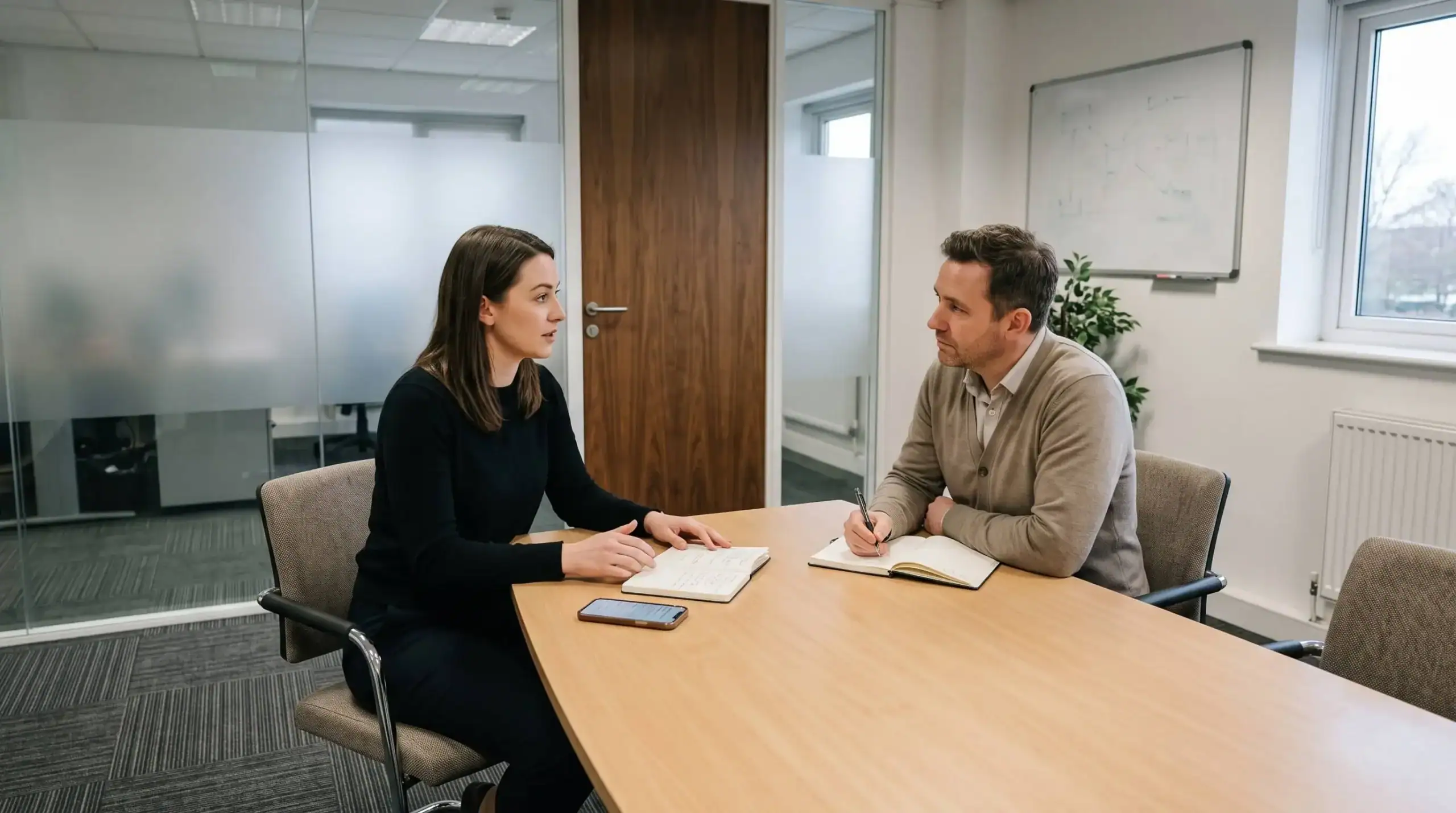
An individual discussion should focus on the task and the support required. Useful questions include:
- Which parts of the work are causing difficulty, discomfort or fatigue?
- Are the equipment, instructions and working arrangements suitable?
- What changes could help, and how should their effectiveness be reviewed?
Where the relationship between work and health is unclear, occupational health advice can help inform decisions about fitness for particular duties, adjustments and return-to-work arrangements. The employer remains responsible for managing workplace risks.
Health information requires particular care. ICO guidance requires employers to identify a lawful basis and an appropriate special category condition for processing it. Collect only necessary information, explain its use and restrict access. Managers will often need information about work capabilities and adjustments rather than detailed medical records.
Training should be accessible to the people who need it. Clear instructions, readable materials, opportunities to practise and time to ask questions can support understanding. Self-paced learning may suit some employees, while others may benefit from demonstrations or additional supervised practice.
Choose these arrangements according to individual needs and the task. Age should not determine assumptions about digital skills, preferred learning methods or the ability to learn.
Experience also needs to be supported by current knowledge. When equipment, procedures or responsibilities change, experienced workers may need further instruction and assessment. HSE describes competence as a combination of training, skills, experience, knowledge and the ability to apply them safely. Course completion alone does not establish competence for a particular role.
Consider a warehouse employee who reports shoulder discomfort after a change to picking arrangements. A review identifies frequent reaching to an upper shelf and repeated handling of bulky packages.
The employer could assess moving frequently picked stock to a more accessible height and introducing suitable handling equipment. The worker should contribute to the assessment, with occupational health advice sought if needed. Any changes should be checked for new risks and reviewed after implementation.
This illustrative example begins with a reported difficulty and examines its relationship to the work. It also creates an opportunity to improve the task for everyone carrying it out.
Managing an ageing workforce requires coordination between line managers, health and safety staff, HR and workers. Responsibilities for implementing changes should be clear, and agreed arrangements should be carried forward and reviewed when a worker changes manager or location.
Human Focus Risk Assessment Training provides an introduction to identifying hazards, evaluating risks, selecting controls and recording and reviewing findings. It can support understanding of the assessment process alongside the workplace knowledge, experience and supervision needed to apply it effectively.