Health and safety in green jobs relies on controlling falls, fire, electrical hazards, moving plant, harmful exposures and physical strain. Employers and contractors need a suitable method for the site, clear responsibility for precautions and checks that those precautions remain effective as the work changes.
Installing renewable equipment, upgrading buildings and recovering materials all require decisions about how people reach the work, move loads and control sources of harm. Those decisions shape the risks faced by installers, operators and maintenance teams.
Several businesses may depend on the same precautions. A specialist installer may rely on scaffolding supplied by another contractor or information held by the building operator. The contractor supplying a safeguard needs to know how long others will depend on it.
For employers, facilities teams and project managers, oversight extends into maintenance and routine use. A revised electrical sequence, an unsuitable pedestrian route or repeated awkward handling can require changes to the way the work is organised.
A review of 31 papers on solar installation identified electrical and fire risks, heat stress, manual handling and falls as its main risk categories (Duroha and Macht, 2023). These hazards can occur within one job. A method for raising panels, positioning them on a roof and connecting them must protect workers throughout the sequence.
Four subcontractors were installing an air source heat pump on a 14-storey apartment building under construction. During welding, sparks ignited uncovered rigid foam insulation and fire spread across the roof.
The workers escaped through a single opening and down a ladder to the floor below. There was no other way off the roof, no means of raising the alarm and no fire extinguishers.
The Health and Safety Executive (HSE) found that the contractor had failed to follow its own hot work procedures. No risk assessment, method statement or welding permit was in place (HSE, 2026a).
The combustible insulation and escape arrangements were both part of deciding whether welding could proceed. Before similar work, consider whether the connection can be made without hot work. If welding is necessary, hot work precautions need to address removing or protecting combustibles, a fire watch, firefighting equipment, alarm arrangements and escape. Check these at the work location before starting.
Battery storage requires a different assessment of how a fire could develop. Laboratory tests on seven commercial lithium-ion battery types measured hazardous fluoride gas emissions during fires (Larsson et al., 2017). The tests demonstrate a gas hazard; they do not predict concentrations around a particular installation.
A battery storage risk assessment therefore needs information about the selected technology and its failure conditions. The Department for Energy Security and Net Zero (DESNZ) identifies equipment separation, site layout and emergency access among the considerations for grid-scale storage (DESNZ, 2024). Resolve these while the layout can still be changed, with emergency arrangements appropriate to the system.
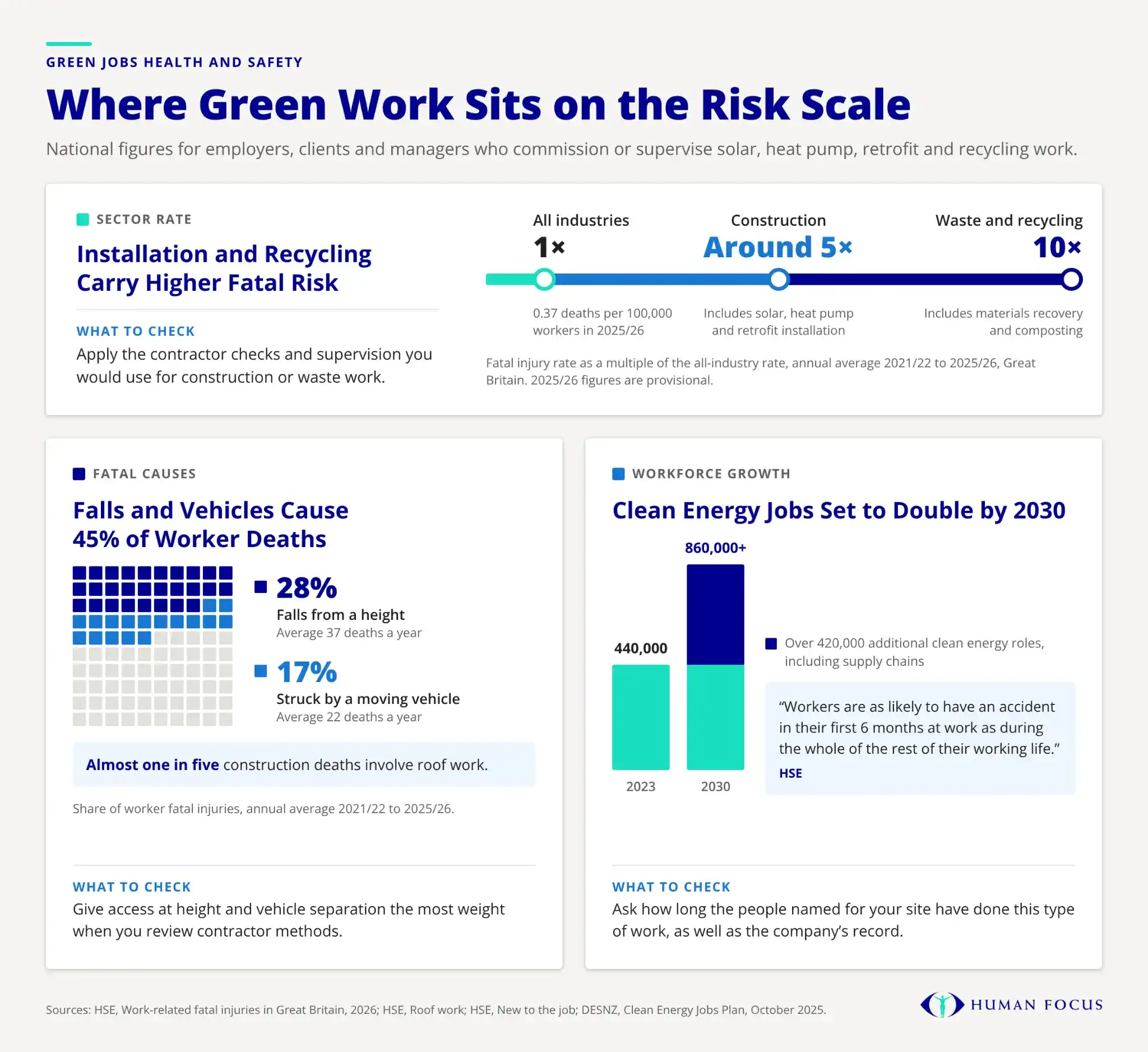
A worker adjusting a solar panel fell four metres from a house roof and broke his leg (HSE, 2025a).
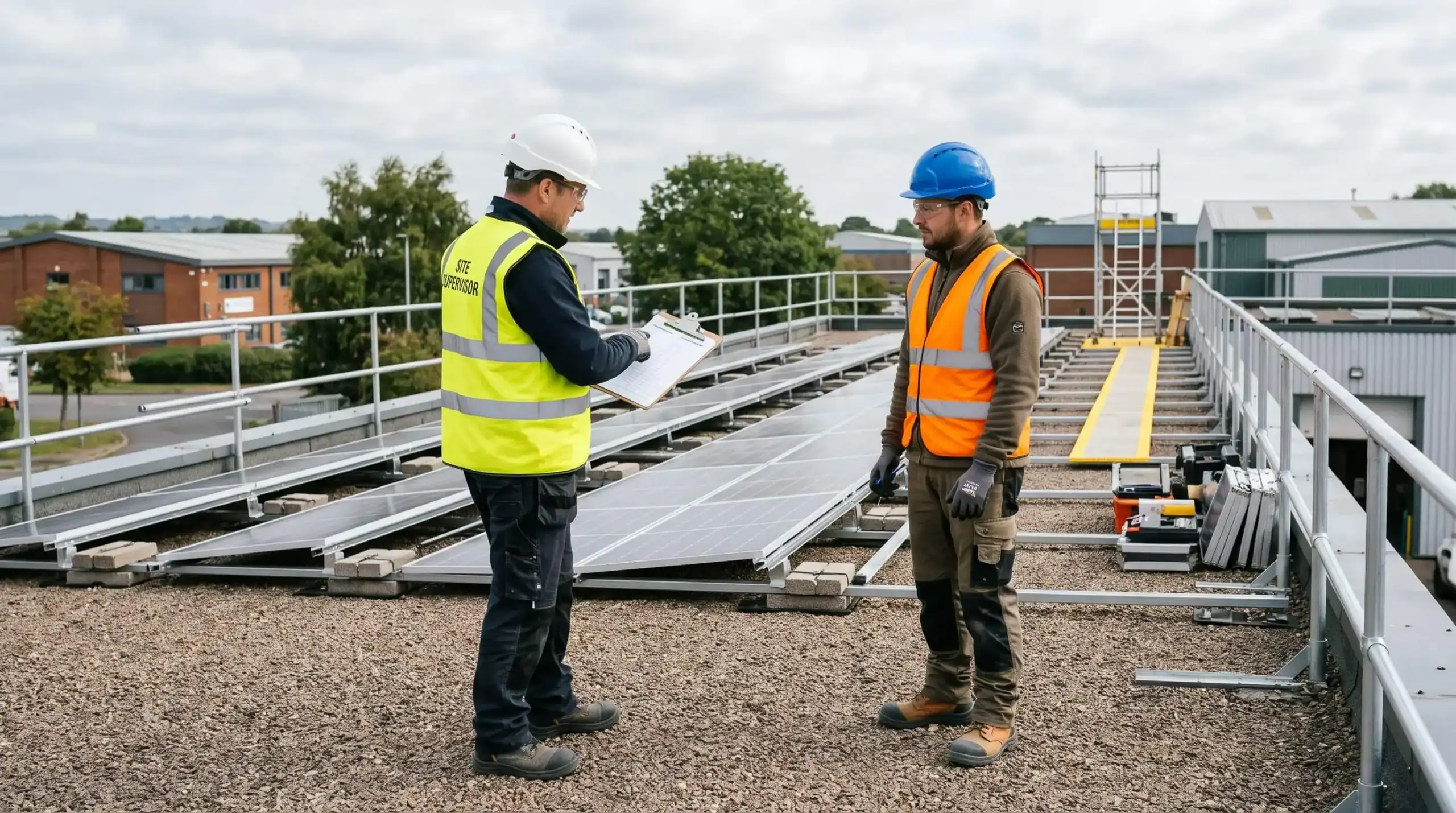
A solar panel installation risk assessment should follow the whole movement, from getting onto the roof and positioning panels to making connections and returning to the access point. Ask the contractor to demonstrate how each stage can be completed while the planned protection remains effective.
The working at height risk assessment also needs to address edges, openings and fragile surfaces. HSE says roofs should be treated as fragile until a competent person confirms otherwise (HSE, n.d.-a). Include weather limits appropriate to the roof, equipment and handling method.
Access decisions continue to matter after installation. The Construction Industry Training Board (CITB) includes future access to maintain the panels and other parts of the roof in its guidance (CITB, 2019). Establish how workers will return once temporary access equipment has been removed.
At a wind-farm substation, maintenance proceeded after a departure from the prepared switching programme. One of two electrical cabinets remained live, leaving part of the system energised. A worker suffered serious injuries in an electrical flashover.
HSE found that following the original programme would have prevented the incident. The company lacked a suitable process for checking that switching programmes were followed or for approving changes (HSE, 2025b).
The initial plan addressed the danger. The failure arose when work departed from it without adequate control. Before a different sequence or parallel activity is accepted, the competent person controlling the electrical work needs to establish whether the planned isolation remains effective.
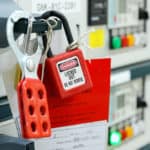
Isolation arrangements must account for all relevant energy sources, stored energy and the possibility of reconnection. HSE’s electrical safety guidance addresses secure isolation and following manufacturers’ procedures and local safety rules (HSE, n.d.-b). If actual conditions differ from the agreed method, pause the affected work until the difference has been resolved.
At a recycling yard, an operative entering the tipping area was struck by a mobile shredder and trapped against a gate post. HSE found that unmanaged vehicle and pedestrian movements had allowed walking close to moving plant to become customary (HSE, 2026b).
For similar operations, observe where people actually walk during deliveries, sorting and plant movements. Check whether segregation or separation protects them when they need access to working areas. Where entry depends on stopping plant, establish who controls the movement and how safe entry is communicated.
Intervention in machinery needs separate arrangements. Clearing a blockage or carrying out maintenance can expose people to dangerous moving parts. HSE emphasises guarding and secure isolation and lock-off procedures for this work (HSE, n.d.-c). A traffic route does not resolve those hazards.
Adding electric vehicle charging also changes how a site is used. Review vehicle movements, pedestrian routes and cable positions around charging bays, alongside competent electrical design. National Highways’ design guidance addresses pedestrian access and cable trip hazards (National Highways, n.d.).
Health risks in recycling depend on the incoming material and how it is handled. A study at six composting and three bioenergy facilities in Finland found that microbial and endotoxin concentrations were generally highest during waste reception and pre-treatment. Levels in loader cabins were lower but could remain elevated relative to cleaner comparison areas (Kontro et al., 2022).
Exposure can vary across a single process, so assess reception, processing, cleaning and maintenance separately. Include what happens when a worker leaves a protected cabin or control room.
Select controls for the actual material and process, including containment or extraction where appropriate. Check that protected working areas remain effective. HSE also identifies infections, asbestos and noise among the health risks in waste and recycling (HSE, n.d.-e).
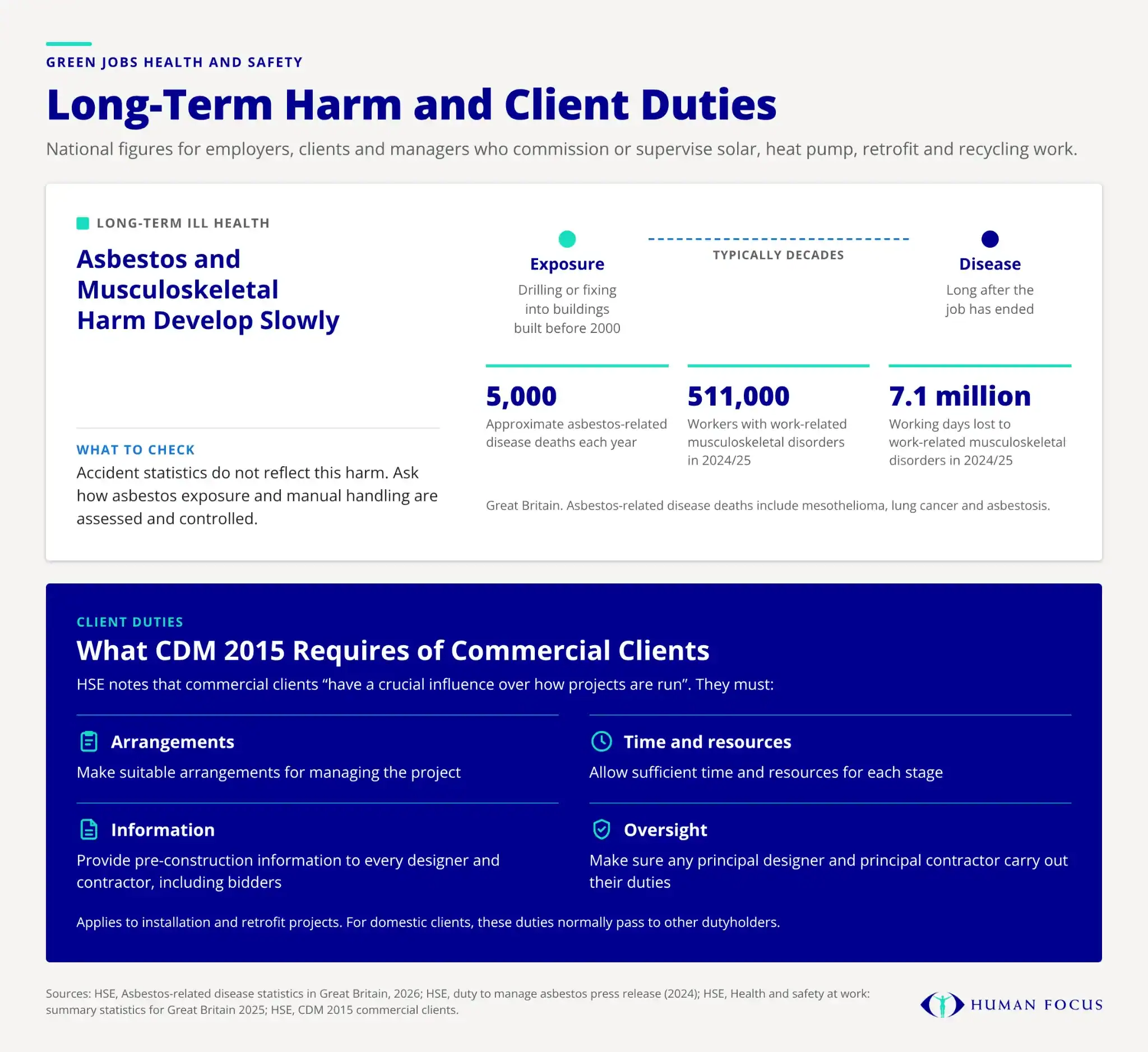
Retrofit work brings the same need to understand the material before disturbing it. An asbestos survey must provide adequate information for the proposed drilling, fixing or removal. A management survey can leave hidden materials unexamined, while restricted or uninspected areas need to be presumed to contain asbestos until inspected (HSE, n.d.-d). Resolve the survey requirements before intrusive work begins.
Maintenance can involve carrying tools, climbing and working in restricted spaces on successive visits. A survey of 176 offshore wind technicians from Denmark and the UK found substantial self-reported musculoskeletal complaints and differences in perceived work demands across turbine sizes (Oestergaard et al., 2022).
A wind turbine risk assessment should examine whether there is enough room to use tools and move components safely. More widely, plan how panels, heat pumps and other equipment will be delivered, lifted and positioned before they arrive. Check the space available for handling and future maintenance.
HSE’s manual handling approach is to avoid hazardous handling where reasonably practicable, assess what cannot be avoided and reduce the remaining risk (HSE, n.d.-f). Suitable lifting aids, better positioning and changes to the method can reduce the need for carrying, reaching or sustained awkward work. Include heat exposure and recovery needs where relevant to the task.
The risks above need to be brought together in the proposed method. In a British study of 100 construction accidents, investigators identified contributions from equipment, workplace conditions and risk management (Haslam et al., 2005). Reviewing those arrangements gives employers and contractors opportunities to address danger before people are exposed.
In Great Britain, employers must assess risks, arrange competent assistance and co-operate with other employers sharing the workplace under the Management of Health and Safety at Work Regulations 1999 (Great Britain, 1999). Northern Ireland has separate legislation.
Define the job, its boundaries and who could be harmed, including other trades and people using the premises. Obtain the site and technical information needed to choose the method. Check installation instructions against the actual access, nearby materials and services. Resolve missing information before it becomes a problem for the crew to discover during the work.
Consider whether hazardous activities can be avoided or changed, then select controls that address the source of danger and protect people before relying on instructions or personal protective equipment. HSE includes redesigning work and substituting materials or processes among the options (HSE, n.d.-g).
Agree who supplies, maintains and checks each shared precaution. On construction projects, the Construction (Design and Management) Regulations 2015 (CDM) allocate duties for planning and managing the work (Great Britain, 2015). If one contractor relies on another’s scaffold or isolation arrangements, agree who must be consulted before those arrangements change.
Check the location with the people doing and supervising the work. Confirm that the agreed access, protective measures and emergency arrangements are available and suitable. Establish that the crew understands the method and has the competence required for its tasks.
For work at height, include how an injured or incapacitated person would be recovered. HSE says emergency and rescue arrangements must be planned without relying on the fire service to provide the rescue (HSE, n.d.-i). Resolve any mismatch between the method and conditions before the affected task starts.
Make review triggers recognisable. A different work position, altered switching sequence, new simultaneous activity or unavailable safeguard needs a decision about whether affected work can continue safely. Name who can make that decision and give supervisors authority to pause the task while it is resolved.
Observe routine work as well as checking planned changes. A pedestrian route that workers regularly leave, or a handling method they cannot sustain, needs attention even if it has become familiar.
Record significant findings, actions and responsibilities. Employers with five or more employees must record the assessment’s significant findings and employee groups especially at risk. Review is required where an assessment may no longer be valid or there has been a significant change (Great Britain, 1999).
A method for installing equipment also needs to explain how people will be protected while doing the work and when they return to maintain it. Keep responsibility for those precautions clear. When access, materials, energy conditions or the sequence changes, establish whether the method still protects the people who depend on it.
For managers and supervisors making these judgements, Human Focus’s Risk Assessment Training covers hazard identification, risk evaluation, selecting controls and reviewing findings. It can support more consistent scrutiny of proposed work methods, alongside the technical expertise needed for the task.
Where a principal contractor is appointed under CDM, it must ensure a suitable site induction is provided. Contractors must provide one for workers under their control where the principal contractor has not already done so (Great Britain, 2015). The induction needs to address the site’s risks and arrangements.
Only where its type, scope and findings provide adequate information for the proposed disturbance. Check that concealed materials and the relevant work areas were investigated. A refurbishment survey by a competent surveyor may be needed (HSE, n.d.-d).
Identify the missing information and request it. HSE identifies instructions for use and maintenance among the information supplied with machinery (HSE, n.d.-h). If a gap prevents a safe method being established, resolve it before the affected work proceeds.
The National Fire Chiefs Council (NFCC) recommends developing emergency plans with the local fire and rescue service for installations within its grid-scale guidance. That guidance concerns open-air lithium systems of at least one megawatt hour and excludes domestic, mobile and temporary systems (NFCC, 2025). Establish the arrangements and requirements for the particular installation.