UV exposure at work needs attention wherever people regularly work outdoors. Construction, agriculture, grounds maintenance, roadworks and waste collection can all involve repeated exposure to sunlight throughout a shift.
The risk is easy to underestimate on a cool or cloudy day. Ultraviolet radiation cannot be felt, so how warm the weather feels is an unreliable guide to exposure. Sun protection therefore needs to be part of planning outdoor work, alongside arrangements for managing heat.
This guide explains the health effects of solar UV, what employers should assess and how to make protection practical throughout the working day.
Sunlight contains ultraviolet radiation, including UVA and UVB. Excessive exposure can damage the skin and eyes. According to the World Health Organization, the effects include:
- Sunburn: skin damage that can cause pain, redness, blistering and peeling.
- Long-term skin damage: premature ageing and an increased risk of skin cancer.
- Eye damage: painful inflammation of the eye surface and, over time, an increased risk of conditions such as cataracts.
The long-term effects matter even when no immediate injury is reported. WHO and the International Labour Organization identify occupational solar UV exposure as a cause of non-melanoma skin cancer, which can develop after years of exposure.
UV damage is different from heat illness. Drinking water and cooling down help manage heat-related risks, but they do not prevent ultraviolet radiation reaching exposed skin or eyes.
Exposure depends on the job. Someone working on an open construction site may have little shelter, while a maintenance worker may move repeatedly between indoor and outdoor tasks. Both patterns should be considered.
Susceptibility also varies. HSE identifies fair or freckled skin, red or fair hair, light-coloured eyes and a large number of moles as reasons for particular care. However, protection should cover the whole workforce: the UK Health Security Agency confirms that all skin types can burn.
HSE also notes that some medicines, workplace chemicals and contact with certain plants can increase sensitivity to sunlight. Workers with concerns should seek advice from a pharmacist, GP or occupational health professional. Employers should provide a confidential way to discuss any adjustments needed, without expecting supervisors to make medical judgements.
In Great Britain, the Management of Health and Safety at Work Regulations 1999 require employers to assess workplace risks and take appropriate action. HSE’s risk assessment guidance explains the need to identify hazards, assess the likelihood and seriousness of harm, and eliminate or control risks.
Where work involves significant sun exposure, this should be addressed within the assessment and working arrangements. A general reminder to “be careful in the sun” does not explain how a worker can reduce exposure while completing the job.
There is an important distinction concerning sunscreen. HSE states that employers are not legally obliged to provide sunscreen or sunglasses for outdoor workers. It nevertheless encourages sun protection advice within routine health and safety training.
Employers should assess the work and establish suitable controls. A government response on outdoor worker protection confirms that sunscreen should complement measures such as avoiding direct sun and working in shade, rather than act as the primary protective measure.
A useful assessment follows the worker through the day. It considers when exposure occurs, how long it lasts and whether the proposed precautions are actually available.
The UV index indicates the strength of ultraviolet radiation. A higher value means a greater potential for harm in a shorter time. WHO recommends sun protection when the UV index reaches 3 or above.
Use the local forecast to help plan work. The index is a public health prompt for protective action; it does not provide a personalised safe exposure time.
In the UK, the NHS identifies 11 am to 3 pm, from March to October, as the period when the sun is strongest. Cloud cover can reduce UV, but it does not reliably remove the risk. Reflection from water, sand and snow, and working at higher altitude, can also increase exposure.
Consider:
- Duration and timing: include short outdoor tasks repeated throughout a shift, as well as continuous outdoor work.
- Work location: identify exposed areas, available shelter and whether shade moves away from the work as the day progresses.
- Work organisation: check whether preparation, assembly or other tasks could move indoors or under cover.
- Clothing and equipment: identify exposed skin and whether sun protection can be worn alongside required PPE.
- Break arrangements: check that workers can reach suitable shade and have opportunities to reapply sunscreen.
- Individual needs: consider reported sensitivities and any professional advice about additional precautions.
Speak with the people doing the work. They can identify practical problems, such as a shaded rest area that is too far from the job or gloves that repeatedly remove sunscreen from the hands. Record the agreed controls, who will put them in place and when they need review.
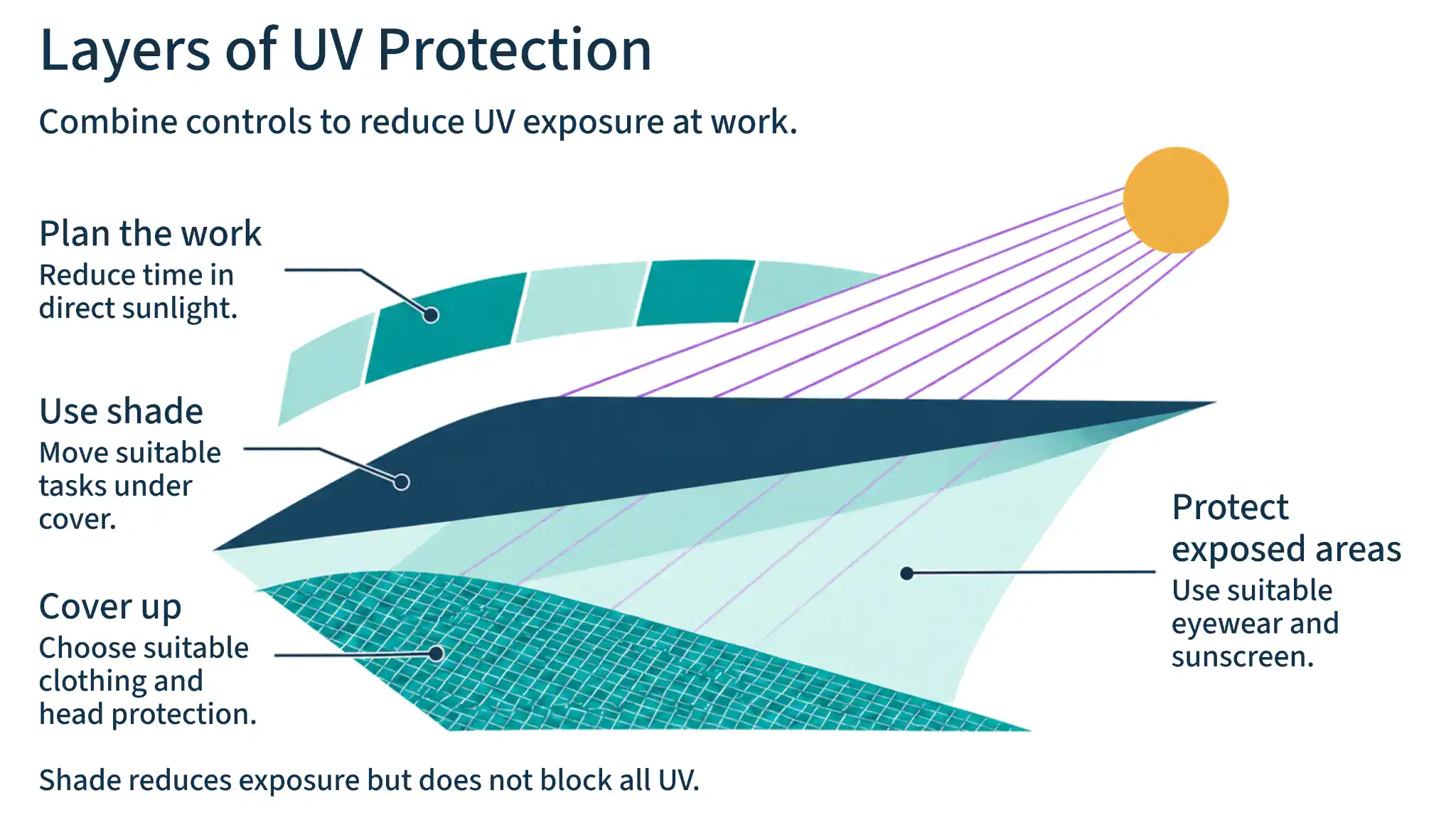
Start by reducing time spent in direct sunlight. Depending on the task, this may mean moving preparation under cover, using a shaded workstation or scheduling exposed work for periods when UV is lower.
Planning should account for the whole shift. Moving one task earlier achieves little if another equally exposed task fills the midday period.
Where the job cannot move, consider suitable temporary shelter and shaded breaks. Check that shelters remain stable and do not obstruct access, traffic routes or safe use of equipment.
Shade reduces exposure, but it does not block all UV. WHO advises that scattered and reflected radiation can still reach people beneath trees, umbrellas and canopies. Combine shade with appropriate clothing and protection for remaining exposed areas.
Covering the skin provides a practical barrier against sunlight. Consider long sleeves, trousers and head protection that shades the face, ears and neck.
Fabric matters as well as coverage. UKHSA guidance on UV protection from clothing explains that weave, composition, stretching and wear affect protection. Clothing with a stated ultraviolet protection factor, or UPF, provides information about how much UV the fabric blocks.
Choose garments suitable for the task and conditions. Where safety helmets are required, use compatible sun-protection accessories intended for that equipment. Avoid improvised modifications.
Sun protection must also work with other controls. HSE’s PPE guidance stresses fit, compatibility and continued effectiveness when equipment is worn together. Loose fabric must not introduce an entanglement risk, and clothing choices should take account of heat and physical workload.
Select eyewear with verified UVA and UVB protection. UKHSA recommends wraparound sunglasses with UV protection, which can help limit light entering from the sides. A dark tint alone does not establish that lenses provide suitable UV protection.
Where the task also presents impact, dust or chemical hazards, select eye protection that addresses those hazards as well. Check compatibility with helmets, hearing protection and any respiratory protective equipment.
The NHS recommends sunscreen with at least SPF 30 and at least four-star UVA protection. SPF describes UVB protection; the UVA rating addresses a different part of the spectrum.
Apply sufficient sunscreen to exposed areas, including the ears, face and neck, following the product instructions. Reapply at least every two hours and after sweating, washing or rubbing it off. Water-resistant products may be useful for wet or physically demanding work, but still need reapplication.
Work arrangements should make this possible. For example, crews moving between sites need access to sunscreen and time to use it. Where an employer supplies sunscreen, include stock levels and expiry dates in routine checks.
Sunscreen does not justify extending time in the sun. It supports the protection provided by work planning, shade and clothing.
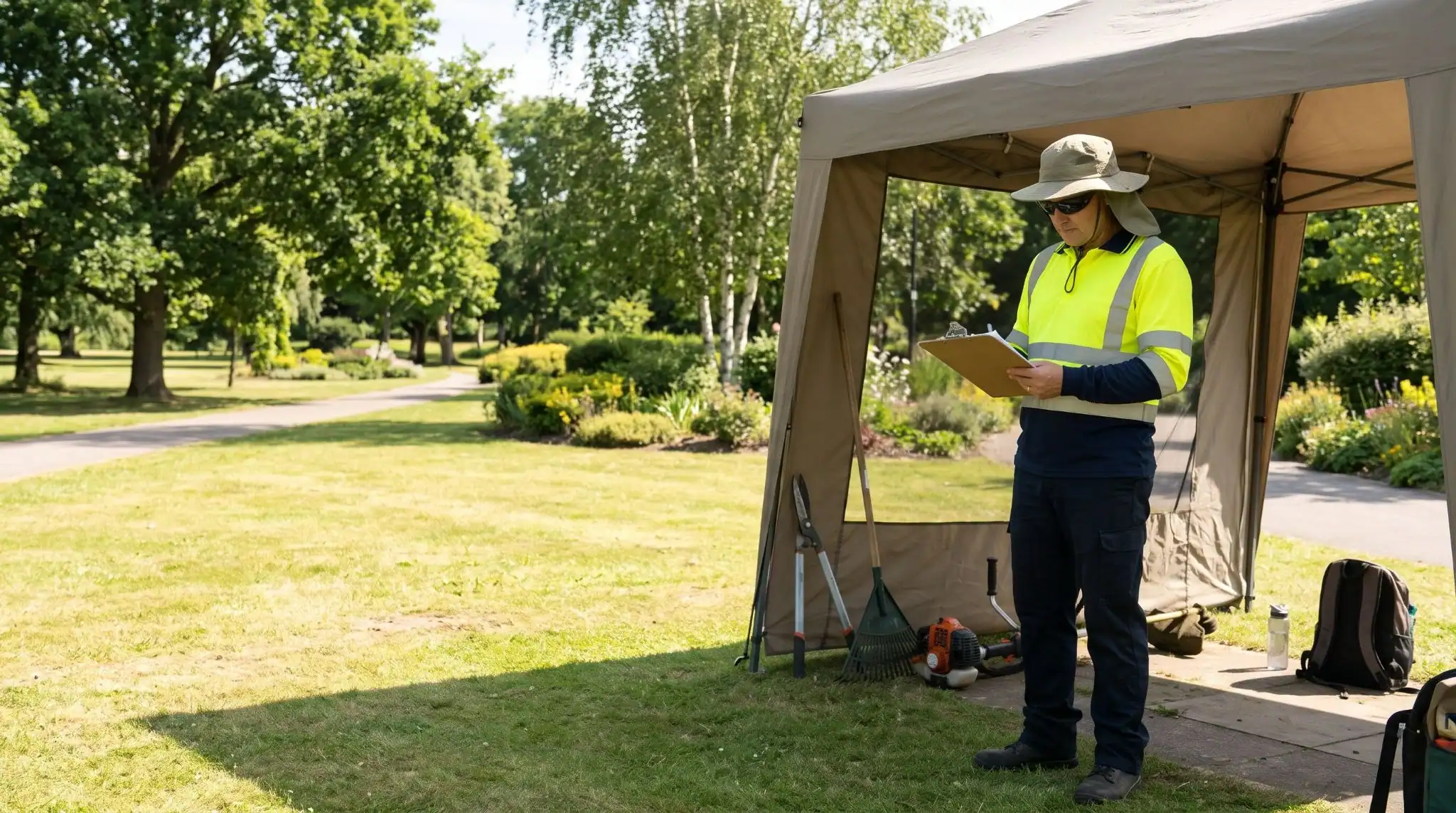
Consider a grounds maintenance team scheduled to work across an exposed playing field and a partly shaded garden. The UV forecast is high around the middle of the day.
The supervisor could arrange the exposed field work earlier, then schedule suitable work in the shaded area or under cover during stronger UV periods. This would depend on other constraints, including machinery safety, public access and noise restrictions.
The plan would also identify a shaded break location, suitable clothing, head and eye protection, and opportunities to apply sunscreen to uncovered skin. As the sun moves, the supervisor would check whether the garden work remains shaded.
This is an illustrative approach, not a fixed timetable. The assessment must reflect actual conditions, and protection may still be needed outside the midday period.
A useful briefing explains the day’s arrangements: which tasks have changed, where shade is available, what protection is needed and how workers can raise problems.
The following checks can help supervisors turn the assessment into practical action.
Encourage workers to notice unusual skin changes. HSE advises prompt medical attention for spots or moles that change in size, shape or colour, or that itch or bleed. Workplace reporting can help identify exposure problems, but a supervisor should not diagnose a skin condition.
Solar UV is generally lower during UK winter, so precautions should remain proportionate. Check the UV forecast, location and individual needs. Snow reflection and higher altitude can increase exposure. A worker with a photosensitive condition may need precautions beyond those normally used by colleagues.
Yes, some UV can pass through glass, although protection varies. The Australian Radiation Protection and Nuclear Safety Agency explains that laminated windscreens generally provide substantially more protection than ordinary side-window glass. For workers spending long periods in direct sunlight inside vehicles, consider the glazing and exposure pattern rather than assuming every window blocks all UV.
Review the task, garment and other controls with the worker. Consider different suitable clothing, more shade or changes to work timing. Required PPE should remain effective. If protection causes overheating, restricts movement or interferes with equipment, resolve the conflict through the assessment rather than expecting workers to improvise.
Artificial UV sources require their own assessment and controls. Welding, UV curing and some disinfection equipment can create different exposure conditions from sunlight. In Great Britain, the Control of Artificial Optical Radiation at Work Regulations apply to hazardous artificial sources. General sun-protection advice is insufficient for assessing those processes.
Managing UV exposure at work involves identifying who is exposed, choosing practical controls and reviewing whether they remain effective.
Human Focus Risk Assessment Training introduces the risk assessment process, including hazard identification, evaluating risks, selecting controls and recording and reviewing findings. It can support managers and supervisors in understanding the process and contributing to workplace assessments, alongside the knowledge, experience and task-specific instruction their responsibilities require.