In short: After suspected accidental asbestos disturbance at work, employees who have not been specifically trained and assigned to respond to asbestos incidents should stop work, follow their workplace’s emergency procedure and avoid further contact with the material. The procedure should identify the route for visible contamination and who may enter the affected area. The next stage is managed through the employer’s arrangements for responding to the incident.
What to Do After Suspected Accidental Asbestos Exposure: Emergency Procedures for Employees
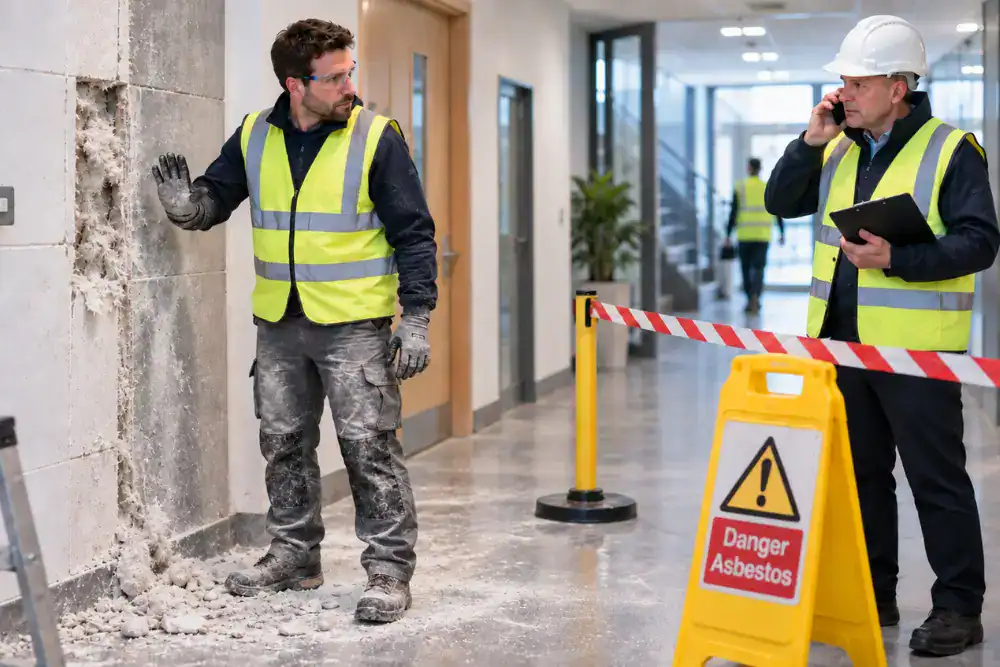
After an unexpected asbestos disturbance, well-intentioned action can make the situation harder to control. Employees therefore need to understand the limits of their role as clearly as the actions expected of them.
This article explains that boundary for employees in Great Britain and how their immediate response fits into the wider arrangements for assessing and managing the incident.
Use this article alongside your workplace’s emergency procedure, the employer’s assessment of who may be exposed and the controls required, and training appropriate to your role. In Northern Ireland, follow the Control of Asbestos Regulations (Northern Ireland) 2012 and guidance from the Health and Safety Executive for Northern Ireland (Northern Ireland, 2012; HSENI, n.d.).
Why Does Asbestos Exposure Matter?
The Health and Safety Executive (HSE) reports around 5,000 deaths each year from asbestos-related disease and identifies asbestos as a major cause of work-related disease deaths in Great Britain (HSE, Asbestos overview).
Asbestos-related diseases typically take decades to develop, so the health effects are not immediate after exposure (HSE, Asbestos overview).
Undisturbed asbestos in good condition generally presents a low risk. Drilling, cutting, sanding, breaking or otherwise damaging asbestos-containing material (material that contains asbestos) can release fibres that may be inhaled. Asbestos fibres in the air or on clothing cannot be seen, smelled or felt (HSE, Worker guide).
Buildings built or refurbished before 2000 may contain asbestos in products such as asbestos insulating board (a lightweight fire-protection and insulation board), sprayed asbestos coatings (fire, heat or sound insulation applied to surfaces), floor tiles, pipe lagging (insulation wrapped around pipes) and asbestos-cement sheets (cement products reinforced with asbestos fibres) (HSE, Worker guide).
In Great Britain, under the Control of Asbestos Regulations 2012, before work that may expose employees to asbestos begins, the employer must determine whether asbestos is present or likely to be present, or presume that it is present; complete a suitable and sufficient risk assessment (a structured check of who may be exposed and which controls are required); and provide information, instruction and training appropriate to the risk (Great Britain, 2012).
Where neither the asbestos register (the record of known or presumed asbestos) nor a survey report describing the inspected area and identified materials covers the exact work location, the employer must complete the required suitable and sufficient assessment or presume asbestos and apply the required controls. HSE guidance says anyone carrying out the assessment or advising on controls should have adequate asbestos knowledge, training and experience for the task (Great Britain, 2012; HSE, L143).
What Should Employees Do After Suspected Asbestos Disturbance?
Employees should follow the six immediate safeguards in order so the response progresses through the correct stages.
1. Stop Work Without Causing Further Disturbance
Leave suspected material undisturbed and do not continue drilling, sanding or clearing debris (HSE, EM1).
Put down tools and, if it can be done without further disturbance, safely shut down powered equipment; employees with visible dust or debris across clothing, hair or footwear should follow the route in safeguard 4.
2. Warn Others, Restrict Access and Report the Incident
Alert everyone who may be affected and keep anyone not needed for the response out of the area.
Place a warning sign if one is available; HSE uses ‘Possible asbestos contamination’. Keep unauthorised people out until the area has been assessed (HSE, EM1).
Report the problem as soon as possible under the employer’s emergency procedure. This normally means contacting the supervisor, site manager, client representative or the person responsible for the premises. For the Great Britain duty to manage, a dutyholder is the person or organisation responsible for maintenance or repair of non-domestic premises (premises not used as a private home), or of shared areas in buildings containing more than one home; responsibility may be shared (Great Britain, 2012).
Reporting allows the employer to arrange laboratory analysis to determine whether asbestos is present or to presume asbestos. The employer’s assessment should then determine the controls for the next stage of the response (HSE, L143).
For in-house work, notify the person responsible for the asbestos management plan (the written record of how known or presumed asbestos is managed) so that person or organisation can review and update it; contractors should also notify the client or person in charge (HSE, EM1).
In Great Britain, the Control of Asbestos Regulations apply to a self-employed person as if that person were both employer and employee, making them responsible for identifying asbestos risks and selecting controls for their work. They should also report the incident under the site procedure; under the Reporting of Injuries, Diseases and Dangerous Occurrences Regulations 2013 (RIDDOR), the ‘responsible person’ means the person or organisation legally required to make a report, which may be the self-employed worker, an employer or the person in control of the premises depending on the event (Great Britain, 2012; HSE, Asbestos FAQs).
3. Leave Asbestos Clean-up to Workers Trained for the Task
Do not dry-sweep asbestos dust or use a domestic or standard vacuum. For non-licensed work in Great Britain (work with asbestos that may be performed without an asbestos licence issued by HSE), the employer must prepare a written plan describing how the task is to be carried out and how exposure and spread are to be controlled (Great Britain, 2012). HSE guidance says the plan should include cleaning arrangements and identifies a Class H vacuum, which meets the standard for high-hazard dust, as one possible method for specified tasks (HSE, L143; HSE, EM4).
Employees who have not been assigned to the clean-up should not attempt it; the employer should appoint and supervise people whose training and experience match the specific clean-up task (HSE, L143).
In Great Britain, any work on sprayed asbestos coatings—surface coatings containing asbestos for fire, heat or sound insulation—must be carried out by a contractor holding an asbestos licence issued by HSE. Licensing is also required for most repair or any removal of asbestos insulation, including insulation wrapped around pipes or plant, and for most work on asbestos insulating board (AIB), a flat sheet, tile or building board made from asbestos and other material (Great Britain, 2012; HSE, Licensed work guidance).
HSE guidance says a licensed contractor is also required to clean up large amounts of asbestos-containing debris or material, including after a fire, flood or water leak. If it is uncertain whether the clean-up requires a licence, stop work and obtain advice from someone with suitable asbestos training, knowledge and experience (HSE, Worker guide).
4. Remove Contamination According to What Is Visible
Visible dust or debris on clothing, footwear, skin or hair determines which emergency cleaning route applies; it does not measure how many fibres were inhaled (HSE, EM1).
- For limited visible contamination, such as dust on one sleeve or shoe, the site procedure may direct the person to use damp rags until the item is visibly clean (HSE, EM1).
- For more extensive visible contamination across clothing, hair or footwear, remain in place and seek trained help under the emergency procedure; only a person using the personal protective equipment (PPE) and respiratory protective equipment (RPE) specified by that procedure should enter to assist (HSE, EM1).
When the emergency procedure authorises decontamination to begin, follow this lettered sequence:
- Use suitable respiratory protective equipment only if it is available, specified by the emergency procedure, and you are trained to use it (HSE, EM1).
- Use damp rags with a gentle patting action to remove as much surface dust as possible; do not rub, brush or shake the dust off (HSE, EM1; HSE, EM8).
- Remove disposable overalls carefully so they turn inside out; avoid pulling contaminated clothing over the head where possible (HSE, EM8).
- Place used rags, disposable overalls and contaminated clothing in double-wrapped, labelled asbestos-waste packaging designed to contain fibres; bag reusable protective overalls separately for a specialist laundry (HSE, EM8; HSE, Asbestos FAQs).
- Follow the emergency procedure on washing exposed skin or hair and showering, particularly if dust reached the scalp (HSE, EM1).
Record what happened and the actions taken. In Great Britain, the employer or other ‘responsible person’—the person or organisation required to report an event under RIDDOR—must determine whether a report is required: HSE states that asbestos exposure is reportable when work causes an accidental release or escape of airborne fibres in a quantity sufficient to cause damage to health (HSE, Asbestos FAQs).
5. Record Possible Exposure with Your General Practitioner
HSE advises that routine chest X-rays cannot show whether asbestos fibres have been inhaled and should not be used unless a doctor identifies a medical reason. Anyone concerned about possible work-related exposure should ask their general practitioner (GP) to record the date, duration, asbestos type and estimated amount of exposure where known. Anyone with symptoms that begin suddenly should seek medical advice because another hazard may be involved (HSE, Asbestos FAQs).
6. Wait Until Asbestos Is Confirmed or Presumed Before Work Resumes
Employees cannot confirm asbestos by appearance, colour or smell because similar-looking materials may or may not contain it (HSE, EM1; HSE, Worker guide).
If the employer needs confirmation rather than treating the material as asbestos, the employer or person responsible for the premises should arrange for a trained person assigned to sampling to take an asbestos sample and for a laboratory accredited by the United Kingdom Accreditation Service (UKAS) to analyse it. Until the result is known, the employer should presume that the material contains asbestos and apply the controls identified by its assessment (HSE, Survey guidance).
In Great Britain, before work likely to disturb the building structure begins, the employer must determine whether asbestos is present or likely to be present; HSE guidance says the survey used for that purpose should cover the exact area and task (Great Britain, 2012; HSE, Survey guidance). HSE guidance states that a refurbishment or demolition survey (a survey that may use destructive inspection to locate asbestos in the affected area) is needed before structural work begins (HSE, Survey guidance).
Where asbestos is confirmed or presumed, the employer responsible for the work must not allow work to resume until the required written plan is prepared and the selected controls are in place. An employer with five or more employees must also record the significant findings of the assessment (Great Britain, 2012).
What Should Employees Remember After Suspected Asbestos Disturbance?
Used together, the six safeguards support a structured response to an unplanned disturbance.
Following the site procedure helps avoid improvised movement or decontamination decisions.
The outcome of the employer’s assessment should be a clear instruction for everyone affected.
How Can Asbestos Awareness Training Help Employees?
If your organisation needs employees to recognise materials that may contain asbestos before disturbance and to know the initial reporting route, the Human Focus online Asbestos Awareness course, approved by the UK Asbestos Training Association (UKATA), covers common locations and emergency actions (Human Focus, n.d.).
The course develops awareness only and does not qualify or authorise anyone to carry out work that disturbs asbestos-containing materials (UKATA, 2025).
Contact Human Focus to discuss how Asbestos Awareness Training can be delivered across your workforce and matched to the people who need it.