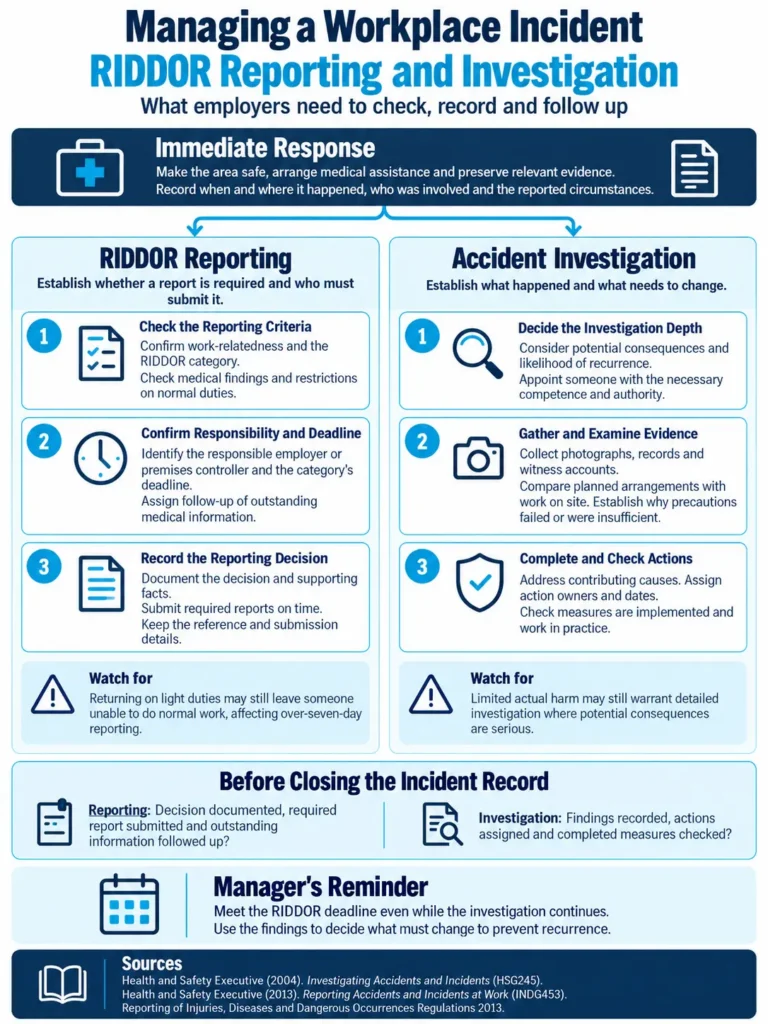
RIDDOR reportable incidents in Great Britain include work-related accidents causing death, specified worker injuries or more than seven consecutive days of injury-related incapacity for normal duties (HSE, n.d.-h).
Non-worker injuries usually qualify following a work-related accident and direct transfer from the scene to hospital for treatment of that injury. Listed dangerous occurrences and diagnosed occupational diseases meeting the relevant exposure criteria are also reportable. Certain gas incidents and dangerous gas fittings have separate provisions (HSE, n.d.-h).
RIDDOR stands for the Reporting of Injuries, Diseases and Dangerous Occurrences Regulations. Great Britain uses the 2013 regulations. Northern Ireland has separate rules under its 1997 regulations, including a different incapacity threshold (HSENI, n.d.).
A 50-year-old construction worker was levelling ground inside a three-metre-deep excavation at a London site. It had been raining. The side of the excavation collapsed, pinning him against a wall and causing life-changing injuries.
The company director and another person took him to hospital in a works van. The director did not report the accident to HSE. The regulator learned about it two months later, when the worker’s solicitor made contact.
HSE published the case on 26 June 2026. Its inspectors had found serious failures in the planning, management and supervision of construction work. The conviction described in the release concerned construction-management breaches (HSE, 2026).
After the immediate response to an injury, the employer still needs to establish whether a report is required and ensure it is submitted. That decision starts with how the accident arose.
Deciding what must be reported under RIDDOR starts with the accident itself. Being on work premises is not enough to establish a connection with work.
Look at how the task was organised, supervised and performed. Consider the equipment and substances involved, and the condition of the premises. Any of these may have played a part. You do not need to prove fault or a breach of health and safety law before reporting (HSE, n.d.-f).
For the accident route, there must be a separate, identifiable, unintended event causing physical injury. Gradual harm from repeated exposure is not classed as an accident under RIDDOR. The occupational disease provisions may apply instead (HSE, n.d.-f).
Check exemptions before proceeding. Accidents involving moving vehicles on public roads are generally excluded. Exceptions include loading and unloading, work alongside the road, escapes of substances and accidents involving trains. A description such as “injured during a delivery” therefore needs further detail (HSE, n.d.-c).
For a work-related accident, establish whether the injured person was at work before choosing the injury test. For non-fatal worker injuries, apply the specified-injury or over-seven-day incapacity test. For someone not at work, injury and direct transfer from the scene to hospital for treatment form the usual test (HSE, n.d.-h).
Deaths caused by work-related accidents are reportable, subject to applicable exemptions. Suicides are excluded (RIDDOR, 2013, reg. 6; HSE, n.d.-h).
To identify RIDDOR reportable injuries to workers, first check the specified-injury categories:
- Doctor-diagnosed fractures other than to fingers, thumbs or toes.
- Amputation of an arm, hand, finger, thumb, leg, foot or toe.
- Injuries a doctor diagnoses as likely to cause permanent loss or reduction of sight in one or both eyes.
- Crush injuries to the head or torso causing damage to the brain or internal organs in the chest or abdomen.
- Burns covering more than 10% of the body or causing significant damage to the eyes, respiratory system or other vital organs.
- Scalping requiring hospital treatment.
- Loss of consciousness caused by head injury or asphyxia.
- Injuries from enclosed-space work that cause hypothermia or heat-induced illness, require resuscitation or lead to hospital admission for more than 24 hours.
These categories and their conditions are set out in Regulation 4 of RIDDOR 2013.
HSE identifies a reporting failure in the excavation case, but does not disclose the precise injury classification. The worker’s hospital journey cannot establish that category. Hospital attendance alone does not make a worker’s injury reportable (HSE, n.d.-g).
A finger fracture is excluded from the specified-fracture category. It can still become reportable through the effect on the person’s normal work.
Consider an employee who breaks a finger in a work-related accident on Monday. They return on Tuesday, but can only manage light duties. The attendance record shows them back at work. They remain unable to perform their normal job.
RIDDOR requires a report when injury-related incapacity lasts more than seven consecutive days. Light duties count where the injury prevents normal work. Exclude the accident day, but include weekends and rest days when the person would still have been unable to do their normal duties (HSE, n.d.-h).
For the Monday accident, Tuesday is day one. The following Monday is day seven. If the restriction continues into Tuesday, it exceeds seven days. Exactly seven days does not meet this reporting threshold, although another category may apply (HSE, 2013).
The follow-up question is whether the employee can do their normal work. A return to the workplace does not answer it.
The reporting test changes for someone who is not at work.
HSE gives the example of a member of the public who trips over a trailing cable and is injured. A friend takes them directly to hospital for treatment. HSE confirms that this is reportable. An ambulance is not required (HSE, n.d.-b).
The conditions are a work-related accident, an injury and direct transfer from the scene to hospital for treatment of that injury. Diagnostic tests alone, such as X-rays, do not count as treatment. Precautionary attendance without an apparent injury does not qualify (HSE, 2013).
Accidents on hospital premises have a different non-worker test, requiring a specified injury (HSE, 2013).
Not every report starts with an injury-causing accident. A diagnosed occupational disease or a listed dangerous occurrence can create a reporting duty in its own right.
For diseases, check the diagnosis against the worker’s current exposure. Occupational dermatitis is reportable where work involves significant or regular exposure to a skin irritant or sensitiser. Occupational asthma requires significant or regular exposure to a known respiratory sensitiser (HSE, n.d.-e).
A doctor must diagnose the condition. Employees must provide the diagnosis to their employer in writing. A doctor’s verbal diagnosis can be sufficient for a self-employed person. Separate provisions cover occupational cancers and diseases attributed to occupational exposure to biological agents (HSE, n.d.-e; HSE, 2013).
For a RIDDOR dangerous occurrence, match the event to a listed Schedule 2 description. Nobody needs to have been injured, but an ordinary near miss is not automatically reportable (HSE, n.d.-a).
For example, mechanical failure of a load-bearing part of lifting equipment during normal operation meets that dangerous-occurrence category. Failure of a lifting accessory, such as a sling, is excluded from that particular category. Establish exactly what failed and check other applicable categories before concluding that no report is required (HSE, n.d.-a).
These RIDDOR examples show why the first incident description may be insufficient. The facts that change the decision need to reach the person responsible for reporting.
Reporting responsibility follows the employment relationship and control of the premises. It does not automatically fall to the manager who first hears about the accident.
- Employers report qualifying incidents involving their employees wherever they work.
- Premises controllers report relevant incidents involving non-workers and self-employed people on their premises, and relevant dangerous occurrences.
- Self-employed people report qualifying accidents on their own or domestic premises and reportable occupational diseases.
If a self-employed person suffers a specified or over-seven-day injury at someone else’s work premises, the premises controller reports it (HSE, n.d.-k).
For agency workers, check the actual employment relationship and establish which organisation has the legal reporting duty. An employee normally informs their employer rather than submitting the RIDDOR report themselves. Raising a concern with HSE is a separate route (HSE, n.d.-k).
As a practical arrangement, identify who will obtain medical and duty-restriction updates, who will submit the report and who will confirm submission. A line manager may hold information about light duties that never appears in an absence record.
Once an event meets a reporting category, a completed investigation is not a prerequisite for reporting it (HSE, 2004). The general deadlines are (HSE, n.d.-j):
The 10-day limit is a deadline for receipt of the report. The initial notification must be made without delay. Specialist provisions, including some offshore dangerous occurrences and gas reporting, have separate arrangements (HSE, n.d.-j; RIDDOR, 2013, sch. 1).
Use the appropriate form through the official RIDDOR reporting route and retain the submitted report. Telephone reporting is an alternative only for fatalities and specified worker injuries (HSE, n.d.-d).
Sometimes the full extent of an injury is unclear. HSE does not require a precautionary specified-injury report. Notify or update the enforcing authority as soon as that injury is confirmed. Meanwhile, check whether another test, such as over-seven-day incapacity, already requires a report (HSE, n.d.-g).
An accident-book entry does not submit a RIDDOR report. Keeping the internal record and making the required external report are separate tasks.
Keep records of reportable events and work-related accident injuries causing more than three consecutive days of incapacity. Exclude the accident day and include relevant weekends and rest days. Four to seven days of incapacity therefore requires recording, even though it does not meet the over-seven-day reporting threshold (HSE, 2013).
Keep the submitted report or records containing the reporting date and method, event date, time and location, personal details of those involved and a brief description of the event or disease (HSE, n.d.-i). Required record entries must be retained for at least three years from when each entry was made (RIDDOR, 2013, reg. 12).
Those records depend on people raising incidents in the first place. Furtado and colleagues asked 740 staff in a UK veterinary organisation how they understood workplace injuries. Their answers showed different thresholds for what counted as an injury worth reporting, with some harms treated as minor or routine (Furtado et al., 2024).
The study does not establish which injuries met RIDDOR criteria or explain reporting across other sectors. It raises a useful practical question. Does your internal process ask staff to raise an incident, or expect them to decide whether it is legally reportable?
Give staff a clear route to raise incidents for assessment. As a management arrangement, record the reporting decision and its reasons. Assign follow-up where diagnosis or normal-duty restrictions remain unresolved, and check that required reports were submitted. Follow-up must not delay a report that is already required.
Reporting determines what must reach the enforcing authority. Investigation examines what happened and what needs to change.
HSE recommends setting investigation depth according to potential consequences and the likelihood of recurrence. An event can warrant close examination even when it does not meet a RIDDOR category (HSE, 2004).
Once immediate risks are controlled, preserve relevant evidence. Use accident investigation interviews to understand what people encountered and how the work was being carried out. Give corrective actions owners and check their implementation.
Human Focus’s Lead Accident Investigator Training covers evidence collection, witness interviews, analysis and corrective recommendations for appointed investigators. Completing it does not automatically establish competence or organisational authority to lead an investigation.