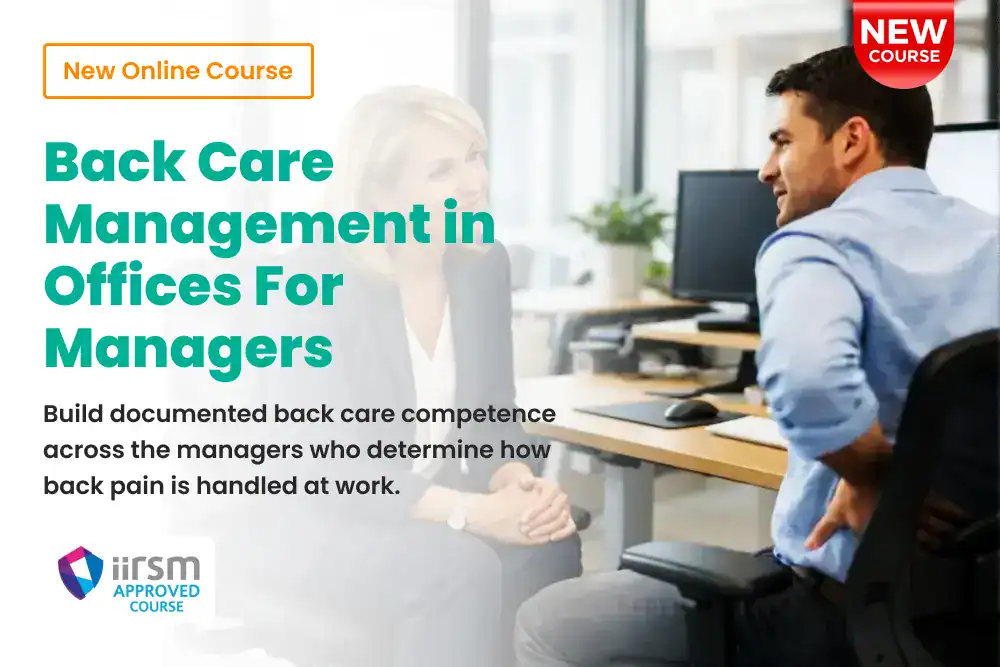
We are pleased to introduce our fully online course: Back Care Management in Offices for Managers.
Back pain is one of the leading causes of long-term sickness absence in UK workplaces. When an employee reports it, many managers respond on instinct, advising rest, reducing workload and waiting for medical clearance. Research shows that employees who stay active recover faster than those who rest or take extended time off.
This IIRSM-approved course gives managers and supervisors the evidence-based knowledge they need to handle back pain cases effectively. It covers why back pain leads to absence, how manager behaviour directly affects how quickly employees recover and what practical steps keep employees active and in work. The course is designed for office-based environments and is suitable for line managers, HR managers, operations managers and anyone with responsibility for employee welfare and absence management.
Back pain imposes significant direct costs on UK employers through sickness pay, but the indirect costs are often greater still, including reduced productivity, disruption to team workloads and the difficulty of managing prolonged or repeated absence.
The Health and Safety Executive (HSE) recognises psychosocial factors – including job stress, difficult workplace relationships and low job satisfaction – as significant contributors to back pain absence. Physical demands are not always the primary cause. Employees who remain active and continue working recover faster than those who rest or take extended time off, yet many managers still treat absence as the appropriate response.
Inconsistent handling across a management team compounds the problem further. One manager encourages adjusted duties and early contact while another advises the employee to stay home until fully recovered. When the advice employees receive from different sources conflicts, recovery stalls and the absence problem deepens.
This course gives managers a structured, repeatable approach built on three evidence-based principles:
- Maintaining a consistent message – reinforcing evidence-based guidance and countering unhelpful advice employees may have received elsewhere
- Facilitating quick recovery – making temporary, time-limited adjustments to tasks and duties that allow employees to stay at work or return before they are fully pain free
- Agreeing recovery goals – setting realistic, agreed targets with employees and addressing the psychosocial factors that may be slowing a return to full duties
Organisations gain:
- Reduced back pain-related absence through earlier, more effective management intervention
- Greater consistency in how back pain cases are handled across teams and line managers
- Stronger return-to-work processes through structured goal-setting and time-limited adjustments
- A workplace culture in which employees feel comfortable raising health concerns early
This training is designed for:
- Line managers and team leaders responsible for employees experiencing back pain
- Operations managers and office managers overseeing staff welfare and absence
- HR and people managers involved in absence management and return-to-work processes
- Health and safety managers responsible for workplace health programmes
- Supervisors with responsibility for employee wellbeing in office-based settings
By the end of this course, managers will understand:
- Why back pain leads to absence and how the modern evidence-based approach differs from common assumptions about rest and recovery
- Why employees who remain active and continue working recover faster than those who take extended absence
- How psychosocial factors – including job stress, workplace relationships and low job satisfaction – contribute to back pain absence and what managers can do to address them
- How to apply the three principles of back pain management – maintaining a consistent message, facilitating quick recovery and agreeing recovery goals
- How to make temporary, time-limited workplace adjustments that support employees with back pain without allowing those arrangements to drift indefinitely
- How tone, body language and listening skills affect whether employees feel comfortable raising concerns and returning to work
- How to make early contact with absent employees in a way that supports recovery rather than creating pressure
Need to give your managers a consistent, evidence-based approach to back pain absence? Enrol your management team on Back Care Management in Offices for Managers today. Strengthen how back pain cases are handled across your organisation, reduce the risk of prolonged absence and give your managers the practical knowledge they need to support employees and manage absence effectively.
Enrol Now
For more details about this course, please contact us.